Culture Ark · D-0807 · Food · Browse the gallery · The full 2,000-pick list
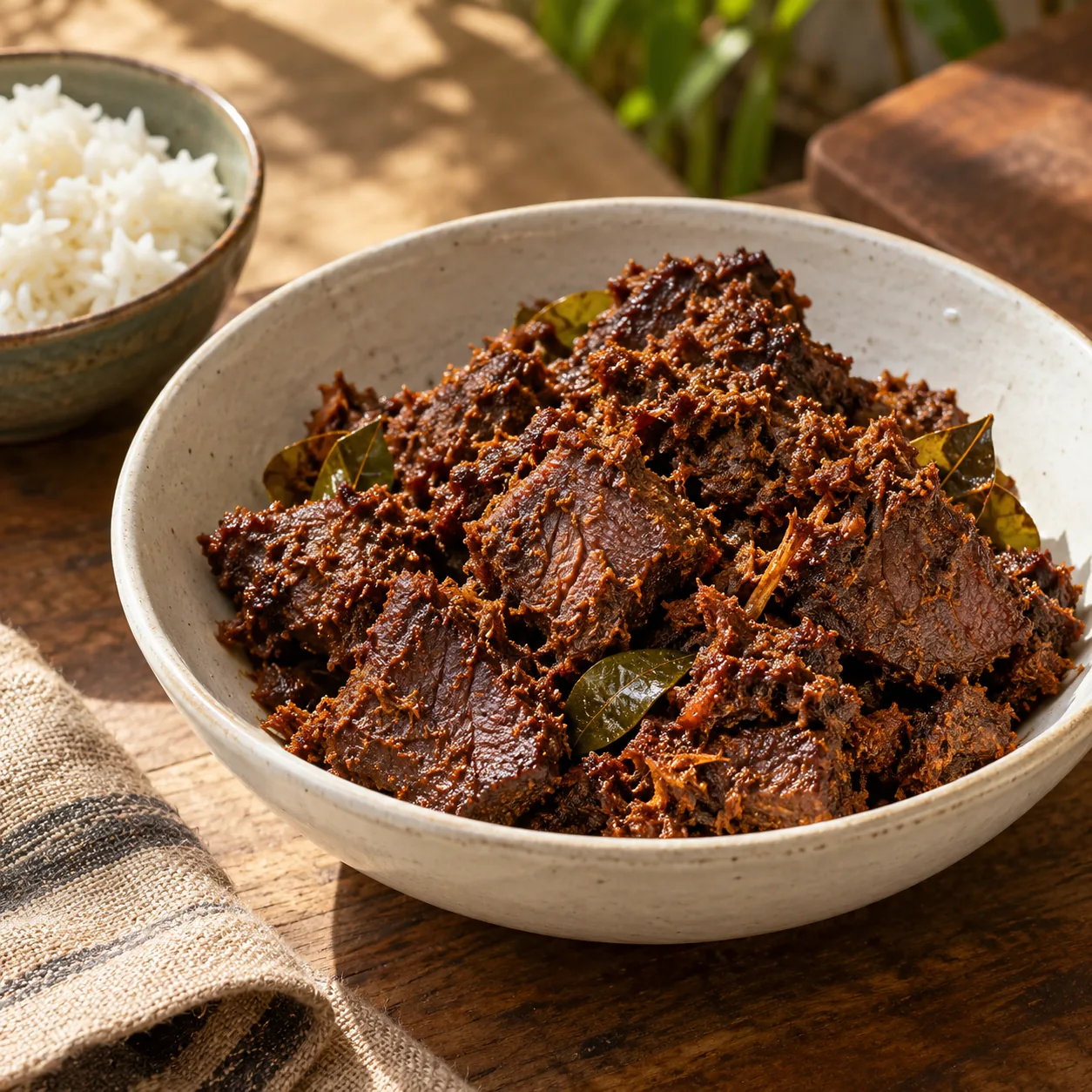
Generated interpretation, not documentary evidence. Invented dry rendang-inspired dark meat pieces and spice coating beside rice; a contemporary interpretation, not a documented Minangkabau household meal.
Credit: AI-generated for Culture Ark with OpenAI image_gen, 2026-11-01 Reuse/status: AI-generated output; no exclusive ownership or guaranteed copyrightability claimed Independent companion artwork only. Underlying works, performer and trademark rights remain separate. No exclusive ownership or public-domain claim.
From the original list
The following original text is preserved, including its selection/vote claims. Preservation is not independent verification of every assertion.
Why: Slow-cooked spicy beef.
What to preserve: Recipe
Year and origin: traditional · Indonesia (Minangkabau)
Vote: 3/9 (historian 1 · future kid 1 · curator 1)
Learn more: Rendang on Wikipedia
Supplemental context
Rendang is a particularly useful selection for showing how a cooking process can become a cultural identifier. Indonesia's tourism account describes a sequence in which coconut-milk cooking moves through wetter stages before reaching a much drier rendang. The distinction helps future readers avoid treating every brown curry-like dish as interchangeable. The source places the preparation in Minangkabau culture while acknowledging wider variations and ingredients. An archive can preserve both that community association and the fact that living recipes change between households and occasions. Our illustration emphasizes a dark, dry-looking coating, but it does not reproduce a named cook's recipe or prove the precise ingredients from appearance alone.
Creator/community: Minangkabau cooks and communities Place/era: West Sumatra, Indonesia; living rendang traditions
Context and limits
No exact cooking duration, storage life or food-safety advice is supplied. Kalio and dry rendang should not be collapsed into one stage. Generated leaves and spice fragments are decorative, not botanical identification.
Where to learn more
- https://apiarybee.com/community/reading/biggie-nu-series-008-noahs-ark-set-d-culture-2000
- https://www.indonesia.travel/id/id/travel-ideas/gastronomy/lezatnya-rendang-minangkabau-yang-mendunia
Apiary library | Original Culture Ark article
Public ID and individual routes: pending publisher allocation. Internal source ID: D-0807
Part of the Culture Ark: 2,000 things people should still be able to see in 2,000 years, picked by AI research teams. This page keeps the original list entry for D-0807 word for word and adds context. Browse the gallery. The Culture Ark is an Artificial Mind Hive (AMH) project. AMH is owned by Austin Little.

Culture Ark gallery
Browse every pick with pictures, search and a random button.
Open the gallery →