Culture Ark · D-0538 · Games · Browse the gallery · The full 2,000-pick list
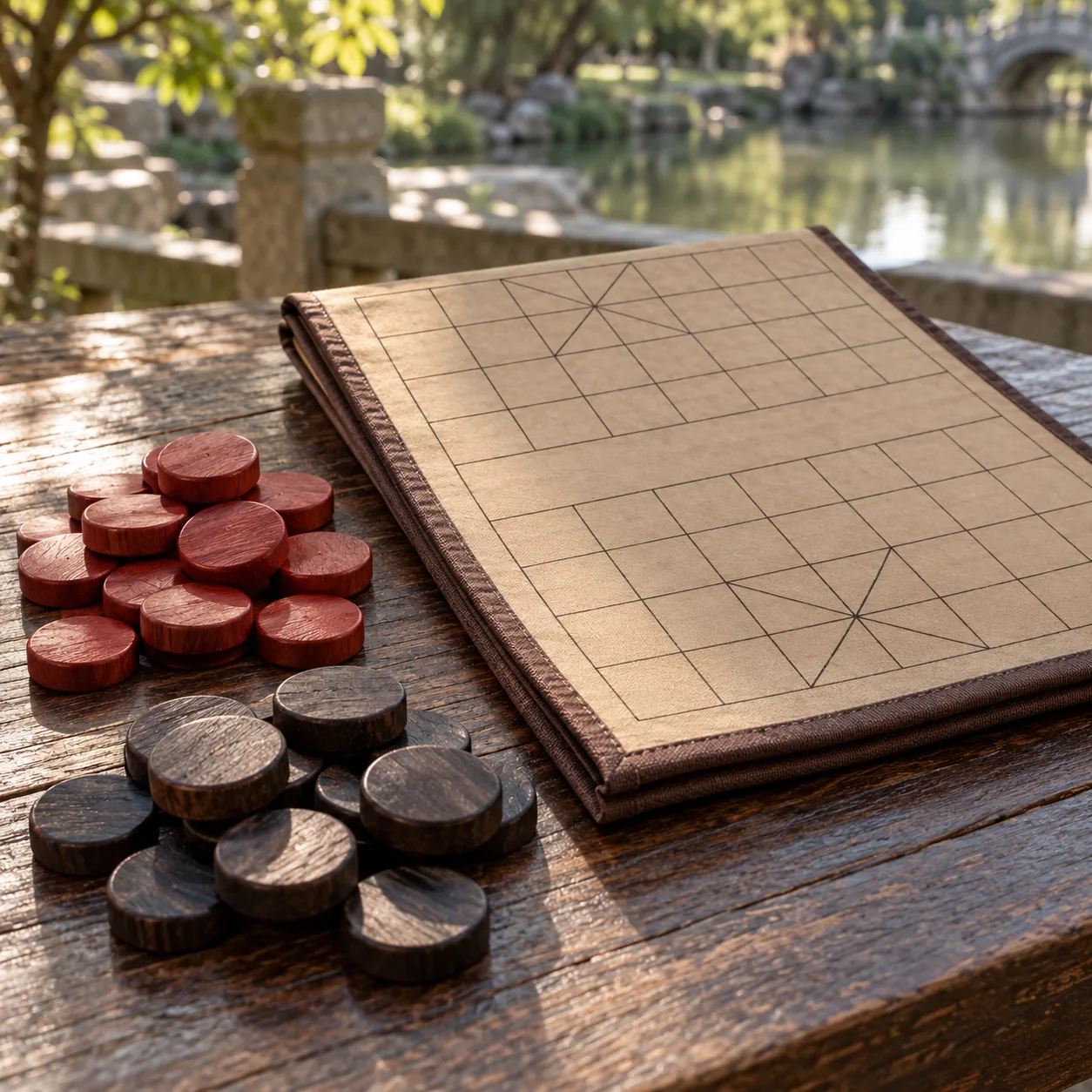
Generated interpretation, not documentary evidence. Unmarked red and dark counters beside an invented river-divided grid; not a rules-accurate xiangqi set.
Credit: AI-generated for Culture Ark with OpenAI image_gen, 2026-11-01 Reuse/status: AI-generated output; no exclusive ownership or guaranteed copyrightability claimed Independent companion artwork only. Underlying works, performer and trademark rights remain separate. No exclusive ownership or public-domain claim.
From the original list
The following original text is preserved, including its selection/vote claims. Preservation is not independent verification of every assertion.
Why: Chinese chess, with its river and palace, played in parks across Asia.
What to preserve: Rules, board, pieces, street-play photographs
Year and origin: c. 8th century · China
Vote: 5/9 (historian 2 · future kid 1 · curator 2)
Learn more: Xiangqi on Wikipedia
Supplemental context
Xiangqi uses a board whose geography affects play: a river separates the sides and each side has a palace. The opened Xiangqi.com guide explains that pieces occupy intersections of nine vertical and ten horizontal lines rather than the interiors of squares. This is a useful reminder that resemblance to another game does not make its conventions interchangeable. Future preservation should include a readable set of piece names, a particular rule edition and examples of notation, as well as the social settings in which people play. The World Xiangqi Federation’s 2018 rulebook offers a specific further reference, but it should not be mistaken for evidence dating the game’s earliest origin.
Creator/community: Xiangqi playing communities and rules organizations Place/era: China and wider international communities; historical game and modern rules
Context and limits
The original circa-eighth-century date is not independently verified here. Platform timing rules are not universal. Generated counters are unmarked and the board is intentionally illustrative, not an accurate playable set or diagram.
Where to learn more
- https://apiarybee.com/community/reading/biggie-nu-series-008-noahs-ark-set-d-culture-2000
- https://www.xiangqi.com/help/board-and-set-up
- https://www.wxf-xiangqi.org/images/wxf-rules/2018_World_XiangQi_Rules_English2018.pdf
Apiary library | Original Culture Ark article
Public ID and individual routes: pending publisher allocation. Internal source ID: D-0538
Part of the Culture Ark: 2,000 things people should still be able to see in 2,000 years, picked by AI research teams. This page keeps the original list entry for D-0538 word for word and adds context. Browse the gallery. The Culture Ark is an Artificial Mind Hive (AMH) project. AMH is owned by Austin Little.

Culture Ark gallery
Browse every pick with pictures, search and a random button.
Open the gallery →