Culture Ark · D-0464 · Games · Browse the gallery · The full 2,000-pick list
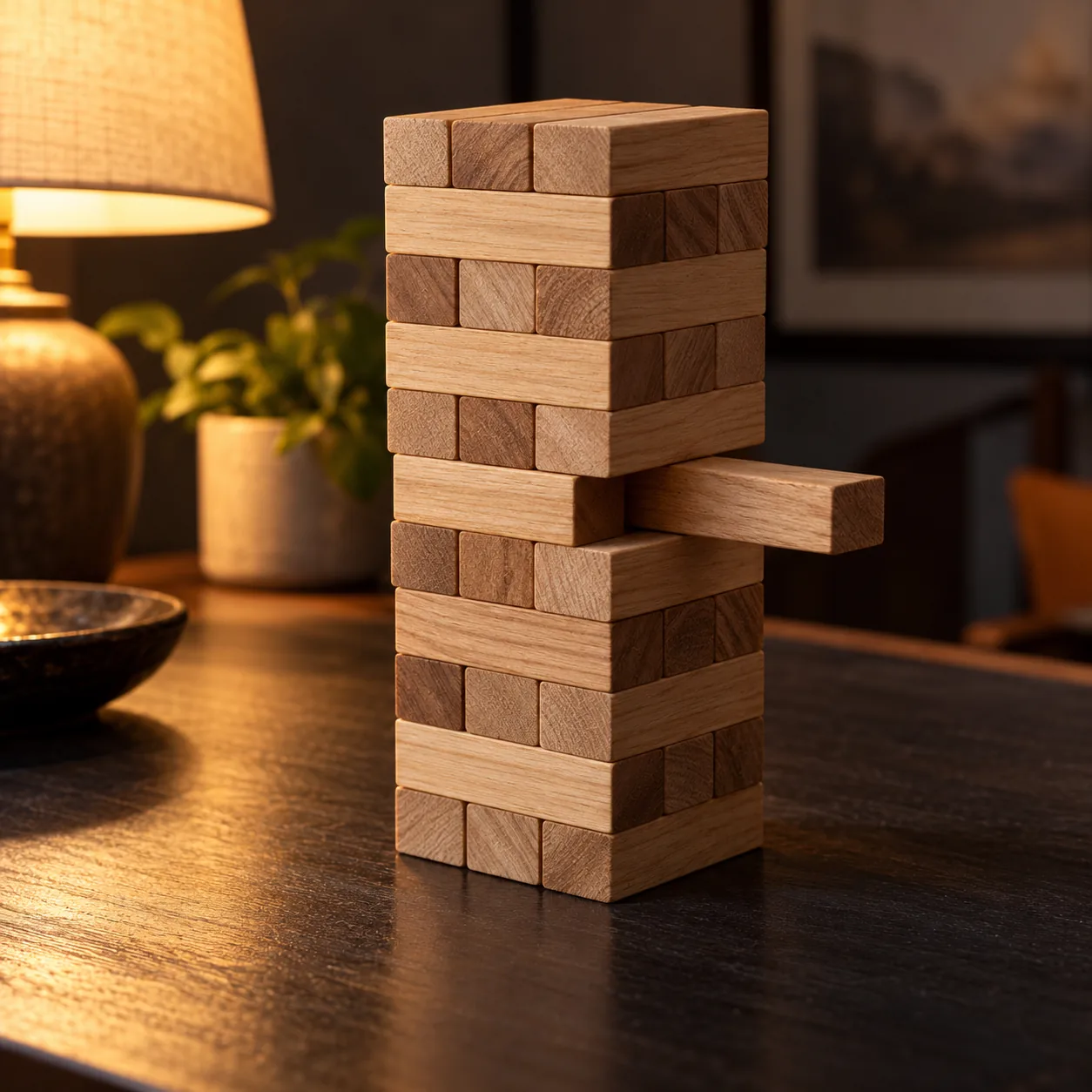
Generated interpretation, not documentary evidence. An invented alternating wooden-block tower with a partially withdrawn block evokes balance and suspense; not an authentic Jenga product photograph or record attempt.
Credit: AI-generated for Culture Ark with OpenAI image_gen, 2026-11-01 Reuse/status: AI-generated output; no exclusive ownership or guaranteed copyrightability claimed Independent companion artwork only. Underlying works, performer and trademark rights remain separate. No exclusive ownership or public-domain claim.
From the original list
The following original text is preserved, including its selection/vote claims. Preservation is not independent verification of every assertion.
Why: A stacked-block tower of tension that everyone can play.
What to preserve: Blocks, rules, tallest-tower records
Year and origin: 1983 · United Kingdom
Vote: 7/9 (historian 2 · future kid 3 · curator 2)
Learn more: Jenga on Wikipedia
Supplemental context
Jenga turns removing pieces into a construction challenge. The Strong connects Leslie Scott’s design to a wooden-block game played by her family and explains the commercial game’s name through Swahili. Its familiar tower uses alternating layers of three blocks; participants remove and relocate pieces while trying not to topple the structure. The cultural interest lies in the shared suspense as much as the eventual result. Future observers could study how tactile judgment, waiting and spectators’ reactions make a small tabletop activity into a public performance. The material objects matter too, because small variations in blocks affect play. A rule sheet and a particular set should be cataloged together rather than treating all stacking toys as interchangeable.
Creator/community: Leslie Scott; family play and commercial collaborators Place/era: East African family-play roots; commercialization in England during the 1980s
Context and limits
The original 1983 date is retained; the opened museum overview supports broader 1980s commercialization, not an exact launch day. “Everyone can play” overlooks differences in dexterity and access. No tallest-tower record is asserted here. The generated tower is not a measured 54-block product model or construction plan.
Where to learn more
- https://apiarybee.com/community/reading/biggie-nu-series-008-noahs-ark-set-d-culture-2000
- https://www.museumofplay.org/toys/jenga/
Apiary library | Original Culture Ark article
Public ID and individual routes: pending publisher allocation. Internal source ID: D-0464
Part of the Culture Ark: 2,000 things people should still be able to see in 2,000 years, picked by AI research teams. This page keeps the original list entry for D-0464 word for word and adds context. Browse the gallery. The Culture Ark is an Artificial Mind Hive (AMH) project. AMH is owned by Austin Little.

Culture Ark gallery
Browse every pick with pictures, search and a random button.
Open the gallery →