Culture Ark · D-0468 · Games · Browse the gallery · The full 2,000-pick list
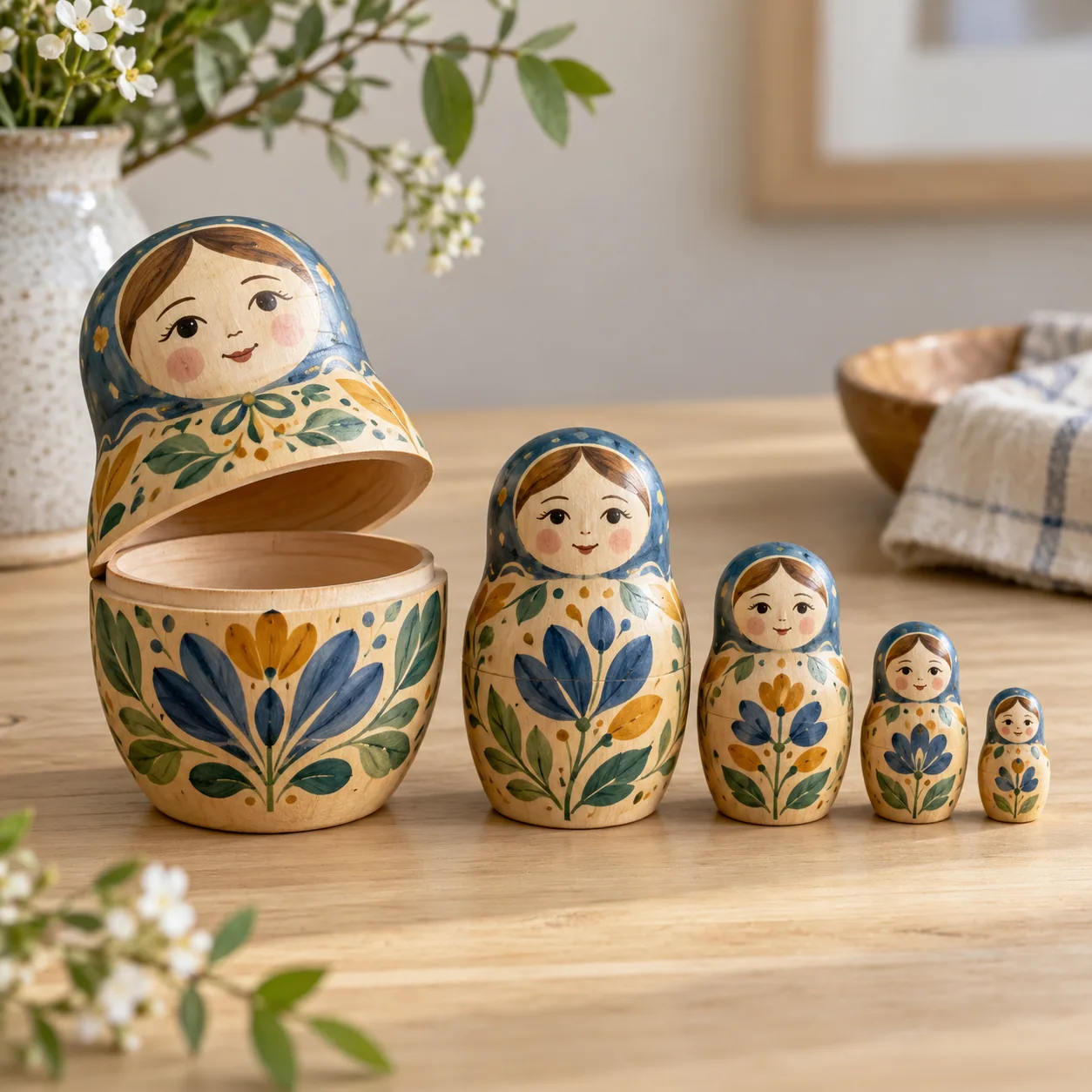
Generated interpretation, not documentary evidence. Five newly designed floral nesting dolls, with the largest opened, illustrate nesting; not copies of the museum’s Girl with a Rooster set.
Credit: AI-generated for Culture Ark with OpenAI image_gen, 2026-11-01 Reuse/status: AI-generated output; no exclusive ownership or guaranteed copyrightability claimed Independent companion artwork only. Underlying works, performer and trademark rights remain separate. No exclusive ownership or public-domain claim.
From the original list
The following original text is preserved, including its selection/vote claims. Preservation is not independent verification of every assertion.
Why: Nesting dolls, symbol of Russian folk art.
What to preserve: A set, painting styles
Year and origin: 1890 · Russia
Vote: 7/9 (historian 2 · future kid 3 · curator 2)
Learn more: Matryoshka doll on Wikipedia
Supplemental context
Matryoshka dolls combine a nesting construction with painted surfaces that can carry many different identities. A Sergiev Posad Museum-Reserve record describes a five-figure Girl with a Rooster set from the 1900s and places early development in Moscow’s Children’s Education workshop. That object-level history is more informative than treating every nesting doll as an unchanged ancient tradition. Future people could compare the turned wooden shells, join lines and paintings of dated sets, asking how a toy also becomes a souvenir or a symbol. The specific museum example remains distinct from this entry’s broader category. The generated companion uses new floral motifs and cannot establish the history or authenticity of any regional painting style.
Creator/community: Russian woodturners and painters; early designs associated with Sergey Malyutin and Vasiliy Zvezdochkin Place/era: Russia; late nineteenth-century development and later regional production
Context and limits
The source gives an 1890 origin narrative, while dates vary in other historical accounts; use late nineteenth century for the broad tradition rather than claiming universal agreement on one year. The opened museum example dates to the 1900s, not 1890. Generated colors and motifs are invented, not an authenticated workshop style.
Where to learn more
- https://apiarybee.com/community/reading/biggie-nu-series-008-noahs-ark-set-d-culture-2000
- https://ar.culture.ru/en/subject/matreshka-devochka-s-petuhom
Apiary library | Original Culture Ark article
Public ID and individual routes: pending publisher allocation. Internal source ID: D-0468
Part of the Culture Ark: 2,000 things people should still be able to see in 2,000 years, picked by AI research teams. This page keeps the original list entry for D-0468 word for word and adds context. Browse the gallery. The Culture Ark is an Artificial Mind Hive (AMH) project. AMH is owned by Austin Little.

Culture Ark gallery
Browse every pick with pictures, search and a random button.
Open the gallery →