Culture Ark · D-0461 · Games · Browse the gallery · The full 2,000-pick list
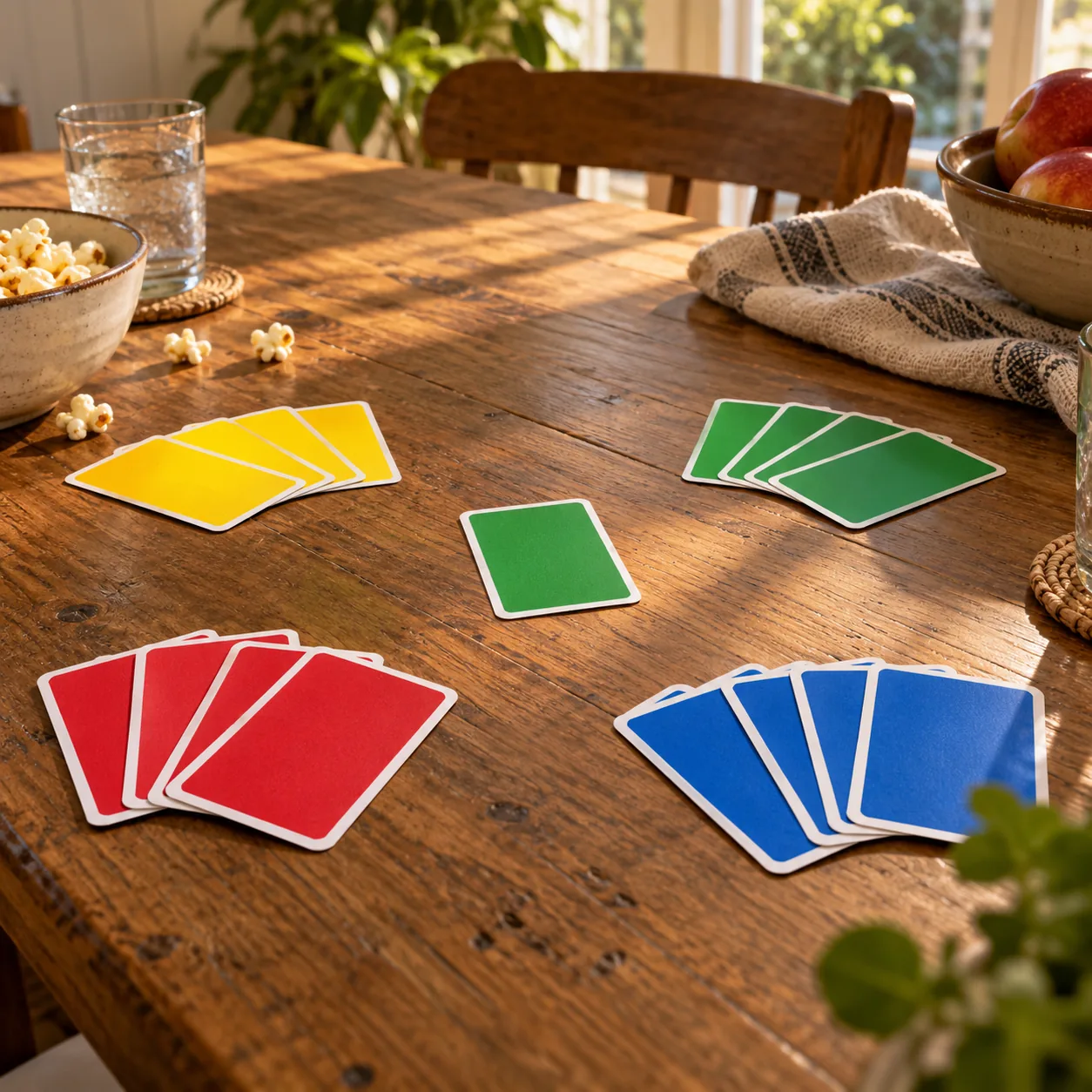
Generated interpretation, not documentary evidence. Four fans of plain colored cards and a lone card evoke color matching and the last-card moment; not an official UNO deck or legal game state.
Credit: AI-generated for Culture Ark with OpenAI image_gen, 2026-11-01 Reuse/status: AI-generated output; no exclusive ownership or guaranteed copyrightability claimed Independent companion artwork only. Underlying works, performer and trademark rights remain separate. No exclusive ownership or public-domain claim.
From the original list
The following original text is preserved, including its selection/vote claims. Preservation is not independent verification of every assertion.
Why: A simple color-matching card game played in nearly every home.
What to preserve: A deck, rules, house-rule debates
Year and origin: 1971 · United States
Vote: 7/9 (historian 2 · future kid 3 · curator 2)
Learn more: Uno (card game) on Wikipedia
Supplemental context
UNO combines matching cards with actions that change the flow of a round. The Strong traces its development to Merle Robbins and preserves examples from the early printings. Mattel’s W2085 instructions provide a concrete edition to understand: players match number, color or symbol and try to empty their hands, with scoring across rounds. For future people, the interest is not just the deck’s design but the negotiations around play. A printed rule and a household’s remembered rule need not be identical, and preserving both would reveal how a commercial game becomes a social custom. The spoken last-card announcement also makes performance part of the game rather than leaving all information on the table.
Creator/community: Merle Robbins and family; later commercial publishers Place/era: United States; developed 1971
Context and limits
“Nearly every home” is rhetorical, not a measured global adoption claim. W2085 is one 108-card rule sheet, not the rules for every later themed or expanded UNO edition. The blank color-card artwork is not a playable deck or reproduction of official graphics.
Where to learn more
- https://apiarybee.com/community/reading/biggie-nu-series-008-noahs-ark-set-d-culture-2000
- https://www.museumofplay.org/blog/americas-favorite-game-and-success-story-uno/
- https://www.museumofplay.org/toys/uno/
- https://service.mattel.com/instruction_sheets/W2085.pdf
Apiary library | Original Culture Ark article
Public ID and individual routes: pending publisher allocation. Internal source ID: D-0461
Part of the Culture Ark: 2,000 things people should still be able to see in 2,000 years, picked by AI research teams. This page keeps the original list entry for D-0461 word for word and adds context. Browse the gallery. The Culture Ark is an Artificial Mind Hive (AMH) project. AMH is owned by Austin Little.

Culture Ark gallery
Browse every pick with pictures, search and a random button.
Open the gallery →