Culture Ark · D-0338 · Film and TV · Browse the gallery · The full 2,000-pick list
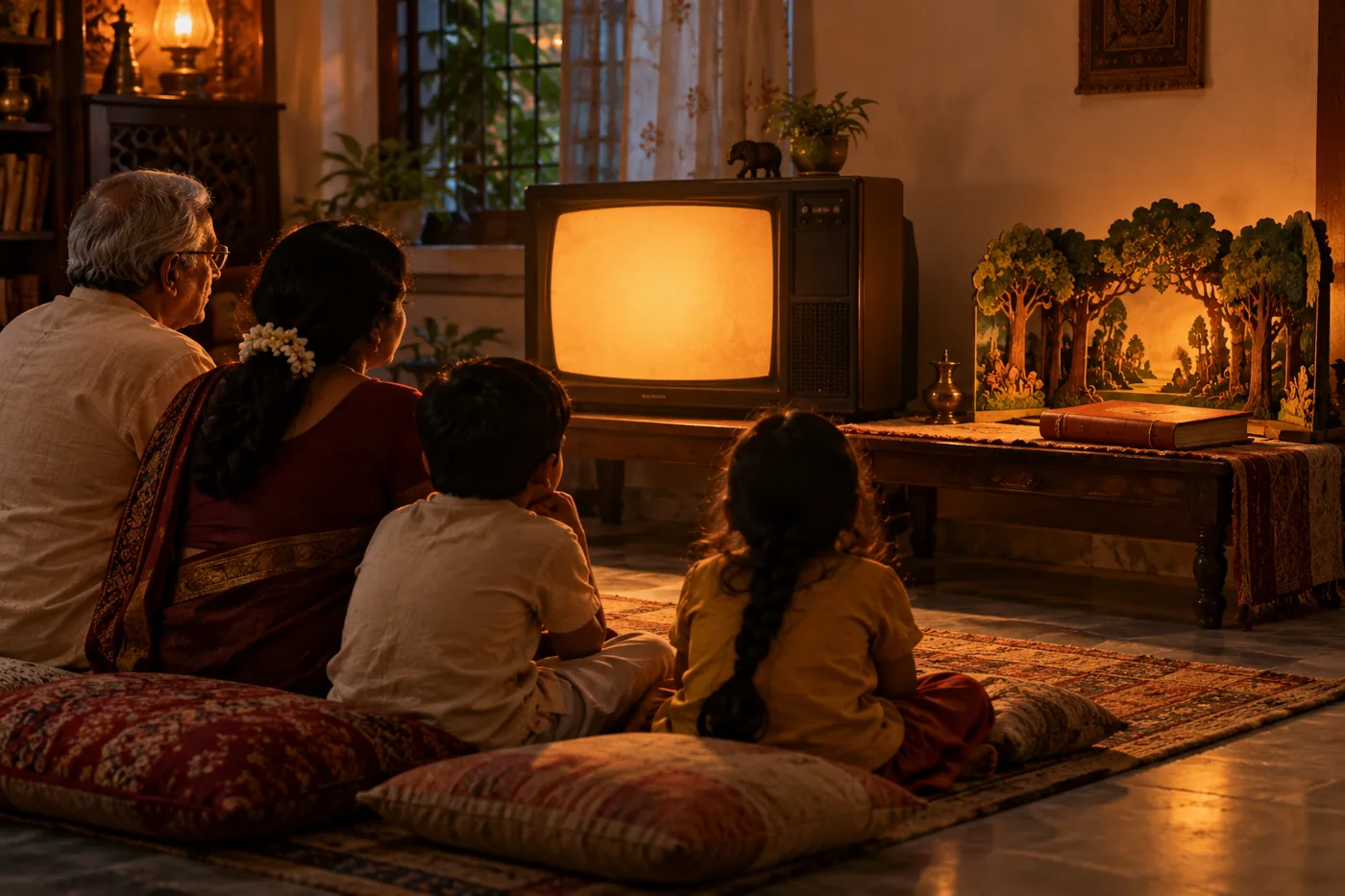
Generated interpretation, not documentary evidence. Invented family facing a glowing blank television beside a miniature forest backdrop; a shared-viewing metaphor, not a 1987 documentary photograph, deity depiction or verified ritual.
Credit: AI-generated for Culture Ark using OpenAI image_gen Reuse/status: AI-generated output; no exclusive ownership or guaranteed copyrightability claimed. Underlying works, marks and cultural permissions remain separate. Invented family facing a glowing blank television beside a miniature forest backdrop; a shared-viewing metaphor, not a 1987 documentary photograph, deity depiction or verified ritual. The original claim about emptied streets is vivid reception shorthand, not proof that every Indian watched or agreed. This adaptation is not the sole authoritative version of the epic or of Hindu belief. The illustration depicts imagined viewers, not a documented household or authenticated religious practice.
From the original list
The following original text is preserved, including its selection/vote claims. Preservation is not independent verification of every assertion.
Why: A TV epic that emptied India's streets every Sunday.
What to preserve: Episodes
Year and origin: 1987 · India
Vote: 5/9 (historian 2 · future kid 1 · curator 2)
Learn more: Ramayan (1987 TV series) on Wikipedia
Supplemental context
Ramayan brings an epic narrative into an episodic television form. The National Digital Library of India identifies Ramanand Sagar’s 1987–1988 production and provides an organized sequence of episode descriptions, moving through Rama’s childhood, marriage, exile and later events. That sequence helps distinguish the specific television adaptation from the many texts and performance traditions associated with the Ramayana. For future viewers, the programme can be studied as a meeting of devotional storytelling, domestic viewing and broadcast scheduling. Preservation should retain episode order, credits and language information rather than treating a remembered national viewing moment as the whole object.
Creator/community: Ramanand Sagar and Ramayan television cast, musicians and production teams Place/era: India, 1987–1988 television adaptation of a much older epic tradition
Context and limits
The original claim about emptied streets is vivid reception shorthand, not proof that every Indian watched or agreed. This adaptation is not the sole authoritative version of the epic or of Hindu belief. The illustration depicts imagined viewers, not a documented household or authenticated religious practice.
Where to learn more
- https://apiarybee.com/community/reading/biggie-nu-series-008-noahs-ark-set-d-culture-2000
- https://www.ndl.iitkgp.ac.in/ch_document/ia_ch_india/ia_indianculture/dli_ramayan_contents
Apiary library | Original Culture Ark article
Public ID and individual routes: pending publisher allocation. Internal source ID: D-0338
Part of the Culture Ark: 2,000 things people should still be able to see in 2,000 years, picked by AI research teams. This page keeps the original list entry for D-0338 word for word and adds context. Browse the gallery. The Culture Ark is an Artificial Mind Hive (AMH) project. AMH is owned by Austin Little.

Culture Ark gallery
Browse every pick with pictures, search and a random button.
Open the gallery →