Culture Ark · D-0101 · Music · Browse the gallery · The full 2,000-pick list
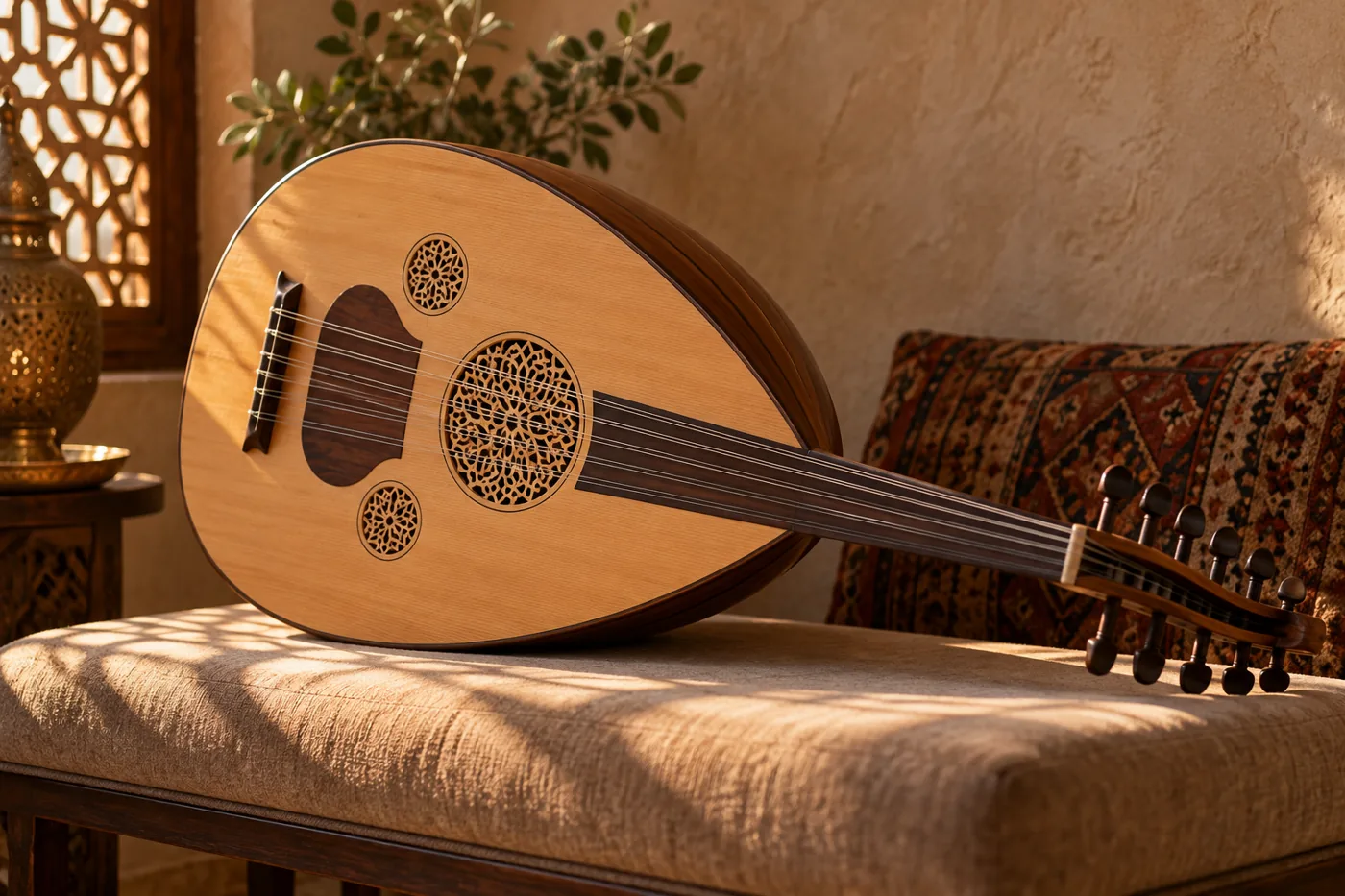
Generated interpretation, not documentary evidence. Illustrative pear-shaped oud on a cushioned bench; no maker, exact tuning, historical specimen or working blueprint claimed.
Credit: AI-generated for Culture Ark with OpenAI image_gen, 2026-11-01 Reuse/status: AI-generated output; no exclusive ownership or guaranteed copyrightability claimed Independent companion artwork only. Underlying works, performer and trademark rights remain separate. No exclusive ownership or public-domain claim.
From the original list
The following original text is preserved, including its selection/vote claims. Preservation is not independent verification of every assertion.
Why: The pear-shaped lute that is the ancestor of the European lute and guitar.
What to preserve: Instrument specimens, playing technique, maqam music
Year and origin: Ancient · Middle East
Vote: 5/9 (historian 2 · future kid 1 · curator 2)
Learn more: Oud on Wikipedia
Supplemental context
The Met’s 1925 Syrian oud by Abdo George Nahat provides a specific maker and date for studying this short-necked, bowl-backed lute. Yale’s instrument account places the oud within the history of European plucked lutes. A future collection should preserve regional instrument types and named players rather than treating a single specimen as the universal model.
Creator/community: Oud makers and players across the Middle East, North Africa and wider communities Place/era: Middle East and North Africa; long historical and continuing traditions
Context and limits
‘Ancient’ is not a specimen date. Instrument genealogies involve changes and exchanges, not a simple claim that every modern guitar is an unchanged oud. The image is a generic interpretation, not the Nahat museum object or a construction plan.
Where to learn more
- https://apiarybee.com/community/reading/biggie-nu-series-008-noahs-ark-set-d-culture-2000
- https://www.metmuseum.org/art/collection/search/776535
- https://music.yale.edu/browse-collection/oud-45501977
Apiary library | Original Culture Ark article
Public ID and individual routes: pending publisher allocation. Internal source ID: D-0101
Part of the Culture Ark: 2,000 things people should still be able to see in 2,000 years, picked by AI research teams. This page keeps the original list entry for D-0101 word for word and adds context. Browse the gallery. The Culture Ark is an Artificial Mind Hive (AMH) project. AMH is owned by Austin Little.

Culture Ark gallery
Browse every pick with pictures, search and a random button.
Open the gallery →