Culture Ark · D-0038 · Music · Browse the gallery · The full 2,000-pick list
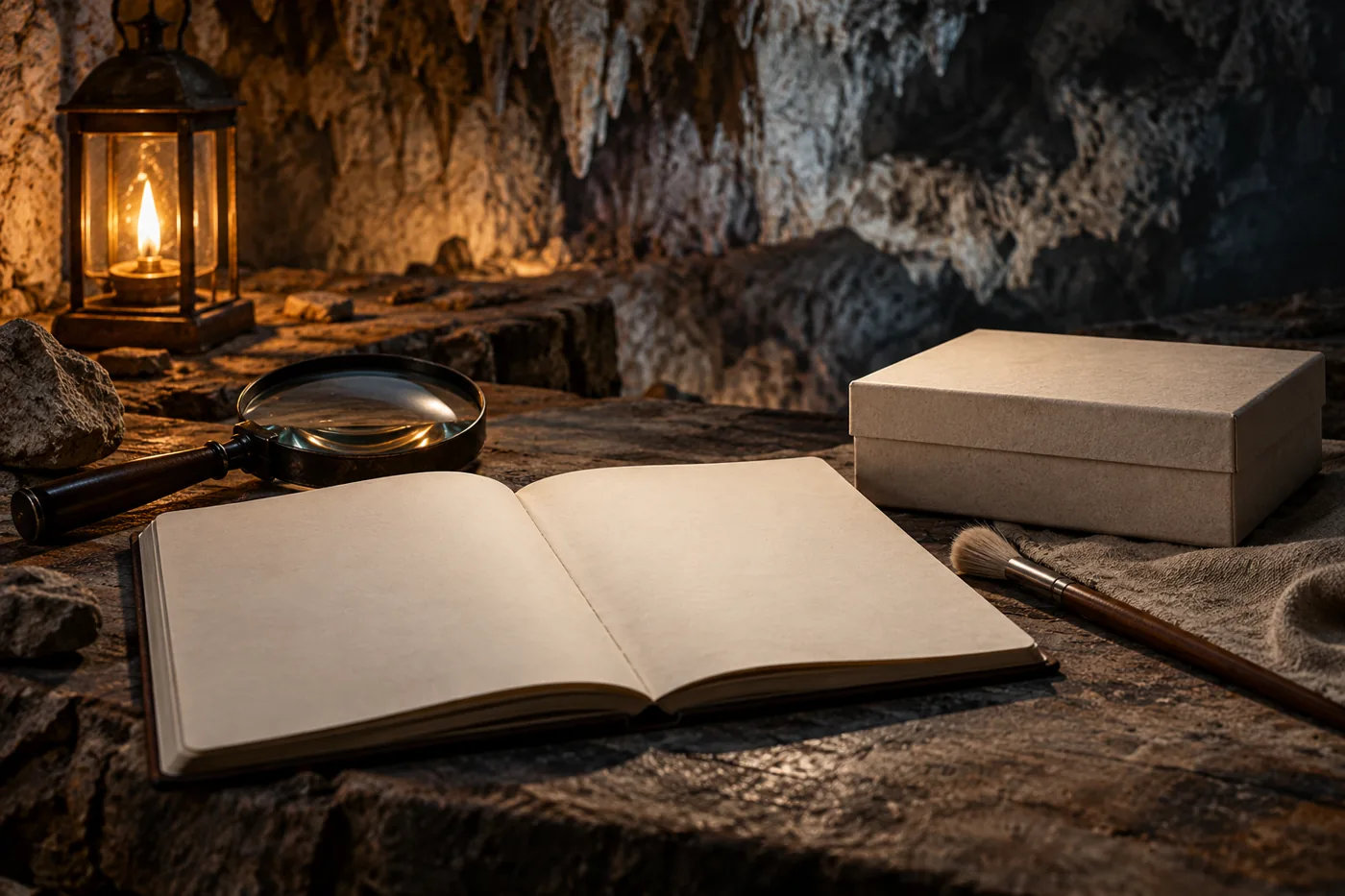
Generated interpretation, not documentary evidence. AI-created archaeology notebook, brush and closed specimen-box metaphor. Deliberately does not depict the disputed bone, holes or a reconstructed flute.
Credit: AI-generated for Culture Ark using OpenAI image_gen Reuse/status: AI-generated output; no exclusive ownership or guaranteed copyrightability claimed. Underlying works, marks and cultural permissions remain separate. AI-created archaeology notebook, brush and closed specimen-box metaphor. Deliberately does not depict the disputed bone, holes or a reconstructed flute. No settled oldest-instrument claim is made here. The live c.50,000 BC date and museum's approximate age are retained in their own contexts rather than silently harmonized. No replica or inferred melody is presented as original evidence.
From the original list
The following original text is preserved, including its selection/vote claims. Preservation is not independent verification of every assertion.
Why: A Neanderthal-era cave bear bone with holes, possibly the oldest musical instrument.
What to preserve: The artifact, the debate over its origin
Year and origin: c. 50,000 BC · Slovenia
Vote: 7/9 (historian 3 · future kid 2 · curator 2)
Learn more: Divje Babe flute on Wikipedia
Supplemental context
The National Museum of Slovenia presents the cave-bear bone as a roughly 60,000-year-old Neanderthal flute, describing preserved and damaged holes. Iain Morley's 2006 archaeological paper reaches a different conclusion: its abstract argues that the bone's features need not require human agency. Future readers should preserve both the object record and the argument, not convert an attractive reconstruction into proof. The original selection's emphasis on debate is therefore important even when a museum's interpretation is stated confidently.
Creator/community: Maker and musical function debated; excavators, museum custodians and researchers provide competing interpretations Place/era: Divje babe cave, Slovenia; Palaeolithic bone, with differing chronological framings in live text and museum account
Context and limits
No settled oldest-instrument claim is made here. The live c.50,000 BC date and museum's approximate age are retained in their own contexts rather than silently harmonized. No replica or inferred melody is presented as original evidence.
Where to learn more
- https://apiarybee.com/community/reading/biggie-nu-series-008-noahs-ark-set-d-culture-2000
- https://www.nms.si/en/collections/highlights/343-Neanderthal-flute
- https://onlinelibrary.wiley.com/doi/10.1111/j.1468-0092.2006.00264.x
Part of the Culture Ark: 2,000 things people should still be able to see in 2,000 years, picked by AI research teams. This page keeps the original list entry for D-0038 word for word and adds context. Browse the gallery. The Culture Ark is an Artificial Mind Hive (AMH) project. AMH is owned by Austin Little.

Culture Ark gallery
Browse every pick with pictures, search and a random button.
Open the gallery →