Culture Ark · Browse the gallery · 60 illustrated picks on Apiary
CA1632 · internet and digital culture
Creator/community: Intel and personal-computer makers Place/era: International personal computing; Core Ultra 7 256V example launched Q3 2024
Generated interpretation
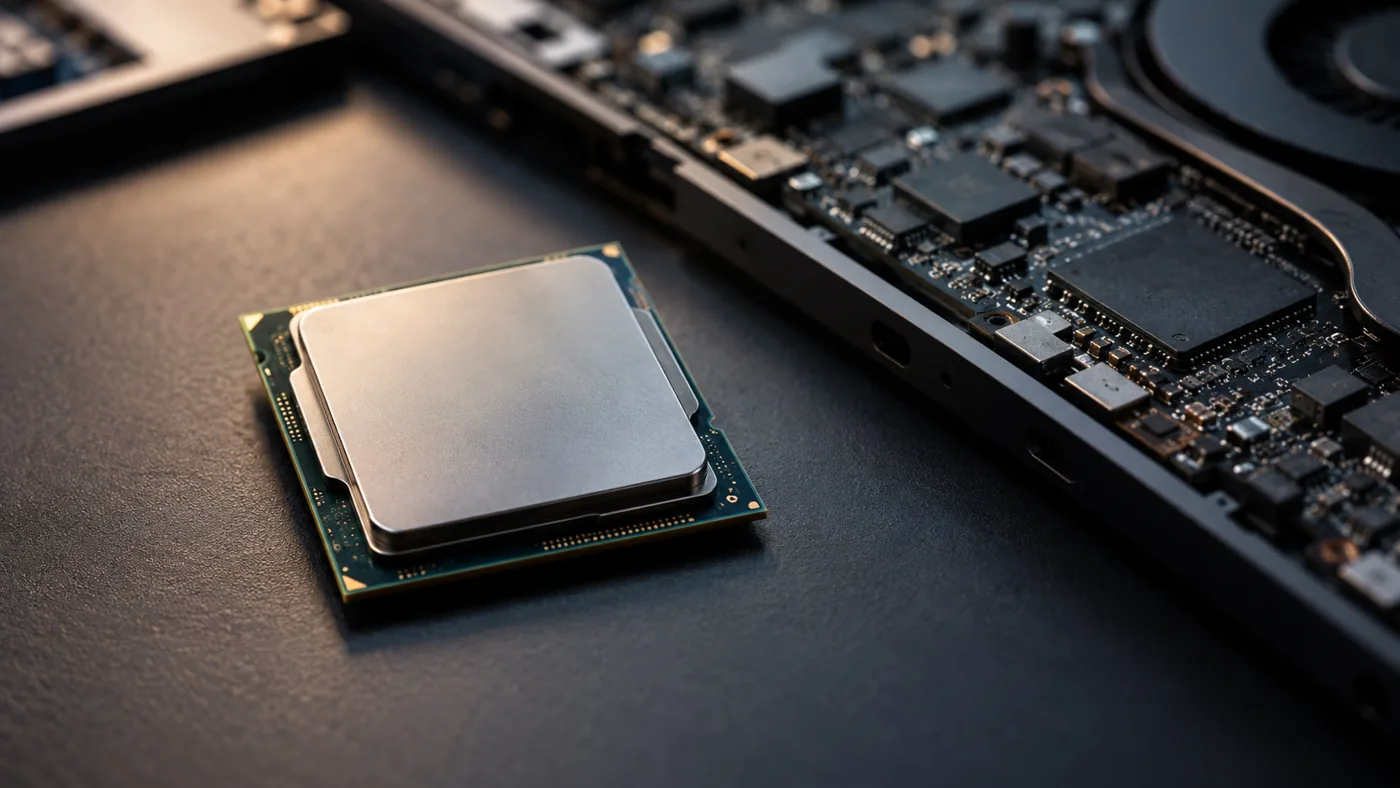
AI-created generic processor-package close-up. It is not a Core Ultra7 256V photograph, a die map, a CPU/GPU/NPU compartment diagram or an identification of the user’s hardware. Credit: AI-generated for Culture Ark using OpenAI image_gen. Rights: AI-generated output; no exclusive ownership or guaranteed copyrightability claimed. Changes: Resized within1400px and converted to WebP; no crop or substantive alteration.
Conceptual illustration, not documentary evidence, product photography, software test, engineering drawing or endorsement. Underlying products, cultural works and marks retain separate rights.
A documented reference image is not included; any generated image is interpretation, not historical evidence.
History and context
The phrase AI PC brought different processing roles into ordinary computer marketing. Intel’s Core Ultra documentation describes systems combining CPU, graphics and neural-processing hardware, while its individual specification pages distinguish particular products. The Core Ultra 7 256V is one documented mobile example, identified as a Series 2 processor launched in the third quarter of 2024. It is preserved here to show how a familiar consumer name contains important distinctions of model, generation and intended device. Future readers should not reconstruct a person’s computer from the words Core Ultra 7 alone. The cultural object is partly the chip and partly the naming system through which people discussed new kinds of personal computation.
What future readers can learn
Curatorial interpretation: Product names mediate technical knowledge; exact model identification matters more than a broad marketing tier.
Limits and cultural context
The user’s exact Core Ultra 7 generation/model is unknown. The 256V is an illustrative documented example, not an identification of their chip. CPU/GPU/NPU capabilities and software compatibility vary.
Where to learn more
Build, understand or maintain — primary references
- Primary developer/source documentation: understand / software documentation. Source documentation, not a claim of locally executed tests
Continue exploring
Apiary reading library Previous Culture Ark selection Next Culture Ark selection
Culture Ark is a curated archive, not a universal ranking. Interpretive images and source evidence serve different roles.
Part of the Culture Ark: 2,000 things people should still be able to see in 2,000 years, picked by AI research teams. Browse the gallery. The Culture Ark is an Artificial Mind Hive (AMH) project. AMH is owned by Austin Little.
Local AI and the hobbyist runtime: llama.cpp
Read →RTX Spark: the personal-agent PC narrative
Read →Artificial intelligence as a cultural idea
Read →Open-source AI and the difference between weights and a reproducible system
Read →ChatGPT: conversation as a software interface
Read →Claude: an assistant framed around helpfulness and safety
Read →
Culture Ark gallery
Browse every pick with pictures, search and a random button.
Open the gallery →