Culture Ark · Browse the gallery · 60 illustrated picks on Apiary
CA1216 · craft and material culture
Creator/community: Adolphe Sax; later makers, performers and musical communities Place/era: Paris, France, ca. 1855 object; instrument patented 1846, later international musical use
Generated interpretation
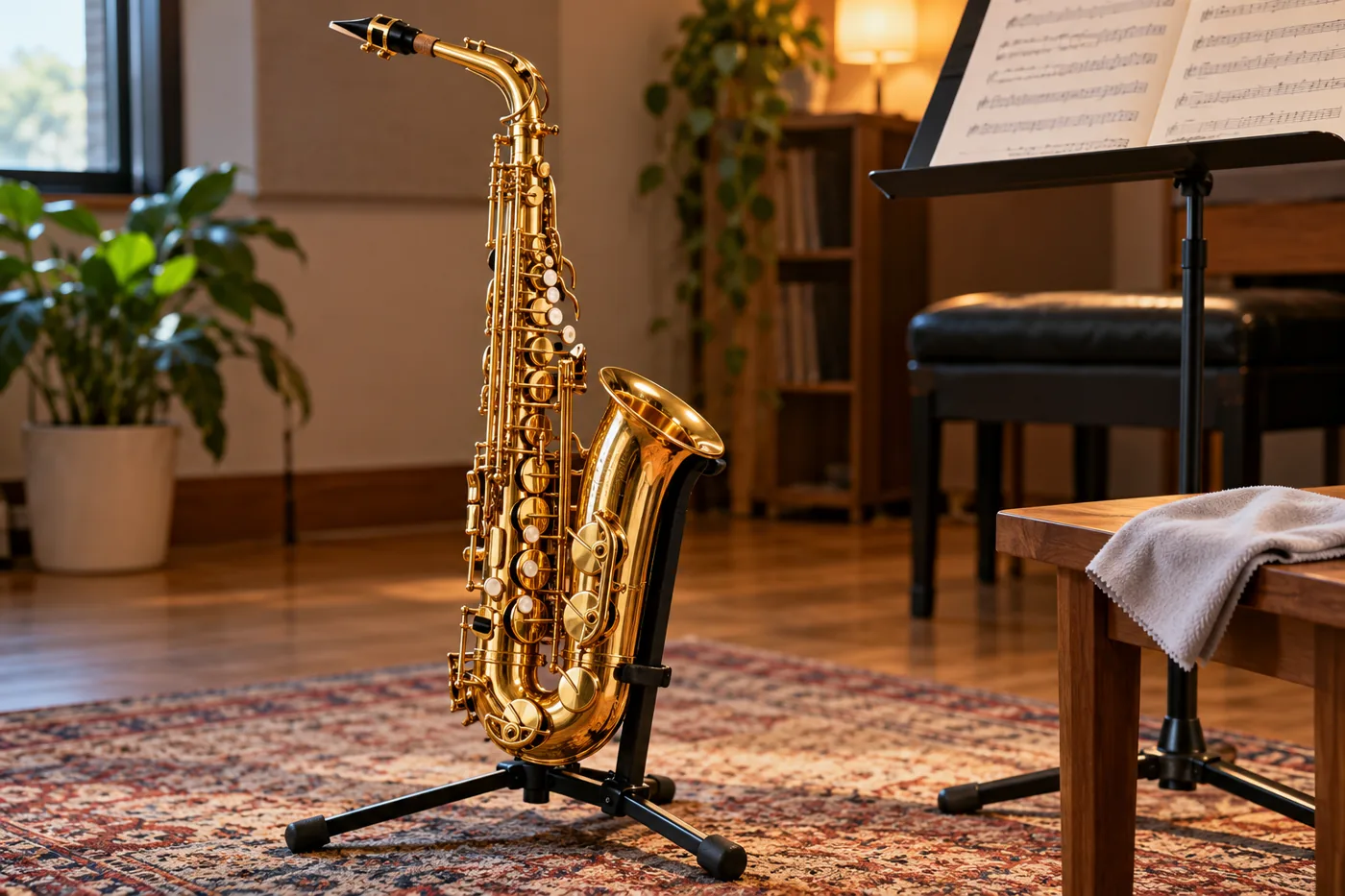
AI-created generic modern alto saxophone in a practice room. It is not the ca.1855 Adolphe Sax museum object, a Yamaha model, an engineering drawing or a repair demonstration. Credit: AI-generated for Culture Ark using OpenAI image_gen. Rights: AI-generated output; no exclusive ownership or guaranteed copyrightability claimed. Changes: Resized within1400px and converted to WebP; no crop or substantive alteration.
Conceptual illustration, not documentary evidence, product photography, software test, engineering drawing or endorsement. Underlying products, cultural works and marks retain separate rights.
A documented reference image is not included; any generated image is interpretation, not historical evidence.
History and context
This alto saxophone, made by Adolphe Sax in Paris around 1855, anchors the history of an instrument whose later cultural roles exceeded its inventor’s original setting. The Metropolitan Museum describes the saxophone’s 1846 patent and early success in bands, followed by its association with jazz and popular music. The surviving brass object connects those histories to skilled manufacture: a reed, air column, tone holes and linked keys turn breath and finger movement into a flexible musical voice. Manufacturer guides provide a second kind of evidence, explaining components, fabrication stages and everyday care. Together, the museum object and practical references preserve both an expressive cultural symbol and the material knowledge needed to understand it.
What future readers can learn
Curatorial interpretation: An instrument’s later identity can differ from its original intended setting; musical expression depends on craft, maintenance and learned technique.
Limits and cultural context
The historical museum instrument is not a modern Yamaha model. Linked manufacturer guides explain contemporary examples, not a dimensioned reconstruction of this ca. 1855 object. No generated illustration is an engineering drawing.
Where to learn more
Build, understand or maintain — primary references
- Parts and component diagram: understand / diagram. Modern saxophone component overview, not a dimensioned fabrication plan Official page opened; linked diagram not yet pixel inspected
- How a saxophone is made: manufacturing overview. Manufacturer process overview, not complete build instructions Official page opened
- Care after playing: maintenance. Manufacturer guidance; do not disassemble keys yourself Official page opened
- Troubleshooting: repair referral. Pad alignment problems referred to expert; not a repair manual Official page opened
Continue exploring
Apiary reading library Previous Culture Ark selection Next Culture Ark selection
Culture Ark is a curated archive, not a universal ranking. Interpretive images and source evidence serve different roles.
Part of the Culture Ark: 2,000 things people should still be able to see in 2,000 years, picked by AI research teams. Browse the gallery. The Culture Ark is an Artificial Mind Hive (AMH) project. AMH is owned by Austin Little.

Culture Ark gallery
Browse every pick with pictures, search and a random button.
Open the gallery →