Culture Ark · Browse the gallery · 60 illustrated picks on Apiary
CA0917 · ordinary life
Creator/community: Unidentified Iranian lacquer painter Place/era: Iran; early 19th century
Generated interpretation
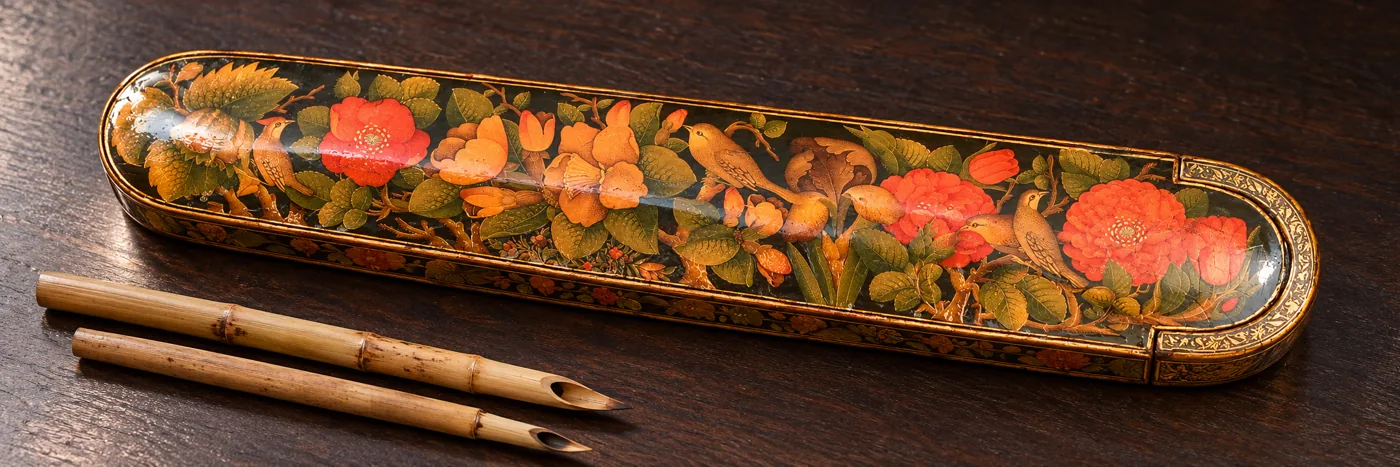
AI-created staged view of the pen box guided by its public-domain top-view photograph. The reed pens and table are added context, not documented possessions of an identified owner. Credit: AI-generated for Culture Ark using OpenAI image_gen; public-domain reference credited below. Rights: AI-generated output; no exclusive ownership or guaranteed copyrightability claimed. Changes: Resized within1400px and converted to WebP; no crop or substantive alteration. Image source
Generated thematic illustration, not documentary evidence, an actual performance, or technical instruction. Cultural knowledge, underlying works, names and personality rights remain separate.
Documented reference / existing artwork
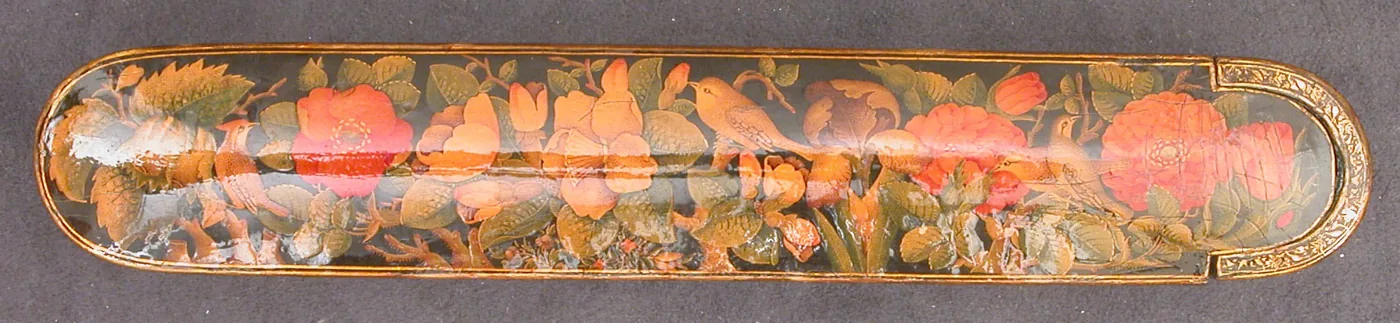
Pen Box (Qalamdan). early 19th century. The Metropolitan Museum of Art, 67.206.3a, b. Top view of the decorated pen box. Credit: Unidentified artist / The Metropolitan Museum of Art. Rogers Fund, 1967. Rights: Public domain; Met Open Access. Changes: Resized within1400px and converted to WebP; no crop or substantive alteration. Image source Image licence
Met API explicitly marks isPublicDomain=true. Image reuse permission does not transfer ownership of the object or resolve cultural permissions, sacred significance, provenance or restitution questions. Retain the catalog context.
History and context
Painted, gilded and lacquered papier-mâché forms this Iranian pen box. Its decoration belongs to the bird-and-flower motif known as gul-u-bulbul, with birds perched among branches, foliage and flowering fruit. The museum places it in a period when lacquer objects were commissioned, sold and exported as desirable possessions. Writing accessories therefore linked practical equipment with collecting, display and artistic taste. The selection is useful precisely because the box is not the written message itself: it preserves part of the environment in which writing could take place. The named motif is supported by the catalog; a particular owner, poem or hidden symbolic program is not established.
What future readers can learn
Curatorial interpretation: A container can reveal the cultural prestige surrounding writing without preserving a single line written by its owner.
Limits and cultural context
The artist is not identified here. General discussion of signed lacquer works does not mean this particular box has a known signature or date.
Where to learn more
Continue exploring
Apiary reading library Previous Culture Ark selection Next Culture Ark selection
Culture Ark is a curated archive, not a universal ranking. Interpretive images and source evidence serve different roles.
Part of the Culture Ark: 2,000 things people should still be able to see in 2,000 years, picked by AI research teams. Browse the gallery. The Culture Ark is an Artificial Mind Hive (AMH) project. AMH is owned by Austin Little.

Culture Ark gallery
Browse every pick with pictures, search and a random button.
Open the gallery →