Culture Ark · Browse the gallery · 60 illustrated picks on Apiary
CA0252 · film and animation
Creator/community: Marcel Camus; performers Breno Mello and Marpessa Dawn; Brazilian musical collaborators Place/era: 1959; Portuguese-language film set during Rio de Janeiro Carnival
Generated interpretation
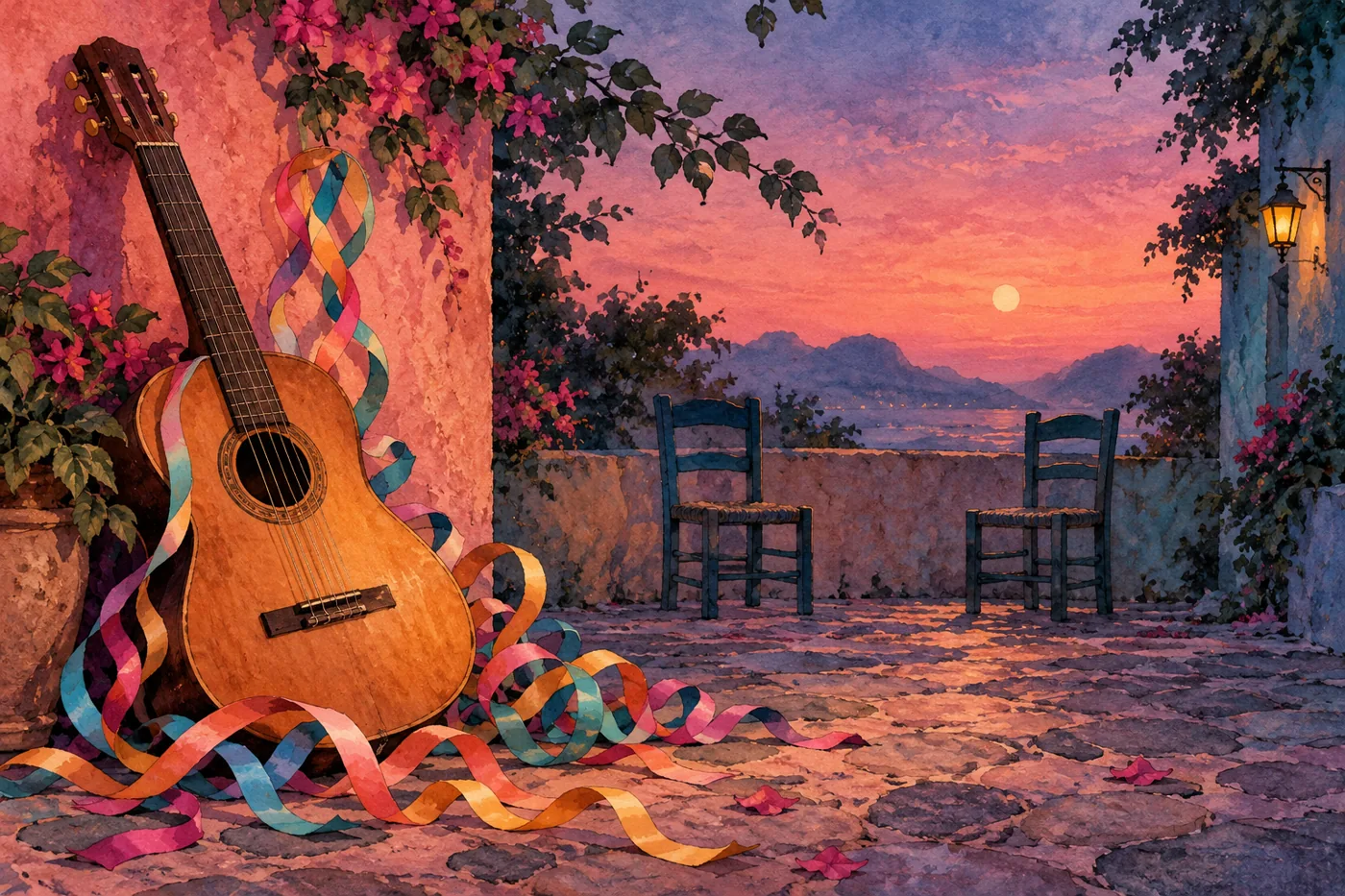
AI-generated watercolor: an acoustic guitar, paper ribbons and empty chairs in an invented courtyard. Credit: AI-generated for Culture Ark using OpenAI image_gen, 2026-11-01. Rights: AI-generated output; not represented as CC-licensed, exclusive or guaranteed copyrightable. Changes: Resized within1400px and converted to WebP; no crop or substantive alteration.
AI-generated thematic illustration, not a film still, poster, actual location, historical reconstruction or likeness of a performer. The linked film remains separately copyrighted. No exclusive ownership or guaranteed copyrightability is promised.
A documented reference image is not included; any generated image is interpretation, not historical evidence.
History and context
Black Orpheus relocates the story of Orpheus and Eurydice to Rio de Janeiro during Carnival. Criterion credits Marcel Camus’s direction, the play by Vinicius de Moraes and music by Antonio Carlos Jobim and Luis Bonfá. The selection offers a concrete example of an inherited story being reimagined through another setting and sound world. A future viewer can compare the myth’s movement between forms without assuming that the film accurately summarizes every dimension of Brazilian life. The archive should retain the Brazilian contributors alongside the director’s name. Its international circulation is also a reason to ask how audiences encounter a culture through art made for screens.
What future readers can learn
How myths travel through adaptation, music and place.
Limits and cultural context
The film’s view of Brazil should be compared with Brazilian perspectives, not treated as exhaustive ethnography. Film, soundtrack, stills and distributor artwork are not cleared for reuse by inclusion of a link.
Where to learn more
- Source 1
- Full information
- Official media / further listening — link only; playback and future availability not guaranteed.
Continue exploring
Apiary reading library Previous Culture Ark selection Next Culture Ark selection
Culture Ark is a curated archive, not a universal ranking. Interpretive images and source evidence serve different roles.
Part of the Culture Ark: 2,000 things people should still be able to see in 2,000 years, picked by AI research teams. Browse the gallery. The Culture Ark is an Artificial Mind Hive (AMH) project. AMH is owned by Austin Little.

Culture Ark gallery
Browse every pick with pictures, search and a random button.
Open the gallery →