Culture Ark · Browse the gallery · 60 illustrated picks on Apiary
CA0064 · music
Creator/community: Réunion musicians and communities Place/era: Réunion; plantation-era roots and continuing reinvention
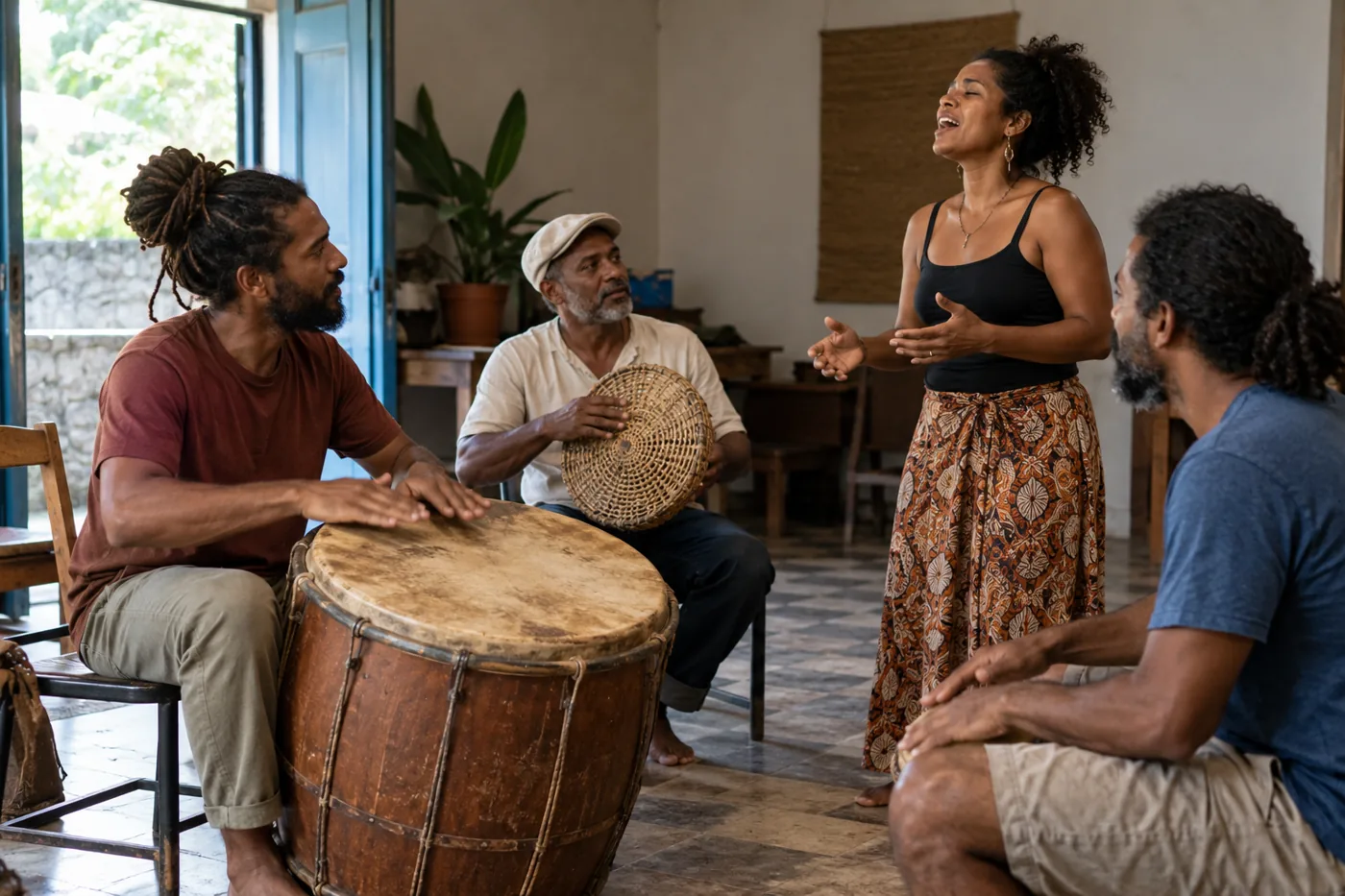
Generated interpretation
Imagined companion to Maloya; does not document named people, a specific venue, ritual, recording or event. Credit: AI-generated with OpenAI image_gen for Culture Ark. Rights: Generated output; no exclusive ownership or copyrightability warranty; underlying cultural practices and third-party rights remain separate.. Changes: Resized within1400px and converted to WebP; no crop or substantive alteration.
No community endorsement or sacred authority implied. Imagined everyday settings and materials; not a construction guide or proof of performance practice.
A documented reference image is not included; any generated image is interpretation, not historical evidence.
History and context
Maloya combines music, singing and dance on Réunion. UNESCO traces it to enslaved Malagasy and African people working on sugar plantations, while describing its wider place in island society today. A singer’s exchange with a chorus and a percussion foundation remain important reference points, although performers have introduced other instruments and connections with rock, reggae and jazz. Its settings include ancestor-related ritual, expressions of pain under slavery and political assertion. This entry asks future listeners to hear continuity and reinvention together. A living musical form does not cease to carry history when artists adapt it for new audiences or unfamiliar musical combinations.
What future readers can learn
Curatorial interpretation: Changing instrumentation can coexist with inherited memory, rather than simply destroying an authentic original.
Limits and cultural context
Ritual maloya and stage performance require different context. Historical source estimates of group numbers are not current statistics.
Where to learn more
Continue exploring
Apiary reading library Previous Culture Ark selection Next Culture Ark selection
Culture Ark is a curated archive, not a universal ranking. Interpretive images and source evidence serve different roles.
Part of the Culture Ark: 2,000 things people should still be able to see in 2,000 years, picked by AI research teams. Browse the gallery. The Culture Ark is an Artificial Mind Hive (AMH) project. AMH is owned by Austin Little.

Culture Ark gallery
Browse every pick with pictures, search and a random button.
Open the gallery →