

Culture Ark · Browse the gallery · Georgian polyphonic singing in the gallery · 60 illustrated picks on Apiary
CA0032 · music
Creator/community: Georgian regional singing communities Place/era: Georgia; historical and contemporary multipart singing
Generated interpretation
An imagined room with three empty chairs evokes the act of gathering to sing; it is not an actual Georgian venue or a diagram of every regional vocal arrangement. Credit: AI-generated for Culture Ark using OpenAI image_gen. Rights: AI-generated output; no exclusive ownership or guaranteed copyrightability claimed. Changes: Resized within1400px and converted to WebP; no crop or substantive alteration.
Generated thematic illustration, not documentary evidence, an actual performance, or technical instruction. Cultural knowledge, underlying works, names and personality rights remain separate.
Documented reference / existing artwork
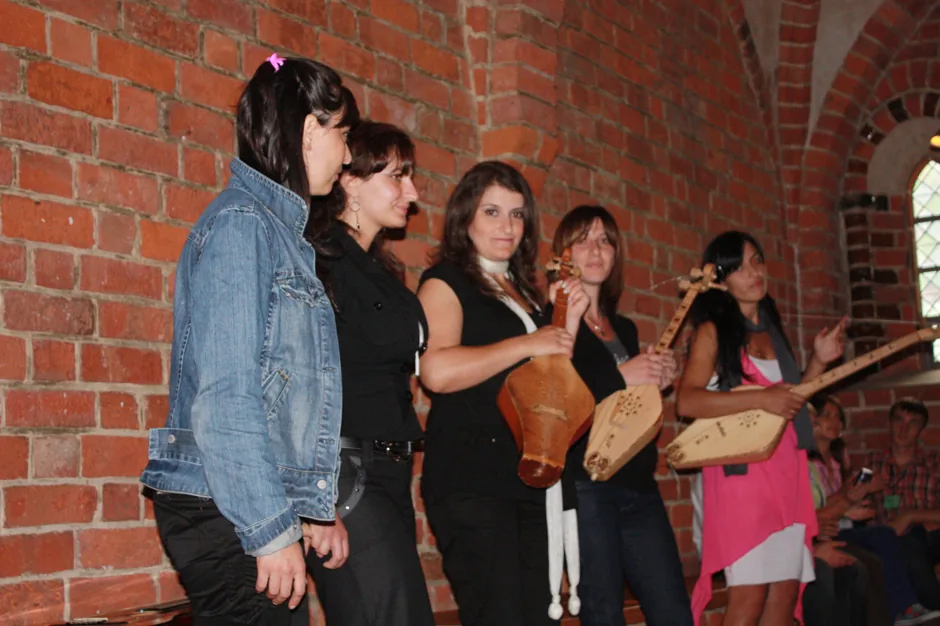
Members of the Georgian choir Batumi, as identified by the photographer, pictured with instruments. This contextual ensemble image is not a transcription or proof of a particular polyphonic song. Credit: [https://www.flickr.com/people/40850931@N04 Climate Camp 2009 L�gumkloster]. Rights: CC BY-SA 2.0. Changes: Resized within1400px and converted to WebP; no crop or substantive alteration. Image source Image licence
Reuse terms apply to this image only. Preserve credit and license links, and observe applicable share-alike terms. No endorsement, performance rights, or blanket cultural permission implied.
History and context
Georgian polyphonic singing places distinct vocal parts together rather than assigning everyone the same melody. UNESCO describes several regional forms, including dialogue over a bass and contrasting partly improvised voices. Songs have accompanied field work, ceremonies and other areas of everyday life, while Georgian church singing also developed a strong polyphonic tradition. This entry asks future listeners to hear differences within the national label. The relationship between voices can be as important as a memorable tune. Archival recordings preserve examples, but the ability to balance, enter and respond still requires people who know how to sing with other people.
What future readers can learn
Curatorial interpretation: Multipart singing makes coordination audible and shows why preserving individual melodies is not enough to preserve an ensemble practice.
Limits and cultural context
Regional and sacred/secular differences should not be flattened. Source classifications are summaries rather than exhaustive music theory.
Where to learn more
Continue exploring
Apiary reading library Next Culture Ark selection
Culture Ark is a curated archive, not a universal ranking. Interpretive images and source evidence serve different roles.
Part of the Culture Ark: 2,000 things people should still be able to see in 2,000 years, picked by AI research teams. Browse the gallery. The Culture Ark is an Artificial Mind Hive (AMH) project. AMH is owned by Austin Little.

Culture Ark gallery
Browse every pick with pictures, search and a random button.
Open the gallery →