

Culture Ark · Browse the gallery · Emoji in everyday digital conversation in the gallery · 60 illustrated picks on Apiary
CA0019 · internet and digital culture
Creator/community: Japanese mobile-phone designers and users; Unicode participants, platform designers and global messaging communities Place/era: Japan-origin mobile communication, late twentieth century onward; global digital culture
Generated interpretation
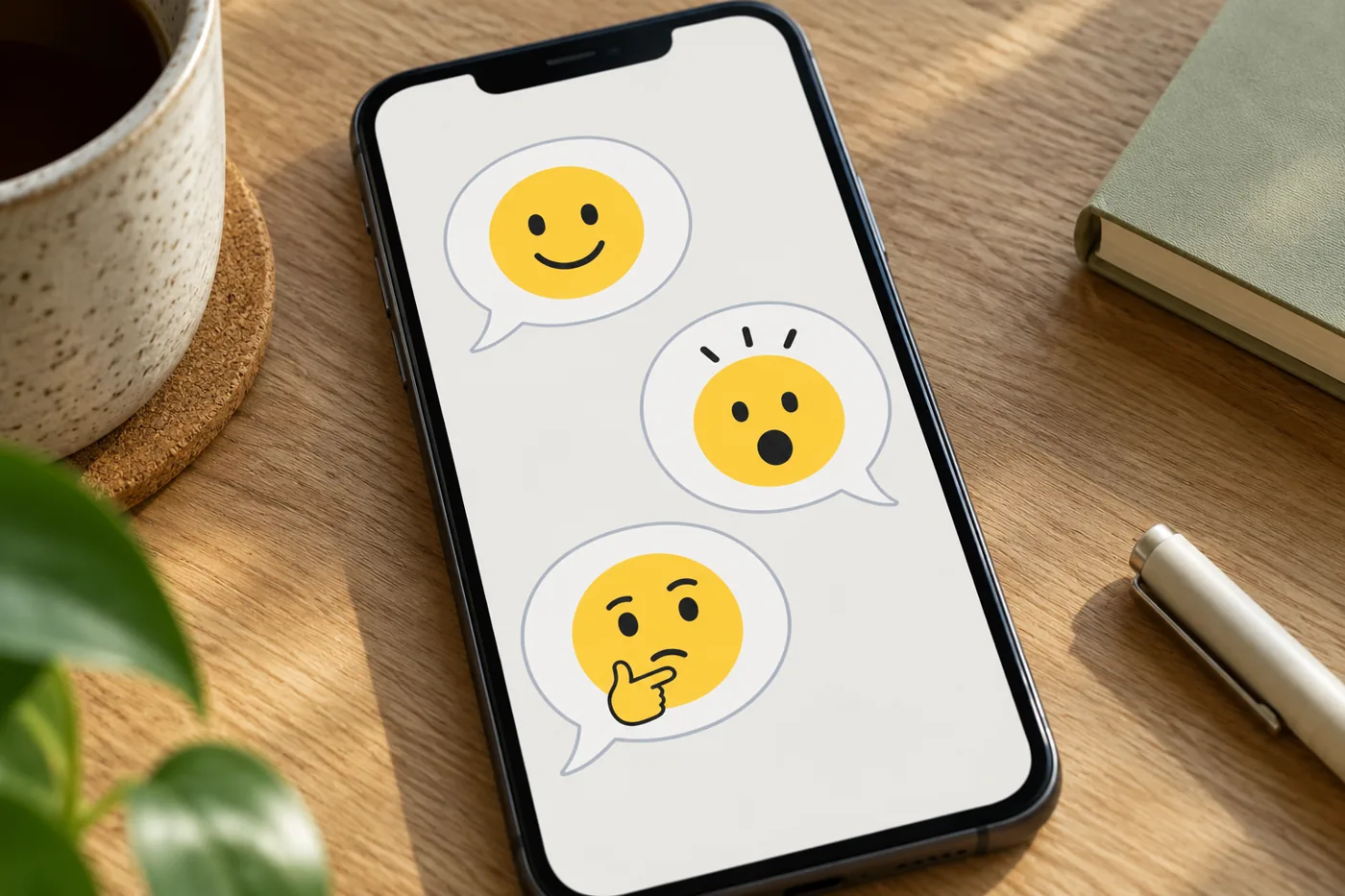
Invented smartphone pictorial conversation with simple expressive faces; not an archived app interface or private conversation. Credit: AI-generated for Culture Ark using OpenAI image_gen, 2026-11-01. Rights: AI-generated output; no exclusive ownership or guaranteed copyrightability claimed. Changes: Resized within1400px and converted to WebP; no crop or substantive alteration.
Interpretive presentation artwork, not documentary evidence. Underlying music, film, brands and personality rights remain separate.
Documented reference / existing artwork
Grinning Face U+1F600, rendered by OpenMoji. Credit: OpenMoji contributors. Rights: CC BY-SA 4.0. Changes: None; original SVG preserved. Image source Image licence
Upstream README and license explicitly license graphics CC BY-SA 4.0. Preserve attribution; adaptations need share-alike. This is not exclusive ownership.
History and context
Emoji are picture characters used within written communication, including images of faces, food, animals, places and activities. Unicode traces their association with Japanese mobile phones and explains how incompatible carrier systems created obstacles to exchanging messages. Standardization helped characters travel between devices, but the character and its drawn appearance are not identical things. That distinction matters for preservation: an archive should record a message’s date, platform and intended context instead of assuming a tiny symbol always had one meaning. Emoji also differ from older text emoticons such as a smile assembled from punctuation. Together they reveal efforts to bring facial expression, tone and playful ambiguity into brief written exchanges.
What future readers can learn
Future readers can see how ordinary communication combined language, pictures and shared conventions. It is a useful case of everyday culture shaped jointly by users and technical institutions.
Limits and cultural context
Emoji are not a universal language with fixed meanings. Platform artwork can carry separate rights; Unicode’s charts do not grant unrestricted commercial reuse of vendor illustrations. Preserve examples with context and verified artwork licenses.
Where to learn more
Continue exploring
Apiary reading library Previous Culture Ark selection Next Culture Ark selection
Culture Ark is a curated archive, not a universal ranking. Interpretive images and source evidence serve different roles.
Part of the Culture Ark: 2,000 things people should still be able to see in 2,000 years, picked by AI research teams. Browse the gallery. The Culture Ark is an Artificial Mind Hive (AMH) project. AMH is owned by Austin Little.

Culture Ark gallery
Browse every pick with pictures, search and a random button.
Open the gallery →