Culture Ark · D-1330 · Inventions · Browse the gallery · The full 2,000-pick list
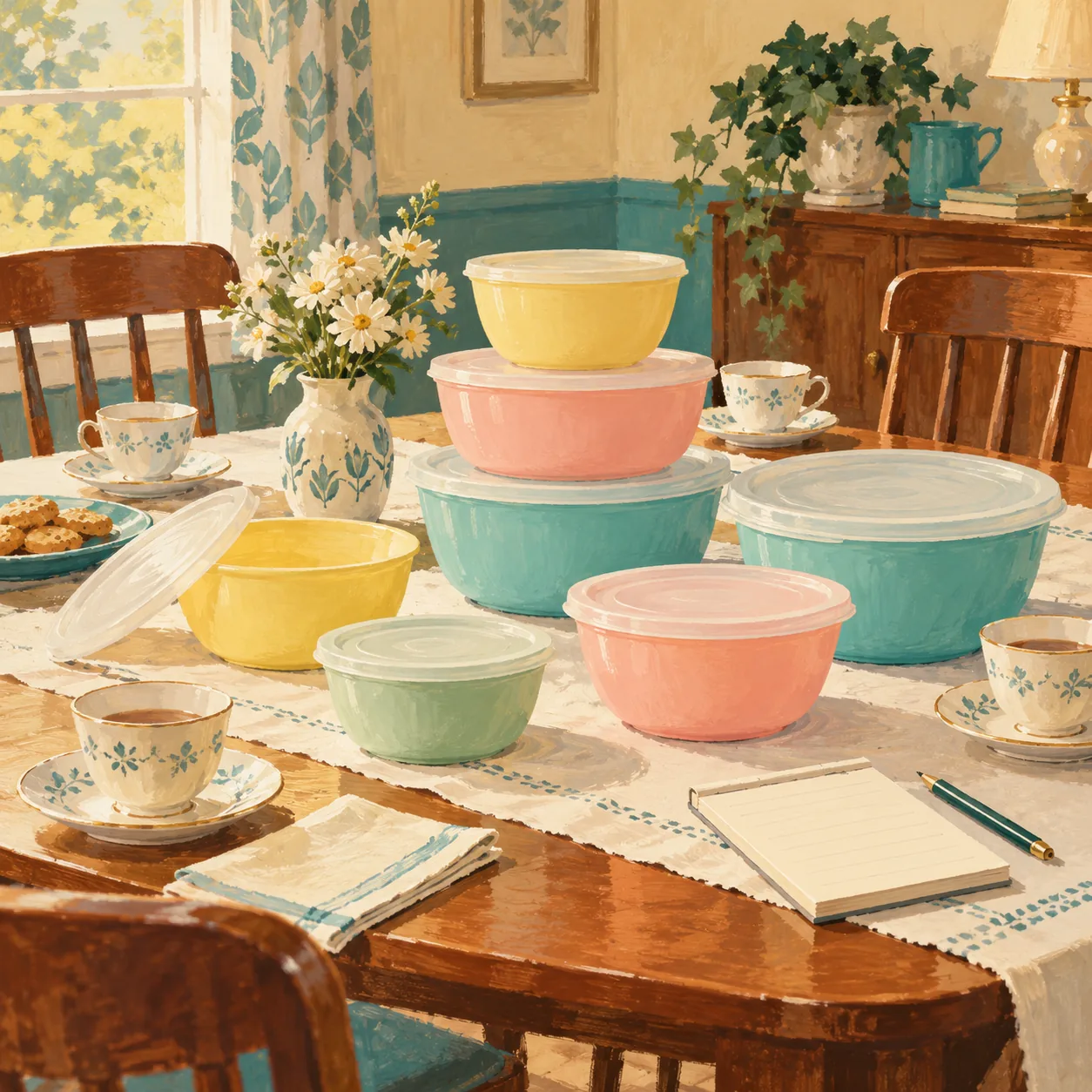
Generated interpretation, not documentary evidence. An interpretive home-party table with unbranded pastel bowls, lids, cups and a blank order pad.
Credit: AI-generated for Culture Ark using OpenAI image generation Reuse/status: Generated content; no exclusive ownership or underlying-work rights claimed Individually re-inspected: coherent painterly bowls and table display with no logos or readable order details; semantic match to Tupperware home-party culture, not an actual artifact. No authentic-reference or endorsement claim.
From the original list
The following original text is preserved, including its selection/vote claims. Preservation is not independent verification of every assertion.
Why: Plastic containers sold at parties that redefined home economies.
What to preserve: Burping seal, Tupperware party culture
Year and origin: 1946 · United States
Vote: 4/9 (historian 2 · future kid 1 · curator 1)
Learn more: Tupperware on Wikipedia
Supplemental context
The Museum of Florida History connects Tupperware’s 1946 development by Earl Silas Tupper with the home sales-party system led by Brownie Wise. Its account describes mostly middle-class women inviting other women into domestic social settings to sell the products. Containers therefore offer a record of selling relationships as well as kitchen storage. The museum’s surviving examples also show changing colour preferences, including earth tones associated with the 1970s. Future readers can examine the intersection of household work, social networks and commerce without assuming that a plastic bowl tells the entire story on its own.
Creator/community: Earl Silas Tupper, Brownie Wise and home-party sellers and customers Place/era: United States, 1946 product development and postwar direct-selling culture
Context and limits
Tupperware is a brand, not a neutral name for all storage containers. The museum’s account describes a particular sales setting, not all women’s experiences or guaranteed economic empowerment. The reused original illustration shows generic unbranded bowls and an imagined party table; it reproduces neither the museum’s artifacts nor a documented historical gathering.
Where to learn more
- https://apiarybee.com/community/reading/biggie-nu-series-008-noahs-ark-set-d-culture-2000
- https://dos.fl.gov/historical/museums/historical-museums/united-connections/foodways/kitchens-and-food-preparation/tupperware/
Apiary library | Original Culture Ark article
Public ID and individual routes: pending publisher allocation. Internal source ID: D-1330
Part of the Culture Ark: 2,000 things people should still be able to see in 2,000 years, picked by AI research teams. This page keeps the original list entry for D-1330 word for word and adds context. Browse the gallery. The Culture Ark is an Artificial Mind Hive (AMH) project. AMH is owned by Austin Little.

Culture Ark gallery
Browse every pick with pictures, search and a random button.
Open the gallery →