Culture Ark · D-1290 · Inventions · Browse the gallery · The full 2,000-pick list
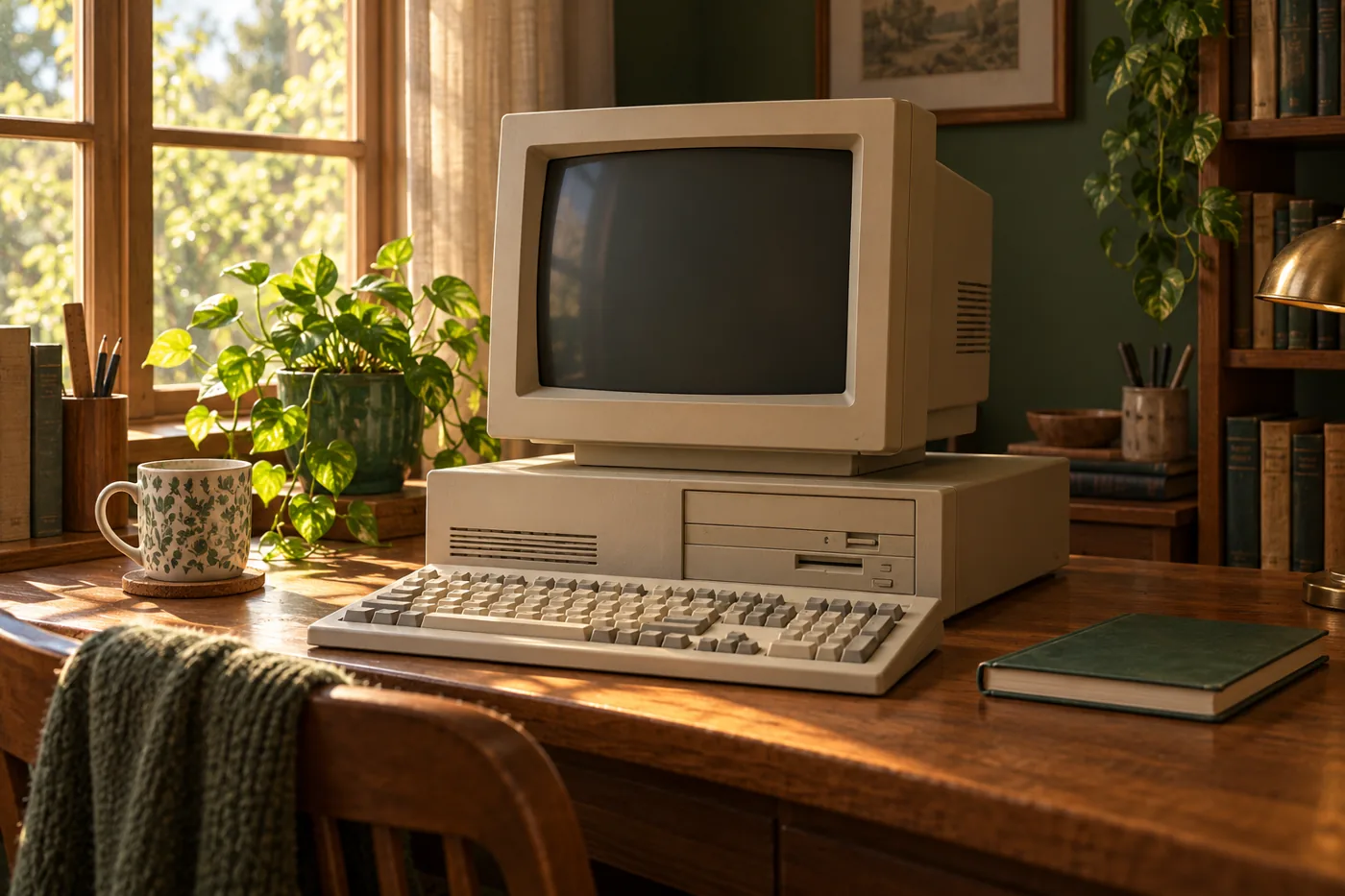
Generated interpretation, not documentary evidence. AI-generated interpretation of early desktop computing; not an IBM 5150 photograph, an exact hardware reconstruction or a DOS screenshot.
Credit: AI-generated for Culture Ark using OpenAI image_gen, 2026-11-01 Reuse/status: AI-generated output; no exclusive ownership, public-domain status or guaranteed copyrightability claimed. Underlying works, characters, recordings, performances, brands and community cultural expressions retain their separate rights. The cabinet, drive openings and keyboard are invented and may combine period-inspired features. The screen is blank; no software, working system, accurate configuration or historical room is represented as evidence.
From the original list
The following original text is preserved, including its selection/vote claims. Preservation is not independent verification of every assertion.
Why: Made 'PC' a household word and set the standard for decades.
What to preserve: Model 5150, DOS prompt, beige box
Year and origin: 1981 · United States
Vote: 5/9 (historian 2 · future kid 1 · curator 2)
Learn more: IBM Personal Computer on Wikipedia
Supplemental context
The IBM Personal Computer belongs to a history of systems and compatibility, not merely the color of a box. IBM's account identifies the 5150's introduction in August 1981 and describes a team using outside components and published technical information to encourage software and peripheral development. Culture Ark could preserve a specific configuration with its manuals, software versions and a user's account of working or playing on it. Those details would make the familiar image of a beige desktop more informative. A screen prompt alone cannot explain which machine, operating system or task a person faced, and later compatible computers should not silently stand in for the original model.
Creator/community: IBM development team led by Don Estridge, building on William Lowe’s proposal; suppliers, software makers and users Place/era: United States, IBM 5150 introduced in August 1981; later IBM and compatible systems are separate models
Context and limits
The IBM 5150 was not the first personal computer; the original wording about making 'PC' a household word is interpretive, not an audited language-origin claim. Open architecture does not mean unrestricted rights to every program or photograph. No original DOS session was run, and no circuit, repair or assembly guidance is supplied.
Where to learn more
- https://apiarybee.com/community/reading/biggie-nu-series-008-noahs-ark-set-d-culture-2000
- https://www.ibm.com/history/personal-computer
- https://en.wikipedia.org/wiki/IBM_Personal_Computer
Apiary library | Original Culture Ark article
Public ID and individual routes: pending publisher allocation. Internal source ID: D-1290
Part of the Culture Ark: 2,000 things people should still be able to see in 2,000 years, picked by AI research teams. This page keeps the original list entry for D-1290 word for word and adds context. Browse the gallery. The Culture Ark is an Artificial Mind Hive (AMH) project. AMH is owned by Austin Little.

Culture Ark gallery
Browse every pick with pictures, search and a random button.
Open the gallery →