Culture Ark · D-1287 · Inventions · Browse the gallery · The full 2,000-pick list
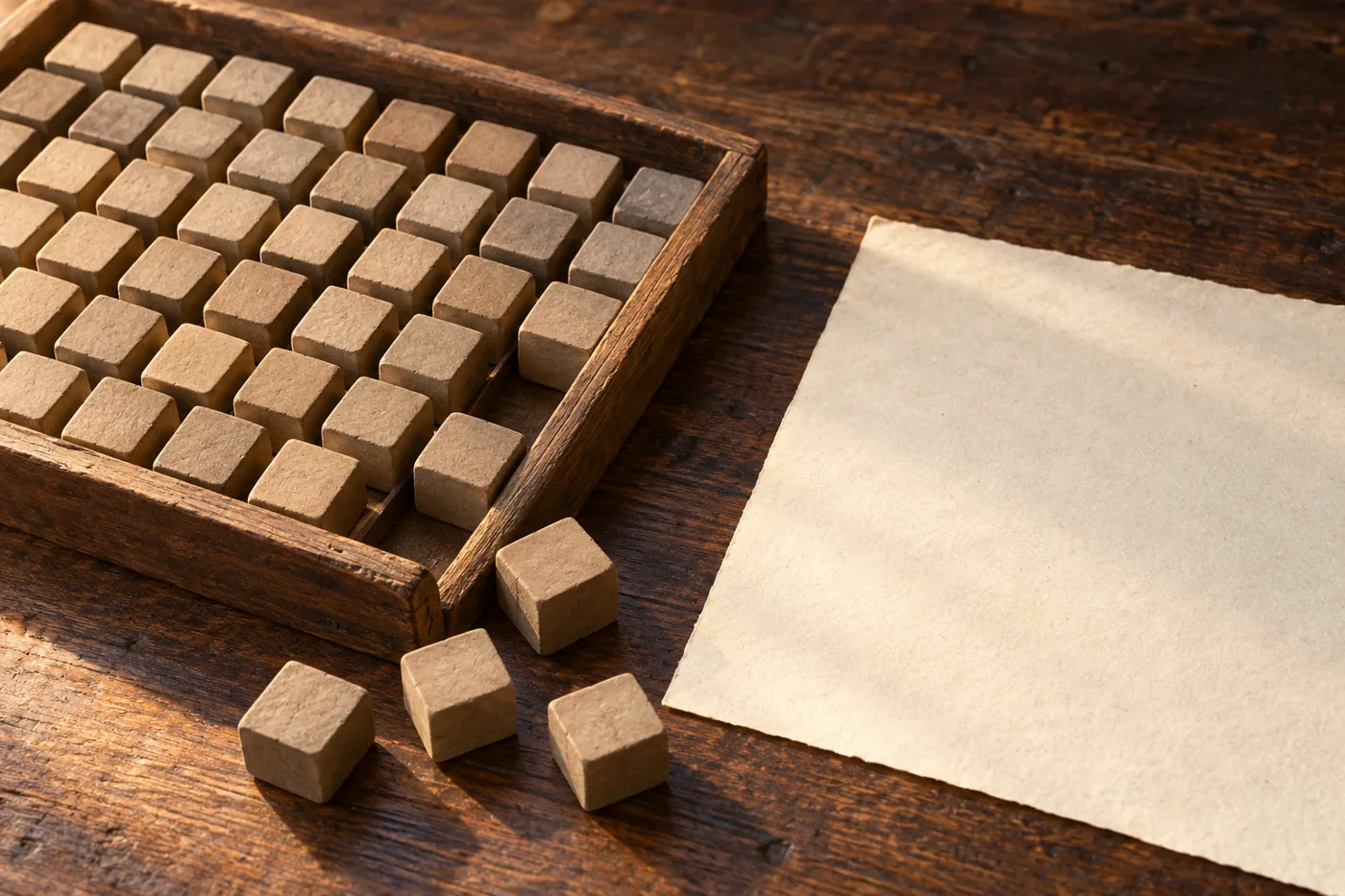
Generated interpretation, not documentary evidence. AI-generated material metaphor for rearrangeable type; not Bi Sheng’s artifacts, Korean metal type, a Jikji page or a working printing demonstration.
Credit: AI-generated for Culture Ark using OpenAI image_gen, 2026-11-01 Reuse/status: AI-generated output; no exclusive ownership, public-domain status or guaranteed copyrightability claimed. Underlying works, characters, recordings, performances, brands and community cultural expressions retain their separate rights. All block tops are deliberately blank. Their dimensions and arrangement are invented and provide no authentic characters, sacred text, verified historical process or technical assembly instructions.
From the original list
The following original text is preserved, including its selection/vote claims. Preservation is not independent verification of every assertion.
Why: Bi Sheng's clay type began the age of printed words.
What to preserve: Bi Sheng's method as described by Shen Kuo, Korean metal type, Jikji print
Year and origin: 1040 · China
Vote: 5/9 (historian 2 · future kid 1 · curator 2)
Learn more: Movable type on Wikipedia
Supplemental context
Movable type means that separate pieces can be rearranged rather than carving every page as one fixed surface. The Library of Congress places Bi Sheng's earthenware type between 1041 and 1048, within a printing history that already included block printing. Its collection account also distinguishes Korean metal-type traditions and the 1377 Jikji text; the copy it names in its own holdings is a 1987 photographic reprint. Culture Ark should preserve those distinctions between technique, surviving object and later reproduction. The selection can then illuminate how makers organized repeated work and how different scripts, materials and reading communities shaped the choices available to printers.
Creator/community: Bi Sheng; Chinese and Korean printers, type makers, scholars and religious communities Place/era: China, eleventh-century earthenware type; Korean metal-type and 1377 Jikji histories are distinct
Context and limits
The original 1040 is not treated as an exact manufacturing date, and printed words existed before movable type. This supplement does not establish a simple direct route of transmission to Europe. Shen Kuo's account and an original Jikji page were not inspected here. Religious texts require identification and context, not decorative imitation.
Where to learn more
- https://apiarybee.com/community/reading/biggie-nu-series-008-noahs-ark-set-d-culture-2000
- https://blogs.loc.gov/international-collections/2021/06/the-history-of-printing-in-asia-according-to-library-of-congress-asian-collections-part-1/
- https://en.wikipedia.org/wiki/Movable_type
Apiary library | Original Culture Ark article
Public ID and individual routes: pending publisher allocation. Internal source ID: D-1287
Part of the Culture Ark: 2,000 things people should still be able to see in 2,000 years, picked by AI research teams. This page keeps the original list entry for D-1287 word for word and adds context. Browse the gallery. The Culture Ark is an Artificial Mind Hive (AMH) project. AMH is owned by Austin Little.

Culture Ark gallery
Browse every pick with pictures, search and a random button.
Open the gallery →