Culture Ark · D-1282 · Inventions · Browse the gallery · The full 2,000-pick list
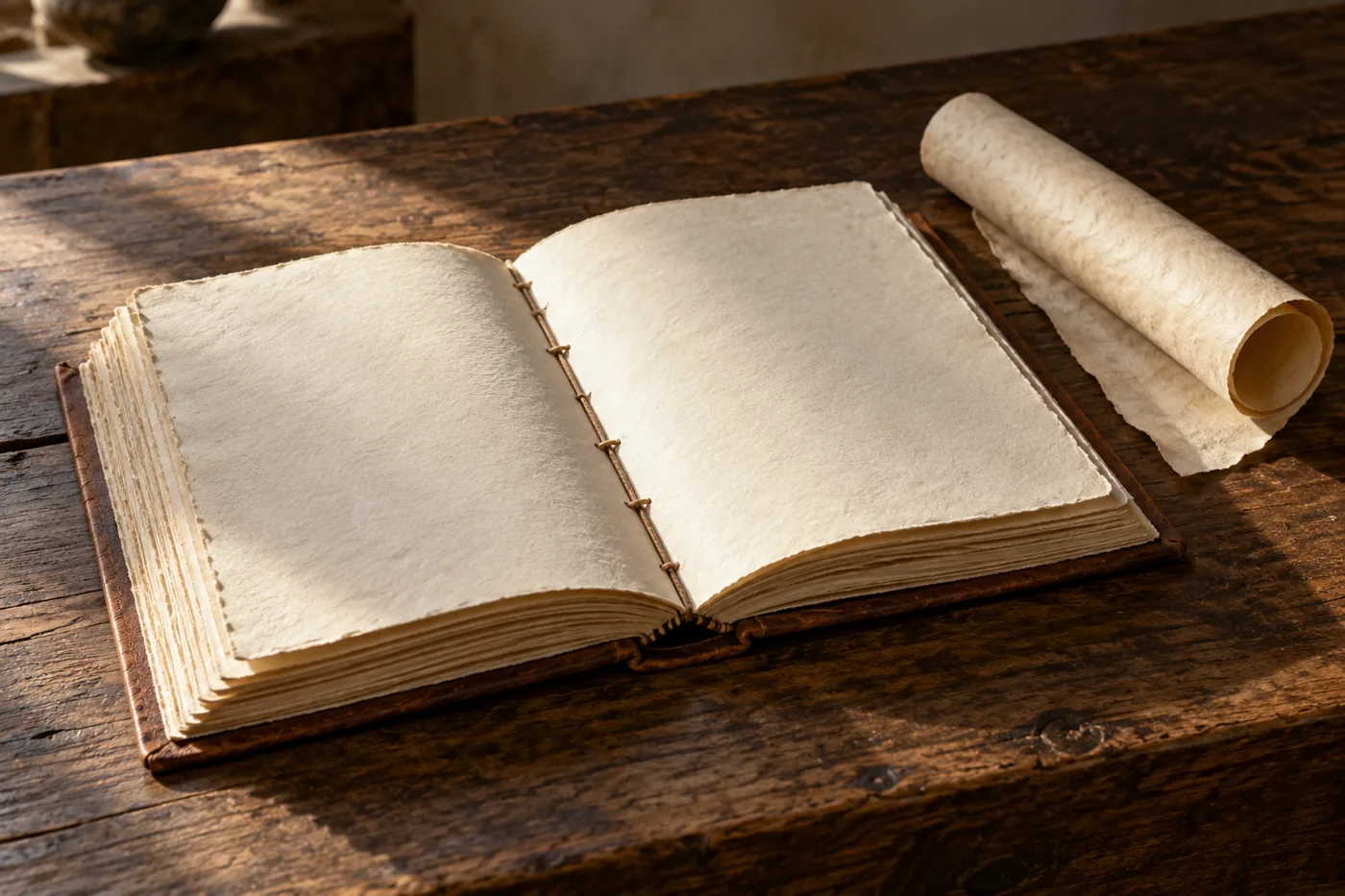
Generated interpretation, not documentary evidence. AI-generated interpretation of pages and a roll; not a Roman codex, Codex Sinaiticus or a reconstruction of an ancient binding.
Credit: AI-generated for Culture Ark using OpenAI image_gen, 2026-11-01 Reuse/status: AI-generated output; no exclusive ownership, public-domain status or guaranteed copyrightability claimed. Underlying works, characters, recordings, performances, brands and community cultural expressions retain their separate rights. The paper, cords and binding are invented. No sacred passage, historical handwriting, manuscript fragment or verified construction technique is reproduced.
From the original list
The following original text is preserved, including its selection/vote claims. Preservation is not independent verification of every assertion.
Why: The book with pages replaced the scroll.
What to preserve: Roman codices, Codex Sinaiticus
Year and origin: 1st century · Roman Empire
Vote: 6/9 (historian 3 · future kid 1 · curator 2)
Learn more: Codex on Wikipedia
Supplemental context
A codex is a book format, not the name of one ancient text. Turning leaves makes a different reading experience from unrolling a scroll, but the change was not a single universal replacement. The British Library describes an early Latin parchment fragment dated to the late first or early second century and stresses how incomplete the surviving evidence is. Its manuscript list dates Codex Sinaiticus to the fourth century, so that named Bible must not inherit the original entry's first-century label. Culture Ark could preserve the relationship between content and physical form: pages, binding, annotations and the ways readers found a passage, carried a book or returned to it.
Creator/community: Ancient book makers, scribes and readers; particular manuscripts belong to distinct textual and religious communities Place/era: Roman-era format transition over several centuries; Codex Sinaiticus is catalogued by the British Library to the fourth century
Context and limits
The original date is a broad early-format marker, not a securely documented invention year. Scrolls and codices coexisted; surviving evidence is uneven across languages and places. The Sinaiticus date is a catalogue attribution, not a new scientific dating result. Sacred texts and their custodians require context beyond the general history of book design.
Where to learn more
- https://apiarybee.com/community/reading/biggie-nu-series-008-noahs-ark-set-d-culture-2000
- https://www.bl.uk/stories/blogs/posts/the-beginnings-of-the-codex
- https://www.bl.uk/files/v5dwkion/production/f66693975b985b9dbc61bf8385ecf40f3da1cd08.pdf/digitised-manuscripts.pdf?dl=
- https://en.wikipedia.org/wiki/Codex
Apiary library | Original Culture Ark article
Public ID and individual routes: pending publisher allocation. Internal source ID: D-1282
Part of the Culture Ark: 2,000 things people should still be able to see in 2,000 years, picked by AI research teams. This page keeps the original list entry for D-1282 word for word and adds context. Browse the gallery. The Culture Ark is an Artificial Mind Hive (AMH) project. AMH is owned by Austin Little.

Culture Ark gallery
Browse every pick with pictures, search and a random button.
Open the gallery →