Culture Ark · D-1264 · Inventions · Browse the gallery · The full 2,000-pick list
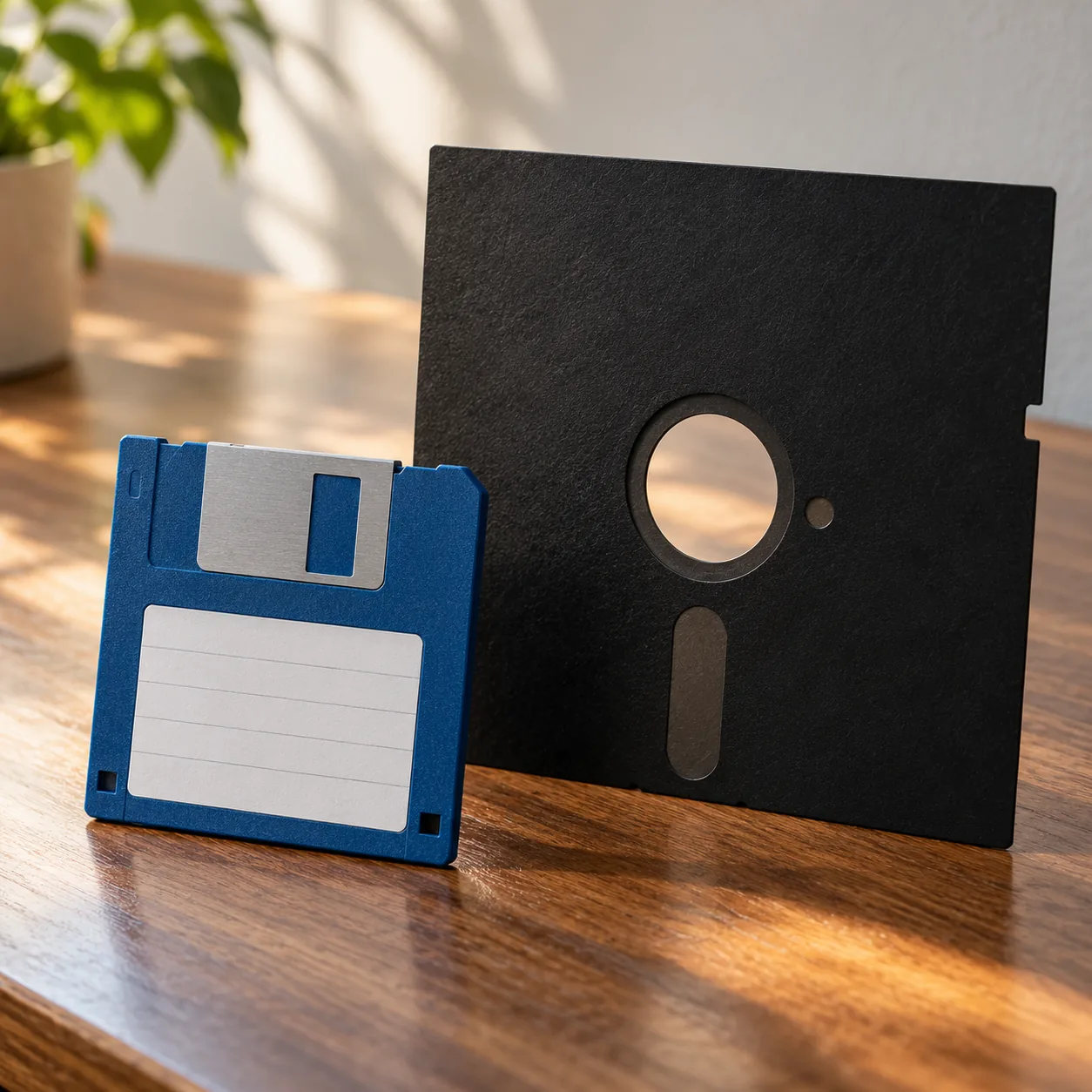
Generated interpretation, not documentary evidence. Generated flexible-disk and rigid-case disk still life with blank labels; not actual preserved data, exact dimensions or a complete three-format comparison.
Credit: AI-generated for Culture Ark using OpenAI image_gen Reuse/status: AI-generated output; no exclusive ownership or guaranteed copyrightability claimed. Underlying works, marks and cultural permissions remain separate. Generated flexible-disk and rigid-case disk still life with blank labels; not actual preserved data, exact dimensions or a complete three-format comparison. The source is a manufacturer’s retrospective, not an independent account of every format or software-industry origin. Its broad claims about software history and some later product chronology are not adopted. Disks did not literally vanish; legacy use is acknowledged. The two illustrated formats are not to scale.
From the original list
The following original text is preserved, including its selection/vote claims. Preservation is not independent verification of every assertion.
Why: Its picture survives as the Save icon long after the disk vanished.
What to preserve: 8-, 5.25- and 3.5-inch disks, the save icon
Year and origin: 1971 · United States
Vote: 6/9 (historian 2 · future kid 2 · curator 2)
Learn more: Floppy disk on Wikipedia
Supplemental context
Floppy disks made computer files into objects people could label, carry and exchange. IBM’s institutional history traces development to a San Jose team working in 1967 on an inexpensive way to load instructions and updates into mainframes. It distinguishes the start of drive sales in 1971 from patents received in 1972. Later disk formats became associated with installing programs, submitting schoolwork and moving documents between machines. Their cultural importance lies partly in this physical routine: digital information could inhabit a pocket or a desk drawer rather than appear to exist only within a network. The familiar disk-shaped save symbol also invites future readers to ask how an interface can preserve the outline of an object after its everyday use declines.
Creator/community: IBM engineers including David L. Noble’s team and Warren L. Dalziel; later manufacturers and computer users Place/era: United States, development from 1967 and sales from 1971; international personal-computer culture
Context and limits
The source is a manufacturer’s retrospective, not an independent account of every format or software-industry origin. Its broad claims about software history and some later product chronology are not adopted. Disks did not literally vanish; legacy use is acknowledged. The two illustrated formats are not to scale.
Where to learn more
- https://apiarybee.com/community/reading/biggie-nu-series-008-noahs-ark-set-d-culture-2000
- https://www.ibm.com/history/floppy-disk
Apiary library | Original Culture Ark article
Public ID and individual routes: pending publisher allocation. Internal source ID: D-1264
Part of the Culture Ark: 2,000 things people should still be able to see in 2,000 years, picked by AI research teams. This page keeps the original list entry for D-1264 word for word and adds context. Browse the gallery. The Culture Ark is an Artificial Mind Hive (AMH) project. AMH is owned by Austin Little.

Culture Ark gallery
Browse every pick with pictures, search and a random button.
Open the gallery →