Culture Ark · D-1262 · Inventions · Browse the gallery · The full 2,000-pick list
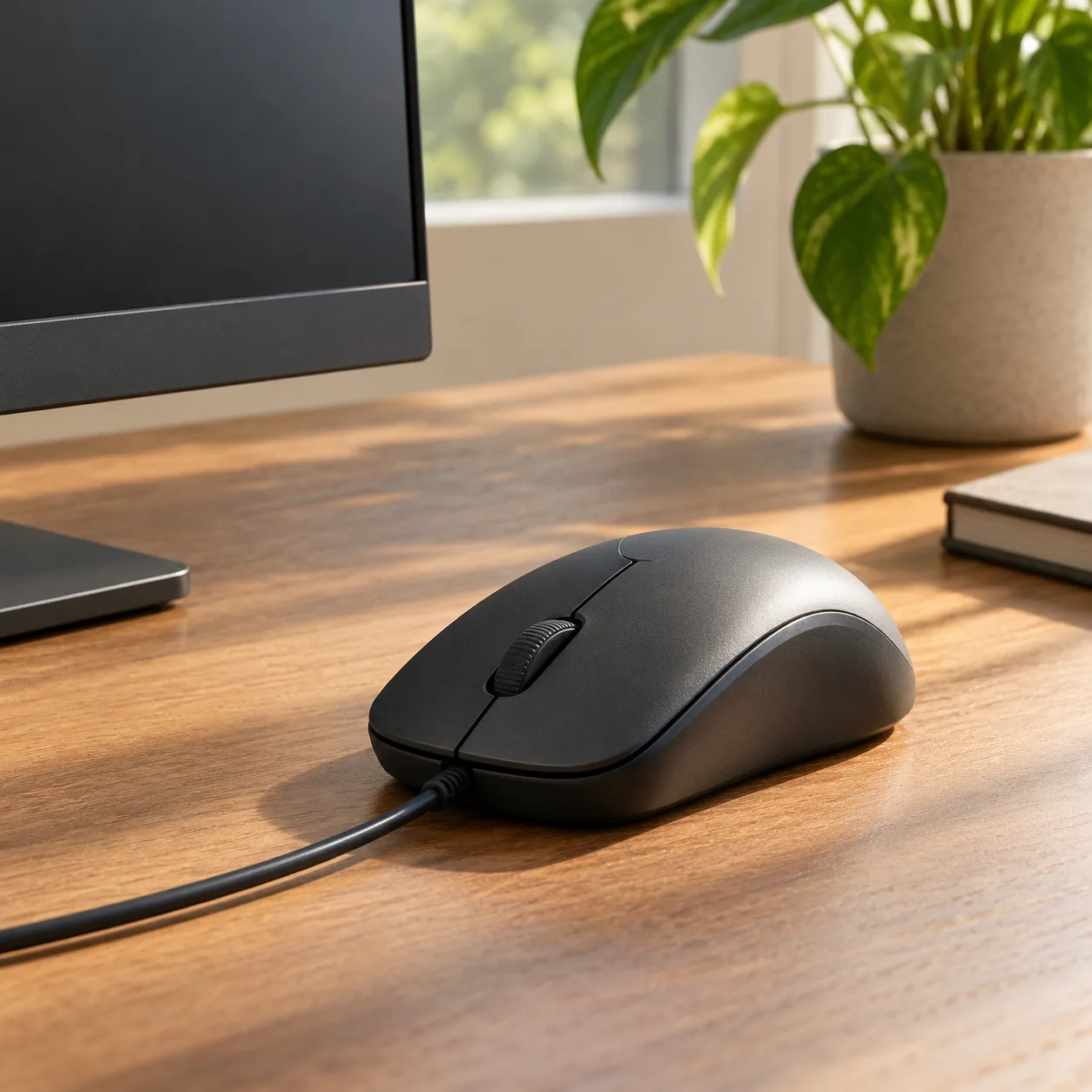
Generated interpretation, not documentary evidence. Generated contemporary wired mouse on an imagined desk; not Engelbart’s prototype, a specific branded product or an internal-mechanism diagram.
Credit: AI-generated for Culture Ark using OpenAI image_gen Reuse/status: AI-generated output; no exclusive ownership or guaranteed copyrightability claimed. Underlying works, marks and cultural permissions remain separate. Generated contemporary wired mouse on an imagined desk; not Engelbart’s prototype, a specific branded product or an internal-mechanism diagram. The original 1964 date compresses conception, design, prototype and demonstration milestones; CHM dates Engelbart’s first design to 1963. This is cultural interface history, not a circuit design or claim that the mouse was everyone’s access method.
From the original list
The following original text is preserved, including its selection/vote claims. Preservation is not independent verification of every assertion.
Why: Point and click: how people talked to computers.
What to preserve: Engelbart's wooden prototype, the Mother of All Demos, optical mice
Year and origin: 1964 · United States
Vote: 6/9 (historian 2 · future kid 2 · curator 2)
Learn more: Computer mouse on Wikipedia
Supplemental context
The computer mouse translates a movement across a surface into control of a screen. The Computer History Museum places it within a longer family of pointing devices rather than treating it as an isolated miracle. Its account credits Bill English with building Engelbart’s wooden prototype and describes independent work at Germany’s Telefunken, whose rolling-ball design was reported in 1968. SRI supplied three-button mice for Engelbart’s celebrated demonstration that year. These details help future readers understand that familiar interfaces grew through teams, competing approaches and repeated redesign. The mouse also made pointing, selecting and clicking into learned everyday gestures, while variations in shape and control methods remind us that a standard interface does not suit every body.
Creator/community: Douglas Engelbart, Bill English and SRI colleagues; parallel Telefunken development and later interface designers Place/era: United States and Germany, 1960 s; later international desktop computing
Context and limits
The original 1964 date compresses conception, design, prototype and demonstration milestones; CHM dates Engelbart’s first design to 1963. This is cultural interface history, not a circuit design or claim that the mouse was everyone’s access method.
Where to learn more
- https://apiarybee.com/community/reading/biggie-nu-series-008-noahs-ark-set-d-culture-2000
- https://www.computerhistory.org/revolution/story/350
Apiary library | Original Culture Ark article
Public ID and individual routes: pending publisher allocation. Internal source ID: D-1262
Part of the Culture Ark: 2,000 things people should still be able to see in 2,000 years, picked by AI research teams. This page keeps the original list entry for D-1262 word for word and adds context. Browse the gallery. The Culture Ark is an Artificial Mind Hive (AMH) project. AMH is owned by Austin Little.

Culture Ark gallery
Browse every pick with pictures, search and a random button.
Open the gallery →