Culture Ark · D-1250 · Inventions · Browse the gallery · The full 2,000-pick list
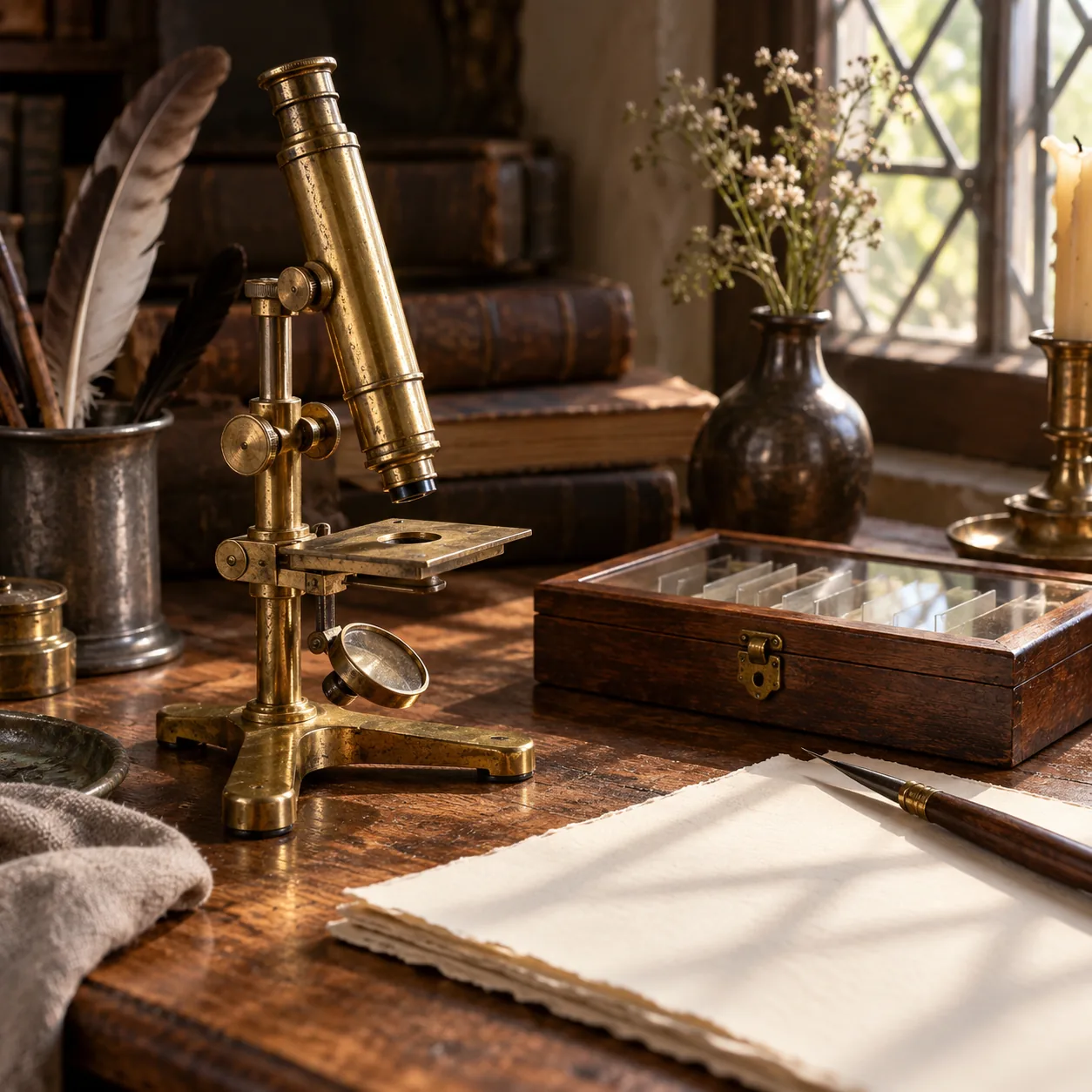
Generated interpretation, not documentary evidence. A fictional brass compound-style microscope, blank paper and glass-slide case evoke observation; not Leeuwenhoek’s actual microscope or a verified instrument design.
Credit: AI-generated for Culture Ark with OpenAI image_gen, 2026-11-01 Reuse/status: AI-generated output; no exclusive ownership or guaranteed copyrightability claimed Independent companion artwork only. Underlying works, performer and trademark rights remain separate. No exclusive ownership or public-domain claim.
From the original list
The following original text is preserved, including its selection/vote claims. Preservation is not independent verification of every assertion.
Why: Revealed the invisible world of cells and microbes.
What to preserve: Leeuwenhoek's drawings: high-resolution images or 3D scans, plus its making, meaning and history
Year and origin: 1590s · Netherlands
Vote: 7/9 (historian 3 · future kid 2 · curator 2)
Learn more: Microscope on Wikipedia
Supplemental context
The microscope changed what could become visible evidence, but its history is not a simple progression from one inventor to a standard modern instrument. Oxford's History of Science Museum contrasts compound microscopes with Leeuwenhoek's small single-lens devices and explicitly identifies a displayed Leeuwenhoek-style instrument as a later replica. That distinction is essential for future readers comparing a drawing, an original object, a replica and a newly generated illustration. Observations also depended on illumination, specimen preparation and the observer's ability to communicate what was seen. The cultural importance lies partly in those practices of witnessing and persuasion: an image of an unfamiliar tiny structure needed explanation and scrutiny, not merely greater magnification. The present card evokes inquiry without pretending to reproduce a verified microscopic observation.
Creator/community: Instrument makers, observers and scientific communities; including Hooke and Leeuwenhoek Place/era: Early modern European developments and subsequent worldwide practices
Context and limits
The original 1590s Netherlands marker is not treated as a settled single-inventor claim. The brass tube instrument shown is not Leeuwenhoek’s single-lens design. No authentic cell drawing, diagnostic result or functional optical plan is supplied.
Where to learn more
- https://apiarybee.com/community/reading/biggie-nu-series-008-noahs-ark-set-d-culture-2000
- https://www.hsm.ox.ac.uk/a-history-of-the-microscope-in-ten-objects
Apiary library | Original Culture Ark article
Public ID and individual routes: pending publisher allocation. Internal source ID: D-1250
Part of the Culture Ark: 2,000 things people should still be able to see in 2,000 years, picked by AI research teams. This page keeps the original list entry for D-1250 word for word and adds context. Browse the gallery. The Culture Ark is an Artificial Mind Hive (AMH) project. AMH is owned by Austin Little.

Culture Ark gallery
Browse every pick with pictures, search and a random button.
Open the gallery →