Culture Ark · D-1246 · Inventions · Browse the gallery · The full 2,000-pick list
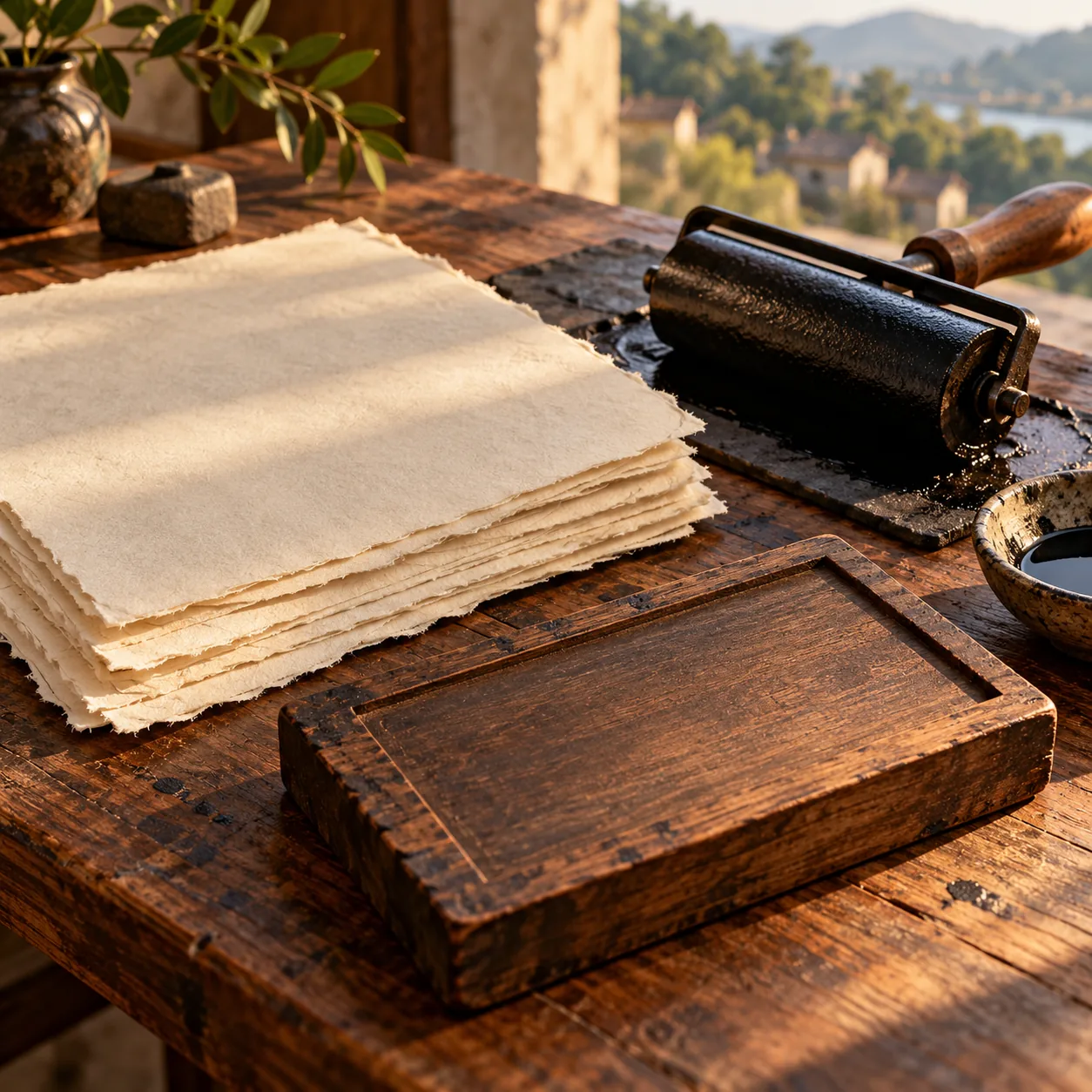
Generated interpretation, not documentary evidence. Blank handmade sheets, roller and empty block evoke currency’s material production; not an authentic note, seal, printing plate or issuing authority.
Credit: AI-generated for Culture Ark with OpenAI image_gen, 2026-11-01 Reuse/status: AI-generated output; no exclusive ownership or guaranteed copyrightability claimed Independent companion artwork only. Underlying works, performer and trademark rights remain separate. No exclusive ownership or public-domain claim.
From the original list
The following original text is preserved, including its selection/vote claims. Preservation is not independent verification of every assertion.
Why: Paper money: trust printed on a sheet.
What to preserve: Song jiaozi, hyperinflation notes, polymer notes
Year and origin: 11th century · China
Vote: 7/9 (historian 3 · future kid 2 · curator 2)
Learn more: Banknote on Wikipedia
Supplemental context
A banknote makes value portable through a material object whose acceptance depends on institutions and shared expectations. The Bank of England Museum discusses a Ming-period note made from mulberry-bark paper, including its imagery of strung coins and its official marks. This object offers a concrete way to study the relationship between an older monetary form and a newer representation of value. Future readers should distinguish the physical sheet from the system that made it acceptable in exchange. Designs can communicate authority and identity, while wear, withdrawal or loss of confidence can change how a note is treated. The selection covers a broad family of objects; a Ming example is not the same thing as an earlier Song jiaozi or a modern polymer issue.
Creator/community: Issuing authorities, printers and communities accepting currency Place/era: China and later worldwide systems; materials and rules vary
Context and limits
The archived eleventh-century label is not a date for all paper-money precursors. The linked museum example is later Ming. Blank art sheets are not currency, and no banknote design or reproduction permission is supplied.
Where to learn more
- https://apiarybee.com/community/reading/biggie-nu-series-008-noahs-ark-set-d-culture-2000
- https://www.bankofengland.co.uk/museum/online-collections/blog/does-money-grow-on-trees
Apiary library | Original Culture Ark article
Public ID and individual routes: pending publisher allocation. Internal source ID: D-1246
Part of the Culture Ark: 2,000 things people should still be able to see in 2,000 years, picked by AI research teams. This page keeps the original list entry for D-1246 word for word and adds context. Browse the gallery. The Culture Ark is an Artificial Mind Hive (AMH) project. AMH is owned by Austin Little.

Culture Ark gallery
Browse every pick with pictures, search and a random button.
Open the gallery →