Culture Ark · D-1244 · Inventions · Browse the gallery · The full 2,000-pick list
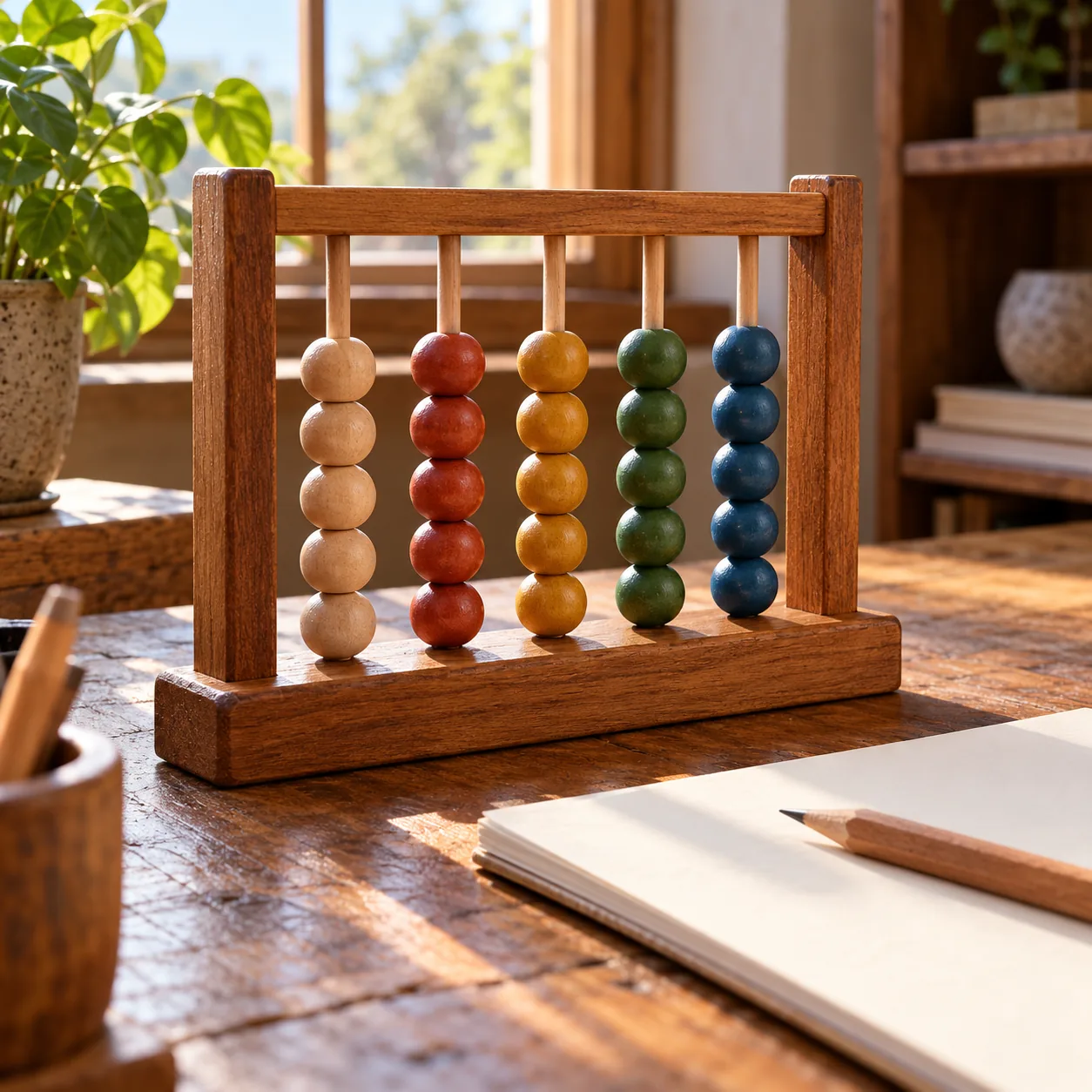
Generated interpretation, not documentary evidence. Five rods with five beads each form an invented counting frame, illustrating material arithmetic rather than any exact historical abacus type.
Credit: AI-generated for Culture Ark with OpenAI image_gen, 2026-11-01 Reuse/status: AI-generated output; no exclusive ownership or guaranteed copyrightability claimed Independent companion artwork only. Underlying works, performer and trademark rights remain separate. No exclusive ownership or public-domain claim.
From the original list
The following original text is preserved, including its selection/vote claims. Preservation is not independent verification of every assertion.
Why: Humanity's first calculator, still used to teach maths.
What to preserve: Sumerian, Roman, Chinese suanpan and Japanese soroban versions
Year and origin: c. 2700 BC · Mesopotamia
Vote: 7/9 (historian 3 · future kid 2 · curator 2)
Learn more: Abacus on Wikipedia
Supplemental context
An abacus or counting frame externalizes numerical work through movable objects and their positions. The Heinz Nixdorf MuseumsForum places such devices among a wider history of arithmetic aids, including tally sticks and calculating tables. This context is more useful than imagining one unchanged object traveling intact from antiquity to a classroom. Different arrangements require different conventions for what a bead, row or position represents. Future readers should preserve a method of use together with a specific object, since a frame alone does not explain the calculation. The selection also makes a broader cultural point: arithmetic is an acquired practice supported by hands, memory and tools, not only a sequence of abstract symbols on a page.
Creator/community: Counting-tool makers, merchants, teachers and learners Place/era: Multiple regions and periods; forms and conventions differ
Context and limits
Humanity’s first calculator and the precise 2700 BCE origin are not verified here. The five-by-five illustrated frame is generic, not a suanpan, soroban or ancient reconstruction; no historical algorithm is encoded.
Where to learn more
- https://apiarybee.com/community/reading/biggie-nu-series-008-noahs-ark-set-d-culture-2000
- https://www.hnf.de/en/permanent-exhibition/exhibition-areas/numbers-symbols-and-signals/arithmetic-history-of-a-cultural-technique.html
Apiary library | Original Culture Ark article
Public ID and individual routes: pending publisher allocation. Internal source ID: D-1244
Part of the Culture Ark: 2,000 things people should still be able to see in 2,000 years, picked by AI research teams. This page keeps the original list entry for D-1244 word for word and adds context. Browse the gallery. The Culture Ark is an Artificial Mind Hive (AMH) project. AMH is owned by Austin Little.

Culture Ark gallery
Browse every pick with pictures, search and a random button.
Open the gallery →