Culture Ark · D-1241 · Inventions · Browse the gallery · The full 2,000-pick list
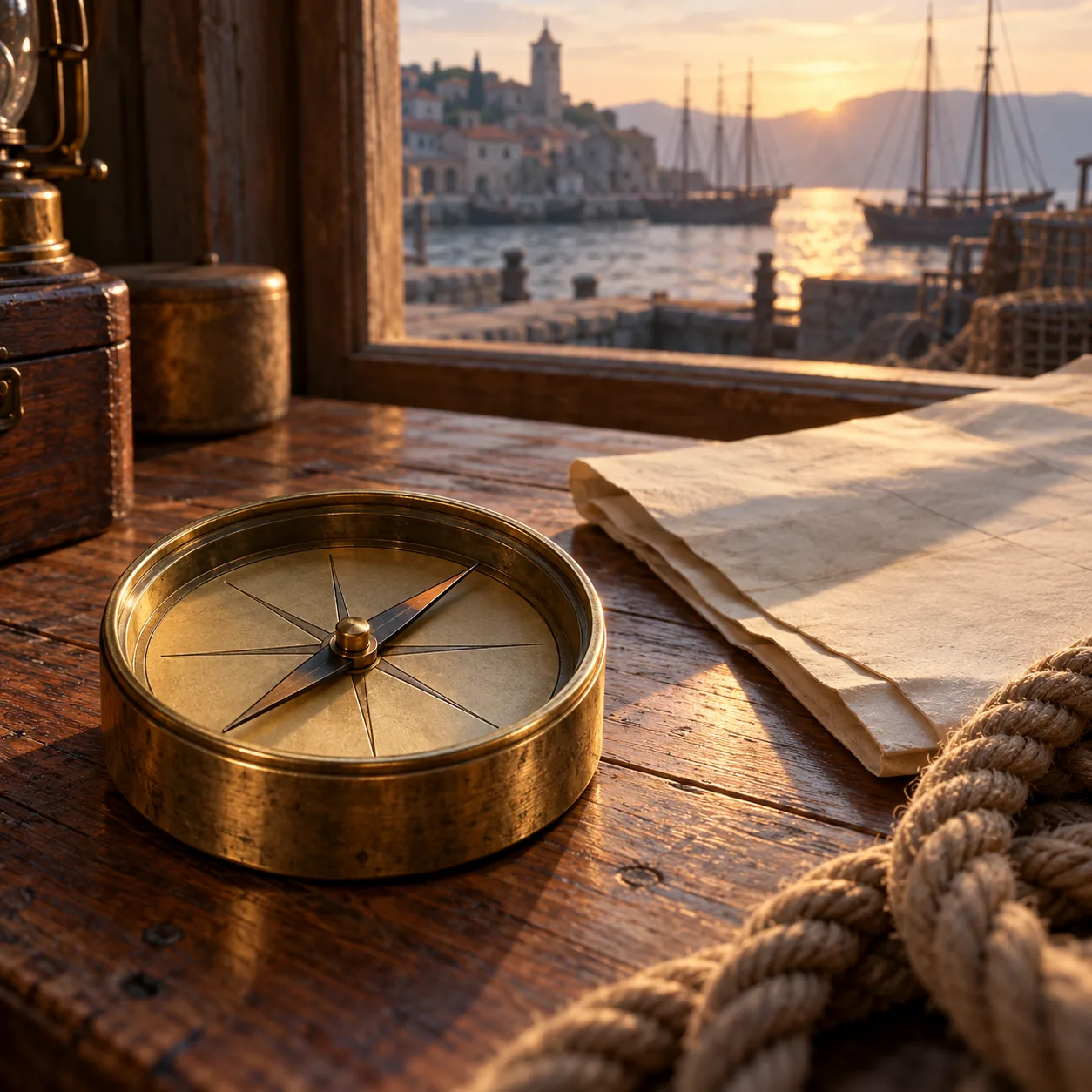
Generated interpretation, not documentary evidence. An invented brass compass beside blank folded paper and rope evokes navigation; not a calibrated instrument, authentic chart or Chinese lodestone spoon.
Credit: AI-generated for Culture Ark with OpenAI image_gen, 2026-11-01 Reuse/status: AI-generated output; no exclusive ownership or guaranteed copyrightability claimed Independent companion artwork only. Underlying works, performer and trademark rights remain separate. No exclusive ownership or public-domain claim.
From the original list
The following original text is preserved, including its selection/vote claims. Preservation is not independent verification of every assertion.
Why: A magnetized needle let people cross oceans without seeing land.
What to preserve: Lodestone spoon, ship compass, how magnetism points north
Year and origin: 11th century · China
Vote: 7/9 (historian 3 · future kid 2 · curator 2)
Learn more: Compass on Wikipedia
Supplemental context
The magnetic compass belongs to a long history of people turning observations of natural materials into dependable practices. The Mariners' Museum describes the development from lodestones to pivoted needles and compass cards, while its collection places particular surviving instruments in later maritime settings. A compass supplies directional information; it does not by itself reveal a ship's complete position, destination or safe route. For future readers the cultural lesson concerns learned cooperation between an object, a chart and an experienced navigator. Ocean travel also depended on other skills and traditions, including systems that did not use magnetic compasses. Keeping those distinctions prevents one useful device from becoming a simplistic explanation for all navigation or global contact.
Creator/community: Instrument makers and navigators across several societies Place/era: Chinese early compass traditions; later maritime developments
Context and limits
The eleventh-century China marker is a broad historical association, not the date of the illustrated object. Magnetic north and geographic north are not interchangeable; local interference matters. Not a navigation guide.
Where to learn more
- https://apiarybee.com/community/reading/biggie-nu-series-008-noahs-ark-set-d-culture-2000
- https://exploration.marinersmuseum.org/object/compass/
- https://www.rmg.co.uk/collections/objects/rmgc-object-7116
Apiary library | Original Culture Ark article
Public ID and individual routes: pending publisher allocation. Internal source ID: D-1241
Part of the Culture Ark: 2,000 things people should still be able to see in 2,000 years, picked by AI research teams. This page keeps the original list entry for D-1241 word for word and adds context. Browse the gallery. The Culture Ark is an Artificial Mind Hive (AMH) project. AMH is owned by Austin Little.

Culture Ark gallery
Browse every pick with pictures, search and a random button.
Open the gallery →