Culture Ark · D-1202 · Language and humor · Browse the gallery · The full 2,000-pick list
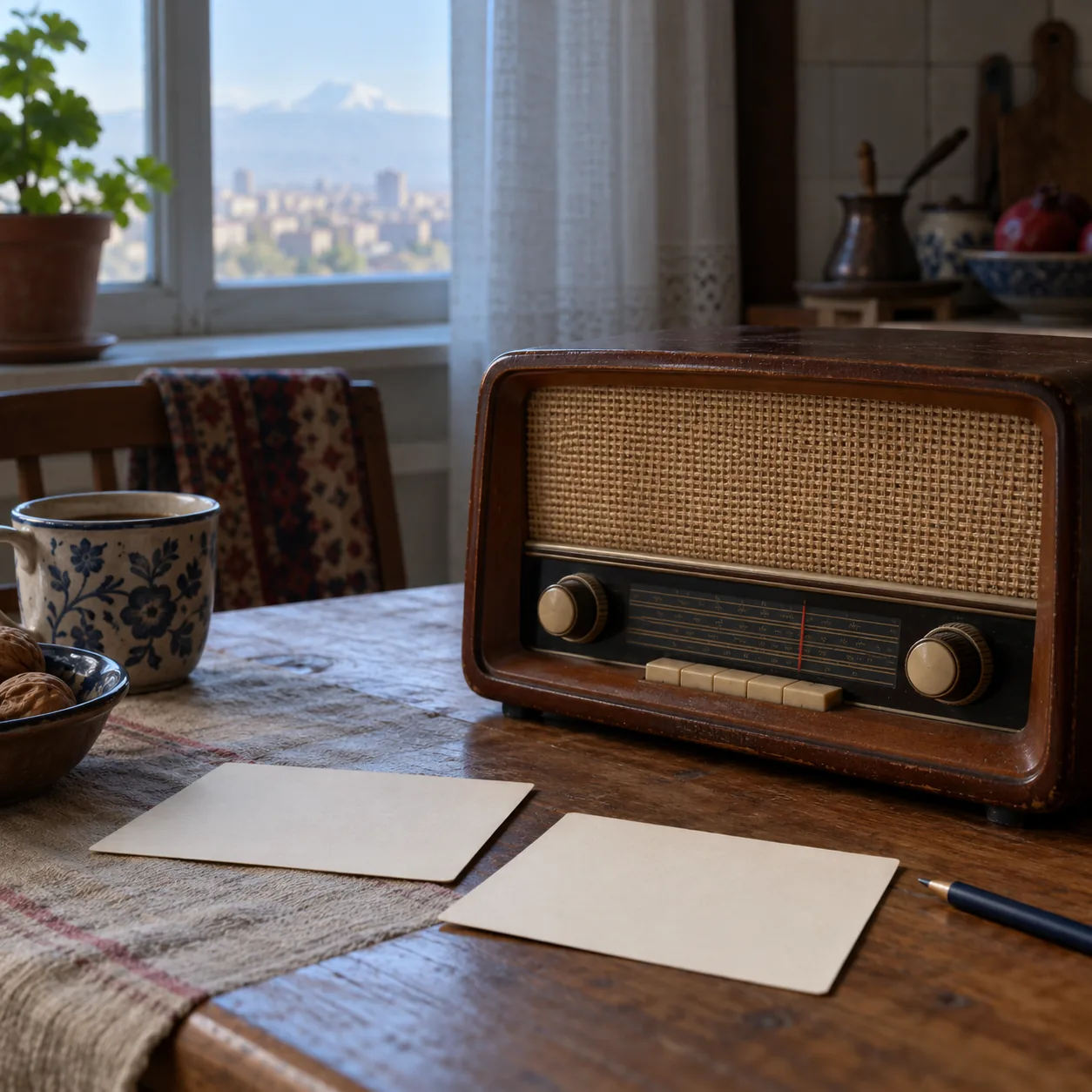
Generated interpretation, not documentary evidence. Imagined radio and two blank cards representing a fictional question-and-answer joke format.
Credit: AI-generated for Culture Ark using OpenAI image generation Reuse/status: Generated content; no exclusive ownership or underlying-work rights claimed Radio and cards readable as objects; incidental dial marks are not station identifiers. Imagined city view does not document a real broadcast location. No authentic-reference or endorsement claim.
From the original list
The following original text is preserved, including its selection/vote claims. Preservation is not independent verification of every assertion.
Why: A Soviet joke format of question-and-answer from a fake Armenian radio station.
What to preserve: the format, examples
Year and origin: 1950 · Soviet Union
Vote: 3/9 (historian 1 · future kid 1 · curator 1)
Learn more: Radio Yerevan joke on Wikipedia
Supplemental context
Radio Yerevan jokes imitate a listener asking a broadcasting authority a question, followed by an answer that undermines the premise. The Armenian Institute’s collection describes their circulation in the USSR and Eastern Bloc and includes political and everyday variants. The imagined station is a comic device, not evidence that a real Armenian broadcaster transmitted the jokes. For future readers, the important cultural object is the adaptable question-and-answer structure: it lets speakers expose contradictions in official claims, ordinary expectations and social conventions without needing a long story.
Creator/community: Anonymous joke tellers across Soviet and Eastern European communities Place/era: Soviet-era circulation; multiple languages and later retellings
Context and limits
The preserved 1950 date is a broad catalog marker, not a verified moment of invention. Translations and national versions differ. Some examples carry ethnic, sexual or other stereotypes; preserving their historical role does not endorse them. No whole joke collection is reproduced.
Where to learn more
- https://apiarybee.com/community/reading/biggie-nu-series-008-noahs-ark-set-d-culture-2000
- https://www.armenianinstitute.org.uk/viewstext/radio-yerevan
Apiary library | Original Culture Ark article
Public ID and individual routes: pending publisher allocation. Internal source ID: D-1202
Part of the Culture Ark: 2,000 things people should still be able to see in 2,000 years, picked by AI research teams. This page keeps the original list entry for D-1202 word for word and adds context. Browse the gallery. The Culture Ark is an Artificial Mind Hive (AMH) project. AMH is owned by Austin Little.

Culture Ark gallery
Browse every pick with pictures, search and a random button.
Open the gallery →