Culture Ark · D-1195 · Language and humor · Browse the gallery · The full 2,000-pick list
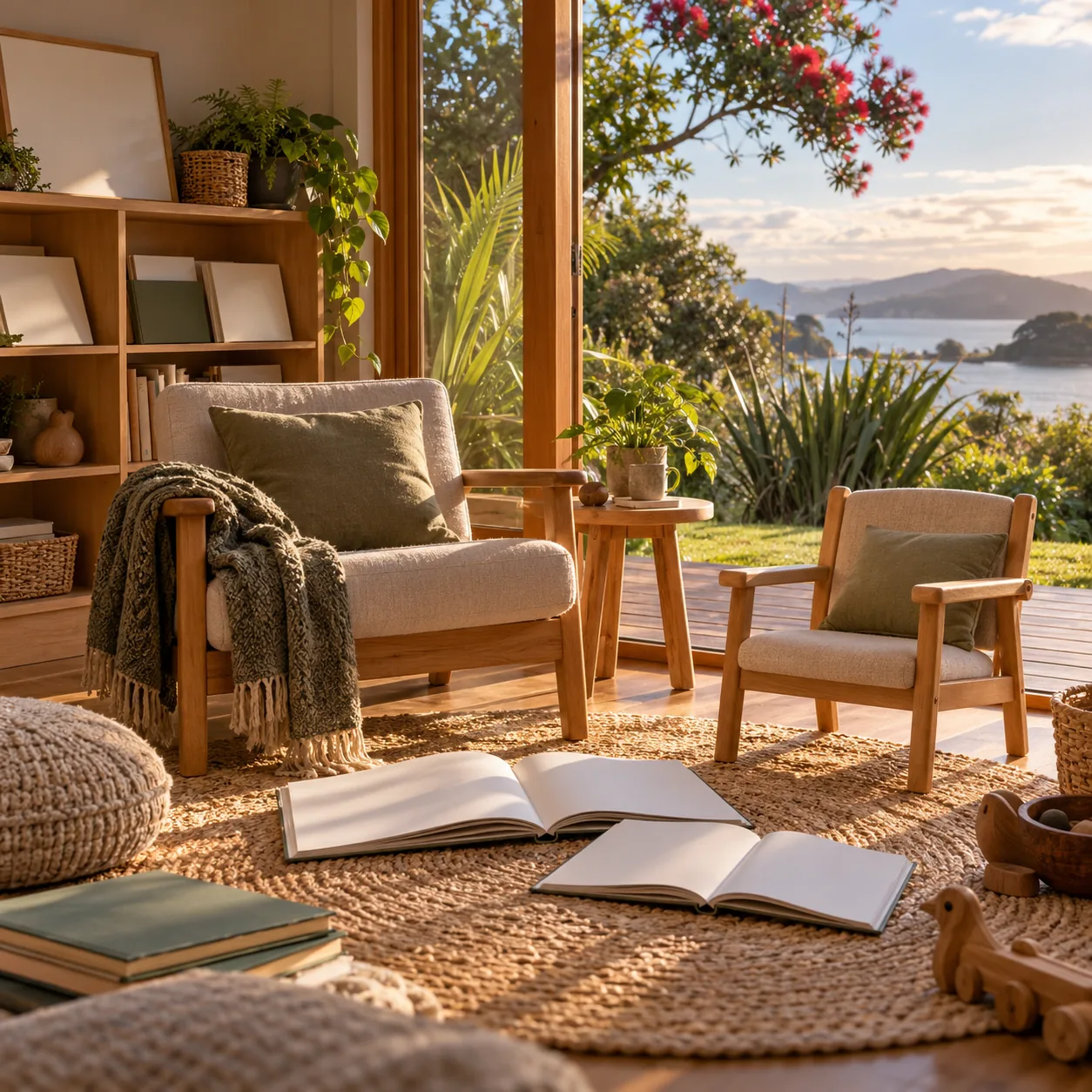
Generated interpretation, not documentary evidence. Adult and child-sized chairs with blank books evoke intergenerational learning in an invented room; not a documentary kōhanga reo.
Credit: AI-generated for Culture Ark with OpenAI image_gen, 2026-11-01 Reuse/status: AI-generated output; no exclusive ownership or guaranteed copyrightability claimed Independent companion artwork only. Underlying works, performer and trademark rights remain separate. No exclusive ownership or public-domain claim.
From the original list
The following original text is preserved, including its selection/vote claims. Preservation is not independent verification of every assertion.
Why: Bringing te reo Māori back from decline.
What to preserve: kohanga reo
Year and origin: 1970 · New Zealand
Vote: 4/9 (historian 1 · future kid 1 · curator 2)
Learn more: Māori language revival on Wikipedia
Supplemental context
Māori language revitalization is a collective process of restoring opportunities for te reo Māori to be spoken, learned and passed between generations. Te Kōhanga Reo National Trust's own history emphasizes whānau responsibility and language immersion, with the first kōhanga reo opening at Pukeatua in Wainuiomata in 1982. This gives substance to the language-nest metaphor: language is sustained in relationships and daily activity, not only through dictionaries or ceremonial recognition. Future readers should understand the movement as community agency rather than an outside rescue of a passive culture. The Trust also describes its institutional development and negotiations with the Crown, showing that education, governance and cultural transmission cannot simply be separated. The selection concerns an ongoing movement, not a revival completed on one date.
Creator/community: Māori whānau, kaumātua, educators and language advocates Place/era: Aotearoa New Zealand; ongoing revival, first kōhanga reo opened 1982
Context and limits
The archived 1970 marker is not the opening date of kōhanga reo. The card depicts a fictional learning space, not a real kōhanga reo, curriculum, ceremony or sacred design.
Where to learn more
- https://apiarybee.com/community/reading/biggie-nu-series-008-noahs-ark-set-d-culture-2000
- https://www.kohanga.ac.nz/kaupapa/te-oorokohanganga
Apiary library | Original Culture Ark article
Public ID and individual routes: pending publisher allocation. Internal source ID: D-1195
Part of the Culture Ark: 2,000 things people should still be able to see in 2,000 years, picked by AI research teams. This page keeps the original list entry for D-1195 word for word and adds context. Browse the gallery. The Culture Ark is an Artificial Mind Hive (AMH) project. AMH is owned by Austin Little.

Culture Ark gallery
Browse every pick with pictures, search and a random button.
Open the gallery →