Culture Ark · D-1157 · Language and humor · Browse the gallery · The full 2,000-pick list
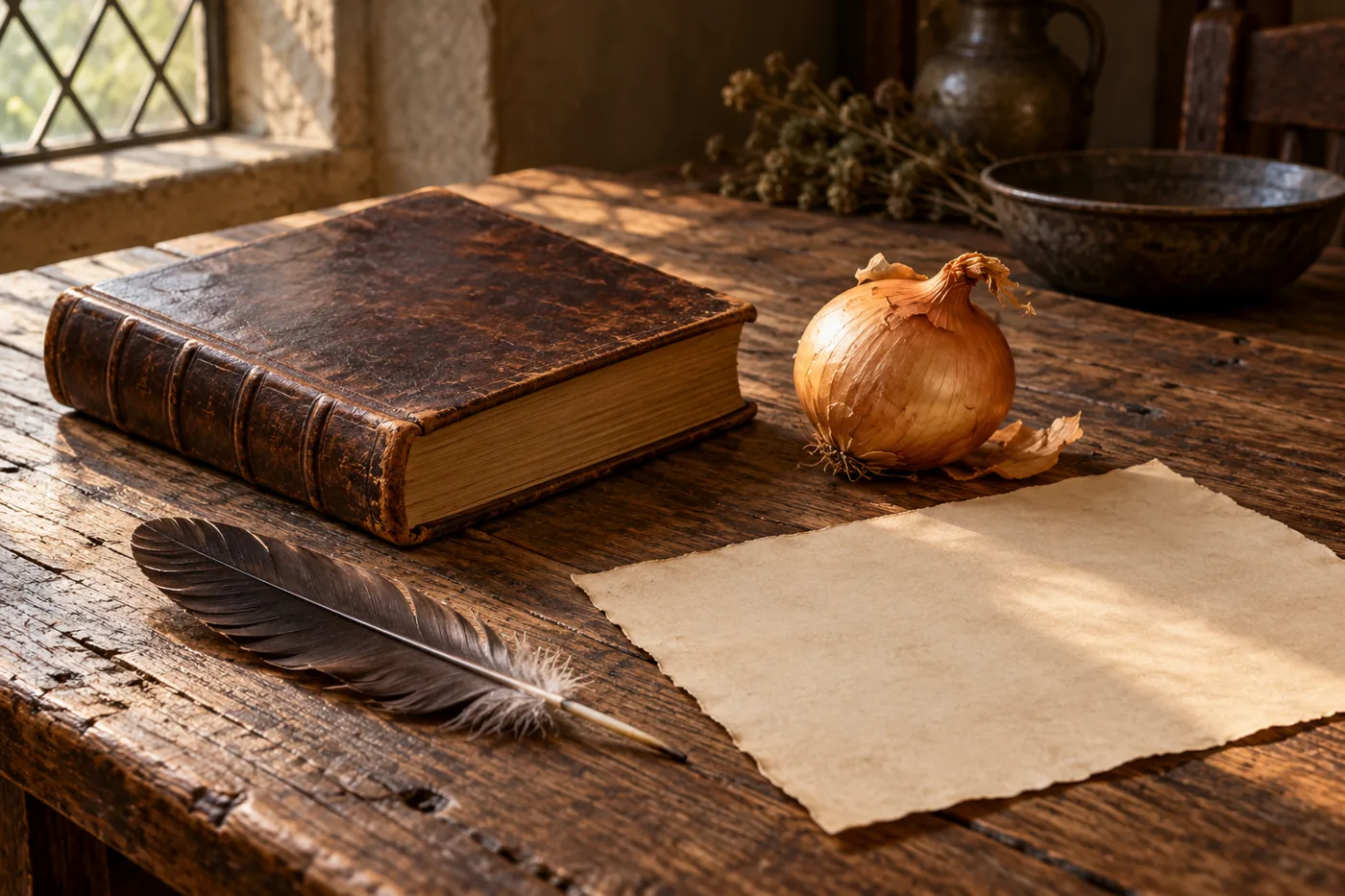
Generated interpretation, not documentary evidence. AI-generated still life evoking books and ordinary things in riddles; not the Exeter manuscript, its historical binding or a riddle answer key.
Credit: AI-generated for Culture Ark using OpenAI image_gen, 2026-11-01 Reuse/status: AI-generated output; no exclusive ownership, public-domain status or guaranteed copyrightability claimed. Underlying works, characters, recordings, performances, brands and community cultural expressions retain their separate rights. All props and the room are invented. The feather is not an identified species specimen, the sheet contains no manuscript script, and the scene does not reconstruct the book's place of production.
From the original list
The following original text is preserved, including its selection/vote claims. Preservation is not independent verification of every assertion.
Why: A tenth-century book with nearly 100 Old English riddles, some cheeky.
What to preserve: the riddles
Year and origin: 975 · England
Vote: 4/9 (historian 1 · future kid 1 · curator 2)
Learn more: Exeter Book on Wikipedia
Supplemental context
The Exeter Book preserves more than a collection of jokes. Its custodian describes a manuscript copied by a single scribe around 970, containing religious and reflective poems as well as just under a hundred riddles. The riddles can be thoughtful, playful or bawdy; ordinary things become unfamiliar through voice, metaphor and misdirection. Exeter Cathedral's account mentions objects and creatures including an onion, a magpie and a book. Culture Ark could preserve selected riddles with their Old English text, a credited translation and an explanation of uncertain solutions. That would let future readers encounter the puzzle before receiving an answer, rather than reducing the manuscript to a list of curiosities.
Creator/community: Old English poets and an unidentified manuscript scribe; Exeter Cathedral as custodian Place/era: England; manuscript copied about 970 according to Exeter Cathedral, at Exeter since 1072
Context and limits
The original 975 is retained, but the custodian gives an approximate manuscript date, not a precise year for every poem. The copying place and scribe's identity are uncertain. Not all riddles are bawdy, and translation can alter a double meaning. No digitized manuscript page or original binding was inspected here.
Where to learn more
- https://apiarybee.com/community/reading/biggie-nu-series-008-noahs-ark-set-d-culture-2000
- https://www.exeter-cathedral.org.uk/interpretation/codex-exoniensis/
- https://en.wikipedia.org/wiki/Exeter_Book
Apiary library | Original Culture Ark article
Public ID and individual routes: pending publisher allocation. Internal source ID: D-1157
Part of the Culture Ark: 2,000 things people should still be able to see in 2,000 years, picked by AI research teams. This page keeps the original list entry for D-1157 word for word and adds context. Browse the gallery. The Culture Ark is an Artificial Mind Hive (AMH) project. AMH is owned by Austin Little.

Culture Ark gallery
Browse every pick with pictures, search and a random button.
Open the gallery →