Culture Ark · D-1141 · Language and humor · Browse the gallery · The full 2,000-pick list
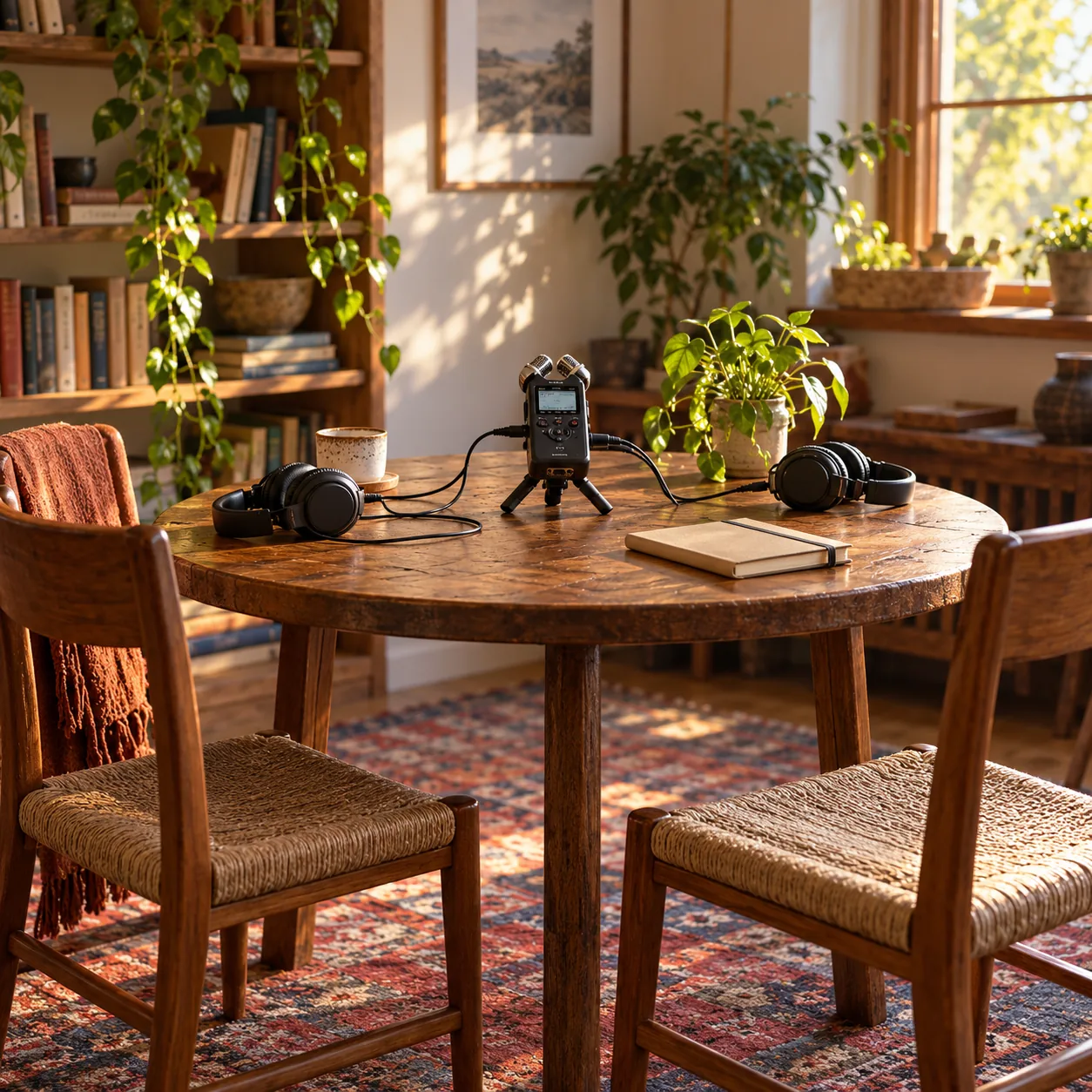
Generated interpretation, not documentary evidence. Invented contemporary recording table with two chairs, recorder, headphones and notebook; not a particular community or documentation session.
Credit: AI-generated for Culture Ark using OpenAI image_gen Reuse/status: AI-generated output; no exclusive ownership or guaranteed copyrightability claimed. Underlying works, marks and cultural permissions remain separate. Invented contemporary recording table with two chairs, recorder, headphones and notebook; not a particular community or documentation session. The original 1990 date is not a beginning of language endangerment. Its half-of-languages prediction lacks a stated baseline or time horizon. UNESCO’s cited estimate concerns languages spoken in 2016, not an inevitable forecast. Respect speaker consent, access restrictions and community governance; Indigenous and endangered are not interchangeable categories.
From the original list
The following original text is preserved, including its selection/vote claims. Preservation is not independent verification of every assertion.
Why: Half the world's languages may vanish.
What to preserve: lists, recordings
Year and origin: 1990 · Worldwide
Vote: 5/9 (historian 2 · future kid 1 · curator 2)
Learn more: Endangered language on Wikipedia
Supplemental context
An endangered language is not simply a rare object awaiting a museum case: it is a means through which people maintain relationships, knowledge and cultural expression. UNESCO’s account of the International Year of Indigenous Languages emphasizes transmission between generations and the importance of Indigenous leadership in revitalization. This selection therefore asks future readers to preserve the social setting of speech alongside recordings and word lists. Who chose what to record, who can listen, and who can teach it are important questions. A recording may support learning, but cannot by itself replace opportunities to speak at home, in education or in public life. The illustrated recording table represents that work without assigning an endangered status to any depicted community.
Creator/community: Language communities, speakers, educators and community-led documentation teams Place/era: Worldwide; continuing language transmission and revitalization
Context and limits
The original 1990 date is not a beginning of language endangerment. Its half-of-languages prediction lacks a stated baseline or time horizon. UNESCO’s cited estimate concerns languages spoken in 2016, not an inevitable forecast. Respect speaker consent, access restrictions and community governance; Indigenous and endangered are not interchangeable categories.
Where to learn more
- https://apiarybee.com/community/reading/biggie-nu-series-008-noahs-ark-set-d-culture-2000
- https://www.unesco.org/en/articles/international-year-indigenous-languages?hub=67103
Apiary library | Original Culture Ark article
Public ID and individual routes: pending publisher allocation. Internal source ID: D-1141
Part of the Culture Ark: 2,000 things people should still be able to see in 2,000 years, picked by AI research teams. This page keeps the original list entry for D-1141 word for word and adds context. Browse the gallery. The Culture Ark is an Artificial Mind Hive (AMH) project. AMH is owned by Austin Little.

Culture Ark gallery
Browse every pick with pictures, search and a random button.
Open the gallery →