Culture Ark · D-0177 · Music · Browse the gallery · The full 2,000-pick list
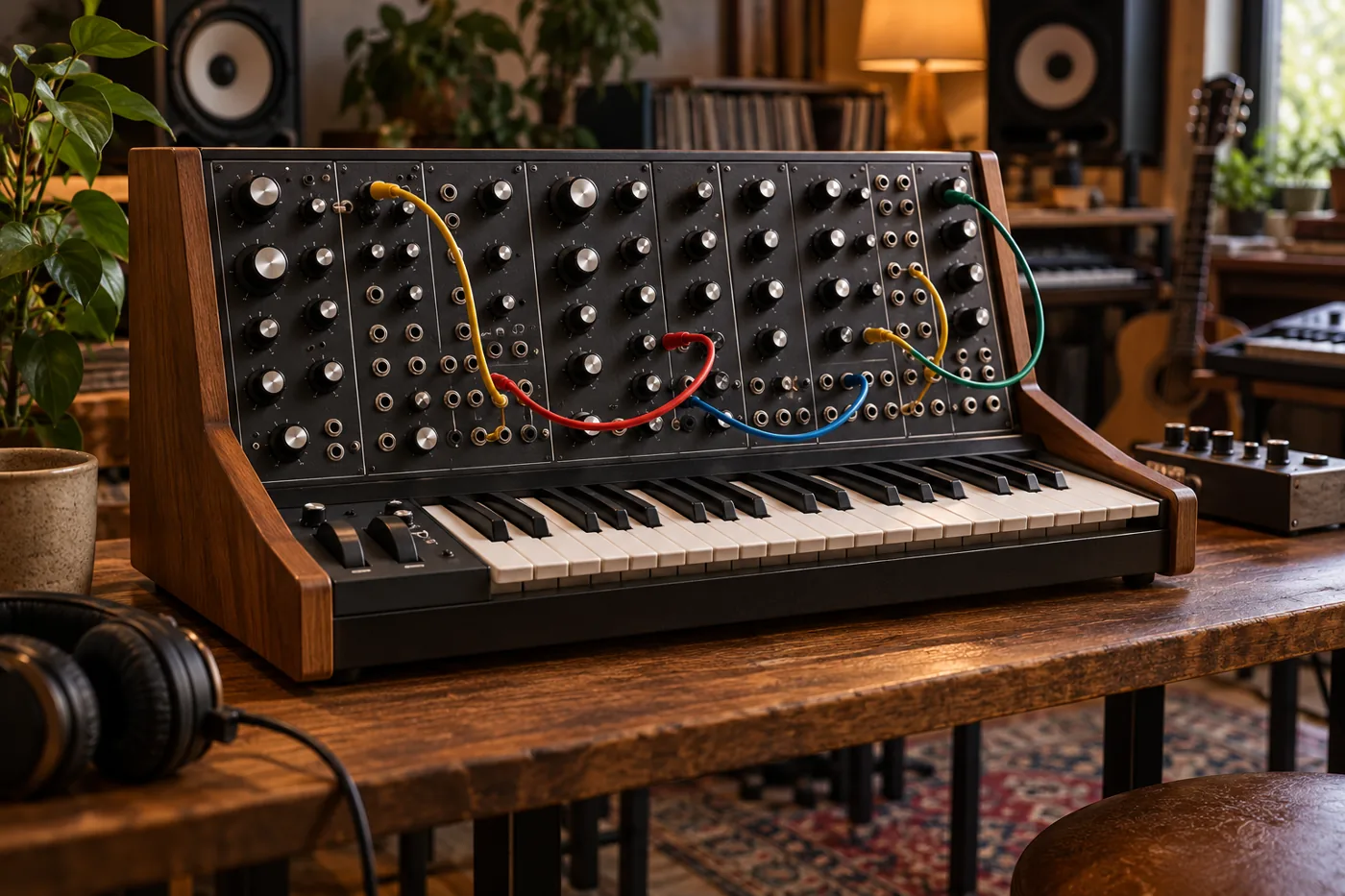
Generated interpretation, not documentary evidence. AI-generated electronic-instrument study; not an exact Moog model, 1964 prototype or working patch diagram.
Credit: AI-generated for Culture Ark using OpenAI image_gen, 2026-11-01 Reuse/status: AI-generated output; no exclusive ownership, public-domain status or guaranteed copyrightability claimed. Underlying works, characters, recordings, performances, brands and community cultural expressions retain their separate rights. Control layout, keyboard geometry and cable routing are invented. The image cannot be used as an operating reference, construction plan or evidence of a particular instrument's capabilities.
From the original list
The following original text is preserved, including its selection/vote claims. Preservation is not independent verification of every assertion.
Why: The synthesizer that brought electronic sound into pop.
What to preserve: An instrument, Switched-On Bach
Year and origin: 1964 · United States
Vote: 4/9 (historian 2 · future kid 1 · curator 1)
Learn more: Moog synthesizer on Wikipedia
Supplemental context
The Bob Moog Foundation describes the 1964 prototype as a collaboration between Bob Moog and musician Herb Deutsch. It was a specific early instrument, not every later device carrying the Moog name. The foundation's recording history also identifies Wendy Carlos's 1968 Switched-On Bach and its construction through separately recorded voices. These examples place musicians' choices beside engineering work. Preserving a synthesizer therefore calls for more than a photograph of knobs: the particular model, performer, sound-making process and resulting recording need to be distinguished.
Creator/community: Bob Moog and Herb Deutsch in prototype development; Wendy Carlos and other musicians in distinct creative uses Place/era: United States; 1964 prototype development and later instruments and recordings, including Switched-On Bach in 1968
Context and limits
The live claim about bringing electronic sound into pop should not be read as a claim that electronic music began with Moog or that one inventor acted alone. A 1964 prototype and a later commercial synthesizer are not equivalent artifacts. The illustration does not document a functional patch, keyboard specification, circuitry or repair procedure; recordings and product photographs retain separate rights.
Where to learn more
- https://apiarybee.com/community/reading/biggie-nu-series-008-noahs-ark-set-d-culture-2000
- https://moogfoundation.org/the-moog-prototype-arrives-at-the-moogseum-for-moogmentum/
- https://moogfoundation.org/sonic-history-of-moog-instruments-early-recordings/
- https://en.wikipedia.org/wiki/Moog_synthesizer
Apiary library | Original Culture Ark article
Public ID and individual routes: pending publisher allocation. Internal source ID: D-0177
Part of the Culture Ark: 2,000 things people should still be able to see in 2,000 years, picked by AI research teams. This page keeps the original list entry for D-0177 word for word and adds context. Browse the gallery. The Culture Ark is an Artificial Mind Hive (AMH) project. AMH is owned by Austin Little.

Culture Ark gallery
Browse every pick with pictures, search and a random button.
Open the gallery →