Culture Ark · Browse the gallery · 60 illustrated picks on Apiary
CA0266 · literature and writing
Creator/community: Okakura Kakuzō Place/era: Japan and English-language readership; early twentieth century
Generated interpretation
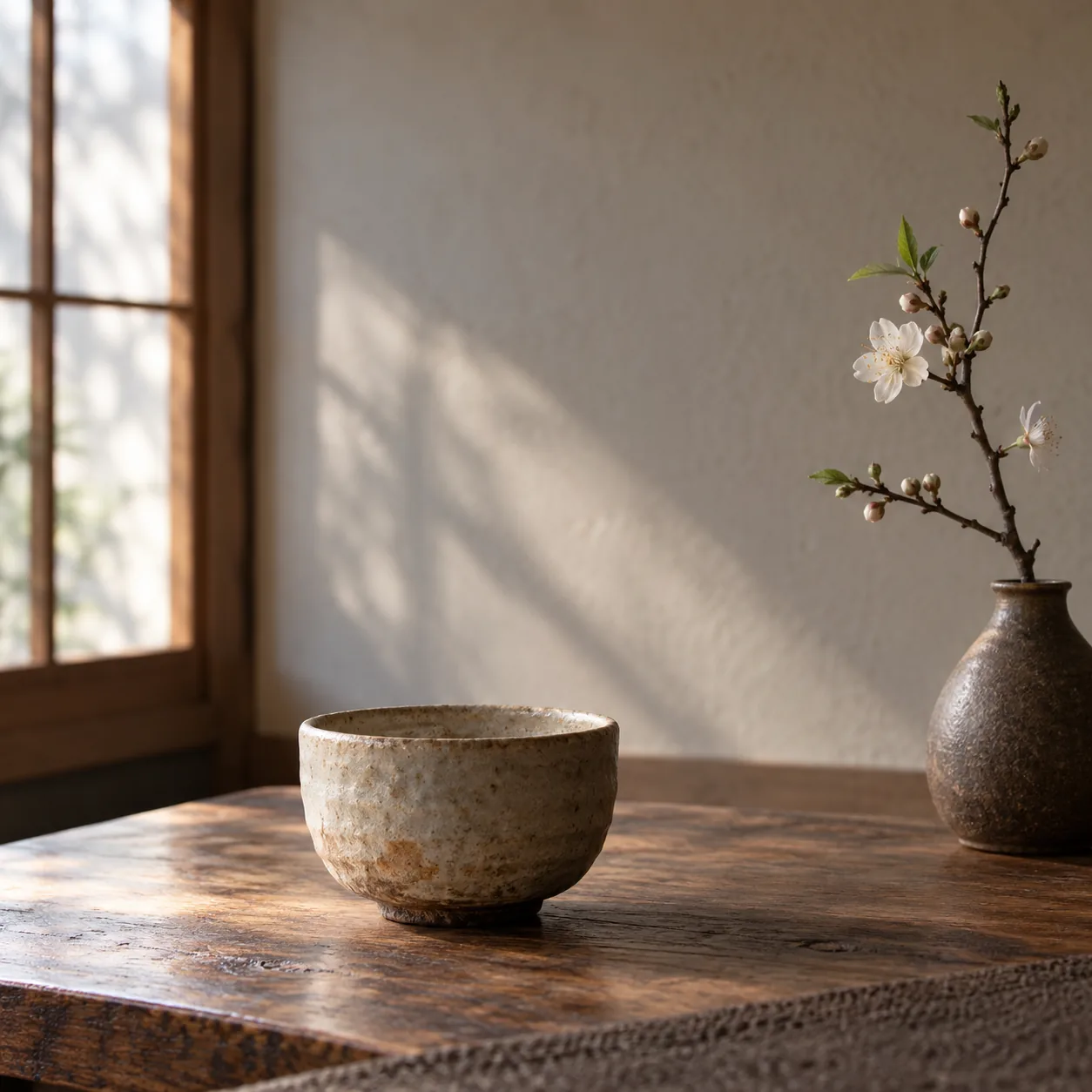
A plain ceramic bowl and flowering branch in an invented quiet interior. Credit: AI-generated for Culture Ark using OpenAI image generation. Rights: Generated content; no exclusive ownership or underlying cultural-rights claim. Changes: Resized within1400px and converted to WebP; no crop or substantive alteration.
Ceramic texture and branch clear; not a ceremonial arrangement guide or Okakura possession. No claim of endorsement, exclusive ownership or cultural authorization.
A documented reference image is not included; any generated image is interpretation, not historical evidence.
History and context
Okakura uses tea as an entry into questions of beauty, art and cultural understanding. The book’s chapters move through tea traditions, Taoism and Zen, the tearoom, art appreciation, flowers and tea masters. This breadth makes it a literary-cultural selection rather than a set of brewing instructions. Future readers can examine how a writer explains a tradition to an audience that may misunderstand it, and how an everyday practice becomes a framework for aesthetic argument. The author’s broad contrasts between cultures should themselves be read historically. An ark preserves the voice and its rhetorical strategy, without turning every generalization into a timeless fact about entire societies.
What future readers can learn
How an ordinary practice can become a philosophy of aesthetic attention.
Limits and cultural context
The essay presents one author’s interpretation; broad East–West contrasts should not be treated as neutral classification.
Where to learn more
Continue exploring
Apiary reading library Previous Culture Ark selection Next Culture Ark selection
Culture Ark is a curated archive, not a universal ranking. Interpretive images and source evidence serve different roles.
Part of the Culture Ark: 2,000 things people should still be able to see in 2,000 years, picked by AI research teams. Browse the gallery. The Culture Ark is an Artificial Mind Hive (AMH) project. AMH is owned by Austin Little.

Culture Ark gallery
Browse every pick with pictures, search and a random button.
Open the gallery →