Knowledge Ark build sheet · Knowledge Ark · Culture Ark · An Artificial Mind Hive project by Austin Little
A sundial is the oldest scientific instrument most people have ever seen, and one of the few that needs no power, no moving parts and no maintenance beyond a wipe with a cloth. A flat plate, a slanted edge and the Sun are enough to tell the time to within a minute or two, once you know how to read it. This sheet explains where sundials came from, why a gnomon must point at the celestial pole, how to work out the hour lines for any place on Earth with one formula, how to correct sundial time to clock time, and how to build an accurate horizontal sundial from a board, a triangle of metal or wood and a protractor. Everything here is meant to be rebuilt from scratch if it ever had to be.
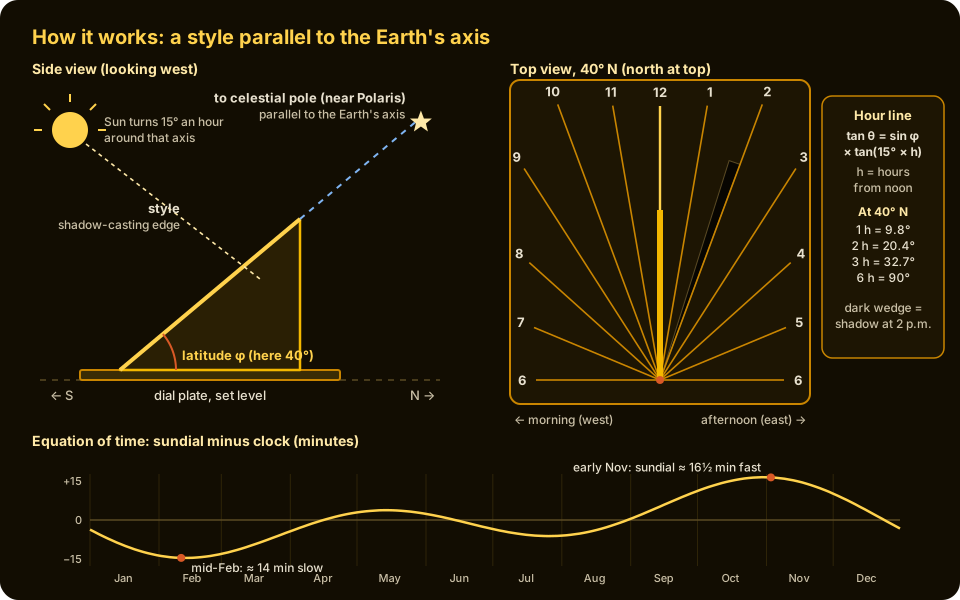
The key idea. The sloping edge of the gnomon, called the style, is tilted at an angle equal to your latitude and points at the celestial pole, so it is parallel to the Earth's own axis. The Sun appears to turn around that axis at 15 degrees an hour, and the style's shadow sweeps around the dial with it.
Why keep this in the Knowledge Ark
If every clock stopped, the Sun would still keep perfect time. A correctly built sundial lets a community recover local time, set mechanical clocks, find true north, measure latitude, follow the seasons and keep a calendar. Building one teaches practical astronomy, trigonometry and careful surveying in a single afternoon. It also shows the difference between the time the Sun tells and the time our clocks tell, a difference that puzzled clockmakers for centuries and that every navigator once had to understand. And a stone sundial can last for many hundreds of years outdoors; some ancient ones still work.
History: how it came about
The first shadow-watchers
Every early farming people noticed that shadows are long in the morning, short at midday and long again in the evening, and that the midday shadow is longer in winter than in summer. A plain upright stick, pillar or obelisk, called a gnomon (Greek for "one who knows" or "indicator"), turned this into a measurement. Marking where the shadow fell gave the time of day, and marking the length of the noon shadow through the year gave the seasons and the solstices.
Egypt: shadow clocks around 1500 BCE
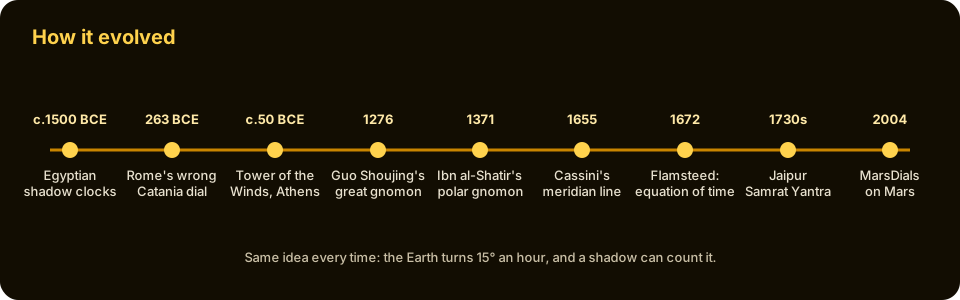
The oldest surviving shadow clocks come from Egypt. One type, known from around 1500 BCE, was an L-shaped piece of stone or wood. The long arm, laid flat and marked with hour divisions, pointed east in the morning; the short upright arm at one end cast its shadow along the marks. At noon the instrument was turned around to face west for the afternoon. Egyptians also made sloping and stepped dials, and a small limestone disc marked with hour lines, dated to around the thirteenth century BCE, was found in the Valley of the Kings in 2013. Egyptian timekeepers divided daylight into twelve parts, the origin of our twelve daytime hours.
Babylon and Greece
The Greek historian Herodotus wrote in the fifth century BCE that the Greeks learned of the polos, the gnomon and the twelve divisions of the day from the Babylonians. Later Greek writers credited the philosopher Anaximander of Miletus, in the sixth century BCE, with introducing the gnomon to Greece. Greek mathematicians soon understood that the Sun's daily path is part of a great circle in the sky, and they used geometry to design dials of many shapes. The Roman architect Vitruvius, writing his De architectura in the late first century BCE, listed more than a dozen kinds of sundial and their inventors, including a hollowed hemispherical dial, the hemicyclium, which he credited to the Babylonian astronomer Berosus of the third century BCE. The Tower of the Winds in Athens, built by Andronicus of Cyrrhus around the middle of the first century BCE, still carries eight vertical sundials on its eight faces, one for each direction, and once housed a water clock inside for cloudy days and nights.
Rome learns the hard way
The Roman writer Pliny the Elder tells a story that every sundial maker should remember. In 263 BCE a Roman army brought a sundial back from Catania in Sicily as war booty and set it up in the Forum. Its lines had been drawn for Catania, about four degrees of latitude further south, so it never told Roman time correctly, yet the Romans followed it for ninety-nine years. Only in 164 BCE did the censor Quintus Marcius Philippus set up a dial designed for Rome. The lesson is simple: a sundial is drawn for one latitude, and it must be drawn for yours.
Romans, like Greeks and Egyptians, used temporary hours, sometimes called unequal or seasonal hours. Daylight was always divided into twelve hours, so a summer hour was much longer than a winter hour. Most ancient dials, with their upright or horizontal pointers, were designed to show these seasonal hours. In 10 BCE the emperor Augustus brought an Egyptian obelisk to Rome and set it up in the Campus Martius as the pointer of a huge meridian marking in the pavement, used to follow the Sun's noon shadow through the year.
China: measuring the noon shadow
Chinese astronomers used a tall gnomon, the gui biao, set beside a horizontal scale on the ground, to measure the length of the noon shadow precisely and fix the dates of the solstices for the calendar. The largest surviving example is the stone observatory at Dengfeng in Henan, built under the astronomer Guo Shoujing around 1276–1279 during the Yuan dynasty, whose gnomon was forty Chinese feet tall, about five times the traditional height, so that the shadow could be measured more finely. Chinese equatorial sundials, with a dial plate parallel to the equator and a pin along the polar axis, also have a long history.
The Islamic world: prayer times and the polar gnomon
In the Islamic world, sundials had a religious purpose as well as a civil one. The times of two of the daily prayers, zuhr and asr, are defined by shadows: midday prayer begins just after the Sun crosses the meridian, and afternoon prayer when a shadow has grown by a set amount beyond its noon length. Astronomers working in Baghdad, Cairo, Damascus and Córdoba from the ninth century onward wrote tables and treatises on gnomonics, the mathematics of sundials, and the thirteenth-century astronomer Abu'l-Hasan al-Marrakushi wrote a detailed manual covering many dial designs. In 1371–72 Ibn al-Shatir, timekeeper of the Umayyad Mosque in Damascus, built a large marble sundial for the mosque with a gnomon set parallel to the Earth's axis. It is one of the earliest known dials of this kind, the design that gives equal hours all year round, and a nineteenth-century copy of it is still on the mosque's minaret today.
Europe: scratch dials, polar styles and setting the clocks
Medieval European churches often had simple "scratch dials" or mass dials carved on a south wall: a peg in a hole and a fan of lines that marked the times of services. As mechanical clocks spread from about 1300 onward, the day began to be counted in equal hours, each one twenty-fourth of a full day, and sundials with a sloping style pointing at the celestial pole, which naturally show equal hours, became common in Europe during the fifteenth and sixteenth centuries. Instrument makers produced portable pocket dials, ring dials and folding diptych dials with built-in compasses.
For several hundred years the relationship between clocks and sundials was the reverse of what we might expect: the sundial was the master and the clock the servant. Early mechanical clocks drifted by many minutes a day, so towns and households reset them by the Sun. Large meridian lines, a brass strip set in a church floor with a small hole high in the roof to let in a spot of sunlight, gave noon and the date with great accuracy; the one laid out by the astronomer Giovanni Domenico Cassini in the Basilica of San Petronio in Bologna in 1655 is about 67 metres long.
The equation of time
Once pendulum clocks became accurate after 1656, people noticed something strange. A good clock and a good sundial did not stay in step. Through the year the sundial ran sometimes ahead of the clock and sometimes behind it, by up to about a quarter of an hour, in a pattern that repeated every year. The difference is called the equation of time. The English astronomer John Flamsteed published a careful treatment of it in 1672, and clockmakers began to print tables of it so customers could set their clocks correctly from a sundial. During the eighteenth and nineteenth centuries cities moved from apparent solar time, the time a sundial shows, to mean solar time, the steady average time a clock keeps, and then in the nineteenth century to standard time zones.
Sundials today, on Earth and on Mars
Sundials are still built as monuments, garden instruments and teaching tools, and some very large ones, like the Samrat Yantra built for Maharaja Jai Singh II at the Jantar Mantar in Jaipur in the early eighteenth century, can be read to within a few seconds. Sundials have even gone to Mars. The rovers Spirit and Opportunity, which landed in 2004, carried small sundials, called MarsDials, that doubled as colour-calibration targets for their cameras, and later rovers have carried them too.
How it works
The Sun's apparent motion
The Earth spins on its axis once a day. To us, standing on the ground, the Sun seems to circle around the sky, turning about the line of the Earth's axis at a very steady rate: 360 degrees in 24 hours, which is 15 degrees per hour. That steady turning is what a sundial measures.
Why the gnomon must point at the pole
The Earth's axis, extended into the sky, points to the celestial pole. In the Northern Hemisphere that point is close to Polaris, the Pole Star; in the Southern Hemisphere there is no bright star there. If a sundial's shadow-casting edge, the style, lies exactly parallel to the Earth's axis, then the Sun turns evenly around that edge, at 15 degrees an hour, no matter what the season. The shadow then falls on the same hour line at the same time every day of the year, summer or winter.
To point at the celestial pole, the style must slope up from the dial towards true north in the Northern Hemisphere (true south in the Southern), at an angle above the horizontal equal to the place's latitude. That is because the height of the celestial pole above the horizon equals your latitude. At the equator the pole sits on the horizon and the style lies flat; at the North Pole it would stand straight up. At 40 degrees north, the style rises at 40 degrees.
The upright triangle of metal or wood that carries the style is often called the gnomon, although strictly the gnomon is the whole shadow-casting part and the style is its sloping edge.
The hour-line formula
On a horizontal dial, the hour lines are not evenly spaced at 15 degrees, even though the Sun moves 15 degrees an hour. The flat dial plate is tilted relative to the plane the Sun turns in, so the angles are squeezed near noon and spread out towards morning and evening. For each hour line, the angle θ between it and the noon line is given by:
tan θ = sin(latitude) × tan(15° × hours from noon)
Here "hours from noon" is 1 for 11 a.m. and 1 p.m., 2 for 10 a.m. and 2 p.m., and so on. Half hours use 0.5, 1.5 and so on. The 6 a.m. and 6 p.m. lines are always at exactly 90 degrees to the noon line, at any latitude, because tan 90° is infinite. Lines for times before 6 a.m. or after 6 p.m., useful in summer at higher latitudes, continue on the other side of the dial below the 6 o'clock line.
Here are the angles, rounded to a tenth of a degree, for four latitudes. Use the formula with your own latitude for best accuracy; the table is a check.
| Hours from noon | Clock hours | 35° | 40° | 45° | 50° |
|---|---|---|---|---|---|
| 1 | 11 and 1 | 8.7° | 9.8° | 10.7° | 11.6° |
| 2 | 10 and 2 | 18.3° | 20.4° | 22.2° | 23.9° |
| 3 | 9 and 3 | 29.8° | 32.7° | 35.3° | 37.5° |
| 4 | 8 and 4 | 44.8° | 48.1° | 50.8° | 53.0° |
| 5 | 7 and 5 | 65.0° | 67.4° | 69.2° | 70.7° |
| 6 | 6 and 6 | 90° | 90° | 90° | 90° |
Working it by hand
If no calculator is available, the formula can still be worked with a table of sines and tangents or with a careful geometric drawing. A traditional geometric method works like this. Draw the noon line. Draw a right-angled triangle on it whose angle at the dial centre equals the latitude; this is the gnomon triangle laid flat. From the point where the style would touch the dial, lay out a set of 15-degree divisions on a circle and project them onto a line at right angles to the noon line; joining the projected points back to the dial centre gives the hour lines. The formula and the drawing give the same answer, but the formula is easier to check.
Sundial time is local apparent time
A sundial shows local apparent solar time. It reads exactly 12 when the Sun crosses your own meridian, the north–south line through where you stand. A clock does not. Clock time differs from sundial time for three separate reasons, and all three can be corrected.
1. Longitude. A time zone keeps one time across a wide band of longitudes, set by a standard meridian, usually a multiple of 15 degrees. The Sun takes 4 minutes to move 1 degree of longitude. For every degree you are west of your zone's standard meridian, the Sun crosses your meridian 4 minutes later, so add 4 minutes to sundial time; for every degree east, subtract 4 minutes. For example, a place at 122 degrees west in a zone whose standard meridian is 120 degrees west is 2 degrees west, so its sundial reads 8 minutes behind standard time all year.
2. The equation of time. The Sun does not move across the sky at a perfectly even rate through the year, for two reasons. The Earth's orbit is an ellipse, so the Earth moves faster when it is closest to the Sun, in early January, and slower in early July. And the Earth's axis is tilted by about 23.4 degrees to its orbit, so the Sun's eastward drift along the ecliptic translates unevenly into time along the equator. Together these make the sundial run ahead of the clock by up to about 16 and a half minutes in early November, and behind it by up to about 14 minutes in mid-February. Sundial and clock agree on four days a year, around 15 April, 13 June, 1 September and 25 December. Many sundials carry a small table or a graph of the equation of time so that readers can correct them.
3. Daylight saving time. Where clocks are put forward an hour in summer, add one hour to the sundial reading during that period.
Putting it together: clock time = sundial time + longitude correction − equation of time (+ 1 hour if daylight saving is in force), where the equation of time is counted as positive when the sundial is ahead of the clock.
The analemma
If you photographed the Sun at exactly the same clock time every day for a year, its positions would trace a lopsided figure-of-eight in the sky, the analemma. Its height shows the seasons, and its sideways swing shows the equation of time. Some sundials engrave an analemma-shaped noon mark so that the shadow of a point on the style touches it at clock noon on every day of the year.
Parts and what each one does
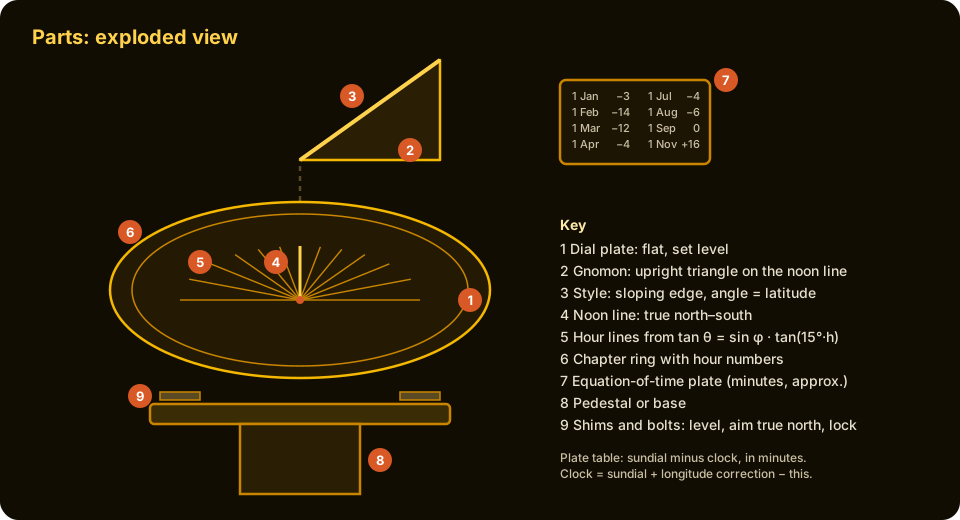
- Dial plate. The flat surface carrying the hour lines. It must be truly flat and set truly level.
- Gnomon. The upright triangle that casts the shadow, standing on the noon line.
- Style. The sloping top edge of the gnomon. It rises at an angle equal to your latitude and points at the celestial pole.
- Noon line. The line under the gnomon, aligned exactly north–south. The shadow falls along it at local apparent noon.
- Hour lines. Lines radiating from the point where the style meets the dial, drawn at the angles from the formula.
- Chapter ring. The band around the edge with the hour numbers, and often half-hour and quarter-hour marks.
- Equation-of-time table or graph. A small plate showing the correction for each date.
- Base or pedestal. A stable post or block that holds the dial at a comfortable height and stops it moving.
- Levelling and fixing. Shims, adjustable feet or a bed of mortar, plus screws or bolts, so the dial can be set level and locked in place pointing true north.
Build it: a horizontal garden sundial for your latitude
This build makes a horizontal sundial about 300 mm across that reads to within a couple of minutes once corrected. Wood is easiest to begin with; the same steps work for slate, stone, concrete or metal.
Materials
- Dial plate: a square or round piece of exterior plywood, hardwood, slate or aluminium about 300 mm across and 12–20 mm thick if wood.
- Gnomon: a piece of 3–6 mm aluminium, brass or stainless steel sheet, or 12 mm hardwood, about 160 × 150 mm.
- Exterior paint, marine varnish or engraving tools for the lines; a fine permanent marker for setting out.
- Two or three small brackets or a slot and epoxy to fix the gnomon.
- A post, pedestal or concrete block for a base, and four screws or bolts.
- A short straight stick or rod about 1 metre long and some pegs or stones, for finding north.
Tools
Protractor (a large one helps), long steel rule, set square, pencil, calculator or a table of sines and tangents, spirit level, saw or hacksaw, file, drill, and a reliable watch.
Step 1: find your latitude
Read your latitude from a map or a GPS receiver to the nearest tenth of a degree if you can. Without either, measure it from the sky: in the Northern Hemisphere, the altitude of Polaris above the horizon is within about a degree of your latitude. Sight it along a protractor with a plumb line, or measure the Sun's altitude at noon on the day of an equinox and subtract it from 90 degrees.
Step 2: calculate the hour-line angles
For your latitude, work out θ for hours from noon of 1, 2, 3, 4 and 5 using tan θ = sin(latitude) × tan(15° × hours). Add the half hours with 0.5, 1.5, 2.5, 3.5, 4.5 and 5.5 if you want them. Write the angles in a list. The 6 o'clock lines are 90 degrees. Check your numbers against the table above.
Step 3: allow for the gnomon's thickness
A gnomon has thickness, and each side of it casts the shadow at different times of day. In the morning the shadow is cast by the west edge of the style, and in the afternoon by the east edge. So draw the noon line as two parallel lines, as far apart as the gnomon is thick, and draw the morning hour lines from the western one and the afternoon lines from the eastern one. With a thin metal gnomon this is a small correction; with a 12 mm wooden one, it matters.
Step 4: lay out the dial
Draw the noon line or lines down the middle of the plate. Mark the dial centre, where the style will touch the plate, about one third of the way from the southern edge so that the lines have room to spread northwards. Using the protractor at the dial centre, mark each hour angle on both sides of the noon line: morning hours on the west side and afternoon hours on the east side. In the Northern Hemisphere, with north at the top of the plate, morning hours are on the left and afternoon on the right. Draw the 6 a.m. and 6 p.m. lines at right angles to the noon line. Rule each line out to the edge with the steel rule, then add the chapter ring and numbers.
Step 5: make the gnomon
Mark a right-angled triangle on the gnomon stock. The angle at the point that touches the dial centre must equal your latitude. Mark it with the protractor, cut it, and file the sloping edge straight and true, because that edge is what casts the shadow. Cut off the sharp tip a little if needed for safety, but keep the line of the style exactly in place.
Step 6: fix the gnomon
Stand the gnomon on the noon line, its low pointed end at the dial centre and its high end towards the north (towards the south in the Southern Hemisphere). It must be exactly vertical to the dial plate: check with a set square from both sides. Fix it with brackets, or cut a slot in the plate and set it in epoxy.
Step 7: finish the surface
Paint, carve or engrave the lines and numbers. Seal wood with several coats of exterior varnish. Add a small plate or painted panel with the equation of time for the first and fifteenth of each month, and the longitude correction for your location, so anyone can convert the reading.
Step 8: find true north
Do not use a magnetic compass alone, because magnetic north differs from true north by an amount called declination that can be many degrees and changes slowly over years. Use the shadow-stick method instead. On level ground, stand a straight stick upright. In mid-morning, mark the tip of its shadow with a peg. Using a string tied to the base of the stick, draw a circle through that mark. In the afternoon, watch for the moment the shadow tip touches the circle again and mark it. The line joining the two marks runs exactly east–west, and a line at right angles to it through the stick runs north–south. At night in the Northern Hemisphere, Polaris is less than a degree from true north and can be used directly.
Step 9: install and align
Set the base solidly in place. Lay the dial on it, level it in two directions with the spirit level and shims, and turn it until the noon line lies exactly along your north–south line. A final fine check: on any day, work out the clock time of local apparent noon using the longitude correction and the equation of time for that date, and at that exact moment turn the dial until the shadow lies on the noon line. Then fix it down permanently.
Test and read it
- Read the dial. The edge of the shadow cast by the style gives the time. Use the west edge of the shadow in the morning and the east edge in the afternoon.
- Convert to clock time. Add the longitude correction, subtract the equation of time for the date and add an hour if daylight saving is in force. Compare with an accurate clock.
- Check through the day. If the dial is right at noon but drifts towards morning and evening, the style angle or the level is wrong. Check that the plate is level and that the style really rises at your latitude.
- Check through the year. A correctly built and aligned dial will agree with the corrected clock time within a minute or two all year round.
- Southern Hemisphere. Everything is mirrored: the style points to the south celestial pole, the shadow turns anticlockwise, and the morning hours, still on the west side of the noon line, appear on the right when the dial is viewed with south at the top.
Safety
- Never look directly at the Sun, and never look at it through any lens, binocular or telescope. Read the shadow, not the Sun. Permanent eye damage can happen in seconds.
- Sharp gnomons. The pointed tip and edges of a metal gnomon are sharp and stand at child and adult eye height on a garden pedestal. File every edge round, blunt the tip and place the dial where people will not fall onto it.
- Heavy dials. Stone, slate and concrete dials are heavy. Lift with help, keep fingers clear when setting them down, and fix them so they cannot topple off a pedestal.
- Tools. Wear eye protection when cutting and drilling metal or stone, and use dust protection when cutting stone or concrete.
- Working outdoors. Laying out a north–south line takes hours in the sun; use sun protection and drink water.
Where sundials are used now
Sundials are garden ornaments, school science projects, public monuments and works of art, and they remain practical for anyone who wants local solar time without a battery. Surveyors and hikers still use the shadow-stick method to find north. The same principles fix the orientation of solar panels, which work best tilted at about the latitude and facing the equator, and the geometry of the gnomon is the geometry of the equatorial telescope mount, whose main axis also points at the celestial pole. The analemma, the equation of time and the 15-degrees-per-hour rule are still taught in navigation and astronomy.
Words to know
- Gnomon: the part of a sundial that casts the shadow.
- Style: the sloping shadow-casting edge of the gnomon, parallel to the Earth's axis.
- Celestial pole: the point in the sky directly above the Earth's axis, around which the stars and Sun appear to turn.
- Latitude: your angle north or south of the equator; also the angle of the style above the dial.
- Local apparent time: the time shown by a sundial at your exact location.
- Mean time: the steady average solar time kept by a clock.
- Equation of time: the difference between sundial time and clock time through the year, up to about 16 minutes either way.
- Declination (magnetic): the angle between true north and the direction a compass points.
- Analemma: the figure-of-eight traced by the Sun's position at the same clock time over a year.
Related in the Knowledge Ark
The Knowledge Ark keeps 6,000 packages for rebuilding, from measuring and timekeeping to records and navigation. Browse them, search by category and open any package at the Knowledge Ark. Its sister, the Culture Ark, keeps 2,000 things people should still be able to see in 2,000 years.
Where to learn more
- The British Sundial Society and the North American Sundial Society: dial designs, registers of historic dials and the mathematics of gnomonics.
- Royal Museums Greenwich: the history of sundials, meridians and the equation of time.
- The Jantar Mantar in Jaipur, a UNESCO World Heritage Site: large eighteenth-century masonry instruments, including the Samrat Yantra.
- Any introductory astronomy or navigation text covering the celestial sphere, latitude and the equation of time.
Knowledge Ark build sheet. An Artificial Mind Hive (AMH) project. AMH is owned by Austin Little.

Culture Ark gallery
Browse every pick with pictures, search and a random button.
Open the gallery →