Knowledge Ark build sheet · Knowledge Ark · Culture Ark · An Artificial Mind Hive project by Austin Little
A loom is a frame that holds one set of threads tight so that another thread can be passed over and under them. That is the whole idea, and it has clothed almost every person who has ever lived. Sails, sacks, blankets, bandages, tents, nets for straining and cloth for trade all come off looms. This sheet explains where the loom came from, how it grew from a pair of sticks into the punched-card Jacquard machine that helped inspire early computers, how weaving actually works, what each part of a loom does, and how to build two working looms from timber, dowel and string: a simple frame loom and a rigid-heddle loom that can weave a long length of real cloth. Everything here is meant to be rebuilt from scratch if it ever had to be.
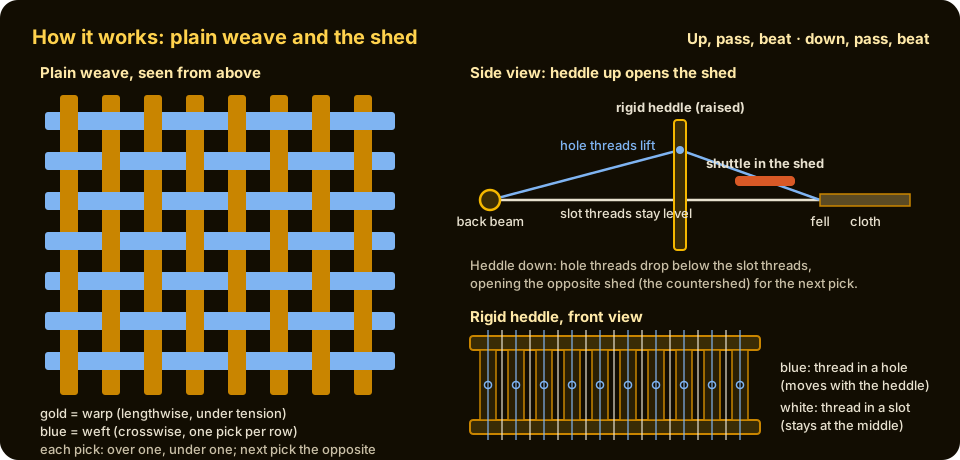
Plain weave and the shed. Left: the weft goes over one warp thread and under the next, then the opposite on the following row. Right: a rigid heddle lifts every other warp thread, opening a wedge-shaped gap called the shed, so the shuttle can pass through in one stroke instead of being darned in thread by thread.
Why keep this in the Knowledge Ark
Cloth is one of the few things every community needs and few people today know how to make. A loom turns spun fibre, whether wool, flax, cotton, hemp, nettle or strips of old fabric, into something strong, flexible and repairable. Woven cloth is warmer than loose fibre, stronger than felt for its weight, and can be cut and sewn into almost anything. The loom also teaches a great deal: how tension makes a structure rigid, how a simple repeated rule (over one, under one) produces a strong material, and how a machine can store a pattern as a set of instructions. That last idea, a pattern held in holes punched in cards, passed from the silk looms of Lyon to the first designs for programmable computers. Few tools connect the everyday and the abstract so directly.
History: how it came about
Before the loom: twisting, twining and the first cloth
Before there was weaving there was string. People twisted plant fibres and animal hair into cord tens of thousands of years ago, and some of the earliest evidence for fabric is not cloth at all but its imprint. Fired clay fragments from Dolní Věstonice and nearby sites in the Czech Republic, roughly 27,000 years old, carry impressions that archaeologists have interpreted as twined and woven fibre. Twining, in which two threads twist around each other as they pass a set of upright threads, can be done with no loom at all, by hand, and it is the ancestor of baskets, mats and the first textiles.
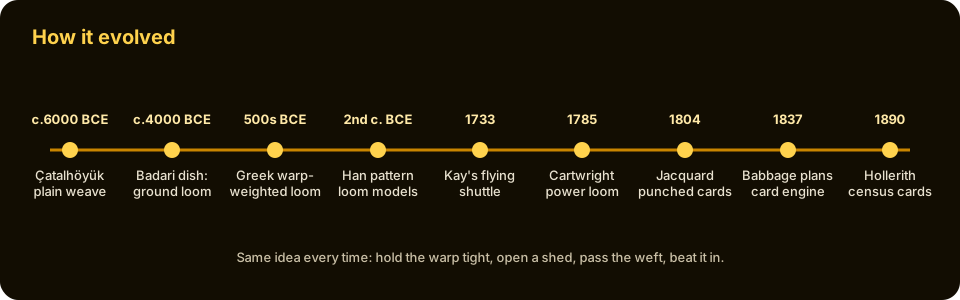
True woven cloth needs the warp, the lengthwise threads, held under steady tension. Once people tied a set of threads between two fixed points, the loom had begun. Some of the oldest surviving woven textiles come from Çatalhöyük in central Turkey, where fragments of plain-weave cloth made from plant bast fibre were found in buildings dated to roughly 6000 BCE. In Egypt, linen cloth was being woven from flax by about 5000 BCE, and linen became central to Egyptian life and burial for thousands of years.
The horizontal ground loom in Egypt
The simplest fixed loom is the ground loom: two wooden beams pegged to the ground, with the warp stretched between them. The weaver crouches or kneels beside it. A pottery dish from Badari in Upper Egypt, made in the Predynastic period around 4000 BCE and now in the Petrie Museum in London, carries one of the oldest known pictures of a loom, showing a horizontal ground loom with its beams and pegs. Much later, painted wooden tomb models from the Middle Kingdom, such as the weaving workshop found in the tomb of the official Meketre at Thebes (around 1980 BCE), show women working at ground looms while others spin and prepare thread. Tomb paintings at Beni Hasan show the same scene. During the New Kingdom a vertical two-beam loom also came into use in Egypt, letting the weaver sit upright and work wider cloth.
The warp-weighted loom
In the Neolithic villages of central and southern Europe and Anatolia another design appears: the warp-weighted loom. It leans against a wall or rests on two uprights. The warp hangs down from a top beam, and instead of a bottom beam, bundles of warp threads are tied to heavy stones or fired-clay weights that keep them taut. Archaeologists find these loom weights in rows on the floors of houses, sometimes exactly where a loom collapsed when a building burned, which shows the width of the loom and how many weights it used. The weaver stands and works from the top downward, beating the weft up toward the top beam. The warp-weighted loom was the standard loom of ancient Greece; a black-figure oil flask of the sixth century BCE in the Metropolitan Museum of Art in New York shows women weaving on one. It was used in Scandinavia for centuries, including for the wool sails of Viking ships, and survived in parts of Norway and Iceland into the twentieth century.
The backstrap loom
The backstrap loom needs almost no timber. One end of the warp is tied to a post or tree. The other end is tied to a bar attached to a strap that goes around the weaver's lower back. By leaning back the weaver tightens the warp; by leaning forward she loosens it. It is portable, can be rolled up with the work inside it, and can produce very fine and complex cloth. It was developed independently in many places and is still used in the Andes, in Mexico and Central America, and across Southeast Asia. The textiles of the ancient Andes, from cultures such as the Paracas and later the Inca, include some of the finest weaving ever made, much of it on backstrap and staked looms.
Pattern looms and drawlooms in China
China was raising silkworms and weaving silk by the third millennium BCE, and Chinese weavers developed the most sophisticated pattern-weaving machines of the ancient world. In 2012 and 2013 archaeologists excavating a Western Han dynasty tomb at Laoguanshan in Chengdu found four model looms dated to the second century BCE. They are multi-shaft pattern looms, with many sets of heddles that can be lifted in sequence to weave complex figured silk. Over the following centuries Chinese weavers developed the drawloom, in which a second worker, the drawboy, sat on top of the loom and pulled groups of cords in a fixed order to lift exactly the warp threads needed for each row of a large pattern. In effect the pattern was stored in the cords and their order. Drawlooms spread along the Silk Road to Persia, the Byzantine world and eventually to Italy and France, where they wove the figured silks of Lucca, Venice and Lyon.
The treadle loom in Europe
Another Chinese and Asian development was the horizontal frame loom with treadles, in which the weaver's feet lift and lower the shafts that hold the heddles, leaving both hands free to throw the shuttle and beat. This type of loom was in use in Europe by around the eleventh century and became the workhorse of medieval and early modern weaving, from Flemish woollens to English broadcloth. Its basic layout is still the layout of a handloom today.
1733: John Kay's flying shuttle
On a wide loom, one weaver could not reach across to pass the shuttle from hand to hand, so broadcloth often needed two people. In 1733 John Kay, from Bury in Lancashire, patented the flying shuttle. The shuttle ran on small wheels along a wooden race at the front of the beater, with a box at each end. A cord and a picking stick let the weaver knock the shuttle from one box to the other with a flick of one hand. One weaver could now weave wide cloth much faster. Kay met hostility from weavers who feared for their work and from manufacturers who would not pay his royalties, and he later moved to France. The flying shuttle made weavers so much faster that spinners could not keep up, which helped push the invention of spinning machines later in the century, including James Hargreaves's spinning jenny and Richard Arkwright's water frame.
1785: Edmund Cartwright's power loom
Edmund Cartwright, an English clergyman with no background in weaving, patented a power loom in 1785, a machine in which the shedding, picking and beating were all driven mechanically rather than by the weaver's body. His first versions were crude and he kept improving them; a mill in Manchester that installed his looms burned down in 1791. Others, including William Horrocks of Stockport in the early 1800s, made the power loom practical, and in 1809 Parliament granted Cartwright £10,000 in recognition of his invention. By the middle of the nineteenth century power looms in Britain numbered in the hundreds of thousands, and hand-loom weavers, who had been well paid a generation before, were thrown into poverty. The power loom is one of the defining machines of the Industrial Revolution.
1804: the Jacquard loom and punched cards
The drawloom could weave magnificent patterns but needed a drawboy pulling cords for every row, which was slow and mistake-prone. In France several inventors tried to automate it. Basile Bouchon in 1725 used a roll of perforated paper to select cords; Jean-Baptiste Falcon in 1728 replaced the roll with a chain of separate punched cards; Jacques de Vaucanson built an automated loom in 1745. Joseph Marie Jacquard of Lyon brought these ideas together into a reliable mechanism that he demonstrated in 1804. On top of the loom, a set of hooks lifts each warp thread individually. A chain of stiff cards, one card per row of the pattern, is pressed against a set of needles. Where a card has a hole, the needle passes through and its hook lifts its warp thread; where there is no hole, the needle is pushed back and the thread stays down. Change the cards and the loom weaves a different pattern. Jacquard's head could be fitted to existing looms, and it spread quickly through the French silk industry despite early resistance from weavers.
From the loom to the computer
The Jacquard loom showed that a machine could follow a stored, changeable program. The English mathematician Charles Babbage, who owned a silk portrait of Jacquard woven on a Jacquard loom from reportedly some 24,000 cards, planned from 1837 to control his Analytical Engine, a design for a general-purpose mechanical computer, with punched cards taken directly from the loom. In 1843 Ada Lovelace, writing the notes to her translation of a paper on the engine, put it this way: "We may say most aptly that the Analytical Engine weaves algebraical patterns just as the Jacquard-loom weaves flowers and leaves." The engine was never completed, but the punched card lived on. Herman Hollerith's electric tabulating machines processed the 1890 United States census from punched cards, and Hollerith's company later became part of IBM. Punched cards carried data and programs into the 1970s. The modern loom itself is computer-controlled, and an electronic Jacquard head still lifts each warp thread individually, one row at a time.
How it works
Warp and weft
Every woven cloth has two sets of threads at right angles. The warp runs the length of the cloth and is put on the loom first, under tension. The weft runs across, from side to side, and is added one row at a time. A single weft row is called a pick. The warp has to be strong and smooth, because it is held tight and rubbed by the moving parts; the weft can be softer and thicker, because it is not under much strain. The number of warp threads per centimetre or per inch is called the sett; it decides how dense and how stiff the cloth will be.
Plain weave
The simplest and strongest structure is plain weave, also called tabby. The first pick goes over warp thread one, under thread two, over three, under four, and so on across. The next pick does exactly the opposite: under one, over two, under three. Repeat. Each warp thread is locked in place by the weft going alternately in front of and behind it, and each weft is locked by the warp. Plain weave is used for linen, calico, canvas and muslin. Other structures, such as twill (where the weft passes over two or more threads and the crossing point steps along each row, making diagonal lines), satin and figured weaves, are all variations on the rule of which threads go up for each pick.
The shed: why a loom is faster than darning
You could weave by threading a needle over and under each warp thread one at a time, like darning a sock. A loom does better by lifting all the alternate warp threads together. The wedge-shaped gap that opens between the raised threads and the lowered threads is the shed. The weaver passes the weft through the whole width in one stroke. Then the threads that were up go down and those that were down go up, forming the opposite shed, called the countershed, and the weft passes back. This change of shed is what traps each pick in place.
The heddle
The device that lifts selected warp threads is the heddle. On many looms each warp thread passes through the eye of a separate heddle made of string, wire or flat steel, and the heddles are hung on frames called shafts or harnesses. Lift a shaft and every thread threaded on it rises. Two shafts are enough for plain weave; four or more give twills and patterns.
The rigid heddle does the same job with one piece. It is a frame filled with flat slats. Each slat has a small hole in its middle, and between each pair of slats is a long slot. Warp threads are threaded alternately: one through a slot, the next through a hole, the next through a slot. When the heddle is raised, the threads in the holes are lifted with it, but the threads in the slots simply slide along their slots and stay at the middle. That opens one shed. When the heddle is pushed down, the threads in the holes drop below the slot threads, opening the countershed. Two positions, two sheds: plain weave with a single moving part.
The beater
After each pick the weft lies loosely at an angle in the shed. It must be pushed up firmly against the cloth already woven. The edge of the finished cloth where the new pick goes is called the fell. On a floor loom the weft is pushed by a reed, a comb-like frame of thin metal strips that also keeps the warp evenly spaced, carried in a swinging frame called the beater. On a rigid-heddle loom the heddle itself acts as the reed and beater: after passing the shuttle, you pull the heddle toward you to beat the pick into place. On a frame loom a wide-toothed comb or a fork does the job.
The shuttle
The shuttle carries the weft through the shed. The simplest is a stick shuttle, a flat stick with a notch at each end around which the weft is wound. Boat shuttles hold the weft on a bobbin and run smoothly across the lower layer of the shed; Kay's flying shuttle was a boat shuttle with wheels. Industrial looms today often use no shuttle at all, firing the weft across with a rapier, a jet of air or a jet of water.
Tension, take-up and draw-in
A warp must be tight and, just as important, evenly tight; a slack thread makes a loop or a weak line in the cloth. On a loom with beams, the warp is wound on the back warp beam and the finished cloth on the front cloth beam. Ratchets on both beams hold the tension. As the cloth grows toward the heddle, the weaver releases the back ratchet, winds the cloth forward on the front beam and tightens again. Weft that is pulled tight across the warp makes the cloth narrower toward the middle, a fault called draw-in; it is avoided by laying each pick in the shed at a slant or in a gentle arc before beating, so there is enough weft to go over and under every warp thread without pulling the edges in.
Selvedges
The edges of the cloth where the weft turns back are the selvedges, from "self edge". Because the weft wraps around the outermost warp thread on every pick, a woven cloth does not unravel at the sides. Neat, straight selvedges are the clearest sign of a careful weaver.
Parts and what each one does
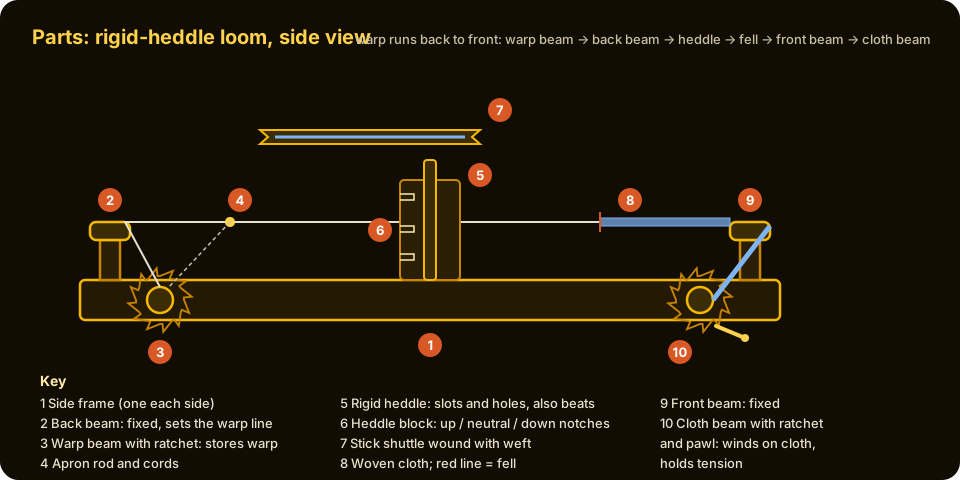
- Side frames. Two long boards that hold every other part square and parallel. They take the full pull of the warp, so they must be stiff and firmly joined.
- Back beam. A fixed, smooth bar at the back over which the warp passes. It sets the height and line of the warp.
- Warp beam with ratchet. A rotating roller below the back beam that stores the unwoven warp. A ratchet wheel and pawl stop it turning back.
- Apron rods and cords. Thin rods tied to each beam with cords. The warp is tied to the rods, so none of it is wasted wrapped around the beams.
- Rigid heddle. The frame of slots and holes that lifts or lowers alternate warp threads and also beats the weft into place.
- Heddle blocks. Notched blocks on each side frame that hold the heddle in the up, neutral or down position.
- Shuttle. Carries the weft through the shed.
- Cloth and fell. The woven cloth, and its leading edge where each new pick is beaten in.
- Front beam. A fixed bar at the front over which the finished cloth passes.
- Cloth beam with ratchet and pawl. A rotating roller that winds up the finished cloth and holds the warp tight.
A frame loom has fewer parts: a rigid rectangular frame, pins or notches along the top and bottom to hold the warp, a flat shed stick woven through the warp to make one shed, string leashes (loop heddles) tied to a heddle rod to make the other, a stick shuttle and a comb or fork to beat.
Build it: a frame loom and a rigid-heddle loom
Build the frame loom first. It takes an afternoon, teaches warping, shedding, beating and finishing, and weaves pieces up to about 300 by 400 millimetres: mats, wall pieces, patches, small bags. The rigid-heddle loom takes a weekend and weaves cloth about 300 millimetres wide and as long as the warp you put on it, enough for scarves, towels, belts and lengths that can be sewn together into blankets.
Materials: frame loom
- Four pieces of straight, knot-free softwood, 19 × 45 mm: two at 500 mm (sides) and two at 400 mm (top and bottom).
- Wood glue, eight 40 mm wood screws, and four small steel corner brackets.
- About 120 small panel pins or brads, 20–25 mm long.
- A flat stick for the shed stick, about 25 × 6 × 400 mm, and a dowel about 10 mm × 400 mm for the heddle rod.
- A flat stick for the shuttle, about 25 × 6 × 300 mm, with a V-notch cut into each end.
- Strong, smooth warp yarn: cotton string, linen or a firm worsted wool. Weft yarn: any wool, cotton, or strips of old cloth about 15 mm wide.
- A wide-toothed comb or an old dinner fork for beating.
Materials: rigid-heddle loom (about 300 mm weaving width)
- Two side boards, straight softwood or hardwood, 19 × 70 mm × 700 mm.
- Back beam and front beam: two pieces 19 × 45 mm × 420 mm, smoothly rounded on the top edge.
- Four posts 19 × 45 mm × 80 mm to carry the back and front beams.
- Warp beam and cloth beam: two hardwood dowels 25 mm × 480 mm.
- Two ratchet wheels cut from 12–18 mm plywood, about 90 mm across with 12 teeth, and two hardwood pawls about 60 × 20 × 12 mm.
- Two heddle blocks, 19 × 70 × 130 mm.
- Two apron rods, 10 mm dowel × 380 mm, and strong cord.
- For the heddle: four strips of hardwood 20 × 6 × 380 mm for the rails, and about 22 flat wooden craft sticks about 114 × 10 × 2 mm (or slats cut to that size). A purchased rigid-heddle reed of 7.5, 8 or 10 dents per inch can replace the home-made one and allows finer yarn.
- Wood glue, 40 mm screws, 6 mm bolts with washers and wing nuts for the pawls, sandpaper, and paste wax.
Tools
Saw, drill with 3 mm, 6 mm and 26 mm bits, screwdriver, hammer, square, ruler and pencil, coping saw or jigsaw for the ratchet wheels, rasp or file, sandpaper and clamps.
Step 1: build the frame loom
Glue and screw the top and bottom bars across the ends of the two side pieces to make a rectangle 400 mm wide and 500 mm tall. Check that the diagonals are equal so the frame is square, then add a corner bracket at each corner. Sand everything smooth, especially the edges the yarn will touch.
Step 2: add warp pins
Draw a line along the top bar and the bottom bar, 10 mm from the outer edge. Starting 50 mm in from each side, mark every 6 mm along each line, so the top and bottom marks line up exactly. Hammer a pin at each mark, leaving about 10 mm standing. Six-millimetre spacing gives about four warp threads per inch, right for thick yarn and fabric strips. For finer yarn, add a second staggered row of pins between the first.
Step 3: warp the frame loom
Tie the warp yarn to the first top pin. Take it straight down to the first bottom pin, around it, across to the second bottom pin, around that, and straight up to the second top pin; continue zigzagging so each run between top and bottom is one warp thread. Keep the tension firm and even, like a guitar string that gives slightly under a finger, and tie off at the last pin. Weave the shed stick under the first thread, over the second, under the third, all the way across, and push it up near the top.
Step 4: tie the string heddles
The threads that lie under the shed stick need a way to be lifted. Cut a loop of strong cotton thread about 150 mm long for each of them. Pass each loop around one of those threads and tie both ends to the heddle rod, laid across the front of the warp, so every loop is the same length. Now turning the shed stick on edge opens one shed, and pulling the heddle rod toward you opens the other.
Step 5: build the rigid-heddle loom frame
Screw two posts upright to the inside face of each side board, one 30 mm from each end, so they stand 60 mm above the top edge. Screw the back beam across the tops of the two back posts and the front beam across the two front posts, making a rectangle with the side boards about 380 mm wide inside. Drill a 26 mm hole through each side board 70 mm from the back end and 30 mm below the top edge for the warp beam, and the same at the front for the cloth beam. The dowels should turn freely but not wobble.
Step 6: ratchets and pawls
Cut the two ratchet wheels with sloping teeth, like a saw blade bent into a circle. Drill each to a tight fit on the dowel and glue it on the outside of the right-hand side board, one on each beam, leaving the beams free to turn. Bolt a pawl to the side board just above each wheel so its tip drops by gravity into the teeth. Set the back pawl so the warp beam can turn only to let warp out when the pawl is lifted, and the front pawl so the cloth beam can turn only to wind cloth on. Drill a 6 mm hole through the end of each dowel and push in a 100 mm wooden peg as a handle.
Step 7: make the rigid heddle
Sand the craft sticks smooth and round their edges. Drill a clean 3 mm hole exactly in the centre of each stick and sand the hole so it cannot snag yarn. Lay two rails flat, 74 mm apart. Glue the sticks across them, standing upright in the frame, with a 4 mm gap between neighbouring sticks; a 4 mm spacer strip makes this easy. Glue the other two rails over the first pair to sandwich the stick ends. When dry, each stick is a hole and each gap is a slot. With 10 mm sticks and 4 mm gaps the heddle carries two threads every 14 mm, about three and a half per inch, which suits bulky yarn and rag strips. Wax the slots lightly. Trim the rails so they reach just past the side boards on each side.
Step 8: heddle blocks
Screw one heddle block to the outside of each side board, halfway along, standing above the top edge. Cut three notches in the top edge of each block for the heddle rails to rest in: a high notch about 35 mm above the line of the warp (up shed), a middle notch level with it (neutral), and a low notch about 30 mm below it (down shed). Test with the heddle in place: it should drop into each notch squarely.
Step 9: apron rods
Tie each apron rod to its beam with four or five equal cords, so the rod lies parallel to the beam about 150 mm from it when pulled straight.
Step 10: warp the rigid-heddle loom
Set the heddle in the neutral notch. Clamp a peg to a table at the length you want the warp, for example 2 metres from the back of the loom. Tie the yarn to the back apron rod, pass a loop of yarn through the first slot with a threading hook or a bent wire, and carry the loop to the peg. Keep going across, one loop through every slot needed for your width, so each slot holds two threads. Cut the loops at the peg. Wind the warp onto the warp beam under firm tension, slipping sheets of stiff paper between the layers to keep it even. Then, at each slot, take one of the two threads out and thread it through the hole beside it. Every slot and every hole now carries one thread. Tie the warp onto the front apron rod in small bundles of about 25 mm with a half-bow, then even the tension across and finish with a firm knot.
First cloth: test and adjust
- Weave a header. Open a shed, pass a few picks of thick scrap yarn and beat them firmly. This spreads the warp into an even sheet and gives a firm base for the real cloth.
- Start weaving. Raise the heddle into the up notch, slide the shuttle through, lay the weft at a slant of about 30 degrees, pull the heddle forward to beat, and return it to neutral. Push the heddle into the down notch, pass the shuttle back, slant, beat. Up, pass, beat; down, pass, beat. That is plain weave.
- Count your picks. Aim for about the same number of picks per inch as warp threads per inch, which makes a balanced plain weave where warp and weft show equally.
- Advance the warp. When the fell is about 70 mm from the heddle, lift the back pawl, wind the cloth forward on the cloth beam until the fell is about 50 mm from the front beam, and drop the pawls to retension.
- Troubleshooting. Edges pulling in means too little weft is being laid in each pick: slant it more. Loose loops at the edges mean too much. A warp thread that sags needs a small weight hung from it at the back, or retying. A shed that will not open cleanly usually means the warp is too slack or threads are crossed between the heddle and the back beam.
- Finish. Leave about 150 mm of unwoven warp at each end, cut the cloth off and tie the warp ends in small bundles with overhand knots, or hemstitch them on the loom. Wash the cloth gently in warm water; the fibres relax and bloom, and the cloth becomes softer and more stable.
Safety
- Keep fingers clear of ratchets and pawls when releasing tension. A tight warp can spin a beam suddenly; hold the handle before lifting the pawl.
- Sand every part the yarn or your hands touch. Splinters in the heddle will cut yarn and fingers.
- Use saws, drills and knives carefully, clamp work before cutting, and wear eye protection when drilling or using power tools.
- Panel pins in the frame loom are sharp; keep the frame flat and away from small children, and remove the pins if it is put away.
- Hand looms are slow and safe, but industrial power looms are not. Their shuttles and beaters move with great force, and accidents with them injured many mill workers. Never reach into a running powered loom.
- Long hours of repetitive weaving strain the wrists, shoulders and back. Sit upright at a comfortable height and take breaks.
Where looms are used now
Looms are everywhere, even where they are not seen. Industrial air-jet and rapier looms weave denim, shirting and bed linen at hundreds of picks a minute. Electronic Jacquard looms weave upholstery, labels and pictures. Narrow-fabric looms make seat belts, webbing and ribbons. Woven glass, carbon and aramid fibre become boat hulls, aircraft parts and body armour. Handweavers still use backstrap looms in Guatemala and Bolivia, rigid-heddle and floor looms in homes and studios worldwide, and warp-weighted looms in museums and reconstruction projects. The rule is the same in all of them: hold the warp tight, open a shed, pass the weft, beat it in.
Words to know
- Warp: the lengthwise threads held under tension on the loom.
- Weft: the crosswise thread woven over and under the warp; one row is a pick.
- Shed: the gap opened between raised and lowered warp threads for the weft to pass through.
- Heddle: the part that lifts selected warp threads; a rigid heddle does it with slots and holes.
- Beater / reed: what pushes each pick against the cloth and keeps the warp evenly spaced.
- Shuttle: the tool that carries the weft through the shed.
- Sett: the number of warp threads per inch or per centimetre.
- Fell: the leading edge of the woven cloth.
- Selvedge: the self-finished side edge of woven cloth.
- Plain weave (tabby): over one, under one, alternating every row.
Related in the Knowledge Ark
The Knowledge Ark keeps 6,000 packages for rebuilding, from spinning and dyeing to measuring and records. Browse them, search by category and open any package at the Knowledge Ark. Its sister, the Culture Ark, keeps 2,000 things people should still be able to see in 2,000 years.
Where to learn more
- Petrie Museum of Egyptian Archaeology, London: the Badari dish and early Egyptian textiles.
- The Metropolitan Museum of Art, New York: Egyptian tomb models and Greek vases showing weaving.
- Science and Industry Museum, Manchester, and Science Museum, London: the flying shuttle, power looms, the Jacquard mechanism and Babbage's engines.
- Musée des Tissus, Lyon: silk weaving and the Jacquard loom.
- Any handweaving guide to the rigid-heddle loom covering warping, sett and plain weave.
Knowledge Ark build sheet. An Artificial Mind Hive (AMH) project. AMH is owned by Austin Little.

Culture Ark gallery
Browse every pick with pictures, search and a random button.
Open the gallery →