ApiaryActive
Try: pause · settings · learn · wipe
← Community / Reading Room
WC
Creator Tools · 7 min read

WALO Creators: The Agentic Desk for Shorts, Scripts, and Channel Memory

Creators do not need another blank prompt box. They need a channel brain that remembers the voice and turns one rough idea into a publishable pack.

Most creator AI tools still start from the wrong place: an empty prompt box. Real creators do not need a fresh blank page every day. They need a system that remembers the channel, the recurring characters, the voice, the audience, the lanes, the banned lines, and the next upload target. That is the opportunity for WALO Creators.
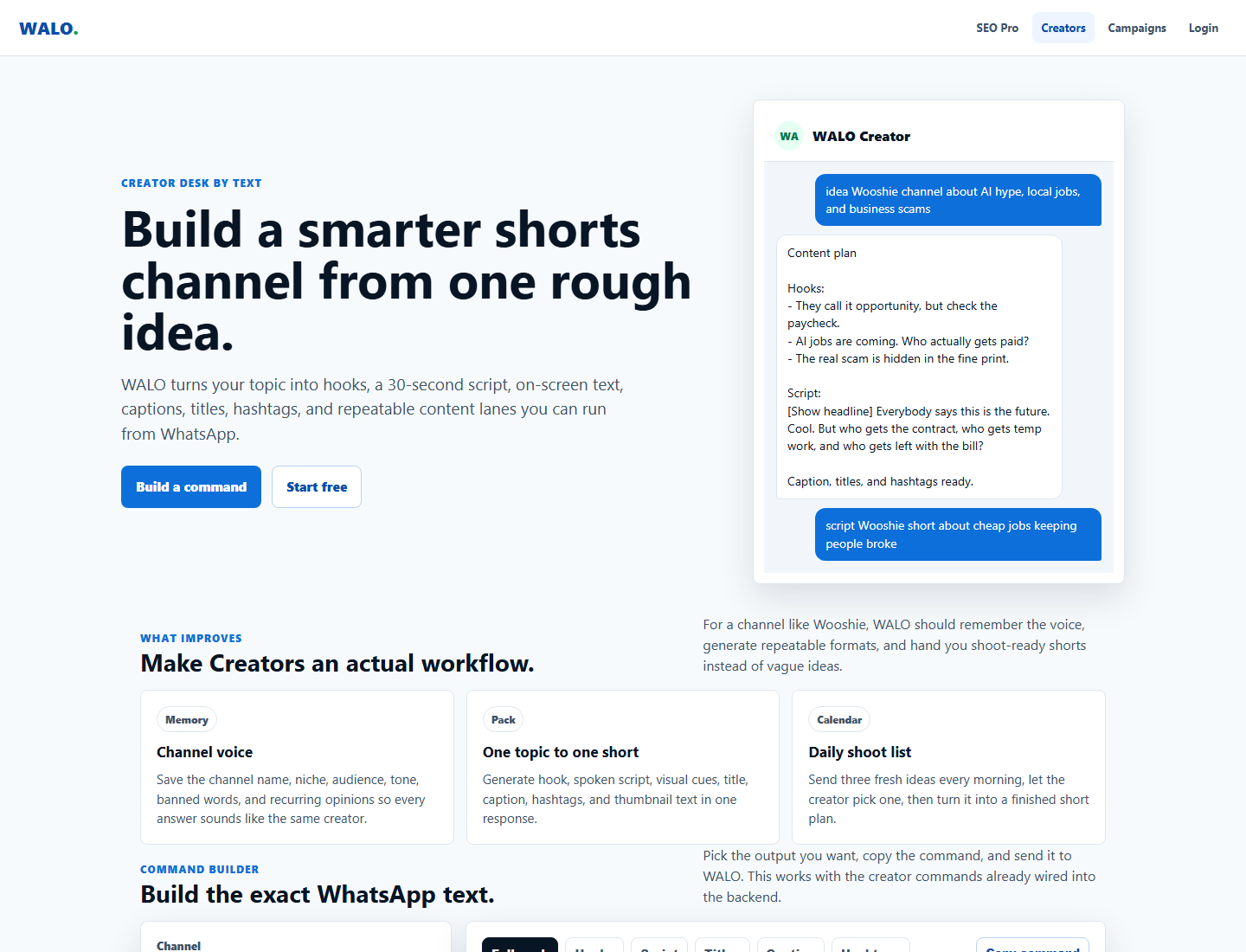
The live WALO Creators page: command builder plus creator memory workflow.

The product should work like a creator desk inside WhatsApp. The creator texts a messy idea. WALO returns a finished content pack: hook, spoken script, scene beats, on-screen words, sound notes, title options, caption, hashtags, upload description, and the next prompt to continue. The value is not just generation. The value is repeatability.

A creator tool becomes useful when it remembers the show.

The Whooshies test case

Whooshies is a good product test because it has a real content shape: short animated consciousness stories about letting go, focus, peace, third eye awareness, Taekwondo discipline, and inner growth. It has recurring characters like WHIT, RUBB, GLO, TY, LITTLE BELT, and NOISE. It has a tone: smart, quick, funny, conscious, kid-safe, but not corny. That is exactly the kind of channel memory an agentic creator app should store.

Once that memory is saved, the creator should not have to explain the whole brand again. A text like "short about letting go, make it Tug-of-War style" should be enough. WALO should know the characters, return a numbered short, and package it for YouTube Shorts, TikTok, and Reels.

The output standard

Every creator response should be complete enough to use. Not vague ideas. Not ten headlines with no production plan. A strong WALO Creators output should include hook, voiceover, animation beats, on-screen words, sound direction, title, caption, hashtags, and the next action.

Where agentic matters

The agentic part is not "write me a script." That is table stakes. The agentic part is the loop: save the channel profile, generate a short, prepare the upload pack, create a calendar, track which ideas were already used, suggest the next lane, and require approval before publishing. If connected to platform APIs later, WALO can draft uploads or schedule posts, but the final publish step should stay gated behind user approval.

The build that should land

  • Creator profile: channel name, platforms, audience, voice, characters, lanes, links, banned claims, and posting goal.
  • Command set: creator setup, creator profile, short, shorts 10, opener, repurpose, calendar 7, and publish checklist.
  • Approval flow: no auto-posting without OAuth and a final explicit approval.
  • Asset memory: store links to pages like Whooshies storylines and the series opener.
  • Performance memory: after uploads, remember which hooks and lanes got views, retention, and comments.

The best creator assistant will not only generate. It will watch what worked, remember it, and steer the next batch. A creator should be able to ask, "what should I post tomorrow?" and get an answer based on the actual channel, not generic advice.


Brand links: WALO Creators - WALO - Whooshies - Whooshies storylines - Whooshies opener - AMH, Artificial Mind Hive.

References

Frequently asked
What is WALO Creators: The Agentic Desk for Shorts, Scripts, and Channel Memory about?
Creators do not need another blank prompt box. They need a channel brain that remembers the voice and turns one rough idea into a publishable pack.
What should you know about the Whooshies test case?
Whooshies is a good product test because it has a real content shape: short animated consciousness stories about letting go, focus, peace, third eye awareness, Taekwondo discipline, and inner growth. It has recurring characters like WHIT, RUBB, GLO, TY, LITTLE BELT, and NOISE. It has a tone: smart, quick, funny,…
What should you know about the output standard?
Every creator response should be complete enough to use. Not vague ideas. Not ten headlines with no production plan. A strong WALO Creators output should include hook, voiceover, animation beats, on-screen words, sound direction, title, caption, hashtags, and the next action.
What should you know about where agentic matters?
The agentic part is not "write me a script." That is table stakes. The agentic part is the loop: save the channel profile, generate a short, prepare the upload pack, create a calendar, track which ideas were already used, suggest the next lane, and require approval before publishing. If connected to platform APIs…
What should you know about the build that should land?
The best creator assistant will not only generate. It will watch what worked, remember it, and steer the next batch. A creator should be able to ask, "what should I post tomorrow?" and get an answer based on the actual channel, not generic advice.
References & sources
  1. Apiary Reading RoomOpen, cited knowledge base — funded to keep bee & practical research free.
From the Apiary Reading Room. Opinion & editorial — not financial advice. We don't overclaim.
More from the Reading Room
SP

Field-Service AI Study: Why Contractors Need Quote Flow, Not Another Empty Chat Box

A market read on small-business AI adoption, field-service software growth, and why quote-first products like Service Pricer fit the real operator workflow.

Read →
SA

Small Business SEO Audits: The Work Owners Know They Need But Put Off

An SEO audit only matters when it turns into fixes. The useful product finds weak pages, explains the gap, and gives the owner an approve button.

Read →
IN

IndexNow, Sitemaps, and the Real Limit of Auto-Submitting Pages

Submitting a URL is useful, but it is not magic. The real win is making the page crawlable, linked, submitted, and watched.

Read →
RW

Rank Alerts: How a Local Business Knows It Is Finally Passing the Copycat

Daily rank checks are not vanity when they track the pages and competitors that actually steal calls.

Read →
KG

Competitor Keyword Gaps: Finding the Pages the Other Guy Has and You Do Not

The easiest content plan is often hiding in the competitor pages already ranking above you.

Read →
WA

WhatsApp Becomes the Business Command Line

For small operators, the best dashboard is often the app already open on their phone.

Read →
YR

Review Replies and Yelp Responses: The Small Business Reputation Loop

A good reply system helps the owner answer fast without sounding fake, defensive, or generic.

Read →
EC

Email Campaigns for Local Service: Useful Follow-Up Without Spam Energy

The best campaign is not blasting strangers. It is following up with the people who already raised a hand.

Read →
QF

Quote Follow-Up: Where Service Pricer and WALO Fit Together

Most lost jobs are not lost on price. They are lost when nobody follows up clearly and fast.

Read →
CS

Shorts Content Engines: From One Idea to Ten Usable Uploads

Creators do not need more vague ideas. They need repeatable scripts, titles, captions, sounds, and channel memory.

Read →
TL

Agent Approval Logs: Why AI Business Apps Need Receipts

The more an AI app can do, the more it needs proof of what it changed, when, and under whose approval.

Read →
LB

The Local Business AI Stack: Search, Replies, Quotes, Campaigns, and Memory

A small business does not need twenty disconnected AI tools. It needs one operating loop that remembers the work.

Read →
WA

WALO and the Agentic App Shift

The next useful AI apps will not just answer. They will remember, route, submit, follow up, and prove the work happened.

Read →
SP

Service Pricer: The Contractor SaaS Built Around Quotes, Jobs, and Real Operator Pain

A look at Service Pricer as the local-business operating system: login, tabs, quote workflow, and the bridge to WALO-style replies.

Read →
AK

Karpathy and the Decade of Agents

The clearest voice in AI just told everyone to slow down — and why that's bullish.

Read →
RB

The Hands That AI Is Building

The chips and reactors are the brain. This is the body — the hands, wheels, and eyes that turn a model's output into work in the physical world.

Read →
📉

Ten Years of Decline: The Numbers Alone

A decade of U.S. colony-loss data, what's driving it, and what the same math says is coming if nothing changes.

Read →
🐝

Can We Build Bee Formula?

They make baby formula and it works — it isn't milk. Here's the real science on doing the same for bees, so anyone, anywhere can keep a hive.

Read →
⚖️

The Pollinator Protection & Restoration Act — a model bill

A model bill that turns a barely-felt per-unit "pennies" levy on bee-toxic pesticide makers and sellers into a locked, accountable Pollinator Protection Fund — built on the proven Pittman-Robertson template.

Read →
AG

The $15,000 Door Problem: Why Rolling-Steel Spring Barrels Need a Serviceable Design

Commercial roll-up doors often bury the highest-wear part inside the hardest assembly to reach. This is the first Apiary priority: make the barrel torsion system easier to inspect, rebuild, and replace without forcing full-door replacement.

Read →
AG

Garage Door Counterbalance: Extension Springs, One-Piece Hardware, and Modern Torsion

A field map of old and new spring systems: extension springs, one-piece/vertical hardware, older San Francisco-style doors, and modern torsion shafts.

Read →
AG

Why More Spring Can Mean More Cycles: Wire Size, Length, and Fatigue Life

A practical explanation of why a 10k-cycle spring can often be upgraded to a higher-cycle spring by spreading stress through more steel, when the math is verified for the actual door.

Read →
AG

Can Garage Door Springs Be Made Better? Coatings, Alloys, Shot Peening, and Field Reality

The next product question after sizing: can spring life improve through better steel processing, corrosion control, surface treatments, and field data?

Read →