The University of Calgary Solar Car Team is a student-run group based at the Schulich School of Engineering in Calgary, Alberta. Its members design, build and race cars that run on sunlight. Since it formed in the fall of 2004 the team has built a prototype and six solar race cars. They have raced on Australian highways in the World Solar Challenge, on North American public roads in the North American Solar Challenge and its successor the American Solar Challenge, and on closed circuits in the Formula Sun Grand Prix. Its best-known results are a class win and tenth place overall with its first real car, Soleon, at the 2005 World Solar Challenge; Canada's first cruiser-class solar car, Schulich Delta; and a class win at the 2019 Formula Sun Grand Prix with the two-seat Schulich Elysia.
This article covers the team's history and cars, explains how a solar race car works and how the competitions are run, and looks at what a team like this achieves, where its limits are, and some common misunderstandings about solar cars.
Overview
| Item | Details |
|---|---|
| Founded | Fall 2004 |
| Home | Schulich School of Engineering, University of Calgary, Alberta, Canada |
| Type | Multidisciplinary, student-run solar car racing team |
| Members | Mostly undergraduates in engineering, science and business. About 60 students in 2019, about 80 in 2022 |
| Main events | World Solar Challenge (Australia), North American / American Solar Challenge, Formula Sun Grand Prix |
| Vehicles | X1 prototype, Soleon, Schulich I, Schulich Axiom, Schulich Delta, Schulich Elysia, Schulich Helios (in development) |
| Notable firsts | Canada's first cruiser-class solar car (Schulich Delta); first cruiser-class car to compete at the Formula Sun Grand Prix (2015) |
| Stated aims | Hands-on engineering and business experience for students; public education about sustainable energy |
Origins: a race that ended in Calgary
The team came about because of a specific race. In 2005 the North American Solar Challenge, the cross-continental solar car rally then co-sponsored in Canada by Natural Resources Canada, ran from Austin, Texas, to Calgary, a route of about 2,495 miles (2,494.9 miles in the event records). With the finish line on its doorstep, the University of Calgary started a team in the fall of 2004 so it could have a car in the race.
The schedule was very tight. Established solar car programs usually have two years between major races to design, build and test a car. The Calgary team, with little experience, had a working car in about nine months. The Wikipedia history of the team calls this a "miracle". The pressure shaped its first two vehicles. The X1 was a quick prototype used to learn the basics and train drivers, and Soleon was the race car built at the same time.
The team grew up with the engineering school around it. Businessman and philanthropist Seymour Schulich gave the university 25 million dollars, the Alberta government matched it with another 25 million, and the engineering faculty was renamed the Schulich School of Engineering. Every car the team has built since has carried the Schulich name: Schulich I, Schulich Axiom, Schulich Delta, Schulich Elysia and Schulich Helios.
The fleet, car by car
The team's cars show how student solar racing has changed over twenty years. Early cars were steel or aluminium frames with fibreglass or composite shells. Later cars used carbon-fibre structures, gallium arsenide solar cells, and eventually practical features such as doors, passenger seats and plug-in charging.
| Vehicle | Class | In service | Structure | Solar array | Approx. mass (no driver) | Listed top speed |
|---|---|---|---|---|---|---|
| X1 | Prototype | May 2005 to June 2006 | Steel space frame, fibreglass and gelcoat shell | None (decorative stickers only) | Not listed | About 70 km/h |
| Soleon | Challenger | June 2005 to July 2007 | Aluminium space frame, carbon fibre and Kevlar shell | Silicon | About 500 lb | 140 km/h |
| Schulich I | Challenger | September 2007 to May 2011 | Steel space frame, carbon fibre and Kevlar shell | Gallium arsenide triple-junction | About 520 lb | 105 km/h |
| Schulich Axiom (2010) | Challenger | From October 2009 | Carbon fibre and Kevlar chassis and shell | Gallium arsenide triple-junction | About 600 lb | 130 km/h |
| Schulich Axiom (2011 rebuild) | Challenger | From May 2011, retired 2013 | Carbon fibre chassis and shell | Monocrystalline silicon (UC Solar) | About 390 lb | 110 km/h |
| Schulich Delta | Cruiser | Built 2012 to 2015, retired 2015 | Four wheels, two doors, passenger seat, cargo space | Not listed | Not listed | Not listed |
| Schulich Elysia | Cruiser / multi-occupant | 2019 to summer 2025 | Catamaran-inspired frame, NACA ducts and fans | Multi-junction gallium arsenide | Not listed | Not listed |
| Schulich Helios | Challenger (per team site) | In development | Not yet published | Not yet published | Not yet published | About 110 km/h (theoretical target) |
The figures above come from the team's own fleet page and the Wikipedia article. Masses are given in pounds because that is how the team publishes them. 500 lb is about 227 kg and 390 lb is about 177 kg.
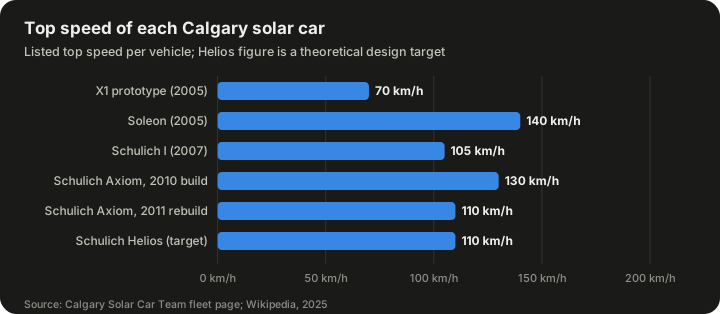
| Vehicle | Listed top speed (km/h) |
|---|---|
| X1 prototype (2005) | 70 |
| Soleon (2005) | 140 |
| Schulich I (2007) | 105 |
| Schulich Axiom, 2010 build | 130 |
| Schulich Axiom, 2011 rebuild | 110 |
| Schulich Helios (theoretical target) | 110 |
Source: Calgary Solar Car Team fleet page and Wikipedia. Helios is a design target, not a measured speed.
A note on reading this chart: top speed is not the main measure of a solar car. A road race is won on average speed over thousands of kilometres, and that depends on efficiency, reliability and energy strategy much more than on a peak number. Soleon's 140 km/h is the highest top speed in the fleet, but the later, slower-rated cars were built to different rules and for different jobs.
X1: the learning car
The X1 was commissioned in May 2005 and retired in June 2006. It had a steel space frame and a fibreglass shell finished with gelcoat. It had no working solar array, and the cells on its body were decorative stickers. It could reach about 70 km/h. Its job was to teach a new team how to lay out a chassis, steer and brake a very light electric vehicle, and train drivers before the real car was ready. Only its chassis survives. The team describes it as the groundwork for every Schulich car that followed.
Soleon: the debut
Soleon was built in 2004 to 2005 and commissioned in June 2005. It used an aluminium space frame inside a carbon fibre and Kevlar shell, with a silicon solar array. It weighed about 500 lb without a driver and had a listed top speed of 140 km/h.
In its first season Soleon ran both major long-distance races of 2005:
- 2005 North American Solar Challenge (Austin to Calgary): 13th of 17 finishers. The team also received the Best Rookie Team award and the Teamwork and Esprit de Corps awards.
- 2005 World Solar Challenge (Darwin to Adelaide): 10th overall of 18 and first in its class (recorded as the Stock class). It was the top Canadian team in the event.
A tenth-place finish in Australia, months after a first race in North America, was a strong start for a team less than a year old. Soleon was retired in July 2007. In the fall of 2008 it was donated to the Telus World of Science in Calgary, where it was displayed for two years.
Schulich I: moving to gallium arsenide
Schulich I was commissioned in September 2007. It had a steel space frame with a carbon fibre and Kevlar shell, weighed about 520 lb, and had a listed top speed of 105 km/h. Its main technical change was the solar array. It used gallium arsenide (GaAs) triple-junction cells instead of the silicon cells on Soleon. These are the same family of high-efficiency cells used on spacecraft.
The switch came at the same time as a major rule change in Australia. For 2007 the World Solar Challenge cut the allowed array area to 6 square metres for silicon cells, a 25 percent reduction, and to 3 square metres for gallium arsenide. A team choosing GaAs therefore had to get its power from half the area. That trade-off between cell efficiency, cost and allowed area recurs throughout solar racing.
Schulich I's 2007 World Solar Challenge almost ended before it began. During pre-race testing in Darwin a rear tyre blew out and the car crashed. The team rebuilt the tail section overnight. The car went on to finish 8th of 19 in the Challenge class and 15th of 37 overall. It was the first of six Canadian teams to cross the timing finish line.
In 2008 the car raced the North American Solar Challenge from Dallas, Texas, to Calgary, a ten-day event. It finished 6th of 15, which the team describes as its best result at the time. Schulich I was retired in May 2011, once Axiom had taken over driver training, mechanical testing and public events.
Schulich Axiom: one car, two builds
Schulich Axiom was commissioned in October 2009. In its first form it had a carbon fibre and Kevlar chassis and shell and a triple-junction GaAs array, weighed about 600 lb, and had a listed top speed of 130 km/h. At the 2010 American Solar Challenge, a 1,770 km route from Tulsa, Oklahoma, to Chicago, Illinois, it finished 6th of 18. The team also won an award for mechanical engineering excellence and shared a sportsmanship award with two other teams. (The team's fleet page calls this race the North American Solar Challenge, but by 2010 the event had gone back to the American Solar Challenge name.)
For the 2011 World Solar Challenge Axiom was rebuilt. The new version had an all-carbon-fibre chassis and shell and a monocrystalline silicon array from UC Solar, and its mass dropped sharply. Team member Mico Madamesila described the result: "Axiom has dropped from around 600 lbs without driver and ballast to 390 lbs—a loss of 210 lbs!" Its listed top speed fell to 110 km/h, but mass matters far more than top speed on a long solar route, as later sections explain.
In Australia the rebuilt Axiom finished 18th of 37. It completed 1,840 km of a route of more than 3,000 km. Not finishing the whole distance on solar power is common in this race. Teams that fall behind the official schedule are usually trailered forward and ranked by distance covered. The car was retired in 2013 and became mainly a display vehicle.
Schulich Delta: Canada's first cruiser
In 2013 the World Solar Challenge added a Cruiser class for more practical, multi-seat solar cars. Instead of a one-person, ultra-light racer, a cruiser has to look and act more like a road car. The Calgary team's answer was Schulich Delta, which it describes as Canada's first cruiser-class solar car. Delta had four wheels, two doors, a passenger seat, cargo space and cupholders, none of which earlier Calgary cars had. The team says it was designed in eight months and built in three.
Delta finished 8th in the Cruiser class at the 2013 World Solar Challenge, held from October 6 to 13, 2013, and won the event's Safety Award. In July 2015 it raced at the Formula Sun Grand Prix at the Circuit of the Americas in Austin, Texas. It was the first cruiser-class car to compete at that event. It completed 84 laps with a fastest lap of 5:33.886 and placed 9th overall. Delta was retired in 2015 and now does educational demonstrations.
Schulich Elysia: the two-seat class winner
Design work on Schulich Elysia began in 2016, and the car was finished in 2019. Development took more than four years because of several setbacks, and by the time it raced the team had not competed for more than six years. Elysia was built for comfort and as a statement about solar transport. It had a catamaran-inspired frame, NACA ducts and fans for airflow and battery cooling, a multi-junction GaAs array, a touchscreen centre console, a backup camera, speakers, generous trunk space and cupholders. It could also be plugged into a Level 1 or Level 2 wall charger using the SAE J1772 connector, the standard North American plug for electric cars.
The car's first race was the July 2019 Formula Sun Grand Prix at the Circuit of the Americas, a track about 5.5 km long. That was the first year the event ran a separate multi-occupant vehicle (MOV) category. University of Calgary reporting on the event said three days were spent on scrutineering (technical inspection), followed by three days and 24 hours of racing. Elysia:
- won the MOV class, ahead of cars from Waterloo, Berkeley, North Carolina State and Michigan State
- finished 4th overall (the university's report says out of 14 teams that passed scrutineering; Wikipedia gives 17)
- completed 122 laps, the most in its class, with a fastest lap of 5:05.971
- won the Mechanical Design Award, the MOV Charging System Award and the Aesthetics Award, plus the Corner 8 Award, a joke prize for repeatedly getting stuck on the hill at one turn
At the time the team had about 60 undergraduates from engineering, the Faculty of Arts and the Haskayne School of Business. Business manager and co-chair Sarah Lam said: "We were definitely itching to get back on the race track." Funding came from community sponsors and the Schulich Student Activity Fund.
The team's next goal was the 2020 American Solar Challenge. The COVID-19 pandemic intervened, and the car sat in the shop for most of two years. The team got access to it again in the fall of 2021. In July 2022 Elysia raced the Formula Sun Grand Prix at Heartland Motorsports Park in Topeka, Kansas, 2,447 km by road from Calgary. It finished 3rd in the MOV class against 20 other teams, completed 238 laps (nearly 1,000 km of driving), and set a fastest lap of 3:51. The team then had about 80 members, 13 of whom travelled to Kansas. Energy storage lead Colton Giesbrecht said the pandemic had hurt the team and that it was hard to stay motivated without a known start date.
The team's site says Elysia was retired in summer 2025 and that its final race was the Formula Sun Grand Prix in Bowling Green, Kentucky. The 2025 Grand Prix was held at the National Corvette Museum Motorsports Park in Bowling Green, so this was most likely Elysia's last race. The team's site also says Elysia won its class at the "2019 American Solar Challenge". The 2019 event Elysia won was the Formula Sun Grand Prix. The American Solar Challenge, which serves as the road-race qualifier's main event, ran in 2018 and then 2021, so that line on the site should be read as a reference to the 2019 Grand Prix.
Schulich Helios: the next car
The team is building its next car, Schulich Helios, aiming for the Formula Sun Grand Prix in summer 2026, with a theoretical top speed of about 110 km/h. Plans have changed along the way. In 2022 the university described Helios as a sixth-generation, four-seat sedan, while the team's current fleet page lists it as a Challenger-class car, the single-seat racing category. Sources also number the generations differently: Wikipedia calls Elysia the sixth-generation car. Until the car appears, its specification should be treated as provisional.
Results at a glance
| Year | Event | Car | Result |
|---|---|---|---|
| 2005 | North American Solar Challenge (Austin to Calgary) | Soleon | 13th of 17 finishers; Best Rookie Team; Teamwork and Esprit de Corps awards |
| 2005 | World Solar Challenge | Soleon | 10th of 18 overall; 1st in class; top Canadian team |
| 2007 | World Solar Challenge | Schulich I | 8th of 19 in Challenge class; 15th of 37 overall; first Canadian team across the timing line |
| 2008 | North American Solar Challenge (Dallas to Calgary) | Schulich I | 6th of 15 |
| 2010 | American Solar Challenge (Tulsa to Chicago, 1,770 km) | Schulich Axiom | 6th of 18; mechanical engineering excellence award; shared sportsmanship award |
| 2011 | World Solar Challenge | Schulich Axiom (rebuilt) | 18th of 37; 1,840 km completed |
| 2013 | World Solar Challenge | Schulich Delta | 8th in Cruiser class; Safety Award |
| 2015 | Formula Sun Grand Prix (Circuit of the Americas) | Schulich Delta | 9th overall; 84 laps; fastest lap 5:33.886 |
| 2019 | Formula Sun Grand Prix (Circuit of the Americas) | Schulich Elysia | 1st in MOV class; 4th overall; 122 laps; fastest lap 5:05.971; four awards |
| 2022 | Formula Sun Grand Prix (Heartland Motorsports Park) | Schulich Elysia | 3rd in MOV class; 238 laps; fastest lap 3:51 |
Lap counts from different years cannot be compared directly. The 2015 and 2019 events were held at the Circuit of the Americas, a long Formula One circuit. The 2022 event was held at a different, shorter track in Kansas, with different session lengths. The rise from 122 laps to 238 says as much about the venue as about the car.
How a solar race car works
A solar race car is an electric car with a very small, very carefully managed energy budget. The basic parts are the same on every car the Calgary team has built.
The energy chain
- The solar array turns sunlight into electricity. It is made of many individual cells wired into strings and laminated onto the car's upper surface. Each cell type converts a different fraction of incoming sunlight into electricity. Silicon is cheaper and more common. Multi-junction gallium arsenide cells, which stack layers tuned to different parts of the solar spectrum, convert more of the light but cost much more.
- Maximum power point trackers (MPPTs) sit between each string of cells and the battery. A solar cell's output depends on the voltage it is held at, and the best voltage changes with light, temperature and shading. The MPPT keeps adjusting so each string delivers as much power as it can.
- The battery pack stores energy so the car can keep moving through clouds, hills and the early morning and late afternoon, and so it can bank energy while parked. Rules limit pack size, by mass in older World Solar Challenge rules and by energy content in newer ones.
- The motor and controller turn electrical energy into motion. Most competitive cars use a hub motor built into a wheel, which avoids the losses and weight of a gearbox and drive shafts.
- The battery management system watches every cell's voltage and temperature and shuts the pack down if something goes wrong. Lithium cells can fail dangerously if overcharged, over-discharged or overheated, which is why Elysia's design focused on battery cooling.
Where the energy goes
A solar car's energy is used up in three main ways:
- Aerodynamic drag grows with the square of speed, and the power needed to overcome it grows with the cube. Going a little faster costs a lot more energy. This is why solar cars are long, low and smooth, and why designers like the Elysia team spend so much effort on airflow.
- Rolling resistance comes from tyres flexing against the road. It rises with the car's weight, which is one reason the Axiom rebuild's loss of 210 lb mattered so much.
- Electrical and mechanical losses happen in wiring, the motor controller, the motor and the bearings.
On level ground at a steady speed the car needs enough power to cover drag plus rolling resistance plus losses. Hills, headwinds and acceleration add to that, and coasting downhill gives some back.
Worked example: the energy budget (hypothetical)
The figures in this example are chosen to illustrate the arithmetic. They do not describe any Calgary car.
Suppose a car has the 6 square metres of solar collector area allowed under current World Solar Challenge and American Solar Challenge rules. Assume the cells convert 22 percent of sunlight into electricity, and that bright midday sun delivers about 1,000 watts per square metre. The array's peak output would be:
6 m² × 1,000 W/m² × 0.22 = 1,320 W, or about 1.3 kW.
That is about the power of a household electric kettle. The real average over a day is lower, because the sun is lower in the morning and evening, the array is not always pointed straight at the sun, and clouds and heat reduce output.
Now the battery. From 2025 the World Solar Challenge limits the battery pack to 11 megajoules of stored energy. Since one kilowatt-hour is 3.6 megajoules:
11 MJ ÷ 3.6 MJ/kWh ≈ 3.06 kWh.
Suppose our hypothetical car needs 1,500 W to cruise at a steady speed on flat ground. In full sun the array supplies 1,320 W, so the battery makes up a 180 W shortfall. At that rate a full 3.06 kWh pack would last:
3,060 Wh ÷ 180 W ≈ 17 hours.
Under cloud, with the array giving perhaps a quarter of its peak, about 330 W, the shortfall becomes 1,170 W and the same pack lasts:
3,060 Wh ÷ 1,170 W ≈ 2.6 hours.
This is why weather forecasts and speed strategy decide solar races. A team that drives too fast on a cloudy morning can empty its battery and crawl for the rest of the day. A team that drives too slowly leaves sunlight unused.
Structure and safety
Early Calgary cars used steel or aluminium space frames, which are networks of welded tubes, covered by a separate composite body. Later cars, starting with Axiom, used carbon fibre for the chassis itself. Carbon fibre composites can be both light and stiff, but they need careful design for crashes, because a composite structure fails differently from a metal one. Race organizers inspect roll protection, seat belts, braking, visibility and stability during scrutineering, and a car that fails cannot race. Schulich I's tyre blowout in Darwin shows why: even at modest speeds, a light car on narrow tyres can lose control quickly.
The competitions
The Calgary team has raced in three main kinds of event. Each tests different things.
World Solar Challenge
The World Solar Challenge began in 1987. The idea is credited to Danish-born adventurer Hans Tholstrup. The route runs about 3,022 km through the Australian outback from Darwin in the Northern Territory to Adelaide in South Australia, with timing ending on the outskirts of Adelaide, 2,998 km from Darwin. The first race was won by General Motors' Sunraycer.
The event has several classes. The Challenger class is the main race for efficient, usually single-seat cars. The Cruiser class, added in 2013, is for practical multi-seat cars and is scored on a mix of speed, passenger-kilometres and practicality rather than speed alone. An Adventure class, added in 2007, is for cars built to older rules. The 2021 race was cancelled, leaving a four-year gap between the 2019 and 2023 events.
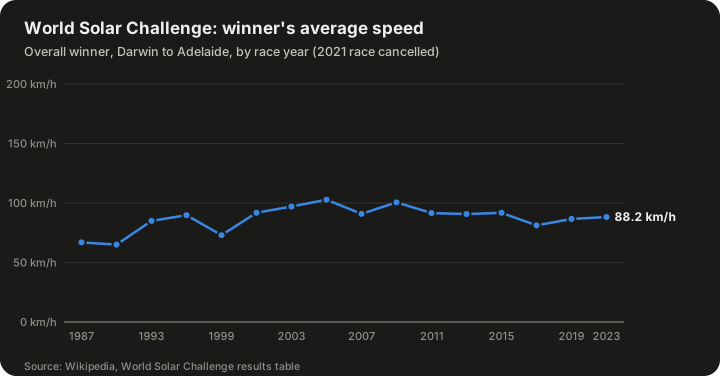
| Year | Winner | Winner's average speed (km/h) |
|---|---|---|
| 1987 | GM Sunraycer | 66.90 |
| 1990 | Spirit of Biel | 65 |
| 1993 | Honda Dream | 84.96 |
| 1996 | Honda Dream | 89.76 |
| 1999 | Aurora 101 | 72.96 |
| 2001 | Nuna (Delft) | 91.81 |
| 2003 | Nuna 2 | 97.02 |
| 2005 | Nuna 3 | 102.75 |
| 2007 | Nuna 4 | 90.87 |
| 2009 | Tokai Challenger | 100.54 |
| 2011 | Tokai Challenger | 91.54 |
| 2013 | Nuna 7 | 90.71 |
| 2015 | Nuna 8 | 91.75 |
| 2017 | Nuna 9 | 81.2 |
| 2019 | Agoria Bluepoint | 86.6 |
| 2023 | Innoptus | 88.2 |
Source: Wikipedia, World Solar Challenge results table. The article's text gives 90.07 km/h for 2007 while its table gives 90.87 km/h; the table value is shown here.
The chart shows why winning speeds have not simply kept rising. In 2005, the year Soleon raced, the Dutch Nuna 3 became the first winner to average more than 100 km/h. Organizers then tightened the rules. They cut array area in 2007, lowered battery mass limits in 2009 (lithium battery limits fell to 20 kg), cut array area again in 2017, and in 2025 set the collector area at 6 square metres with an 11 MJ battery limit. Each change was meant to keep speeds safe on public highways and keep teams innovating. Winning speeds since 2007 have mostly stayed between about 81 and 92 km/h, apart from 2009.
North American and American Solar Challenge
The North American event began as Sunrayce USA, organized by General Motors in 1990 after its Sunraycer won in Australia. GM chose to sponsor college races instead of racing itself. Races ran under the Sunrayce name in 1993, 1995, 1997 and 1999. In 2001 the event became the American Solar Challenge, sponsored by the U.S. Department of Energy and the National Renewable Energy Laboratory. From 2005 to 2008 it was the North American Solar Challenge, with Natural Resources Canada as co-sponsor and routes that ended in Calgary in both 2005 and 2008. Those two races are the reason the Calgary team exists. The American Solar Challenge name returned in 2010, and the event is now run by the Innovators Educational Foundation.
The race is a timed road rally on public roads. Teams drive set stages between checkpoints, with chase and lead vehicles around them, and the lowest total elapsed time wins. Total solar cell and reflector area is limited to 6 square metres. Since 2018 the race has had single-occupant (SOV) and multi-occupant (MOV) classes. The University of Michigan has won many of these races, and the 2026 event was won by the Innoptus Solar Team from KU Leuven in Belgium.
Formula Sun Grand Prix
The Formula Sun Grand Prix is a track race run by the Innovators Educational Foundation. It was first held in 2000, and the 2025 edition marked its 25th anniversary. It works as the qualifier for the American Solar Challenge in race years and as a standalone event in other years. Teams first go through several days of scrutineering, including dynamic tests of braking and handling, then race for laps on a circuit across several days, recharging from the sun in morning and evening sessions. The 2025 event in Bowling Green drew more than 30 teams from the United States, Canada and other countries. It was not a qualifier that year because the American Solar Challenge had last been held in 2024. Despite its name, the event has no link to Formula One or the FIA.
The Grand Prix suits a team like Calgary's. A track race needs less money and logistics than a cross-country rally, with no convoy of support vehicles and no weeks on the road, and it still tests the whole car under race conditions. Most of the team's results since 2015 have come from this event.
How the events compare
| Feature | World Solar Challenge | American Solar Challenge | Formula Sun Grand Prix |
|---|---|---|---|
| Format | Point-to-point road race | Point-to-point timed road rally | Closed-circuit track race |
| Typical distance | About 3,000 km, Darwin to Adelaide | Varies by year; 1,770 km in 2010 | Set by laps completed over the event |
| Where | Australia | United States (into Canada in 2005 and 2008) | U.S. motorsport tracks |
| Main challenge | Long distance, outback heat, wind, road trains | Weather, logistics, public-road traffic | Reliability, cornering, charging strategy |
| Calgary entries | 2005, 2007, 2011, 2013 | 2005, 2008, 2010 | 2015, 2019, 2022, 2025 |
| Cost and logistics | Highest: shipping the car and crew overseas | High: convoy vehicles, weeks on the road | Lowest of the three |
How the team is organized
The team describes itself as a student-run organization that designs, builds and races solar vehicles, and says it has places for engineers, designers and business students. Its members have mostly been undergraduates. In 2019 the team drew on the Schulich School of Engineering, the Faculty of Arts and the Haskayne School of Business. Leadership has included paired engineering and business roles. In 2019 Robert Dunn was engineering manager and co-chair and Sarah Lam was business manager and co-chair. The team has also had communications managers and technical leads such as an energy storage lead.
Most student solar car teams divide the work in similar ways, and Calgary's public material reflects that pattern:
| Area | Typical responsibilities |
|---|---|
| Mechanical | Chassis, suspension, steering, brakes, composite layup, crash structure |
| Electrical | Solar array, maximum power point trackers, battery pack and management, motor controller, wiring |
| Aerodynamics and body | Shell shape, ducts and cooling, testing and simulation |
| Software and telemetry | Driver displays, data logging, live data to the chase team |
| Strategy | Weather and route modelling, speed planning, race-day decisions |
| Business and communications | Sponsorship, budget, outreach, social media, event logistics |
The team's mailing address is in the Schulich School of Engineering, and it asks for sponsorship and donations through its website. The public record does not give a breakdown of the team's budget.
What the team gives students and the public
Education
The team's stated mission is to educate the community about sustainable energy and to give students and faculty from different departments a shared project. A solar car is a complete engineering system. Building one forces students to deal with trade-offs between mass, strength, cost, power and safety, with deadlines and tight budgets, and with a final test that cannot be faked. When a car fails scrutineering or breaks down on the road, the team learns why.
The business side matters just as much. Somebody has to raise money, manage sponsors, plan shipping and border crossings, and present the project to the public and the media. The team's 2019 structure, with paired engineering and business co-chairs, reflects this.
Outreach
The cars have a second life as teaching tools. Soleon was displayed at the Telus World of Science in Calgary for two years after 2008. Axiom became mainly a display vehicle, and Delta now does educational demonstrations. Seeing a working car that runs on sunlight makes renewable energy concrete for school groups and visitors.
Technology transfer
Some technologies used in solar racing, including high-efficiency cells, low-loss hub motors, careful battery management, and aerodynamic and lightweight design, also appear in mainstream electric vehicles. It would be wrong to claim that any specific consumer product came from the Calgary team. The broader point is that student teams train engineers in these technologies, and the skills move with them into industry.
Challenges a student team faces
Turnover
Students graduate. On a team made up mostly of undergraduates, the people who designed a car may be gone before it races. Elysia took more than four years from the start of design to its first race, which means many students who started it never raced it. Good documentation, overlap between experienced and new members, and simple, maintainable designs all help, but turnover is a constant problem.
Money and logistics
Racing overseas means shipping a car, spare parts, tools and a crew across the world. Long-distance rallies also need support vehicles. A track event like the Formula Sun Grand Prix is far cheaper, which helps explain why Calgary's recent racing has centred on it. High-efficiency GaAs cells add cost. Teams also rely on sponsors in money and in kind, and those relationships have to be rebuilt as students graduate.
Changing rules
Organizers change the rules often, sometimes significantly. The 2007 cut in array area, the 2009 battery limits, the 2013 creation of the Cruiser class, the 2017 array reduction, and the 2025 move to energy-limited batteries all forced teams to rethink their designs. A car built for one set of rules may be uncompetitive or illegal under the next. That is one reason Axiom was rebuilt in 2011 instead of simply being raced again.
Disruption
The COVID-19 pandemic stopped the team's plans and kept Elysia in the shop for most of two years, with the team only getting the car back in the fall of 2021. Uncertain race dates made it hard to keep members motivated, as the team's energy storage lead said at the time.
Weather and reliability
Even a well-built car can be beaten by clouds, wind and mechanical problems. Schulich I's crash before the 2007 race and Axiom's partial completion of the 2011 route show how hard the long road races are. In the Grand Prix, a single failure during scrutineering or a session can cost laps that cannot be recovered.
Common misconceptions about solar cars
"Solar cars run only on sunlight while they drive." All competitive solar cars carry a battery, and race rules allow and limit it. The battery smooths out clouds and hills and stores energy collected while the car is parked, including in morning and evening charging periods. Elysia could also be plugged into a wall charger, although race rules control when and whether outside charging is allowed.
"A faster top speed means a better solar car." Road races are decided by average speed over long distances under a fixed energy budget. Because drag rises steeply with speed, efficiency, reliability and strategy matter more than peak speed. Soleon had the team's highest listed top speed, 140 km/h, but later cars rated slower were built for very different rules and races.
"Solar race cars are prototypes of future family cars." The cars are research and teaching platforms built for specific race rules. Even cruiser-class cars like Delta and Elysia, which have doors, passenger seats and luggage space, are far lighter and more fragile than road cars. The engineering lessons carry over to electric vehicles. The cars themselves are not meant to be sold.
"Covering a car in panels could power a normal car." A normal car's roof and bonnet hold only a few square metres of panels. As the worked example shows, even 6 square metres of good cells give only about 1.3 kW in full sun. That is enough for a very light, very streamlined car but far less than a typical car needs at highway speed. Solar racers work because of their extreme efficiency, not just their solar cells.
"Not finishing the full World Solar Challenge route means the car failed." Many cars in the World Solar Challenge do not cover the whole route on solar power within the time limits. Results are often ranked by distance covered, and Axiom's 1,840 km in 2011 still placed it 18th of 37.
Frequently asked questions
When was the University of Calgary Solar Car Team founded? In the fall of 2004, so the university could compete in the 2005 North American Solar Challenge, which finished in Calgary.
What was the team's first car? The X1 prototype, commissioned in May 2005, was a training car with no working solar array. The first race car was Soleon, commissioned in June 2005.
What is the team's best result? Two stand out. Soleon finished 10th overall and first in its class at the 2005 World Solar Challenge, months after the team was formed. Schulich Elysia won the multi-occupant class at the 2019 Formula Sun Grand Prix and placed 4th overall.
Why are the cars named Schulich? After Seymour Schulich's 25 million dollar donation to the university, which the Alberta government matched, the engineering faculty became the Schulich School of Engineering. The team's cars since Schulich I have carried the name.
What is a cruiser-class solar car? A more practical solar car with more than one seat and features such as doors and cargo space. The World Solar Challenge added the class in 2013. Calgary's Schulich Delta was Canada's first, and Schulich Elysia followed.
How many people are on the team? The number changes from year to year. University reports gave about 60 students in 2019 and about 80 members in 2022.
What is the team working on now? Schulich Helios, aimed at the Formula Sun Grand Prix in summer 2026, with a theoretical top speed of about 110 km/h. Its final specification has not been published.
Can non-engineering students join? Yes. The team says it has places for engineers, designers and business students, and members have come from engineering, science, arts and business.
Where can I see one of the cars? Retired cars have been used for display and education. Soleon was shown at the Telus World of Science in Calgary for two years, and Delta does educational demonstrations. Contact the team for current displays.
Summary
The University of Calgary Solar Car Team began in a hurry in 2004, because a continental solar race was about to finish in its home city. In twenty years it has gone from a sticker-covered steel prototype to carbon-fibre racers with gallium arsenide cells and a two-seat car with a touchscreen, backup camera and plug-in charging. Its results include a class win in Australia in its first season, Canada's first cruiser-class solar car, and a class win at the 2019 Formula Sun Grand Prix. It has also dealt with the same problems as every student team: graduating members, changing rules, high costs, weather, and a pandemic that kept its newest car parked for two years. Its real output is the engineers and business graduates who have learned, by building something difficult, how much engineering it takes to run a car on sunlight.
Sources
- University of Calgary Solar Car Team (Wikipedia)
- Calgary Solar Car Team: Fleet background
- Calgary Solar Car Team: home page
- University of Calgary News: Blaze of glory for UCalgary solar car team in Texas (July 23, 2019)
- University of Calgary News: UCalgary solar car team back on Formula Sun Grand Prix podium (Aug. 19, 2022)
- World Solar Challenge (Wikipedia)
- American Solar Challenge (Wikipedia)
- Electrek: Formula Sun Grand Prix 2025, a brief history, full schedule and teams (June 25, 2025)