The Nevada Commission on Mineral Resources is a seven-member state board, appointed by the Governor, that sets policy and adopts regulations for the exploration and production of minerals, oil, gas and geothermal energy in Nevada. Its staff agency is the Nevada Division of Minerals (NDOM). The two are often treated as one body. Wikipedia's article on the agency describes it as the Division of Minerals and focuses on its job of regulating geothermal drilling, on private and public land alike. Its headquarters are in Carson City, and it also has an office in Las Vegas.
In practice the Commission and Division do much more than geothermal permitting. They permit and inspect oil and gas wells, regulate exploration wells for lithium and other minerals dissolved in underground brines, run a pooled bond programme that helps small miners pay for reclamation guarantees, keep the state's register of mining and energy operations, and run one of the largest abandoned-mine safety programmes in the United States. This article explains how the Commission is set up, what each of its programmes does, the numbers behind Nevada's mineral and geothermal industries, and the limits and common misunderstandings around the agency.
At a glance
| Item | Details |
|---|---|
| Name | Commission on Mineral Resources; staff agency is the Division of Minerals of the Commission |
| Governing law | Nevada Revised Statutes (NRS) Chapter 513, plus NRS 522 (oil and gas), 534A (geothermal), 534B (dissolved minerals) and 519A (reclamation bond pool) |
| Members | Seven, appointed by the Governor for four-year terms |
| Lineage | Nevada Oil and Gas Conservation Commission (from 1977); Oil, Gas and Mining Board (1983); Commission on Mineral Resources (1993) |
| Offices | Carson City (headquarters) and Las Vegas |
| Chief officer | The Administrator of the Division, appointed by the Commission |
| Main programmes | Abandoned Mine Lands; Oil and Gas; Geothermal; Dissolved Mineral Resource Exploration; Reclamation Bond Pool; Mining (claims and production data); Education and outreach |
| Chair (as reported) | Josh Nordquist (chair in 2021–2023 meeting records) |
History and lineage
Wikipedia traces the agency back to 1977, when it existed as the Nevada Oil and Gas Conservation Commission. It was replaced by the Oil, Gas and Mining Board in 1983, and that body was replaced by the Commission on Mineral Resources in 1993.
The statute notes in NRS Chapter 513 match this sequence. The definitions section was first added to the law in 1977 and amended in 1983, 1993 and 1999. The section that creates the seven-member Commission was added in 1983. The state's geothermal statute, NRS 534A, has an even older core. Its definition of a "geothermal resource" was added in 1975, before the agency took its current form.
Several of the agency's best-known programmes were added later by the Nevada Legislature:
| Year | Change |
|---|---|
| 1975 | Geothermal resources defined in state law (NRS 534A.010) |
| 1977 | Nevada Oil and Gas Conservation Commission; geothermal exploration data must be filed with the state |
| 1983 | Oil, Gas and Mining Board; seven-member commission structure written into NRS 513; geothermal well permits added to NRS 534A |
| 1987 | Abandoned Mine Lands (AML) programme created, funded by a fee on mining claim filings |
| 1989 | Counties allowed to apply for money to fix dangerous abandoned mines; "Good Samaritan" law for volunteer safeguards; reclamation bond pool created |
| 1993 | Body renamed the Commission on Mineral Resources |
| 2011 | Commission required to report to and advise the new Mining Oversight and Accountability Commission |
| 2017 | Assembly Bill 52 creates a permitting path for dissolved mineral (lithium brine) exploration, regulated from 1 January 2018 |
How the Commission is set up
NRS 513.023 creates the Commission on Mineral Resources and says the Governor must appoint seven members with specific backgrounds:
| Seat | Required background |
|---|---|
| Two seats | People familiar with large-scale mining |
| One seat | Someone familiar with the production of oil and gas |
| One seat | Someone familiar with exploration for and development of minerals |
| One seat | Someone familiar with the situations unique to small-scale mining and prospecting |
| One seat | Someone familiar with the development of geothermal resources |
| One seat | A member representing the general public |
Members serve four-year terms. The law describes the Commission as consisting of the appointed members and the Division (NRS 513.025), which is why the Division's formal name is "the Division of Minerals of the Commission".
Other rules in the statute:
- Chair. The members choose a Chair from among themselves, who serves at the pleasure of the Commission. Meeting records from 2021 show the Commission choosing a chair every two years.
- Secretary. The Administrator of the Division acts as Secretary and keeps minutes and recordings.
- Meetings. The Commission must meet at least once every four months. Special meetings can be called in an emergency by the Chair or the Administrator.
- Quorum. Four members.
- Pay. Members can receive no more than $80 a day while on Commission business, plus the standard state travel allowances.
Duties of the Commission
Under NRS 513.063 the Commission must:
- keep itself informed about the whole field of law and administration given to the Division;
- report to the Governor, the Mining Oversight and Accountability Commission and the Legislature on matters concerning the Division;
- advise and make recommendations to the same three on state policy on minerals;
- set the administrative policies of the Division;
- adopt the regulations needed to carry out the duties of the Commission and the Division.
In short, the Commission is the policy-setting and rule-making board. The Division does the day-to-day work.
The Division and its Administrator
NRS 513.073 tells the Division to:
- encourage and assist exploration for, and production of, oil, gas, geothermal energy and minerals in Nevada;
- collect and share information that educates people in those industries;
- keep a register of all mining operations and oil, gas and geothermal operations in the state;
- record the yearly production of each registered operation;
- administer the oil and gas law (NRS 522) and the Commission's regulations.
The Division's chief officer is the Administrator, who is appointed by the Commission, not by the Governor. The law requires a college graduate with substantial administrative experience or at least five years in mineral exploration, production or conservation. The Administrator must work full-time for the state and may not hold another paid office. Commission records show Mike Visher serving as Administrator from at least 2021 to 2023 and Robert Ghiglieri signing as Administrator by February 2024.
The Division may ask the Nevada Bureau of Mines and Geology (the state geological survey, based at the University of Nevada, Reno) and the State Engineer (who manages water rights) for help.
A promoter and a regulator at once
The Division's mission statement, repeated in its 2024 abandoned-mines report, is to "promote and support the responsible exploration and development" of the state's mineral, oil, gas and geothermal resources, and also to protect public safety at inactive and abandoned mine sites. That combination of promoting an industry and regulating it is common in western US states, but it is worth noticing. The Division describes four core responsibilities:
- public education and outreach;
- inventorying and fixing abandoned mine hazards;
- regulating oil, gas, geothermal and dissolved mineral exploration and drilling;
- managing the reclamation performance bond pool.
Note what is not on the list. The Division does not issue the main environmental permits for mines (those come from the Nevada Division of Environmental Protection), does not grant water rights (the State Engineer), and does not manage federal land (the Bureau of Land Management and US Forest Service). It also does not decide who owns a mining claim. As the Division's website explains, mining claims are governed by federal law, state statutes and county recording requirements.
Nevada's minerals and energy in numbers
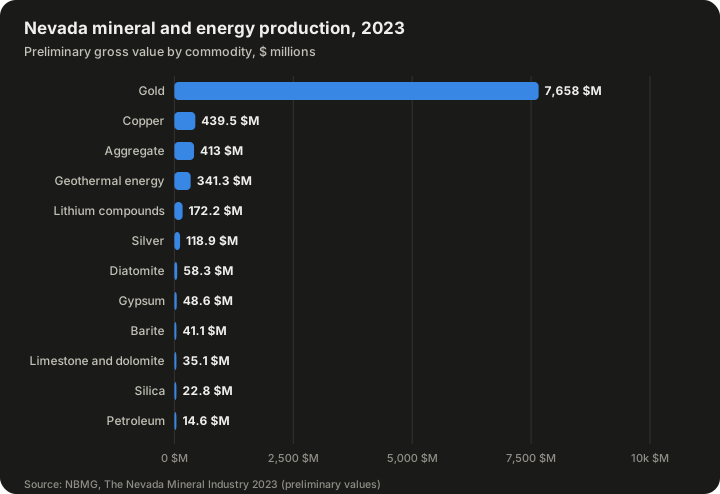
To understand why this small agency matters, it helps to see the size of what it oversees. The Nevada Bureau of Mines and Geology publishes an annual review, The Nevada Mineral Industry. Its 2023 edition gave these preliminary values of production. It notes they are preliminary because the state's official net proceeds figures had not yet been released.
| Commodity (2023) | Value ($ millions) |
|---|---|
| Gold | 7,658 |
| Copper | 439.5 |
| Aggregate (sand, gravel, crushed stone) | 413 |
| Geothermal energy | 341.3 |
| Lithium compounds | 172.2 |
| Silver | 118.9 |
| Diatomite | 58.3 |
| Gypsum | 48.6 |
| Barite | 41.1 |
| Limestone and dolomite | 35.1 |
| Silica | 22.8 |
| Petroleum | 14.6 |
Source: Nevada Bureau of Mines and Geology, The Nevada Mineral Industry 2023 (preliminary values).
A few points stand out:
- Gold dominates. Nevada led the US in gold production. Gold's $7.658 billion is about 82% of the combined value of the twelve commodities in the table ($9.36 billion).
- Geothermal is a major "mineral". At $341.3 million, geothermal energy was the fourth most valuable commodity, ahead of silver and lithium. This is why a minerals agency regulates geothermal wells.
- Lithium is unique here. NBMG says Nevada was the only US state producing lithium compounds from primary extraction. Lithium's value is volatile. NBMG's 2024 edition reported $62.0 million for lithium compounds, down from $172.2 million in 2023.
- Oil is small. Petroleum, at $14.6 million, was the smallest item in the table, but the Division still regulates every oil and gas well in the state.
- Barite. Nevada also led the nation in barite, a heavy mineral used in drilling mud.
Gold output also moves. Trade press coverage of the 2024 figures reported that Nevada's gold production fell by about 500,000 ounces, from 4 million ounces in 2023 to 3.5 million in 2024.
The geothermal programme
Geothermal energy is heat from the Earth's interior. In Nevada it is brought to the surface as hot water or steam through wells, run through power plants, and in most modern plants reinjected into the reservoir. According to the US Energy Information Administration (EIA), Nevada is one of a handful of states with utility-scale geothermal power and is second only to California in geothermal generation. EIA's state profile reports geothermal supplying about 10% of the state's in-state electricity generation.
What the law says
The rules are in NRS Chapter 534A. Its key provisions:
- Definition. A "geothermal resource" is the natural heat of the earth and the energy associated with it, pressure, and all dissolved or entrained minerals that can be taken from the fluid that carries the heat, but not hydrocarbons or helium.
- Ownership. The owner of the land owns the underlying geothermal resources unless they have been reserved by or conveyed to someone else. (On federal land, which covers most of Nevada, the federal government leases geothermal rights through the Bureau of Land Management, but the state permit is still needed to drill.)
- Permits. No one may drill or operate a geothermal well, or drill an exploratory well, without a permit from the Administrator of the Division of Minerals.
- Exploratory wells. The Administrator must approve or reject an application for an exploratory well permit within 10 days of receiving a complete application. The permit lasts no more than two years but can be extended.
- Production and injection wells. For a permit to drill or operate a geothermal well, the Administrator must send copies of the application to the State Engineer, the Nevada Division of Environmental Protection and the Nevada Department of Wildlife, and consult them. The permit may be issued if it is consistent with state water pollution and air quality policies, water law and wildlife law. The decision must be made within 90 days unless there is a conflict or a public hearing is needed.
- Hearings and conditions. The State Engineer and the Administrator may hold public hearings, jointly or separately. Permits must include any conditions the Administrator needs and any the State Engineer imposes under water law.
- Data filing and confidentiality. Exploration and subsurface data from a geothermal project must be filed with the Division within 30 days. It is kept confidential for five years unless the operator agrees to release it, though the Division must share it with the State Engineer and other state agencies, which must also keep it confidential.
- Water. Water brought to the surface and used consumptively outside a geothermal well needs a water right. Water that is reinjected into the same reservoir does not, nor do reasonable losses during well tests or temporary system failures.
- Fees and regulations. The Commission sets permit fees, which can be based partly on acreage, and the money goes into the Division's account. The Commission adopts the detailed regulations in the Nevada Administrative Code, Chapter 534A. The Division announced a public workshop on NAC 534A for 28 September 2026.
Why the state cares about the details
A geothermal reservoir is shared underground. A poorly built well can let hot, mineral-rich fluid leak into shallow drinking-water aquifers, or let cold groundwater flood a hot reservoir. A badly plugged old well can do the same decades later. That is why the permit process brings in the water, environmental and wildlife agencies, and why the Division approves well designs, receives drilling data and inspects wells.
Worked example: the permit clock
Hypothetical. Dates are for illustration only.
A developer submits a complete application for a geothermal production well on 1 March.
- If it is an exploratory well permit, the Administrator must decide by 11 March (10 days).
- For a production well, the Division sends the application to the State Engineer, NDEP and the Department of Wildlife. If there is no conflict and no hearing is needed, the decision is due within 90 days of 1 March, that is, by 30 May.
- If a conflict is found or a hearing is needed, the Division must tell the developer within those 90 days, and the timeline extends.
- Any drilling data the developer collects must be filed within 30 days and stays confidential for five years.
From prospect to power plant: where the Division fits
A geothermal project in Nevada goes through several stages. The Division's role is concentrated in the drilling stages, and it helps to see it alongside the other agencies.
| Stage | What happens | Where the Division comes in |
|---|---|---|
| 1. Rights to the resource | The developer secures the geothermal rights, by owning or leasing private land or, on federal land, by obtaining a federal geothermal lease | None directly. Under NRS 534A.050, the landowner owns the resource unless it has been reserved or conveyed |
| 2. Shallow exploration | Temperature-gradient holes and other shallow exploratory wells test how hot the ground is | Exploratory well permit, decided within 10 days; data filed within 30 days and kept confidential for 5 years |
| 3. Deep drilling and testing | Full-size wells are drilled and flow-tested to measure temperature, pressure and how much fluid the reservoir can deliver | Geothermal well permit after consulting the State Engineer, NDEP and the Department of Wildlife; approval of well design; inspections |
| 4. Water and environment | Water rights for any consumptive use; environmental permits for air and water | The State Engineer and NDEP lead. Reinjected fluid does not need a water right under NRS 534A.040 |
| 5. Operation | Production wells feed the power plant and injection wells return the cooled fluid to the reservoir | Ongoing permits to operate wells; production recorded in the Division's register |
| 6. Closure | Wells that are no longer needed are plugged and abandoned | Approval of plugging, so that old wells do not become leak paths between aquifers |
Two features of the Nevada system stand out. First, the same agency handles geothermal, oil and gas, and lithium-brine wells. All of them involve drilling into hot or pressurised fluids, so the engineering concerns are similar: casing, cementing, blowout prevention and plugging. Second, the confidentiality rule for geothermal data is a deliberate trade-off. The state gets a complete record of what is underground, which it can share with the State Engineer and other agencies. The developer gets five years of protection for exploration results that cost a great deal to collect. Once that period ends, the data can help later explorers and researchers.
The overlap between geothermal and lithium is also a reason the programmes sit together. NRS 534A defines a geothermal resource to include the dissolved minerals that can be recovered from the hot fluid. Companies are now exploring for both heat and lithium in the same basins, as the Division's public DMRE well applications show, and a single regulator that understands both kinds of well is better placed to handle such projects.
The oil and gas programme
Nevada is a minor oil producer, but every oil and gas well in the state falls under the Division. According to its oil and gas programme page, the Division is the state's regulatory authority for oil and gas wells on both private and federal land. The rules are in NRS and NAC Chapter 522.
The process works like this:
- The operator needs Division approval of the drilling and completion programme before starting work.
- While drilling and completing the well, the operator files daily reports.
- The Division inspects the well after completion.
- Maintenance, workovers, and the final plugging and abandonment of the well all need Division approval.
- Operators report production and injection monthly, and the Division tabulates the figures monthly and annually.
The Division publishes a list of Nevada oil producers and, in April 2017, a fact sheet on the use of hydraulic fracturing in Nevada. Production data is available through its open data site and the Bureau of Mines and Geology's well database.
Dissolved Mineral Resource Exploration (lithium brines)
The newest of the Division's regulatory programmes deals with minerals dissolved in underground water. The best-known example is lithium. Nevada's Clayton Valley, near Silver Peak, has long produced lithium from brine, and the global rush for battery materials brought many new companies looking for lithium brines in the state's closed desert basins.
Exploring for a brine is not like exploring for a rock. Explorers have to drill wells and pump and test water. Before 2018 there was no clear permitting path for that. A Division presentation pointed out that pumping and testing brine required a water right, which takes time and can be appealed.
Assembly Bill 52, passed in 2017 and signed into law in June 2017, created a new statute chapter, now NRS 534B, with regulations in NAC 534B. According to the Division:
- the law sets out a permitting path for dissolved mineral exploration, including lithium brines;
- it requires regulations to protect groundwater, oil and geothermal resources from exploration drilling;
- the Division began regulating the programme on 1 January 2018;
- it accepts applications for DMRE wells and notices of intent for DMRE exploration boreholes;
- before drilling, operators must check whether the site lies in an "area with limitations" under NAC 534B, using the Division's map.
A 2023 Division presentation reported a total of 47 DMRE notices and 17 well permits approved. The Division's DMRE well applications are public. They include, for instance, filings by geothermal-and-minerals explorers, which shows how closely geothermal and lithium brine exploration are now linked: hot brines can carry dissolved lithium.
The reclamation bond pool
Every mine and exploration project on public land in Nevada must post a bond, a financial guarantee that the land will be reclaimed if the operator walks away. For a large company that is routine. For a small miner or explorer, finding a commercial surety can be hard or impossible.
The Nevada Legislature addressed this in 1989. NRS 519A.290, amended in 1993, 1997 and 1999, requires the Division of Minerals to run a programme that pools reclamation performance bonds. It must be designed to reduce the financial burden of getting a bond for mining operations, small mining operations, exploration projects and small exploration projects.
How it works, according to the Division and a 2006 legislative audit:
- Operators apply for coverage from the pool to satisfy the bond requirement of the agency regulating them, which is either the Bureau of Land Management or the Nevada Division of Environmental Protection.
- The pool does not decide how big the bond must be. BLM or NDEP does that.
- Participants pay a deposit and then quarterly or annual premiums.
- All participants sign an indemnity agreement. If a participant's bond is forfeited and the pool pays for reclamation, the Attorney General can sue the operator to recover the cost.
- The audit described the pool as providing reclamation bonds for operators who cannot get one through commercial means.
The detailed rules, including how deposits are calculated, are in NAC 519A. The Commission revised them in 2019.
The Abandoned Mine Lands programme
The programme most Nevadans have heard of is the one that fences and fills old mine openings. Nevada has been mined for more than 150 years. The Division's 2024 report estimates there are about 300,000 historic mining features statewide, such as open shafts, adits (horizontal tunnels) and abandoned mill sites. It estimates that about 35,000 of them pose significant safety risks that may need fixing. (The 2023 report gave a range of 40,000 to 50,000, showing how much such estimates change.)
Why it exists
The Legislature created the AML programme in 1987 after fatal and non-fatal accidents at abandoned mines. Such accidents go back to the Comstock Lode silver boom of the 1860s; the Division's reports record the first known death in 1861. NRS 513.094 and the 2024 report set out three main functions:
- Inventory and rank dangerous conditions at mines that are no longer operating, and identify and notify the owner or responsible person where that is feasible.
- Secure hazards on open public land where no claimant or owner can be found.
- Educate the public to recognise and avoid these hazards.
Each January, the Administrator must tell every board of county commissioners about the dangerous conditions found in its county and how they rank. If a claimant does not secure a hazard on time, the county can act under NRS 455. It can issue warnings through the sheriff, have the work done at the owner's expense, and impose fines of up to $250 per violation.
In 1989 the Legislature also passed a "Good Samaritan" law (NRS 41.0331) that lets companies, individuals and civic groups volunteer to build fences or other safeguards around dangerous mine openings.
How it is paid for
The 2024 report states that no state general funds are used to run the AML programme. Money comes from three sources:
| Source | Details |
|---|---|
| Mining claim fee | A fee on each unpatented mining claim filing, collected by county recorders and passed to the Division. The law caps it at $4 per claim; the current fee is $4 (NAC 513.315). |
| Disturbance fee | A one-time fee of $20 per acre of permitted disturbance in new or amended mining or exploration plans of operation on public land (NRS 519A.250). |
| Partner agreements | Assistance agreements with the Bureau of Land Management, US Forest Service and National Park Service. Partners provided $732,239 in 2024. |
Worked example: funding from the fees
Hypothetical figures, for illustration.
- A company files a new plan of operations that will disturb 500 acres of public land. The one-time AML fee is 500 × $20 = $10,000.
- A prospector holding 40 unpatented claims pays the $4 AML fee on each filing: 40 × $4 = $160 a year toward the programme.
Results over time
The Division reports its progress in annual reports. The 2024 figures:
- No reported abandoned mine incidents, the twelfth year in a row without a reported fatality.
- More than 161,000 historic mining features catalogued since 1987.
- 26,030 hazards discovered and ranked since the programme began, with 21,314 recorded as secured. That is 81.9%.
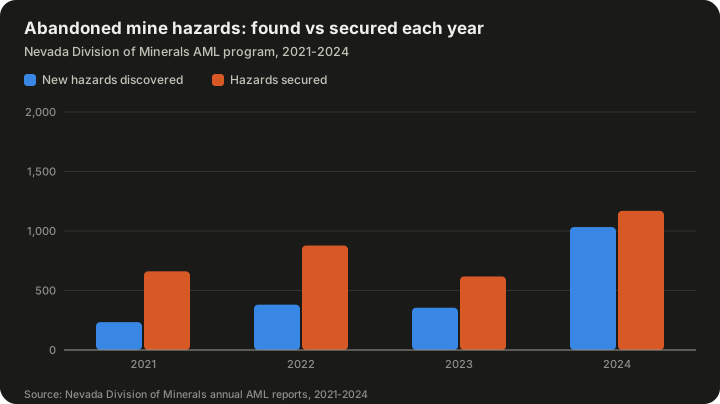
- 1,033 new hazards discovered and 1,169 secured during the year.
- 1,451 known hazards revisited to check that earlier safeguards were still intact.
- Field assessments at 2,602 previously and newly documented sites.
- Ten hard-closure projects in Clark, Humboldt, Mineral, Lander, Lincoln, Lyon, Nye, Washoe and White Pine counties, covering 183 sites.
- The Division and its contractors accounted for 95% of all hazards inventoried and 71% of all securings in Nevada.
| Year | New hazards discovered | Hazards secured | Cumulative discovered | Cumulative recorded secured |
|---|---|---|---|---|
| 2021 | 234 | 661 | 23,962 | 19,753 |
| 2022 | 381 | 878 | 24,634 | 20,388 |
| 2023 | 355 | 618 | 24,989 | 20,740 |
| 2024 | 1,033 | 1,169 | 26,030 | 21,314 |
Source: Nevada Division of Minerals, annual AML reports 2021–2024.
Two things in these figures need care. First, the jump in discoveries in 2024 reflects more searching, not more danger. The Division says its 2024 ranking weighted suspected hazard locations much more heavily than in earlier years, and it uses LiDAR imagery, Google Earth, cloud-based mapping apps and drones to find features. Second, the yearly numbers do not simply add up to the cumulative totals. For example, 1,169 hazards were secured in 2024, but the cumulative "currently recorded as secured" total rose by only 574. The reports do not reconcile the two series. They do describe revisiting old sites to check whether earlier fences and signs are still intact, which is one way a recorded total can differ from a simple running sum.
Ways a hazard is secured
| Method | Typical use |
|---|---|
| Fencing and signs | Quick, cheap temporary securing; needs revisits and repairs |
| Backfill | Filling a shaft or adit with earth or rock; permanent |
| Polyurethane foam (PUF) plugs with backfill | Permanent closure of deep shafts; the 2024 report shows PUF and backfill used at the Olinghouse project in Washoe County |
| Bat-compatible closures (BCC) | Where surveys find bats or other wildlife using the mine |
| Plugs | Concrete or other seals at the opening |
The closure method is chosen with the help of biological and cultural surveys carried out under the National Environmental Policy Act, because old mines can be habitat for bats and can be historic sites in their own right. In 2023, for example, the Division completed 128 permanent closures using backfills, foam plugs or bat-compatible closures.
Mining data, claims and outreach
The Division also acts as an information service. Under NRS 513.073 it keeps the register of mining, oil, gas and geothermal operations and records their annual production. It publishes major-mine lists, producer lists, quantity-and-value-of-production tables and other reports, and it has suggested forms for documents that must be recorded to locate or keep a mining claim.
Its outreach work includes school presentations, videos, handouts and classroom exercises, mostly on the "stay out, stay alive" message about abandoned mines. With the Commission, it gives annual Excellence in Mine Reclamation Awards. The 2026 awards went to SSR Mining (Marigold mine, tailings reclamation) and Nevada Gold Mines (Rain mine, innovative reclamation techniques), with an honourable mention for KG Mining (Bald Mountain).
In August 2026, the Governor signed a memorandum of understanding with the federal Permitting Improvement Steering Council, which oversees the federal FAST-41 process for major infrastructure permits. The Division, with the Governor's Office and the Governor's Office of Energy, will coordinate state agencies on FAST-41 projects.
The Commission's place in Nevada government
The Commission sits in a crowded field. A rough map of who does what:
| Body | Main role in minerals and energy |
|---|---|
| Commission on Mineral Resources / Division of Minerals | Policy and regulations; well permits for oil, gas, geothermal and dissolved-mineral exploration; AML; bond pool; production register |
| Nevada Division of Environmental Protection | Mine reclamation permits, water pollution control and air quality permits |
| State Engineer (Division of Water Resources) | Water rights, including for mines and brine pumping |
| Nevada Bureau of Mines and Geology (University of Nevada, Reno) | State geological survey; mapping, research, annual mineral industry report |
| Nevada Department of Wildlife | Consulted on geothermal well permits; wildlife protection |
| Mining Oversight and Accountability Commission | Legislative-created oversight body that receives reports from the Commission and the Administrator |
| Nevada Department of Taxation | Net proceeds of minerals tax |
| Bureau of Land Management / US Forest Service | Manage federal land, which covers most of Nevada; federal mining claims and geothermal leases |
| Counties | Record mining claims; enforce AML securing orders |
The Administrator must attend each regular meeting of the Mining Oversight and Accountability Commission, created under NRS 514A.040, to report on the Division's activities and on the state of mining and of oil, gas and geothermal production. That reporting duty dates from 2011 and 2013 amendments.
Limits and criticisms
The agency is small for the size of the industries around it, and its structure has some built-in tensions.
Industry representation. Six of the seven seats must go to people familiar with large-scale mining, oil and gas, mineral exploration, small-scale mining or geothermal development. Only one represents the general public. This is a common design for technical regulatory boards, but critics of the mining industry argue that it gives the regulated industries a strong voice in writing their own rules.
Promotion versus regulation. By law the Division must "encourage and assist" exploration and production while also regulating wells and protecting the public from abandoned mines. Supporters say the expertise needed for both is the same. Critics see a potential conflict.
Fee-based funding. The AML programme runs without state general funds, on claim fees, acreage fees and federal partners. This means its budget depends on how many mining claims are filed and how much new disturbance is permitted, which rises and falls with metal prices.
A huge backlog. Even after nearly four decades, the Division estimates tens of thousands of significant hazards remain, against about 26,000 found and ranked so far. With a few hundred to about a thousand securings a year, the work will continue for many years.
Narrow environmental remit. People sometimes expect the Commission to rule on whether a mine or lithium project should go ahead. It does not. Those decisions involve federal land managers, NDEP, the State Engineer and, often, the courts.
Common misconceptions
"The Commission regulates all mining in Nevada." It does not issue the main environmental permits for mines, does not grant water rights and does not manage federal land. Its direct permitting powers are over wells: oil, gas, geothermal and dissolved-mineral exploration.
"It only deals with geothermal." Wikipedia's short article emphasises geothermal drilling, but geothermal is one of several programmes. The abandoned-mines programme is probably the largest by field effort.
"The Commission and the Division are separate agencies." Legally, the Division is part of the Commission. The Commission sets policy and appoints the Administrator, who runs the Division and serves as the Commission's Secretary.
"Abandoned mines are mostly fixed." About 82% of the hazards the programme has found are recorded as secured, but the Division's own estimate of significant hazards is far higher than the number found so far.
"A fenced mine is safe." Fences and signs can be damaged or removed. That is why the Division revisited 1,451 hazards in 2024 to check earlier work. The safest rule is still to stay out of any old mine opening.
"Lithium exploration needs no special permit because it is just water." Since 1 January 2018, dissolved-mineral exploration wells and boreholes in Nevada require a Division permit or notice under NRS 534B.
Frequently asked questions
Who appoints the Commission? The Governor appoints all seven members for four-year terms.
Who chairs it? The members elect a Chair from among themselves. Commission records and Wikipedia list Josh Nordquist as Chair; meeting minutes show him in the role from 2021 through at least 2023.
Where is it based? The headquarters are in Carson City, with a second office in Las Vegas.
Do I need a state permit to drill a geothermal well in Nevada? Yes. NRS 534A.060 says no one may drill or operate a geothermal well, or drill an exploratory well, without a permit from the Administrator of the Division of Minerals.
How long does a geothermal permit take? By law, an exploratory well decision is due within 10 days of a complete application. A production or injection well decision is due within 90 days, unless there is a conflict or a hearing is needed.
Who pays for fixing abandoned mines? Mainly the mining industry, through a $4 fee per mining claim filing and a one-time $20 per acre fee on new disturbance, plus federal partner agreements. No state general funds are used.
What should I do if I find an open mine shaft? Stay away, keep children and pets away, and report it to the Division of Minerals, which has a hazard reporting page on its website.
Can volunteers help secure old mines? Yes. Nevada's Good Samaritan law (NRS 41.0331), passed in 1989, allows companies, individuals and civic groups to help build fences or other safeguards.
Does the Commission regulate lithium mines? It regulates exploration wells for dissolved minerals such as lithium brines. Open-pit lithium clay mines need other permits from federal and state agencies.
How much is Nevada's geothermal energy worth? NBMG valued geothermal energy production at $341.3 million in 2023 (preliminary), the fourth most valuable commodity in the state.
Summary
The Nevada Commission on Mineral Resources is a seven-member, governor-appointed board, and its Division of Minerals is a small agency with a wide brief. It grew out of an oil and gas conservation commission created in 1977 and took its current name in 1993. Today it writes the rules for, and issues permits for, oil, gas, geothermal and lithium-brine wells; keeps the register of every mining and energy operation in a state whose gold production alone was worth about $7.7 billion in 2023; helps small operators bond their reclamation; and spends much of its field effort making old mine openings safe, with more than 21,000 hazards secured since 1987 and no reported fatalities for twelve straight years. It is also, by law, a promoter of the industries it regulates, with a board drawn mostly from those industries. That dual role, and the gap between what it does and what people sometimes assume it does, is the key to understanding it.
Sources
- The State of Nevada Commission on Mineral Resources (Wikipedia)
- Nevada Division of Minerals – official website
- NRS Chapter 513 – Commission on Mineral Resources (Nevada Legislature)
- NRS Chapter 534A – Geothermal Resources (Nevada Legislature)
- NRS Chapter 534B – Dissolved mineral resources (Nevada Legislature)
- Nevada Division of Minerals – Dissolved Mineral Resource Exploration (DMRE)
- Nevada Division of Minerals – Oil and Gas programme
- Nevada Division of Minerals – Bond Pool (Reclamation)
- Nevada Legislative Counsel Bureau – Audit LA06-15, Division of Minerals (2006)
- Nevada Division of Minerals – 2024 Abandoned Mine Lands Report
- Nevada Division of Minerals – 2023 AML Report
- Nevada Division of Minerals – 2022 AML Report
- Nevada Division of Minerals – 2021 AML Report
- Nevada Division of Minerals – presentation to the Nevada Water Resources Association (Jan 2023)
- Commission on Mineral Resources – minutes, 22 July 2021
- Commission on Mineral Resources – meeting packet, 15 February 2024
- Nevada Bureau of Mines and Geology – The Nevada Mineral Industry 2023
- Nevada Bureau of Mines and Geology – The Nevada Mineral Industry 2024
- E&MJ – Gold production slipped in 2024 as prices climbed
- US Energy Information Administration – Nevada State Profile and Energy Estimates