The Smart Grid Interoperability Panel (SGIP) was an American organization set up to solve an unglamorous but basic problem in modernizing the electric grid. The devices and software that make up a "smart" grid, including meters, substation controllers, rooftop solar inverters, building energy systems, electric vehicle chargers and utility back-office software, come from hundreds of vendors. If they cannot exchange information reliably, every utility project turns into a custom integration job, equipment gets locked to a single supplier, and money spent today may be stranded tomorrow. SGIP's job was to get the people who write standards, the people who build equipment and the people who buy it into the same room, and to push the standards process toward a set of specifications that fit together.
The National Institute of Standards and Technology (NIST) launched SGIP in late 2009 as a public-private partnership. It became an independent, member-funded non-profit at the start of 2013, and in April 2017 it merged into the Smart Electric Power Alliance (SEPA), which carries on parts of its work under the SEPA name. This article explains why the panel was created, how it was organized, what it produced, which standards it helped move forward, and what its record says about the limits of coordinating a voluntary standards system. It draws mainly on NIST's own Framework documents, especially Release 3.0 of the NIST Framework and Roadmap for Smart Grid Interoperability Standards (Special Publication 1108r3, 2014), along with federal energy data and contemporary reporting.
What "interoperability" means here
NIST's Framework defines interoperability as "the capability of two or more networks, systems, devices, applications, or components to exchange and readily use information—securely, effectively, and with little or no inconvenience to the user." Two parts of that definition matter. The first is exchange: devices must be able to connect and pass messages at all, which is a question of communication protocols. The second is readily use: once a message arrives, the receiving system has to understand what it means. A meter reading in kilowatt-hours is useless to a system that expects watt-hours, or that labels the same quantity under a different name. Much of the hard work in grid interoperability is at this second, semantic level, in shared information models that define what a "transformer," a "price signal" or a "demand response event" actually is in data.
An everyday comparison helps. Electrical plugs and sockets are interoperable because a physical standard fixes their shape, voltage and frequency. Data interoperability is the same idea applied to information, and it is harder, because information can be structured in endlessly many ways and because electricity systems were historically built as separate islands. A utility's billing system, its outage management system, its substation automation and its customer programs often grew up separately, with their own data formats. The smart grid vision assumes those islands talk to one another, and to millions of customer-owned devices besides.
Why the panel was created
The legal mandate
The direct origin of SGIP is the Energy Independence and Security Act of 2007 (EISA), Public Law 110-140. Title XIII of that law dealt with the smart grid, and Section 1305 gave NIST "primary responsibility to coordinate development of a framework that includes protocols and model standards for information management to achieve interoperability of smart grid devices and systems." The same section gave the Federal Energy Regulatory Commission (FERC) a follow-on role: once FERC judged that the NIST-coordinated process had produced "sufficient consensus," it was to begin rulemaking to adopt standards needed for smart grid functionality and interoperability.
NIST does not write most of the standards in question. Organizations such as the IEEE, the International Electrotechnical Commission (IEC), ANSI-accredited bodies, the North American Energy Standards Board (NAESB) and industry alliances do that. NIST's assignment was coordination: identify which standards already existed, find the gaps and overlaps, and steer the relevant standards bodies toward filling them.
The stimulus deadline
Timing added pressure. The American Recovery and Reinvestment Act of 2009 (ARRA) poured money into grid modernization, including the Department of Energy's Smart Grid Investment Grant (SGIG) program, which was funded at $3.4 billion. According to a DOE summary of the ARRA results, those federal grants went to 99 projects, and recipients added $4.7 billion of their own money. DOE's final report on the program says it launched in 2009, with projects starting in 2010 and finishing in 2015. Utilities were about to install millions of smart meters and other devices on a short timetable. NIST's Release 3.0 notes that grant applicants "were required to describe how the projects would support the NIST Framework." If the standards picture was still murky when that hardware went in, much of it might not work together later.
NIST's three-phase plan
NIST responded with a three-phase plan, described in Release 3.0:
- Accelerate the identification of, and consensus on, smart grid standards.
- Establish a robust Smart Grid Interoperability Panel to sustain the development of the many additional standards that would be needed.
- Create a conformity testing and certification infrastructure.
Beginning in 2008 and through 2009, NIST convened workshops and meetings with experts and stakeholders. By the end of 2009 it had a roadmap and an initial set of standards (Phase 1), which it published in January 2010 as Release 1.0 of the NIST Framework. SGIP was the vehicle for Phase 2 and much of Phase 3. Release 3.0 dates SGIP's establishment to November 2009; the Wikipedia summary gives December 2009. The panel was formally launched at the end of 2009 either way.
Timeline at a glance
| Date | Event |
|---|---|
| December 2007 | EISA (Public Law 110-140) signed; Section 1305 gives NIST its coordination role |
| 2008–2009 | NIST workshops and stakeholder meetings |
| Late 2009 | SGIP established as a NIST-led public-private partnership |
| January 2010 | NIST Framework Release 1.0 (SP 1108) published |
| August 2010 | NISTIR 7628, Guidelines for Smart Grid Cyber Security, released |
| November 2010 and January 2011 | FERC technical conferences on smart grid interoperability standards |
| July 2011 | FERC order declines to start a rulemaking, citing insufficient consensus |
| January 2012 | Interoperability Process Reference Manual (IPRM) released |
| February 28, 2012 | NIST Framework Release 2.0 published |
| December 2012 – January 2013 | SGIP becomes "Smart Grid Interoperability Panel 2.0, Inc.," an industry-led non-profit |
| 2014 | Sharon Allan appointed president and CEO |
| September 2014 | NIST Framework Release 3.0 (SP 1108r3) and Revision 1 of NISTIR 7628 published |
| March 2016 | NAESB members ratify OpenFMB |
| April 2017 | SGIP merger into the Smart Electric Power Alliance completed |
| February 2021 | NIST Framework Release 4.0 (SP 1108r4) published |
How SGIP was organized
The government-funded era, 2009–2012
In its first phase, SGIP was funded by the government and charged members no dues. Release 3.0 lists its three primary functions in that era:
- to oversee activities meant to speed up the development of interoperability and cybersecurity specifications by standards-setting organizations;
- to provide technical guidance for the development of standards for a secure, interoperable smart grid;
- to specify testing and certification requirements needed to assess the interoperability of smart grid equipment.
Direction came from a combination of NIST; EnerNex, a contractor that served as SGIP Administrator; and an elected Governing Board with its committees. The board had a distinctive design. SGIP recognized 22 stakeholder communities, such as utilities of different types, equipment makers, IT and communications companies, regulators, consumer advocates and standards bodies, and each community elected one representative to the board. Members also elected three at-large board members. NIST later wrote that despite worries about managing so many constituencies, "the large stakeholder group was effective," because it gave many people a stake and a voice.
Membership grew quickly. By the end of the government-funded period, according to Release 3.0, SGIP had "over 790 organizational members and over 1900 individual members."
The working groups
SGIP did its technical work in several kinds of groups. In the 2009–2012 period, Release 3.0 lists:
| Type of group | Groups |
|---|---|
| Domain Expert Working Groups (DEWGs) | Building-to-Grid; Business and Policy; Distributed Renewables, Generators and Storage; Home-to-Grid; Industry-to-Grid; Transmission and Distribution; Vehicle-to-Grid |
| Standing committees and permanent working groups | Cybersecurity Working Group; Implementation Methods Committee; Smart Grid Architecture Committee; Smart Grid Testing and Certification Committee |
| Other working groups | Electromagnetic Interoperability Issues; Gas Infrastructure Working Group |
| Priority Action Plans (PAPs) | 22 PAPs operating during the period |
The domain expert groups were where users described what they needed: how a building energy management system should respond to a grid signal, for example, or what information a car charger needs to exchange with a utility. The standing committees ran cross-cutting reviews. Every standard proposed for SGIP's catalog was checked against the architecture committee's principles and the cybersecurity group's requirements. The testing and certification committee worked out how to tell whether a product really met a standard.
Later descriptions, including the Wikipedia summary, group the work under architecture, grid management, cybersecurity, distributed resources and generation, and testing and certification. Those labels describe the same areas through the later committee structure.
Priority Action Plans
The Priority Action Plans were SGIP's most characteristic tool. A PAP was a time-limited project set up when a specific gap or conflict in the standards landscape needed fixing quickly. NIST describes them as projects "run under a common PMO-directed process that addressed standards gaps or harmonization needs." A PAP working group gathered detailed requirements from across stakeholder communities and handed them to the standards organizations that owned the relevant documents. Then the PAP checked the standards body's output against those requirements. Because the standards bodies took part in the PAPs, they tended to make the PAP requirements priorities in their own work.
By the time of Release 3.0 in 2014, the number of PAPs had grown to 25 (counting PAP00), and 13 had been completed. PAPs named in Release 3.0 include:
| PAP | Subject |
|---|---|
| PAP01 | Role of Internet Protocol (IP) in the smart grid |
| PAP03 | Common price communication model |
| PAP04 | Common scheduling mechanism |
| PAP05 | Standard meter data profiles |
| PAP07 | Energy storage interconnection guidelines |
| PAP08 | Common Information Model (CIM) and IEC 61850 harmonization for distribution grid management |
| PAP09 | Standard demand response and distributed energy resource signals |
| PAP10 | Standard energy usage information |
| PAP11 | Common object models for electric transportation |
| PAP12 | Mapping IEEE 1815 (DNP3) to IEC 61850 objects |
| PAP13 | Harmonization of IEEE C37.118 with IEC 61850 and precision time synchronization |
| PAP15 | Harmonizing power line carrier standards for appliance communications in the home |
| PAP17 | Facility smart grid information standard |
| PAP18 | Coexistence of SEP 1.x and SEP 2.0 |
The list shows how practical the work was. PAP10, on standard energy usage information, fed into the effort that gave consumers access to their own electricity data in a standard format. PAP09, on demand response signals, connected to OpenADR. PAP12 and PAP13 were about making two families of utility protocols, one North American and one international, describe the same physical equipment in consistent ways.
The Catalog of Standards
SGIP also kept a Catalog of Standards (CoS), described by NIST as "a compendium of standards and practices considered to be relevant for the development and deployment of a robust and interoperable smart grid." Each entry carried extensive information about the standard's scope, maturity and reviews. Release 3.0 is clear that the catalog was a reference, not a mandate: "it is not anticipated that the standards will be made mandatory."
During 2010–2012, SGIP approved 58 standards into the catalog. By August 2014, 59 entries had been accepted.
Key publications
Two documents from the early years stand out. The first is NISTIR 7628, Guidelines for Smart Grid Cyber Security, released in August 2010 and revised in September 2014. It was produced through SGIP's cybersecurity working group. The second is the Interoperability Process Reference Manual (IPRM), released in January 2012, which set out how testing and certification programs for smart grid standards should work.
The NIST Framework releases
SGIP's work fed directly into successive editions of NIST's Framework. Each edition summarized the standards landscape at that moment.
| Release | Publication | Date | Highlights |
|---|---|---|---|
| 1.0 | NIST SP 1108 | January 2010 | Conceptual reference model; 75 existing standards identified as applicable or likely applicable; 15 high-priority gaps and harmonization issues; action plans; cybersecurity strategy |
| 2.0 | NIST SP 1108r2 | February 28, 2012 | Expanded lists of standards; progress since SGIP's founding; architecture, cybersecurity, and testing and certification chapters |
| 3.0 | NIST SP 1108r3 | September 2014 | Smart grid treated as a cyber-physical system; updated standards list (Table 4-1); SGIP's transition to an industry-led body |
| 4.0 | NIST SP 1108r4 | February 2021 | Updated conceptual model; interoperability profiles for testing and certification; cybersecurity risk guidance |
Release 1.0 described its 75 standards as "applicable (or likely to be applicable)." NIST's Tech Beat announcement of Release 3.0 said its list "includes 74 standards and protocols," including seven standards that had not been listed in 2.0. The numbers stayed similar, but the composition shifted as PAP outputs were added and older documents were replaced. Release 4.0 was written by NIST staff Avi Gopstein, Cuong Nguyen, Cheyney O'Fallon, Nelson Hastings and David Wollman, after SGIP had already merged into SEPA. It shows that the Framework carried on as a NIST product after the panel itself was gone.
The conceptual model
One of the most widely reused products of the process is the NIST smart grid conceptual model, introduced in Release 1.0. It divides the grid into seven domains:
| Domain | Description (from NIST) |
|---|---|
| Customer | The end users of electricity, who may also generate, store and manage energy; sub-domains for home, commercial/building and industrial |
| Markets | The operators and participants in electricity markets |
| Service Provider | The organizations providing services to electrical customers and to utilities |
| Operations | The managers of the movement of electricity |
| Generation | The generators of electricity, who may also store energy for later distribution |
| Transmission | The carriers of bulk electricity over long distances, who may also store and generate electricity |
| Distribution | The distributors of electricity to and from customers, who may also store and generate electricity |
NIST stresses that "domains are not organizations." A regional transmission organization may have actors in both the Markets and Operations domains. A distribution utility will have actors in the Distribution domain, in Operations (its distribution management system) and in Customer (its meters). The model's value is that it gives everyone a shared map. When a standard is proposed, people can say which domains it connects and which interfaces it governs. Release 3.0 also notes that the domains may change over time, for instance with "Bulk Generation" becoming simply "Generation" as distributed energy resources grow in importance.
The standards SGIP worked with
SGIP did not invent a single "smart grid standard." It worked across a portfolio of existing and emerging specifications. The table below lists some of the best-known standards that appear in the NIST Framework and the PAP work, with their general purpose.
| Standard | General purpose |
|---|---|
| IEC 61850 | Communication and data modeling for substation automation and other utility field equipment |
| IEC 61968 / IEC 61970 (Common Information Model) | Shared information model for utility enterprise and control-center applications |
| IEEE 1815 (DNP3) | Widely used North American protocol for supervisory control and data acquisition between control centers and field devices |
| IEEE C37.118 | Synchrophasor measurements and data transfer |
| IEEE 1547 | Interconnection and interoperability of distributed energy resources with the grid |
| UL 1741 | Safety standard for inverters and related equipment used with distributed resources |
| OpenADR 2.0 | Automated demand response signaling between utilities and customer systems |
| Smart Energy Profile 2.0 (later IEEE 2030.5) | Communication between utilities and devices in homes and businesses |
| NAESB REQ18 and related energy usage information standards | Standard model for energy usage information, the basis of consumer data access efforts |
| ANSI C12 series | Electricity metering |
| IEEE 1588 | Precision Time Protocol for clock synchronization |
| IPv4 / IPv6 | Internet Protocol, assessed under PAP01 for smart grid use |
Release 3.0 lists "multiple new or revised standards, including Open ADR 2.0, SEP2, IEEE 1547, NAESB REQ18, and UL 1741 standards" among outcomes with major NIST contributions in the years after Release 2.0. It also notes that the coordination effort by then spanned "more than 25 standards-development organizations (SDOs) and standards-setting organizations (SSOs)."
Why harmonization mattered
Several PAPs dealt with harmonization rather than new standards. The best example is the relationship between the IEC's Common Information Model and IEC 61850. Both are international standards, both describe utility equipment, and both were developed by different committees with different modeling choices. Software built around one did not automatically understand data from the other. PAP08 worked on making them consistent for distribution grid management. Similarly, PAP12 mapped DNP3, which is deeply embedded in North American utility operations, onto IEC 61850 objects, so utilities could gradually adopt the newer model without throwing out installed equipment.
This reflects a principle that runs through the NIST documents: backward compatibility. Release 3.0 says grid modernization "should ensure backward compatibility with existing technology to the greatest extent practical." Utility assets last for decades. A standards strategy that required replacing everything at once would not have been adopted.
Cybersecurity
Connecting grid equipment to networks creates paths for attack that did not exist when relays and meters were purely electromechanical. Cybersecurity was therefore built into SGIP from the start, first as the Cybersecurity Working Group and later, after the 2013 transition, as the Smart Grid Cybersecurity Committee.
The main product was NISTIR 7628. It offered a framework for organizations to analyze the logical interfaces in their smart grid systems, assign security requirements to them, and address privacy risks such as the detailed household information that fine-grained meter data can reveal. Its revision was published in September 2014.
SGIP's cybersecurity approach also put a security review step into the Catalog of Standards. A standard was not added to the catalog until the cybersecurity committee had reviewed it. That did not make any standard "secure" by itself. Security depends on how products are built and operated. But it did mean that known gaps were documented and could be taken back to the standards body.
NIST later pointed to the SGIP experience as a model for national cybersecurity policy. Release 3.0 notes that the process NIST used to carry out Executive Order 13636, Improving Critical Infrastructure Cybersecurity (February 2013), which produced the NIST Cybersecurity Framework, "draws heavily on the successful SGIP experience."
Testing and certification
A standard only delivers interoperability if products actually conform to it, and conformance is not enough on its own. Two products can each pass a conformance test yet still fail to work together, because standards often leave options open. Phase 3 of NIST's plan therefore aimed at a testing and certification infrastructure.
SGIP's Testing and Certification Committee produced the Interoperability Process Reference Manual in January 2012. It described how an industry group or certification body should run a program: test procedures, lab accreditation, how to handle ambiguities in the standard, and how to feed problems back to the standards developer. Release 3.0 describes PAPs being used to incubate new testing initiatives, and NIST built related measurement capabilities of its own, such as a Precision Time Protocol (IEEE 1588) testbed and NISTIR 7823, an AMI smart meter upgradeability test framework.
Release 4.0 in 2021 carried the idea forward with the concept of "interoperability profiles." These narrow a standard's options down to a defined subset so that products certified to the same profile are much more likely to work together.
Regulation: why the standards stayed voluntary
EISA gave FERC the power to adopt smart grid standards by rule once there was sufficient consensus. In practice, that power was not used. Release 3.0 reports that FERC held technical conferences on smart grid interoperability standards in November 2010 and January 2011 and requested further comments in February 2011. In July 2011 it issued an order stating that there was insufficient consensus to start a rulemaking at that time. It "encourages stakeholders to actively participate in the NIST interoperability framework process to work on the development of interoperability standards and to refer to that process for guidance on smart grid standards."
That decision shaped SGIP's role. Its catalog would guide the industry, not bind it. State regulators, who oversee most distribution utility spending, were in a similar position. The National Association of Regulatory Utility Commissioners (NARUC) adopted a resolution, quoted in Release 3.0, saying that "when evaluating smart grid investments, State commissions should consider how certified smart grid interoperability standards may reduce the cost and improve the performance of smart grid projects and encourage participation in the Smart Grid Interoperability Panel."
In other words, the standards gained force through procurement and regulatory review rather than federal mandate. A utility asking its commission to approve a large meter rollout would be expected to explain how its choices lined up with recognized standards.
Smart meters: the deployment SGIP was racing
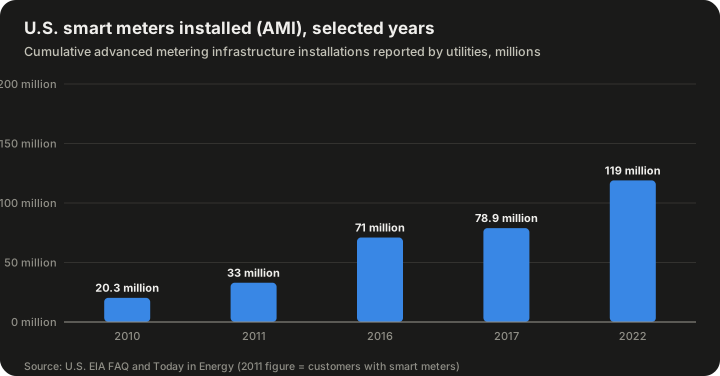
The most visible smart grid investment of the period was the replacement of conventional electricity meters with advanced metering infrastructure (AMI), two-way meters that report usage at intervals and can receive signals. The growth of AMI in the United States shows the scale of the equipment that interoperability standards were meant to cover.
| Year | AMI installations (millions) |
|---|---|
| 2010 | 20.3 |
| 2011 | 33 (customers with smart meters) |
| 2016 | 71 |
| 2017 | 78.9 |
| 2022 | 119 |
Source: U.S. Energy Information Administration FAQ and Today in Energy. Figures are cumulative; the 2011 figure counts customers with smart meters.
EIA's figures show how quickly the installed base grew. In 2010, 1,663 U.S. utilities reported 20,334,525 AMI installations. By the end of 2016, about 71 million AMI meters covered roughly 47% of the country's approximately 150 million electricity customers. EIA reports about 119 million installations, about 72% of all electric meters, in its most recent figures, with residential customers making up about 88% of AMI installations.
The SGIG program alone financed a significant slice of this. A 2013 DOE progress figure, reported by IEEE Spectrum, counted more than 10.8 million newly installed meters, about 8% of U.S. meters at that point. A later Greentech Media summary of the program's 65 advanced metering projects reported 14.2 million meters installed, 92% of the 15.5 million planned.
These numbers explain the urgency behind SGIP. Meters stay in service for many years. Each data format, communications technology and security design chosen during the rollout would be in the field long after the stimulus ended.
From government project to industry non-profit
SGIP 2.0, Inc.
NIST always intended SGIP to become self-sustaining. In December 2012, according to Release 3.0, SGIP moved from a government-funded partnership to an industry-led non-profit, organized as a 501(c)(3) and legally named "Smart Grid Interoperability Panel 2.0, Inc." NIST describes a transition of several months in which the old and new organizations operated in parallel during late 2012 and early 2013.
Most of the structure carried over: the PAPs, domain expert groups, standing committees and Catalog of Standards all continued. The Governing Board's role passed to a Board of Directors. Some groups were renamed; the Cybersecurity Working Group, for example, became the Smart Grid Cybersecurity Committee. NIST and SGIP signed a memorandum of understanding in December 2012 setting out NIST's continuing technical leadership role. NIST also kept providing money through a cooperative agreement.
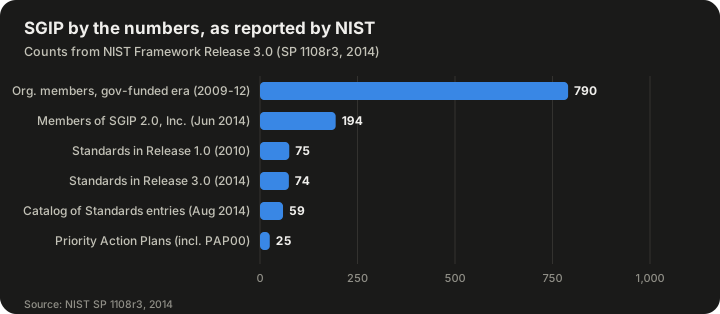
The biggest change was money. The new SGIP charged membership dues, and membership fell sharply. Release 3.0 reports that as of June 2014, SGIP 2.0 had 194 members providing more than 50% of its funding through dues. That compares with more than 790 organizational members when membership was free.
| Measure | Count |
|---|---|
| Organizational members, government-funded era (2009–2012) | over 790 |
| Members of SGIP 2.0, Inc. (June 2014) | 194 |
| Standards identified in Framework Release 1.0 (2010) | 75 |
| Standards listed in Framework Release 3.0 (2014) | 74 |
| Catalog of Standards entries (August 2014) | 59 |
| Priority Action Plans, including PAP00 (2014) | 25 |
Source: NIST SP 1108r3 (Framework Release 3.0), 2014, and NIST Tech Beat.
The two membership numbers measure different things. Free membership attracted organizations that wanted to follow the work, while paid membership kept the ones willing to fund it. A drop of that kind is common when a body moves from public to dues funding. It does not by itself mean the work stopped. But it does show that the paying base was much smaller than the audience.
Leadership and new directions
In 2014, Sharon Allan became SGIP's president and CEO. Under the industry-led model, SGIP put more weight on implementation projects that addressed problems members faced directly.
In 2015, SGIP partnered with the Industrial Internet Consortium on the Internet of Things for the energy sector. The same year, NIST continued its support with funding reported at $2.1 million for 2016–2018. In 2016, SGIP received $615,426 from the Department of Energy for work on reducing the non-hardware "soft costs" of solar projects. That connects to the Orange Button initiative, which SGIP administered and which aimed to standardize solar industry data.
OpenFMB
SGIP's best-known late achievement was the Open Field Message Bus (OpenFMB). The idea came from Duke Energy. As distribution grids gained more intelligent devices, such as reclosers, capacitor controllers, solar inverters, batteries and microgrid controllers, many of them needed to coordinate locally and quickly. Routing every message through a central control system was slow and created a single point of failure. Duke had published a Distributed Intelligence Platform reference architecture in early 2015 and asked NAESB for an open field-device interoperability standard.
NAESB formed an OpenFMB task force working with SGIP. OpenFMB is a framework for peer-to-peer, publish-and-subscribe messaging among devices at the grid edge. It reuses existing information models such as the Common Information Model and IEC 61850 rather than inventing new ones. It is designed to run over standard messaging middleware; draft NAESB documents include sections for the Data Distribution Service (DDS), MQTT and AMQP. NAESB members ratified the OpenFMB model business practices on March 7, 2016, and they were published as book RMQ.26 of NAESB's Retail Markets Quadrant.
OpenFMB is a good example of the SGIP method at its best. A utility identified a concrete need, an industry consortium shaped the requirements, an accredited standards body published the result, and the work drew on existing standards instead of competing with them.
The SEPA merger
In early 2017, at the DistribuTECH conference, SEPA chief executive Julia Hamm and SGIP chief executive Sharon Allan announced that the two organizations intended to merge under the SEPA brand. Both boards approved, and SGIP's members voted on it. SEPA says the merger was completed on April 3, 2017. Four former SGIP board members joined SEPA's board. SEPA said it was adding nearly 80 member organizations to an existing base of more than 1,000.
The merger made sense for both groups. SEPA had grown out of the solar industry and broadened into utility business models and distributed energy integration. SGIP brought technical standards depth, including OpenFMB and the Orange Button work. With distributed energy resources at the center of both organizations' agendas, combining them avoided duplicate effort. SGIP as a separate organization ended, while some of its programs continued within SEPA.
What SGIP achieved
Measuring the impact of a standards coordination body is hard, because its results show up in other organizations' documents and in products that work together without anyone noticing. Still, the record supports several conclusions.
It produced a shared vocabulary. The NIST conceptual model, with its seven domains, became a standard reference diagram for the smart grid in the United States and abroad. Release 3.0 describes liaison relationships with international efforts. In 2014, for example, a joint white paper set out how NIST and SGIP would coordinate with the European Union's smart grid coordination group.
It sped up specific standards. Release 3.0 credits SGIP and NIST with major contributions to OpenADR 2.0, Smart Energy Profile 2.0, IEEE 1547 revisions, NAESB's energy usage information standard, and UL 1741. Thirteen PAPs had been completed by 2014.
It built a cybersecurity baseline. NISTIR 7628 became a widely cited reference for utility security planning, and the habit of reviewing every catalog standard for security gaps was new in this field.
It created a model for public-private standards work. NIST pointed to the SGIP stakeholder process as an effective way for government to convene industry on technical questions, and reused the approach for the national Cybersecurity Framework.
Limits and criticisms
The record also shows real limits, many of them built into the job.
Voluntary standards depend on adoption. Because FERC declined to adopt standards by rule in 2011, SGIP's catalog was guidance. Utilities, vendors and state regulators could follow it or not. In a fragmented industry of investor-owned utilities, public power systems and cooperatives, uptake was uneven.
Coordination is slower than deployment. SGIP was founded while the stimulus-funded rollout was already starting. Some meters and systems installed in 2010–2012 used technologies or versions of standards that were later superseded. A coordination body cannot fully control the timing of procurement decisions made by thousands of separate buyers.
Funding shaped participation. The drop from more than 790 organizational members to 194 after dues began shows how much of the early participation depended on federal support. A smaller member base means fewer voices in consensus processes and a narrower funding base for staff work.
Standards are necessary but not sufficient. Even well-designed standards leave options open. Without interoperability profiles and certification programs, two products claiming the same standard may still not work together. NIST's later emphasis on profiles in Release 4.0 reflects this lesson.
The problem keeps moving. When SGIP began, the main concern was meters and utility systems. By the time it merged, the bigger questions were rooftop solar, batteries, electric vehicles and microgrids, many of them owned by customers rather than utilities. Release 3.0 itself frames the smart grid as a continually evolving system and describes SGIP's goal as a "self-sustaining, ongoing standards process." No single panel could finish the job.
Common misconceptions
"SGIP wrote the smart grid standards." It mostly did not. SGIP identified gaps, gathered requirements and pressed standards bodies such as the IEEE, IEC and NAESB to act. The standards themselves were published by those bodies.
"The standards in the Catalog were mandatory." They were not. NIST stated plainly that it did not expect catalog standards to become mandatory, and FERC declined to begin a rulemaking in 2011.
"SGIP was a government agency." It was created and funded by NIST at first, but it was always a partnership with industry, and from 2013 it was a private non-profit corporation. NIST was a member and technical leader, not the owner.
"Interoperability means everything uses one protocol." Interoperability can be achieved by mapping between standards, as several PAPs did for DNP3 and IEC 61850, and by shared information models. A single universal protocol was never the goal.
"SGIP disappeared without a trace." Its organization ended in 2017, but the NIST Framework continued with Release 4.0 in 2021, OpenFMB remains a NAESB standard, and parts of its work were continued within SEPA.
Frequently asked questions
Who founded the Smart Grid Interoperability Panel? NIST established it in late 2009, as part of its responsibilities under Section 1305 of the Energy Independence and Security Act of 2007.
How was it funded? From 2009 to 2012 it was funded by the federal government and charged no dues. From 2013 it was a non-profit funded partly by member dues and partly by a NIST cooperative agreement. NIST reported that by June 2014, dues provided more than half of its funding.
How many members did it have? More than 790 organizational members and more than 1,900 individual members during the free, government-funded period, and 194 members as of June 2014 under the dues-based model.
What were Priority Action Plans? Time-limited projects aimed at a specific gap or conflict between standards. They gathered requirements, passed them to the responsible standards body and checked the result. By 2014 there had been 25, and 13 were complete.
What is the NIST Framework? A series of NIST Special Publications (SP 1108 and revisions) that set out a conceptual model of the smart grid, list the standards identified as relevant, describe gaps and action plans, and cover architecture, cybersecurity and testing. Releases appeared in 2010, 2012, 2014 and 2021.
What happened to SGIP? It merged into the Smart Electric Power Alliance, with the merger completed on April 3, 2017. Some of its work continued under SEPA.
Is OpenFMB an SGIP standard? OpenFMB was developed through a NAESB task force working with SGIP, and it was ratified by NAESB members in March 2016. It is published by NAESB.
Does any of this affect my home? Indirectly. If your utility has installed a smart meter, lets you download your usage data in a standard format, or runs a demand response program with a smart thermostat, those systems rely on standards of the kind SGIP helped coordinate.
Why it still matters
The issues SGIP worked on have become more pressing, not less. As grids add large amounts of variable renewable generation, batteries, electric vehicles and flexible loads, coordinating millions of devices owned by different parties depends on those devices sharing language and rules. The current generation of efforts, such as IEEE 1547's requirements for smart inverters, IEEE 2030.5 for utility-to-device communication, and interoperability profiles for certification, builds on foundations laid during SGIP's years.
The SGIP story also shows how standards coordination tends to work in the United States: a federal agency with a mandate but limited authority, a large voluntary coalition, standards bodies that keep their own processes, and regulators who encourage rather than require. Its successes came where that coalition focused on a concrete, shared problem. Its limits came from the same voluntary structure that made the coalition possible.
Sources
- Smart Grid Interoperability Panel – Wikipedia
- NIST Framework and Roadmap for Smart Grid Interoperability Standards, Release 3.0 (NIST SP 1108r3), 2014
- NIST Framework and Roadmap for Smart Grid Interoperability Standards, Release 4.0 (NIST SP 1108r4), 2021
- NIST Special Publication 1108r2 (Release 2.0) – SmartGrid.gov
- Smart Grid Investment Grant Program Final Report – U.S. DOE / SmartGrid.gov
- Results from DOE ARRA smart grid programs – NETL
- How many smart meters are installed in the United States? – U.S. EIA
- Smart meter deployments continue to rise – U.S. EIA Today in Energy
- US smart grid status report describes a strong beginning – IEEE Spectrum
- 8 Charts That Illustrate Progress on DOE's Smart Grid Investment Grants – Greentech Media
- Smart Electric Power Alliance Announces Finalization of Merger with SGIP – SEPA
- SEPA Welcomes SGIP Board Members to Board of Directors – SEPA
- SGIP Announces Ratification of OpenFMB by NAESB – SEPA
- NAESB press release on OpenFMB ratification, March 2016