Rosemary Crossley (6 May 1945 – 10 May 2023) was an Australian author, therapist and disability rights advocate. She is best known as the person who brought facilitated communication, usually shortened to FC, to public attention. FC is a technique in which a helper, called a facilitator, physically supports the hand, wrist, arm or shoulder of a person who cannot speak, while that person points to letters, words or pictures. Crossley believed that FC could reveal intelligent, literate people trapped inside bodies that could not speak or move well. Her work with one young woman, Anne McDonald, became a bestselling book, an award-winning film and a landmark court case in Victoria.
Crossley's story is hard to tell in a single line, because two things are true at once. She spent decades campaigning against the neglect of disabled children in institutions, and conditions at the hospital where she worked in the 1970s were by many accounts appalling. At the same time, the method she championed has been tested repeatedly under controlled conditions, and those tests consistently show that the messages produced through FC come from the facilitator, not the disabled person. Every major professional body that has examined the evidence now advises against using it.
This article explains who Crossley was, what she claimed, why so many people believed her, what the controlled research found, and why the debate matters for people with severe communication disabilities today. It describes her claims fairly and then sets out plainly what the evidence shows.
Quick facts
| Item | Detail |
|---|---|
| Born | 6 May 1945, Horsham, Victoria, Australia |
| Died | 10 May 2023, aged 78, of cancer |
| Known for | Developing and promoting facilitated communication (FC) in Australia |
| Honour | Member of the Order of Australia (AM), 1986 Queen's Birthday Honours, for services to people with severe communication impairment |
| Organisation | DEAL (Dignity, Education, Advocacy, Language) Communication Centre, later renamed the Anne McDonald Centre |
| Partner | Chris Borthwick, writer of the screenplay for Annie's Coming Out |
| Main books | The Dole Cookbook (1978), Annie's Coming Out (1980, with Anne McDonald), Facilitated Communication Training (1994), Speechless: Facilitating Communication for People Without Voices (1997) |
| Scientific status of FC | Described by ASHA (2018) as "a discredited technique that should not be used" |
Early life and the St Nicholas Hospital years
Crossley was born in Horsham, a regional town in western Victoria. In the 1970s she worked at St Nicholas Hospital in Carlton, an inner suburb of Melbourne. St Nicholas was run by the state's Mental Health Authority and housed children who had been diagnosed with severe intellectual disabilities, many of whom also had serious physical disabilities such as cerebral palsy.
The hospital belongs to a period when large institutions were the default for disabled children in Australia, as in much of the Western world. Children were often placed there very young and stayed for years. In 1975 Crossley made a submission to a Victorian government committee on what was then called mental retardation. She argued that the hospital's daily schedule served the convenience of staff rather than the needs of the children. She also questioned the Mental Health Authority about specific children, claiming that although they had severe physical disabilities, they were not intellectually disabled.
That claim became the core of her life's work. Crossley believed that many people labelled as profoundly intellectually disabled were in fact capable of understanding language and thinking normally, but could not show it because their bodies would not cooperate. The idea is not absurd on its face. Some people with severe cerebral palsy do have typical intelligence and go on to communicate independently using switches, eye-gaze systems or keyboards. The question that would dominate the next fifty years was whether the particular method Crossley used actually let those people speak for themselves.
Anne McDonald
Background
Anne McDonald was born on 11 January 1961 in Seymour, Victoria. A birth injury left her with severe athetoid cerebral palsy, a form of cerebral palsy that causes involuntary writhing movements. She was diagnosed with a severe intellectual disability. She could not walk, talk or feed herself. When she was three years old, her parents placed her in St Nicholas Hospital, where she lived for about eleven years without education or therapy.
The conditions she lived in were grim. A Health Commission court case later conceded that she weighed only 12 kilograms at the age of 16. A newspaper report in The Age from 31 March 1975 described a 14-year-old Anne McDonald leaving the hospital "for the first time in 11 years" during a strike by psychiatric nurses. Whatever one concludes about FC, the neglect of children like McDonald at St Nicholas is part of the context that made Crossley's campaign so emotionally powerful.
The first "conversations"
In 1977, when McDonald was 16, Crossley reported that she could communicate with her. Crossley supported McDonald's upper arm while McDonald selected word blocks and magnetic letters. According to the account later summarised in the Wikipedia article on McDonald, within two weeks McDonald had spelled out a sentence; a month later she appeared to show familiarity with local politics; and in the following month she was doing fractions.
Crossley offered explanations for how a girl with no schooling could have learned all this. She speculated that McDonald had picked up language from television and overheard conversations, and had learned arithmetic by counting the slats on the barriers of her cot.
Not everyone was convinced. Some of Crossley's co-workers suspected that she was moving McDonald's hand and was herself the author of the messages. Crossley later acknowledged that she had wondered the same thing, at one point fearing she might be "making up sentences to fit what were really random twitchings." Experienced speech therapists also raised the concern that she was manipulating her clients' hands.
The 1979 court case
Through Crossley, McDonald appeared to ask to be discharged from St Nicholas. Her parents and the hospital authorities refused, on the grounds that her communication had not been verified. In 1979, when McDonald turned 18, a habeas corpus action was brought in the Supreme Court of Victoria against the Health Commission. Habeas corpus is an old legal remedy that requires authorities to justify holding a person.
During the proceedings McDonald was assessed. Patricia Margaret Minnes, then senior clinical psychologist with the Health Commission's Mental Retardation Services, was present at the psychological testing and objected to its conclusions. Her statement, preserved in the court record, is worth reading because it anticipates the whole later scientific debate:
"However in my opinion the results of this assessment cannot be considered objectively reliable and valid until such time as Anne is shown to perform at a similar intellectual level under experimentally controlled conditions. In my view there are at least three variables which need to be controlled, namely – (a) the nature of support to Anne's arm, (b) the amount of information available to the supporting person regarding the response requested of Anne, and (c) the nature of Anne's responses."
The court nonetheless accepted that the communication was McDonald's own and allowed her to leave the hospital and live with Crossley. McDonald then lived with Crossley and Chris Borthwick for the rest of her life, a period the Anne McDonald Centre's tributes describe as thirty-two years.
Later life
McDonald was credited with completing a Higher School Certificate at night school and a humanities degree at Deakin University in 1993, both using FC. She was named as co-author of Annie's Coming Out. On 3 December 2008, the International Day of Persons with Disabilities, she received the Personal Achievement Award in the Australian National Disability Awards at Parliament House. She died of a heart attack on 22 October 2010, aged 49.
Her family came to see things differently. In 2012 her mother, Bev McDonald, told the Herald Sun that she was glad her daughter had gained weight under the care Crossley organised, but that she had come to believe the claims of independent communication were "hollow." She said her daughter could only use the letter board when her arm was guided. On one occasion she guided her daughter's elbow to type something rude about Crossley while watching her face, and saw no reaction. Messages she asked her daughter to pass on to Crossley never arrived. McDonald's brother described trying a similar test, holding conversations with his sister in the hope that Crossley would mention them in later FC sessions; none were mentioned.
These are informal tests, not controlled experiments, but they follow exactly the logic that formal studies would use: give the disabled person information the facilitator does not have, and see whether it comes out.
Annie's Coming Out: the book and the film
In 1980 Penguin published Annie's Coming Out, written by Crossley with McDonald credited as co-author. It told the story of McDonald's life in the institution, her apparent discovery of language, and the legal fight for her release. The book won the inaugural Allen Lane Award for the best book of the year dealing with disability and became an international bestseller.
Film Australia bought the rights and assigned Gil Brealey to direct. The screenplay was written by Chris Borthwick and John Patterson, with Crossley and McDonald credited as contributing writers. It had originally been intended that McDonald would play herself, but she had grown too much by the time she left hospital, so nine-year-old Tina Arhondis was cast as "Annie O'Farrell." Angela Punch McGregor played the Crossley figure, renamed Jessica Hathaway. Shooting started in September 1983 and lasted four weeks, mostly at the Convent of the Good Shepherd in Melbourne, on a budget of under one million Australian dollars.
| Film detail | Information |
|---|---|
| Title | Annie's Coming Out (released in the US as A Test of Love) |
| Director | Gil Brealey |
| Producer | Don Murray, Film Australia |
| Australian release | 27 September 1984 |
| US release | 29 March 1985 |
| Running time | 96 minutes |
| Major awards | 1984 AFI Awards for Best Film, Best Adapted Screenplay and Best Lead Actress (Angela Punch McGregor); Prize of the Ecumenical Jury, 1984 Montréal World Film Festival |
Sources differ slightly on the AFI tally: the Wikipedia article on the film, citing contemporary press, lists three wins plus four other nominations, while the article on Crossley also lists Best Supporting Actress. Either way, the film was a critical success, though not a large commercial one. It presented FC to audiences as a proven breakthrough, and it is now often cited as an example of how a powerful story can run far ahead of the evidence.
What facilitated communication is
How a session works
In FC, a person with little or no functional speech sits in front of a keyboard, letter board or set of pictures. A facilitator sits beside them and provides physical support, which may be at the index finger, hand, wrist, elbow or shoulder. The facilitator may also offer emotional encouragement and practical help, such as making sure the person is looking at the keyboard. The person is then said to select letters, and the resulting words are treated as their own communication.
Crossley called her approach Facilitated Communication Training. The Anne McDonald Centre described it as beginning with co-active, hand-on-hand movement, with the stated goal of fading support until the person could communicate independently.
Why it is intuitively convincing
FC is persuasive to the people involved for understandable reasons:
- The messages are often sophisticated. People who had been assumed to understand very little appear suddenly to produce fluent sentences, poetry, political opinions or academic essays. That is deeply moving for families.
- Facilitators are usually sincere. Most facilitators do not believe they are moving the person's hand. They feel the person's hand pulling toward letters.
- It fits a hopeful and partly true idea. It is genuinely the case that motor impairment can hide intelligence, and that disabled people have often been underestimated. FC seemed to offer proof of that principle.
- There is no obvious trick. Observers watching a session see the disabled person's finger touching letters.
The ideomotor effect
Researchers explain the facilitator's sense of not being in control with a well-documented phenomenon called the ideomotor effect. This is the tendency of people to make small, unconscious muscle movements in response to their own expectations. It is the same effect behind Ouija boards and dowsing rods, where participants honestly feel that the planchette or rod is moving by itself. It is sometimes also linked to the "Clever Hans" effect, named after a horse in early twentieth-century Germany that seemed able to do arithmetic but was in fact responding to unconscious cues from people who knew the answers.
The ISAAC committee that reviewed FC in 2014 noted "some evidence that the message construction by facilitators may occur without awareness of producing such a construction." In other words, the evidence does not say that facilitators are usually lying. It says they are usually authoring the messages without realising it.
How FC spread beyond Australia
FC-like methods had appeared before Crossley. In the 1960s, similar techniques were described by Else Hansen in Denmark, Lorna Wing in England and Rosalind Oppenheim in the United States. Danish studies in the 1960s and 1970s had little impact outside Denmark, and the debate there faded in the early 1980s for lack of evidence. Crossley developed her method independently in 1977, and it became popular in Australia largely through her efforts.
The method's global spread came through Douglas Biklen, a professor at Syracuse University in New York, who visited Crossley in Australia and went on to popularise FC in the United States from the late 1980s. In 1992 Syracuse founded the Facilitated Communication Institute, with Biklen as its first director. Biklen later wrote Autism and the Myth of the Person Alone (2005). Crossley was a keynote speaker at the International Association of Severe Disabilities conference in 1990, and her 1994 book Facilitated Communication Training was published in New York by Teachers College Press.
In the early 1990s FC moved quickly through schools and disability services in North America. That rapid adoption, before any controlled testing, is one reason it caused so much harm when allegations of abuse began to appear in FC-typed messages.
Testing authorship: what the controlled research found
The logic of a fair test
The central scientific question about FC is not whether disabled people can be intelligent, or whether they deserve communication. Everyone in the debate agrees on those points. The question is narrower: when a message is produced through FC, who wrote it?
That question can be tested simply. Researchers give the disabled person information that the facilitator does not have, for example by showing a picture to the disabled person while the facilitator sees nothing or sees a different picture. If the person is the author, the typed answer should name what the person saw. If the facilitator is the author, the answer will name what the facilitator saw, or will be wrong.
This is exactly the kind of control Patricia Minnes had asked for in 1979.
The O.D. Heck study (1993)
The best-known early test was carried out at the O.D. Heck Developmental Center in Schenectady, New York, and published by Douglas Wheeler, John Jacobson, Raymond Paglieri and Allen Schwartz in the journal Mental Retardation in February 1993. It involved 12 people from an institutional autism programme and 9 facilitators. The participants were chosen because they were considered the most competent FC users in the programme, and their facilitators believed in the method.
The researchers showed pictures of everyday objects under controlled conditions in which the facilitator either saw the same picture as the participant, saw no picture, or saw a different picture. Meaningful, correct responses appeared only when the facilitators knew the answers. The authors concluded that the facilitators were unknowingly determining what was typed.
The study's results were so striking that the American public-television series Frontline built its 1993 documentary "Prisoners of Silence" around them.
Replications
Similar studies followed rapidly in several countries. An internal study at the Thistledown Regional Centre in Ontario tested 20 people with autism, and the centre stopped using FC when the results showed facilitator influence was "contaminating the messages." By 1995 Gina Green reported at least 24 peer-reviewed studies replicating these findings, and by 2005 more than 50 controlled studies and blind tests had been conducted, consistently showing that facilitators, not communicators, controlled the messages.
A 2001 review by Mark Mostert concluded that FC had "largely been empirically discredited." Jacobson, Mulick and Schwartz argued in 1995 that FC's wide acceptance showed that many professionals had failed to apply scientific judgment to treatment methods.
Systematic reviews
The most authoritative modern assessments are systematic reviews, which search the whole literature, apply consistent rules to decide which studies count, and summarise all of them.
| Review | Commissioned by | Main finding |
|---|---|---|
| Schlosser and colleagues, 2014, Augmentative and Alternative Communication | International Society for Augmentative and Alternative Communication (ISAAC) | "Unequivocal evidence for facilitator control" in quantitative studies that tested authorship |
| Hemsley, Bryant, Schlosser, Shane and colleagues, 2018, Autism & Developmental Language Impairments | American Speech-Language-Hearing Association (ASHA), to update its 1995 statement | 18 studies met inclusion criteria; no new empirical studies addressing authorship; "no evidence that FC is a valid form of communication" for people with severe communication disabilities |
The 2014 ISAAC review sorted all evidence into four groups: quantitative experimental tests of authorship, quantitative descriptive data without authorship testing, qualitative descriptions, and anecdotal reports. Only the first group can actually answer the authorship question, and that group pointed clearly at the facilitator.
What about studies that seem to support FC?
Supporters of FC point to qualitative studies, case reports and testimonials in which FC users appear to say things the facilitator could not have known, or describe their experiences. The ISAAC committee addressed these directly. It said that descriptive studies drawing conclusions about authorship without first verifying authorship by empirical means are "methodologically unsound and should not be used to guide practice or future research." Anecdotes, it said, cannot be "irrefutable evidence" either for or against authorship; that is exactly why controlled tests are needed.
The professional consensus
Professional bodies began issuing warnings in the early 1990s and have continued to do so. The American Psychological Association passed a resolution in 1994 cautioning against FC, citing a lack of scientific evidence, and stated that information obtained through FC should not be used to confirm or deny abuse allegations or to make diagnostic or treatment decisions. A 1998 British government report concluded that the phenomenon "fails to materialise once facilitator effects have been controlled." In January 2020 the American Academy of Pediatrics stated that current evidence does not support FC.
ISAAC's 2014 position statement listed the earlier statements it was consistent with. Grouping those dated statements by decade gives a simple picture of how long and how widely the caution has been held.
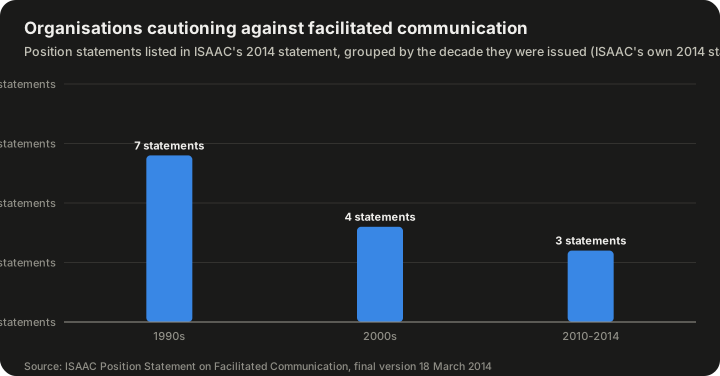
| Period | Statements listed by ISAAC (2014) | Examples |
|---|---|---|
| 1990s | 7 | AACAP 1993, APA 1994, APA Council of Representatives 1994, AAMR 1995, ASHA 1995, AAP 1998, Behavior Analysis Association of Michigan 1998 |
| 2000s | 4 | Zeitschrift für Heilpädagogische Forschung 2003, Association for Behavior Analysis 2005, Scottish Intercollegiate Guidelines Network 2007, New Zealand Ministries of Health and Education 2008 |
| 2010–2014 | 3 | Autism & Asperger Förbundet 2012, Speech Pathology Australia 2012, VALID (Victoria) 2012 |
Source: ISAAC Position Statement on Facilitated Communication, 18 March 2014. One further body in ISAAC's list, the Association for Science in Autism Treatment, is given without a year and is not counted.
ISAAC's own conclusion was blunt: it "does not support FC as a valid form of AAC, a valid means for people to access AAC, or a valid means to communicate important life decisions," and "the weight of evidence does not support FC and therefore it cannot be recommended for use in clinical practice." It also argued that FC appears to conflict with several articles of the UN Convention on the Rights of Persons with Disabilities, because messages attributed to the disabled person may in fact be the facilitator's.
ASHA's 2018 position statement says simply that FC "is a discredited technique that should not be used," and that information obtained through it "should not be considered as the communication of the person with a disability."
It is worth noticing Speech Pathology Australia on that list. The professional association for speech therapists in Crossley's own country reached the same conclusion as its counterparts abroad.
Harms: false allegations and lost opportunities
False allegations of abuse
The most serious harms linked to FC have come from allegations of sexual abuse typed through facilitators. Because facilitators who are worried about abuse may unconsciously produce messages that confirm their fears, FC has generated accusations against parents and carers that later proved unfounded.
| Case | Place and year | What happened |
|---|---|---|
| Gerry Gherardi | North Carolina, 1993 | Accused through FC of sexually abusing his son; charges dropped after court-ordered double-blind tests showed the son could not write the messages |
| Wheaton family | United States, early 1990s | Facilitator Janyce Boynton produced messages describing abuse by a girl's parents; testing by Howard Shane showed the girl could not have authored them |
| "Gina" and "Carla" | Victoria, 1990 | Two women were removed from their families into residential units in December 1990 after allegations made through FC; the Victorian Ombudsman investigated and reported in February 1994 |
| Rom Houben | Belgium, 2006–2009 | A man believed to be in a coma was said to type through FC; independent tests showed correct answers appeared only when the facilitator knew them |
Bernard Rimland reported in 1993 that he knew of about 25 families accused through FC; by 1995 there were 60 known cases. The ISAAC committee noted that "the overwhelming majority" of abuse allegations made through FC were influenced by facilitator control, and that courts had found evidence against the truth of many of them.
The Victorian Ombudsman's 1994 report on Gina and Carla recommended that Gina's mother be reimbursed for legal costs she incurred before the Guardianship Board, and that the state department review management deficiencies and case management, and its oversight of funded agencies. The families had said they suffered trauma and financial hardship from the guardianship applications.
Crossley's own role in disputed cases
The Wikipedia article on Crossley describes several disputed cases in which she was involved. Victorian parliamentary reports by Norman Geschke are cited for cases involving the dismissal of an employee and the forced removal of the woman known as Gina from her home. Other cases mentioned include a client who reportedly consented to a hysterectomy through FC, and a Supreme Court application by Crossley to take Leonie McFarlane, a nonverbal woman with cerebral palsy, to a disability conference interstate. That application failed; McFarlane's parents opposed it, saying she could not communicate independently. In the case of Angela Wallace, an investigation by Peter Eisen concluded that Wallace could not give consent, and also found that Crossley had helped create a false sexual assault accusation in the "Carla" case.
The Stubblefield case
FC's harms are not confined to the 1990s. Anna Stubblefield, then a philosophy professor at Rutgers University–Newark in New Jersey who had been certified as an FC trainer by Syracuse's institute, used FC with a man with severe cerebral palsy, identified in court as D.J., and claimed that he had consented to a sexual relationship. She was convicted in 2015 of aggravated sexual assault and sentenced to 12 years. A 2017 appeal overturned the conviction and ordered a retrial, and in 2018 she pleaded guilty to third-degree aggravated criminal sexual contact and was sentenced to time served. D.J.'s family won a $4 million civil judgment in 2016. Crossley defended Stubblefield by claiming D.J. could answer yes/no questions independently. Sociologist Mark Sherry argued in 2016 that Stubblefield had manufactured D.J.'s communications.
In Queensland in 2014, a disability worker named Martina Susanne Schweiger received an 18-month suspended sentence for two counts of indecent dealing with a 21-year-old client with severe autism, a case linked to FC.
The hidden cost: valid communication not pursued
The ISAAC committee pointed to a quieter but widespread harm. For people with limited or no functional speech, using FC "risks the loss of valuable assessment and intervention efforts, time, and resources that might otherwise have been expended to implement AAC systems and strategies that are empirically validated and do not leave doubt about authorship." Every year spent typing a facilitator's words is a year not spent learning a system that would let the person say what they actually think.
Public scrutiny of Crossley
"Prisoners of Silence" (1993)
The 1993 Frontline documentary that featured the O.D. Heck findings also examined Crossley's work. According to the Wikipedia account, Crossley claimed in that period that a comatose man could choose his own housing, and Frontline disproved the claim using digital overlays of the session footage.
The 2012 Herald Sun articles
In 2012 the Melbourne journalist Andrew Rule published two articles in the Herald Sun, "Rosemary's Baby" and "True Crime," questioning whether McDonald had ever really communicated through FC. These articles carried the McDonald family's accounts described above. The paper later published a clarification that it had not intended to suggest Crossley had deliberately misled people or was a criminal, and removed both articles from its website. That clarification addressed Crossley's intentions; it did not alter the scientific evidence about FC.
Weighing it fairly: the claims and the evidence
The case for Crossley rests on her sincerity, her courage in challenging institutions, and the experiences of families who felt FC transformed their lives. The case against FC rests on controlled tests. The two can be laid side by side.
| Claim made for FC | What the evidence shows |
|---|---|
| FC reveals hidden literacy and intelligence in people assumed to be intellectually disabled | When the facilitator does not know the answer, correct answers disappear; the literacy shown belongs to the facilitator |
| Facilitators only steady the arm and do not choose letters | Facilitators can author messages without being aware of it, through the ideomotor effect |
| Court rulings, such as the 1979 McDonald case, prove the communication is genuine | A court decides a legal dispute on the evidence before it; it does not run controlled tests of authorship. Later controlled studies examined this exact question |
| Testing is disrespectful or stressful and disrupts the communication | Authorship tests can be simple, such as showing a picture the facilitator has not seen; the same tests are routine for any new communication device |
| Many users say FC changed their lives | Anecdotal reports cannot establish authorship, positive or negative, as ISAAC noted |
| Some FC users later type independently | Independent typing, where it occurs, is the goal of all AAC; there is no causal evidence that FC produced it |
The fair summary is this. Crossley's concern for neglected disabled people was real, and institutions like St Nicholas did fail the children in their care. But the specific claim at the centre of her work, that FC lets people with severe disabilities communicate their own thoughts, has been tested many times and has failed those tests consistently. The scientific consensus, reflected in statements from ASHA, ISAAC, the American Psychological Association, the American Academy of Pediatrics and Speech Pathology Australia among others, is that FC is not a valid form of communication.
Successor methods
FC has been followed by related techniques that share its central feature of a helper holding or positioning a board near the user. The most prominent are the Rapid Prompting Method and Spelling to Communicate (S2C), in which a helper holds a letter board in the air while the user points. In a 2019 dispute with the Lower Merion School District in Pennsylvania, a hearing officer found no evidence that S2C enabled the child in that case to communicate. ASHA has also taken a separate position that use of the Rapid Prompting Method "is not recommended because of prompt dependency and the lack of scientific validity."
In 2018 the University of Northern Iowa, which had hosted a summer institute including FC instruction from 2014, stopped supporting FC after a statement calling it "invalidated and demonstrably harmful."
Evidence-based alternatives for people who cannot speak
If FC does not work, what does? Augmentative and alternative communication, or AAC, is the broad field of methods that supplement or replace speech. The key feature of validated AAC is that the user's message can be shown to be the user's own.
| Approach | How it works | Authorship |
|---|---|---|
| Unaided AAC | Gestures, signs, facial expressions, body language | Produced by the user's own body |
| Low-tech aided AAC | Picture cards, communication books, letter boards the user points to without physical guidance | Visible, independent selection |
| Picture exchange | The user hands a picture to a partner to request or comment | Independent action |
| Speech-generating devices | Tablets or dedicated devices that speak words or phrases when selected | User selects independently |
| Switch access and scanning | The device highlights options in turn; the user presses a switch with any reliable movement | Independent, even with very limited movement |
| Eye-gaze systems | A camera tracks where the user is looking to select items | Independent, suits severe motor impairment |
For people with conditions like severe athetoid cerebral palsy, switch access and eye-gaze systems are especially important, because they require only one reliable movement, or none beyond the eyes. These technologies did not exist in mature form in 1977, which is part of the tragedy of the era: there may have been people at St Nicholas who could have communicated with modern tools.
Anyone concerned about a family member's communication should seek an assessment from a qualified speech-language pathologist and the person's doctor, who can recommend approaches suited to the individual.
Legacy
Crossley died of cancer on 10 May 2023, at 78. The Anne McDonald Centre's Committee of Management announced her death, and a celebration of her life was held on 5 June 2023 at St Paul's Cathedral in Melbourne. After her death the centre's services moved online.
Her legacy is divided. Her supporters remember a therapist who refused to accept that disabled children were beyond reach, who exposed an institution that was starving its residents, and who inspired a bestselling book and an award-winning film. Her critics, including the bulk of the speech pathology and psychology professions, see a technique that diverted families from effective communication methods, put words into the mouths of vulnerable people, and in some cases led to false accusations that tore families apart.
The two views are not fully opposed. It is possible to recognise both the real suffering Crossley confronted and the clear evidence that her method did not do what she believed. The broader lesson, which the history of FC teaches more vividly than almost any other case, is that good intentions are not a substitute for testing, and that the people with the most at stake are the people who cannot speak up when a well-meaning helper speaks for them.
Common misconceptions
"Critics of FC think disabled people are unintelligent." They do not. The authorship tests do not measure intelligence. They measure whether the message comes from the person or the facilitator. Many critics are specialists who spend their careers helping nonspeaking people communicate.
"FC was discredited by one study." It was tested in dozens of controlled studies over more than a decade, in several countries, by different research teams, with consistent results.
"Facilitators were frauds." Most were sincere. The evidence points to unconscious influence, not deliberate deception.
"The Supreme Court of Victoria proved Anne McDonald could communicate." The court decided a legal application about her release. Its decision is a historical fact; it is not a scientific test of authorship, and the psychologist present at the time said precisely what controls would be needed.
"FC is just an old idea nobody uses now." Related methods remain in use, and professional bodies continued to issue warnings into the 2010s and 2020s.
Frequently asked questions
Who was Rosemary Crossley?
An Australian therapist, author and disability advocate (1945–2023) who developed facilitated communication in Victoria in 1977 and promoted it internationally. She was made a Member of the Order of Australia in 1986.
Who was Anne McDonald?
A Victorian woman with severe athetoid cerebral palsy (1961–2010) who lived in St Nicholas Hospital from age three. Crossley reported in 1977 that McDonald could communicate through FC, and a 1979 court case allowed McDonald to leave the hospital to live with Crossley.
Did FC work for Anne McDonald?
No controlled authorship test of McDonald's FC communication is documented in the sources used here. Her own family later said she could only use the letter board when her arm was guided and that informal tests failed. Given that FC has failed every adequately controlled authorship test across many studies, the scientific view is that messages produced through FC cannot be attributed to the disabled person without independent verification.
Why do facilitators believe it works?
Because of the ideomotor effect: people make small movements in response to their own expectations without being aware of it. Facilitators genuinely feel that the person is guiding the hand.
Is FC ever acceptable to use?
ASHA's 2018 statement says it should not be used. ISAAC says it cannot be recommended for clinical practice. Neither body recommends it for any group.
What should a family do if a child cannot speak?
Ask the child's doctor for a referral to a qualified speech-language pathologist for an AAC assessment. Validated methods range from picture systems to speech-generating devices, switches and eye-gaze technology.
Is the film Annie's Coming Out accurate?
It accurately reflects the story as Crossley told it in 1980, and it depicts conditions at institutions of the period. It presents FC as genuine, which the later controlled research does not support.
Timeline
| Year | Event |
|---|---|
| 1945 | Crossley born in Horsham, Victoria (6 May) |
| 1961 | Anne McDonald born in Seymour, Victoria (11 January) |
| 1975 | Crossley's submission to a Victorian committee criticising conditions at St Nicholas Hospital |
| 1977 | Crossley reports communicating with McDonald by supporting her arm |
| 1978 | The Dole Cookbook published |
| 1979 | Habeas corpus action in the Supreme Court of Victoria; McDonald leaves St Nicholas |
| 1980 | Annie's Coming Out published by Penguin |
| 1984 | Film Annie's Coming Out released (27 September) and wins AFI Best Film |
| 1986 | Crossley appointed Member of the Order of Australia |
| 1990 | Two women, "Gina" and "Carla," removed from their families after FC allegations (December) |
| 1992 | Syracuse University founds the Facilitated Communication Institute |
| 1993 | O.D. Heck study published; Frontline "Prisoners of Silence" broadcast; McDonald completes Deakin degree |
| 1994 | American Psychological Association resolution; Victorian Ombudsman report (February); Facilitated Communication Training published |
| 1997 | Speechless published |
| 2008 | McDonald receives Personal Achievement Award (3 December) |
| 2010 | McDonald dies (22 October) |
| 2012 | Herald Sun articles by Andrew Rule |
| 2014 | ISAAC position statement and systematic review |
| 2018 | ASHA position statement and systematic review; Stubblefield pleads guilty |
| 2020 | American Academy of Pediatrics states evidence does not support FC |
| 2023 | Crossley dies (10 May) |
Sources
- Rosemary Crossley – Wikipedia
- Anne McDonald – Wikipedia
- Annie's Coming Out (film) – Wikipedia
- Anna Stubblefield – Wikipedia
- Facilitated communication – Wikipedia
- ASHA Position Statement: Facilitated Communication (2018)
- ISAAC Position Statement on Facilitated Communication (2014), hosted by VALID
- Schlosser et al. (2014), Facilitated communication and authorship: a systematic review – PubMed
- Hemsley et al. (2018), Systematic review of facilitated communication 2014–2018 – Autism & Developmental Language Impairments
- Victorian Ombudsman (1994), Investigation of the removal and placement of a client because of allegations made by Facilitated Communication
- Farewell to Rosemary Crossley, 1945–2023 – DARU / Anne McDonald Centre
- Rapid prompting method – Wikipedia
- Wheeler et al. (1993) abstract, SUNY Cortland FC resource page