Panthalassa is an American ocean energy company based in Portland, Oregon. It was founded in 2016 and builds large floating steel devices, which it calls "nodes," that turn the motion of ocean waves into electricity. Most wave energy developers try to send that electricity to shore through undersea cables. Panthalassa's current plan is different. It wants to use the power out at sea, inside the node, to run computer chips for artificial intelligence (AI). The results of the computing would then be sent back to land by satellite. The chips would be cooled by the cold seawater around them.
The company came to wide public attention in May 2026, when it announced a $140 million Series B funding round led by the investor Peter Thiel. Its chief executive, Garth Sheldon-Coulson, is a co-founder. At the time of the announcement Panthalassa had tested several prototypes in the waters of Washington State. It planned to put a pilot series of its next design, called Ocean-3, into the northern Pacific Ocean later in 2026 and to begin commercial deployments in 2027.
This article explains what Panthalassa is building and how its machines are meant to work. It also covers the history of wave energy that the company grew out of, why AI computing has become a target market, and what is known and not yet known about whether the idea will work. Panthalassa is a young private company, so much of the public information about it comes from the company itself and from news coverage of its funding. Where a claim comes only from the company, this article says so.
At a glance
| Item | Detail |
|---|---|
| Founded | 2016 |
| Headquarters | Portland, Oregon, United States |
| Legal form | Public-benefit corporation (the company says it has been one since its founding) |
| Chief executive | Garth Sheldon-Coulson, co-founder |
| Core technology | Free-floating wave energy converters ("nodes") made of steel |
| Current target use | Running AI computing on board, with satellite data links and seawater cooling |
| Earlier target use | Producing hydrogen at sea from groups of nodes |
| Prototypes | Ocean-1 (2021), Ocean-2 (2024 and 2025 trials), Wavehopper |
| Next design | Ocean-3, pilot series planned for the northern Pacific in 2026 |
| Major funding | $140 million Series B, announced May 4, 2026, led by Peter Thiel |
| Staff | About 70 people in early 2024, according to the company's co-founder |
The name
Panthalassa is the name geologists give to the single enormous ocean that surrounded the supercontinent Pangaea about 250 million years ago. The word comes from Greek roots meaning "all" and "sea." The company's name signals its focus on the open ocean, far from coastlines, rather than on the near-shore sites where many earlier wave energy projects were built.
Background: why wave energy has been so hard
To understand Panthalassa, it helps to know the long and difficult history of wave power. People have tried to capture energy from waves for more than two centuries. Very few of those attempts have turned into lasting businesses.
How much energy is in a wave?
Ocean waves are made mostly by wind blowing across the sea surface. The wind passes some of its energy to the water, and the waves carry that energy across great distances with relatively little loss. A swell that reaches the coast of Oregon may have been created by a storm thousands of kilometres away.
Engineers measure wave energy as power per metre of wave crest, usually in kilowatts per metre (kW/m). In deep water the standard formula is:
P = (ρ g² / 64π) × H² × T
Here ρ (rho) is the density of seawater, g is the acceleration due to gravity, H is the "significant wave height" (roughly the average height of the highest third of waves) and T is the wave energy period in seconds. When the constants are worked out, the formula becomes approximately:
P ≈ 0.5 × H² × T (kilowatts per metre of crest, with H in metres and T in seconds)
Two features stand out. First, power rises with the square of wave height, so doubling the height gives four times the power. Second, longer-period waves carry more power than short choppy ones of the same height.
Worked example. Wikipedia's article on wave power gives the case of a moderate ocean swell with a 3 m significant height and an 8 second period. Using the simplified formula: 0.5 × 3² × 8 = 0.5 × 9 × 8 = 36 kW per metre of crest. In other words, every metre along the front of such a swell carries about 36 kilowatts. In a major storm, with waves of about 15 m and a 15 second period, the same formula gives 0.5 × 225 × 15 ≈ 1,690 kW, or about 1.7 megawatts per metre.
That second number explains one of the central problems of wave energy. A device has to collect useful power from ordinary seas of a few tens of kilowatts per metre, but it must also survive storms that hit it with roughly fifty times as much power.
The size of the global resource
How much wave power is there in total? A widely cited peer-reviewed study by Kester Gunn and Clym Stock-Williams, published in the journal Renewable Energy in 2012, estimated the global wave power resource at 2.11 terawatts (TW), plus or minus 0.05 TW. They used six years of wave data from the U.S. National Oceanic and Atmospheric Administration's WaveWatch III model. They measured the energy crossing a line 30 nautical miles offshore around the world's coastlines. They also estimated that about 4.6 per cent of that resource could be extracted with the particular wave machine they modelled.
It is important to understand what that figure measures. It counts the wave energy flowing toward the coast across a line near shore. It does not count all the energy present in waves across the whole surface of the open ocean. Panthalassa's chief executive has said that the open ocean is one of three energy sources on the planet "with tens of terawatts of new capacity potential," alongside solar and nuclear. That is a company claim about a different quantity (energy in the open ocean, not energy reaching coasts). It has not been checked by an independent published study cited in coverage of the company. Readers should treat it as a statement of ambition rather than an established resource estimate.
For comparison, the U.S. National Renewable Energy Laboratory estimated the theoretical wave energy potential of the United States at about 1,170 terawatt-hours per year, close to a third of national electricity consumption at the time of the estimate, with about half of that along the coast of Alaska. Technical and economic potential, meaning the energy that can actually be captured at a reasonable price, is always much lower than theoretical potential.
A short history of wave power
| Year | Event |
|---|---|
| 1799 | Pierre-Simon Girard and his son file the first known patent for extracting energy from ocean waves, in Paris |
| c. 1910 | Bochaux-Praceique builds a device to power his house at Royan, France, apparently the first oscillating water column |
| 1855–1973 | 340 wave energy patents are filed in the United Kingdom |
| 1940s | Japanese researcher Yoshio Masuda's work leads to hundreds of small wave-powered units running navigation lights |
| 1973 | The oil crisis brings government funding for wave research in the UK, Norway and Sweden |
| 1974 | Stephen Salter at the University of Edinburgh invents the "Salter's duck" |
| 1982 | The UK government winds down its wave energy research programme |
| 2000 | The Islay LIMPET, an oscillating water column on a Scottish island, is connected to the UK grid |
| 2003 | The European Marine Energy Centre (EMEC) opens in Orkney, Scotland, as the world's first wave energy test centre |
| 2008 | The Aguçadoura Wave Farm opens off Portugal using Pelamis machines |
| 2014 | Pelamis Wave Power goes into administration |
| 2015 | Aquamarine Power, developer of the Oyster device, follows |
| 2019 | Swedish developer Seabased Industries AB is liquidated |
Salter's duck is a good example of the pattern. In small, controlled tank tests in the 1970s, the device's body could stop about 90 per cent of the wave motion and convert about 90 per cent of that to useful energy, giving an overall efficiency of about 81 per cent. That was a remarkable laboratory result. But the design was judged fragile in rough seas, and government support ended in 1982.
Pelamis, a long, snake-like machine of linked floating sections, became the first offshore wave machine to send electricity into a national grid. Three Pelamis units were installed at Aguçadoura in Portugal in 2008. Yet the company, which had about 70 staff and had spent roughly £90 million over 17 years, failed in late 2014. A year later Aquamarine Power, whose Oyster was a hinged flap anchored to the seabed close to shore, met the same fate.
Scotland's Saltire Prize offered £10 million to the first team to generate 100 gigawatt-hours of wave or tidal electricity over two continuous years by 2017. That works out to an average output of about 5.7 megawatts. The prize was never awarded.
Why wave projects have struggled
The technical and business problems are well known in the industry:
- Survival. Machines must cope with the extreme loads of storms, as the worked example above shows.
- Corrosion and fouling. Saltwater attacks metal, and marine life grows on every surface.
- Moorings and anchors. Holding a large floating object in place in deep, rough water is expensive and hard.
- Power take-off. Converting slow, irregular wave motion into steady electricity needs reliable hydraulic, mechanical or electrical systems.
- Grid connection. Undersea export cables are costly, and the best wave resources are often far from where electricity is used.
- Conflicts at sea. Projects can displace fishing and create hazards to shipping.
- Cost of maintenance. Every repair trip offshore needs boats, crews and good weather.
Panthalassa's design choices can be read as attempts to remove some of these problems entirely, especially the anchors and the export cable.
How a Panthalassa node works
The basic shape
Panthalassa's nodes look very different from most wave machines. According to descriptions of its Ocean-2 prototype, a node has:
- A large air-filled sphere on top that floats at the surface and provides buoyancy. On Ocean-2 it was about 30 feet (9 m) across.
- A long tubular hull that hangs straight down below it. Ocean-2 was about 200 feet (61 m) long in total.
- Turbines that sit in the water path inside the structure.
When it is being towed, the device lies on its side, which is how residents near Everett, Washington, saw it in early 2024. Many mistook it for a capsized sailboat or a tower being towed. In operation it stands upright, with the bulbous top at the surface and the rest of the hull extending straight down.
Turning waves into electricity
The working principle is simple to state. As waves lift and drop the floating sphere, the whole node moves up and down. The long tube reaches down into deeper water, where the water moves much less than at the surface. This difference in motion pushes water up the tube and into the sphere at the top. The water then drains back down through turbines, which spin and generate electricity.
The chief executive has compared the device to a floating hydroelectric dam. In a hydroelectric dam, water held at a height falls through turbines. In the node, wave motion repeatedly lifts water to a height inside the structure, and it then falls back through turbines in the same way.
Water turbines are a mature, well-understood technology. One idea behind this design is to avoid the complicated hydraulic rams, hinges and flexing joints used in some earlier wave machines, which proved hard to keep working at sea.
No anchor, no cable
Ocean-2 was tested while connected to a support system. Panthalassa's newer design, Ocean-3, has no anchor and no cable to shore, according to the company. It is designed to move under its own control and to stay out in the ocean without being tied to the sea floor.
The nodes have no engine and burn no fuel. They steer using the shape of their hull. Sheldon-Coulson told CBS News that the design is "like a little Roomba, except it's enormous," referring to the small robot vacuum cleaners that steer themselves around a room.
Removing the mooring and the export cable addresses two of the biggest costs in offshore energy. It also allows the nodes to operate far from shore, in what the company calls the planet's most energy-dense wave regions. The trade-off is that a free-floating device must look after itself in the open ocean, which raises questions about maintenance, navigation and safety that are discussed later in this article.
What happens to the electricity
A node produces electricity in the middle of the ocean, with no cable to carry it away. So it has to use the energy where it is made. Panthalassa has looked at two ways of doing that.
Hydrogen (earlier plan). The company previously planned to use groups of nodes to make hydrogen in the open ocean. Electricity can split water into hydrogen and oxygen in a device called an electrolyser. The hydrogen could then be stored and shipped. Industry descriptions of Panthalassa have mentioned clean hydrogen for shipping as one of its target markets.
Computing (current plan). The company's main plan now is to place AI computer chips inside sealed containers in the node, below the surface. The chips would be powered directly by the node's electricity and cooled by the surrounding seawater. The company describes this cooling as "free supercooling." Data would travel to and from the nodes through low Earth orbit satellite networks; reports name SpaceX's Starlink.
In this design the node does not export energy at all. It exports answers: the results of computing work. Information is far easier to move than electricity. A satellite link can carry the results of a large amount of computing using only a tiny amount of power, while sending megawatts of electricity to shore would need a thick and expensive cable.
Why AI computing?
The growth in data centre electricity use
The shift toward computing was made against a background of fast growth in electricity demand from data centres, driven especially by AI.
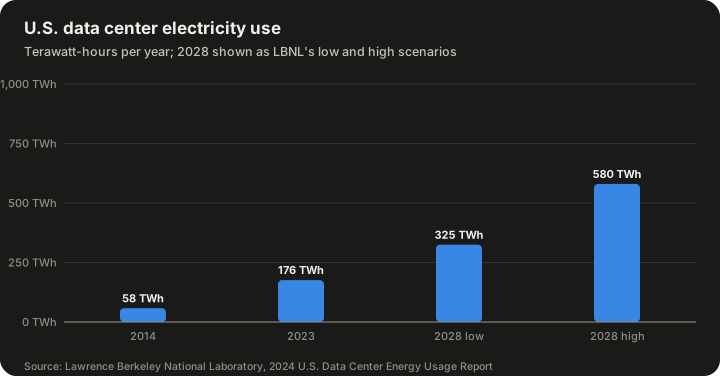
| Year | U.S. data center electricity use (TWh) |
|---|---|
| 2014 | 58 |
| 2023 | 176 |
| 2028 (low scenario) | 325 |
| 2028 (high scenario) | 580 |
Source: Lawrence Berkeley National Laboratory, 2024 United States Data Center Energy Usage Report.
The 2024 report by Lawrence Berkeley National Laboratory for the U.S. Department of Energy found that American data centres used about 176 terawatt-hours (TWh) of electricity in 2023, about 4.4 per cent of the country's total. That was up from 58 TWh in 2014. The report projected 325 to 580 TWh by 2028, which would be roughly 6.7 to 12 per cent of national electricity use.
At the global level, the International Energy Agency (IEA) has produced similar estimates.
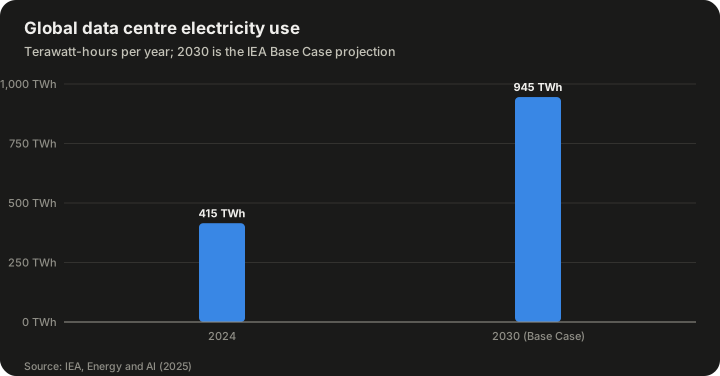
| Year | Global data centre electricity use (TWh) |
|---|---|
| 2024 | 415 |
| 2030 (IEA Base Case) | 945 |
Source: International Energy Agency, Energy and AI (2025).
The IEA's 2025 report Energy and AI estimated that data centres used about 415 TWh in 2024, around 1.5 per cent of world electricity. The United States accounted for 45 per cent, China 25 per cent and Europe 15 per cent. In the IEA's Base Case, global data centre use more than doubles to around 945 TWh by 2030. The agency's scenarios for 2035 range from 700 to 1,700 TWh. The IEA also estimated that about 20 per cent of planned data centre projects could face delays unless problems with grid connections are solved.
A simple calculation helps put these numbers in perspective. An increase from 415 TWh to 945 TWh is an increase of 530 TWh over six years. Spread evenly over the 8,760 hours in a year, 530 TWh per year is about 60 gigawatts of continuous demand (530,000 GWh ÷ 8,760 h ≈ 60.5 GW). That is the new continuous power that would need to be supplied to data centres worldwide by 2030 in the IEA's central case.
The constraints on land
Panthalassa argues that land-based data centres face several bottlenecks. The company's funding announcement listed limited grid capacity, scarce cooling water, supply chain bottlenecks, slow permits, and impacts on local communities and infrastructure. These are real concerns that other observers, including the IEA, have raised. Whether ocean-based computing is a practical answer to them is a separate question.
The company's pitch is that its nodes would sidestep all of these at once:
| Land-based problem | Panthalassa's proposed answer |
|---|---|
| Waiting for grid connections | Each node generates its own power and needs no grid |
| Cooling water use | Seawater surrounds the chips |
| Land use and local opposition | Nodes operate far offshore |
| Permits for power plants and transmission | No transmission lines or power plants on land |
| Fuel and emissions | Wave energy, with no fuel burned |
Sheldon-Coulson told CBS News that demand for AI power is not going to stop: "We're still at the beginning of this demand."
Inference rather than training
Coverage of the 2026 funding round described the Ocean-3 nodes as designed to run AI inference. In AI, training is the process of building a model by processing huge amounts of data, usually on thousands of chips that must exchange data with each other very quickly. Inference is the process of using a finished model to answer requests, such as replying to a question.
This distinction matters for an ocean design. Satellite links are slower and carry less data than the fibre-optic cables that connect chips inside a land data centre. Starlink also has higher latency (delay) than a wired connection. Wikipedia's article on the company notes that this may limit the nodes to longer computing jobs, where a short delay in getting the answer back matters less. Work that can be split into many independent pieces, each sent to a node and returned when finished, is better suited to this arrangement than work requiring constant fast communication between chips.
A precedent: Microsoft's Project Natick
Putting computers in the sea is not a new idea. Between 2018 and 2020 Microsoft ran Project Natick, in which it sealed a data centre of 12 racks and 864 servers inside a nitrogen-filled cylinder and placed it on the seabed off the Orkney Islands in Scotland. When it was brought back up after two years, Microsoft reported that the servers' failure rate in the water had been one-eighth of that of a land-based comparison group. Microsoft suggested the reasons might include the absence of people on board and the use of dry nitrogen instead of oxygen-rich air.
Project Natick shows that sealed computer containers can work reliably underwater for years. It is, however, a different case from Panthalassa's. Natick was a fixed installation in relatively shallow water, connected to shore by cable for power and data. Panthalassa's nodes would generate their own power from waves, move freely in the open ocean, and communicate by satellite. Microsoft later said it would not build further undersea data centres.
History of the company
Founding and research years (2016–2020)
Panthalassa was founded in 2016. Speaking in early 2024, Sheldon-Coulson said the company had been working for about eight years, and that the first four to five years were spent on research and development. The company describes itself as a public-benefit corporation, a type of U.S. company that is legally allowed to pursue a stated public benefit alongside profit.
The company says its team includes people who have worked at SpaceX, Google, Blue Origin, Boeing, NASA, Los Alamos National Laboratory, the U.S. Air Force and the U.S. Army, among others. In 2024 Sheldon-Coulson described a staff of about 70 people with backgrounds in aerospace, research universities, naval architecture, software, metal fabrication and the armed forces. The company works in Oregon and Washington.
Ocean-1 (2021)
The first sea-going prototype, Ocean-1, was a smaller version of the later design. It was deployed from Port Angeles, Washington, in 2021 and tested in the Strait of Juan de Fuca, the channel between Washington's Olympic Peninsula and Vancouver Island in Canada.
Ocean-2 (2024 and 2025)
Ocean-2 was the company's first large prototype. It was about 200 feet (61 m) long, with a top section about 30 feet (9 m) across. It completed a three-week sea trial in the Strait of Juan de Fuca in 2024. In February 2024 it was docked in Everett, Washington, before being taken by barge to Portland. Its appearances while being towed around Puget Sound had drawn speculation on social media. The local newspaper, The Everett Herald, reported that people had guessed it was a capsized white sailboat or a communications tower.
According to Wikipedia, a 2025 test in Puget Sound produced up to 50 kilowatts in good wave conditions. The company's website describes Ocean-2 as its Pacific Ocean pilot deployment.
To put 50 kW in context: it is a modest figure compared with the megawatt-scale output usually discussed for commercial power plants. A single 1 MW machine running flat out would produce twenty times as much. But a peak of 50 kW in good conditions showed that the basic mechanism, lifting water inside the structure and draining it through turbines, could generate useful electricity at sea from a full-size hull. Commercial machines would need to produce more, and to do so reliably for years, in all kinds of weather, without a crew on hand.
Wavehopper
The company has also tested a prototype called Wavehopper. Trade press reports say Ocean-1, Ocean-2 and Wavehopper were all tested at sea between 2021 and 2024. Few public details of Wavehopper have been released.
Series B funding (May 2026)
On May 4, 2026, Panthalassa announced that it had raised $140 million in a Series B round led by Peter Thiel, a co-founder of PayPal and Palantir.
New investors named in the announcement included John Doerr, Marc Benioff's TIME Ventures, Max Levchin's SciFi Ventures, Susquehanna Sustainable Investments, the venture fund of Hanwha Asset Management (USA), Anthony Pratt, Fortescue Ventures, Future Positive, WTI, Nimble Partners, Super Micro Computer, Sozo Ventures, Dylan Field, Planetary VC, Leblon Capital, Resilience Reserve, the Portland Seed Fund and the Intrepid Oregon Fund. Returning investors included Founders Fund, Gigascale Capital, Lowercarbon Capital, Unless and WovenEarth.
The company's announcement did not disclose a valuation or the amounts invested by each backer. Several news outlets described it as a billion-dollar company, but that figure was reported rather than confirmed in the funding announcement itself.
The funds were to be used to complete a pilot manufacturing facility near Portland and to speed up deployment of the Ocean-3 series. The company says the nodes are designed to be mass-produced from plate steel in coastal factories.
Statements made at the time included:
- Peter Thiel: "The future demands more compute than we can imagine. Extra-terrestrial solutions are no longer science fiction. Panthalassa has opened the ocean frontier."
- Garth Sheldon-Coulson: "We're now ready to build factories, deploy fleets, and provide a sustainable new source of energy for humanity."
- John Doerr described the company's system as "a game changer in addressing global energy needs and clean power generation" and said: "It is a triple win: workers benefit, communities benefit, and we gain a strategic asset that strengthens American technological leadership."
Ocean-3 and the plan for fleets
In April 2026, Sheldon-Coulson told CBS News that construction of Ocean-3 was "well under way" and that he expected units to be operating offshore around August 2026. The company also said it had all the private funding it needed for its current plans. Its stated long-term goal is to deploy thousands of nodes in the open ocean, working together as a distributed data centre.
Timeline
| Date | Event |
|---|---|
| 2016 | Panthalassa founded |
| 2016–c. 2021 | Research and development phase |
| 2021 | Ocean-1 deployed from Port Angeles and tested in the Strait of Juan de Fuca |
| 2024 | Ocean-2 completes a three-week sea trial in the Strait of Juan de Fuca |
| February 2024 | Ocean-2 docked in Everett, Washington, before being barged to Portland |
| 2025 | Ocean-2 tested in Puget Sound; up to 50 kW reported in good conditions |
| April 2026 | CBS News report; company says Ocean-3 construction is "well under way" |
| May 4, 2026 | $140 million Series B led by Peter Thiel announced |
| 2026 (planned) | Ocean-3 pilot series in the northern Pacific Ocean |
| 2027 (planned) | First commercial deployments |
Comparing Panthalassa with other approaches
Versus earlier wave energy devices
| Feature | Typical earlier wave projects | Panthalassa's design |
|---|---|---|
| Location | Near shore or at test centres | Far offshore in the open ocean |
| Holding position | Anchors and moorings | Free-floating, steered by hull shape |
| Getting energy out | Undersea export cable to the grid | No cable; energy used on board |
| Power take-off | Often hydraulics, hinges or linear generators | Water lifted inside the structure and drained through turbines |
| Product | Electricity sold to the grid | Computing services (earlier, hydrogen) |
| Material | Varied | Plate steel, aimed at mass production |
Versus other ideas for powering data centres
Panthalassa is one of many attempts to find power for AI. Others include building data centres next to existing nuclear plants, restarting or building new nuclear reactors, adding large solar and battery projects, building gas turbines on site, and placing data centres in cold climates. Some companies have proposed putting computers in orbit. Thiel's phrase "extra-terrestrial solutions" points to this wider search for computing sites beyond conventional land-based buildings.
What sets Panthalassa apart is that it combines three things in one machine: the energy source, the cooling, and the computer. That removes the need to connect separate pieces, but it also means that if one part fails, the whole unit may be out of action.
Open questions and challenges
Panthalassa's design is new, and the company had not, as of mid-2026, published independently checked figures for the output, cost or reliability of a full-scale commercial node. Several challenges have been raised by independent observers and are clear from the physics.
Maintenance far from shore
Computers fail. Even in a well-run land data centre, technicians routinely replace failed drives, power supplies and boards. The Uptime Institute, an organisation that studies data centre reliability, has noted that remote maintenance, especially of power and networking equipment, is a major challenge when no staff are on site. A node hundreds of kilometres out to sea cannot be visited quickly. Project Natick's low failure rate suggests that sealed systems can be reliable, but Natick's servers sat still on the seabed, while a wave node is constantly moving.
Storms and survival
The worked example earlier shows that storm waves can carry around 1.7 megawatts per metre of crest, compared with about 36 kilowatts per metre in a moderate swell. A machine designed to capture energy efficiently in ordinary seas must also survive the very worst conditions. Many earlier wave devices failed this test. A free-floating node has one possible advantage: with no mooring, it does not have to resist being dragged by storm waves while held in one place. It may also be able to steer away from the worst weather. These advantages are plausible but have not yet been shown at commercial scale in public trials.
Corrosion and marine growth
Steel in seawater corrodes, and plants and animals settle on any surface left in the ocean. TechRadar's coverage of the funding round pointed to the "harsh realities of waves and corrosion." Coatings, cathodic protection and periodic cleaning are standard in shipping and offshore oil and gas. They add cost, and they will matter even more for a fleet meant to stay at sea for long periods.
Navigation and the law of the sea
Free-floating, self-steering nodes would share the ocean with ships. They would need lights, radar visibility and collision avoidance. Questions about which country's rules apply to an unmoored commercial device on the high seas, and how such devices would be registered and insured, have not been widely discussed in public coverage. These are areas where the company will need to satisfy regulators.
Data links
Satellite internet has improved quickly, but it still offers less bandwidth and more latency than fibre-optic cables. This limits the types of computing work the nodes can do. As noted above, inference work that can be split into independent pieces fits better than tightly linked training work.
Environmental effects
Public reports on Panthalassa have said little about environmental studies. Questions that apply to any large ocean structure include noise, entanglement risk for marine animals, the release of heat into the water, and the effects of corrosion protection chemicals. Heat release from a single node would be small relative to the ocean, but a fleet of thousands would need study. The CBS report noted that it included no independent experts or regulators and no discussion of marine impacts.
Economics
Sheldon-Coulson told CBS News that wave power "will really be the cheapest energy on the planet." No independent cost analysis supporting this claim was cited in coverage of the company. The history of wave energy includes many projects that looked cheap on paper and expensive at sea. The economics of a node will depend on how much power it actually produces over its life, how long it lasts, how often it needs repair, and how much the computer chips inside it are used.
Common misconceptions
"Panthalassa sends wave power to shore." It does not plan to. Its current design has no export cable. The electricity is used on board, and only data leaves the node.
"The nodes are anchored buoys." The Ocean-3 design has no anchor. The nodes are meant to move under their own control, steering with their hull shape.
"The technology is proven at commercial scale." As of mid-2026, Panthalassa had tested prototypes, with a reported peak output of up to 50 kW from Ocean-2 in good conditions. The commercial Ocean-3 series had not yet been deployed.
"Underwater data centres are completely new." Microsoft's Project Natick ran a sealed seabed data centre off Orkney from 2018 to 2020. Panthalassa's idea differs because it generates its own power and floats freely, but sealed computing at sea has been tested before.
"Tens of terawatts of wave power is an established figure." It is the company's claim. The best-known peer-reviewed estimate of wave power reaching the world's coasts is about 2.1 terawatts. That study measured a different quantity, so the two figures are not directly comparable, but the larger claim has not been independently published in the sources covering the company.
"Wave energy has never worked." Wave machines have produced electricity many times, from Japanese navigation buoys in the 1940s to Pelamis units feeding grids in the 2000s. The problem has been making them survive and pay for themselves, not making them generate power at all.
Frequently asked questions
What does Panthalassa make? It designs and builds large floating steel nodes that turn wave motion into electricity, which it plans to use on board to run AI computer chips.
Where is it based? Portland, Oregon. It also works in Washington State, where its prototypes have been tested.
Who runs it? Garth Sheldon-Coulson, a co-founder, is the chief executive.
How does a node make electricity? Wave motion moves the floating node up and down. This pushes water up a long tube into the top of the structure. The water then drains back through turbines that generate electricity.
How are the computers cooled? By the seawater surrounding the sealed containers that hold them.
How does data get to and from the nodes? By low Earth orbit satellite networks. Reports name SpaceX's Starlink.
How much power has a prototype produced? Ocean-2 reportedly produced up to 50 kW in good wave conditions during a 2025 test in Puget Sound.
Who invested in the company? Its $140 million Series B in 2026 was led by Peter Thiel and included John Doerr, TIME Ventures, SciFi Ventures, Founders Fund, Lowercarbon Capital and many others.
When will the nodes be in commercial use? The company planned a pilot series of Ocean-3 nodes in the northern Pacific in 2026 and commercial deployments in 2027. These are company targets, not completed events.
Did Panthalassa always plan to do computing? No. It previously planned to use groups of nodes to produce hydrogen in the open ocean.
Is it a nonprofit? No. It is a for-profit public-benefit corporation, a legal form that lets a company commit to a public benefit alongside earning profit.
Why Panthalassa matters
Panthalassa is worth following for reasons that go beyond one company. It is a test of whether wave energy, after more than two centuries of attempts, can find a business model that avoids its biggest costs. By leaving out moorings and cables, and by selling computing instead of electricity, it changes the problem that wave energy has to solve.
It is also a sign of how strongly AI's demand for electricity is pulling investment toward new energy ideas. The figures from Lawrence Berkeley National Laboratory and the IEA show data centre power use rising sharply. Investors are now willing to fund approaches that would have seemed unusual only a few years ago.
Whether Panthalassa succeeds will depend on things that only long, real-world operation can show: how much power the nodes produce over months and years, how well they survive storms and corrosion, how often the computers inside them fail, and whether the whole system costs less than the alternatives on land. The Ocean-3 pilot series is the first step toward answering those questions.
Sources
- Panthalassa (company) – Wikipedia)
- Panthalassa – company website
- ESG Today: Peter Thiel Leads $140 Million Capital Raise for Panthalassa to Power AI Computing Using Ocean Waves (May 5, 2026)
- Water Power Magazine: Panthalassa secures $140m for wave powered AI systems (May 2026)
- ITPro: Panthalassa "has opened the ocean frontier" (May 2026)
- CBS News: Using wave energy to power sea-based AI data centers (April 19, 2026)
- The Everett Herald: That mysterious floating object near Everett? It's a prototype (Feb 13, 2024)
- GeekWire: Data centers at sea: Oregon's Panthalassa nets $140M led by Peter Thiel (May 4, 2026)
- TechRadar: A billion-dollar bet on floating data centers (May 2026)
- Lawrence Berkeley National Laboratory: 2024 United States Data Center Energy Usage Report
- Berkeley Lab news release on the 2024 data center report
- International Energy Agency: Energy and AI, executive summary (2025)
- Gunn and Stock-Williams, "Quantifying the global wave power resource," Renewable Energy 44 (2012)
- Wave power – Wikipedia
- Quartz: The promise of ocean wave power has enticed, and eluded, engineers for 40 years
- BBC: Microsoft's underwater data centre resurfaces after two years