Energy-Quest was a student-run American organization that set out, in the mid-2000s, to warn the public about the risks of depending on fossil fuels and to promote energy conservation and renewable energy. Its method was unusual. Instead of relying mainly on reports, lectures or lobbying, it planned to win attention through a series of record-setting ocean voyages. The organization began under the name The Hydrogen Expedition, after its original goal: sailing around the world in a boat powered only by a hydrogen fuel cell.
The project was started by Joseph F. Sahid, a student at the University of Pennsylvania, and was organized and staffed by university students. Energy-Quest's plans grew to include three voyages: support for the Earthrace biodiesel powerboat record attempt, a planned round-the-world trip in a very small hybrid-powered boat called the Aurora Expedition, and the hydrogen-powered Triton Expedition. Of these, only Earthrace, which was led by others, actually completed its voyage. According to Wikipedia, the Energy-Quest program has since been discontinued.
Energy-Quest is a small subject. Public records about it are limited, and Wikipedia's article on it is marked as needing more citations. This article therefore sets out what can be confirmed about the organization itself and then places it in its real context: the history of record-breaking voyages with alternative fuels, the technical difficulties of hydrogen-powered boats that the project ran into, and what later projects showed about whether its goals were achievable.
At a glance
| Item | Detail |
|---|---|
| Original name | The Hydrogen Expedition |
| Later name | Energy-Quest |
| Founder | Joseph F. Sahid, University of Pennsylvania student |
| Start | Organizing under way by late 2004; Wikipedia dates the project's start to summer 2005 |
| Type | Student-run awareness and advocacy organization |
| Aims | Raise awareness of the risks of fossil-fuel dependence; promote conservation and renewable energy |
| Method | Record-setting ocean voyages designed to attract media coverage |
| Planned voyages | Earthrace (biodiesel), Aurora Expedition (hybrid diesel, solar and wind), Triton Expedition (hydrogen fuel cell) |
| Completed | Earthrace set a round-the-world powerboat record in 2008; Energy-Quest's role was organizational and fundraising support in the U.S. |
| Status | Discontinued |
Origins: The Hydrogen Expedition
A high-school idea
The best contemporary account of the project's early days is a November 15, 2004, article in The Daily Pennsylvanian, the University of Pennsylvania's student newspaper. It described Joseph Sahid, then a freshman in the College of Arts and Sciences, as the founder of the Hydrogen Expedition. Its aim was to circumnavigate the globe in the first vessel powered by a hydrogen fuel cell.
According to the article, Sahid began the work while still a senior in high school. As part of his research, he spent a summer on a 13-foot Boston Whaler, a small open motorboat, chasing large storms on the Atlantic Ocean. That summer he also opened an office for the project in New York City, worked with a small group of assistants, and wrote to Nobel laureates, cabinet officials, members of Congress and media figures. Wikipedia's article describes him as a graduate of Phillips Exeter Academy.
In his first few months at Penn, Sahid gathered about a dozen students to work on the project. The team began meeting in lounges in the university's Quadrangle residence halls.
The dates
There is a small inconsistency in the record. Wikipedia says the project "was started in the summer of 2005" and calls Sahid a sophomore at the time. The Daily Pennsylvanian, however, was already reporting on the Hydrogen Expedition in November 2004, when Sahid was a freshman, and it said he had begun the work in high school. The most likely explanation is that the idea and early organizing came first, and that the project became a more formal organization, possibly under the Energy-Quest name, around 2005. The public sources do not settle the exact sequence.
The plan
The Daily Pennsylvanian listed the team's plan in order:
- Partner with Penn or another organization that had nonprofit status.
- Carry out a feasibility study to find the best boat design and the cost of the expedition.
- Raise funds, which the newspaper called potentially the hardest step.
- Attract media attention to help get equipment and money.
- After departure, use the voyage to publicize fuel cells and alternative energy around the world.
Sahid estimated that the project would cost "several million dollars," though he said he was not sure of the exact figure. No sponsors or confirmed partners were named at that stage.
The students' reasoning about publicity was explicit. "I expect that the media will be excited by the fact that the expedition is being organized entirely by college students," Sahid told the newspaper. He also described the project as "a win-win for sponsors, participants, the media and society."
Team members expressed the generational spirit of the effort. Tom Dougherty, a sophomore, said: "Ultimately, I think [hydrogen] will be the energy source for our generation. The best people to get it all together are people of this generation." David Bock, another sophomore, said hydrogen power was "a great way [for America] to get back on the world's good side."
Expert doubts from the start
The same article recorded the cautious views of two Penn professors of chemical and biomolecular engineering, and their comments turned out to be important.
John Vohs said the goal was commendable: "It's a laudable goal," he said, but "at the state of the technology right now, it's not very feasible." He explained that fuel cells were still largely at the research stage.
Raymond Gorte praised the students' dedication and said their plans might be feasible. But he made a deeper point about hydrogen itself: "The problem is that hydrogen is not an energy source – it is a way to store energy." Hydrogen still has to be made using some other source of energy. "They don't really solve the energy problem," he said.
Gorte's point is central to understanding both the promise and the limits of a hydrogen-powered voyage, and it is explained in more detail below.
Mission and strategy
What Energy-Quest wanted to achieve
According to Wikipedia, Energy-Quest was launched to educate the public about the risks of an energy crisis brought on by dependence on fossil fuels. It promoted two remedies: energy conservation (using less energy) and renewable energy (getting energy from sources such as the sun, wind and plants that are naturally replaced).
Why record-setting voyages?
The organization's main tool was spectacle. Long ocean voyages, especially those that set world records, have a long history of attracting newspaper and television coverage. They offer a story with a beginning, a middle and an end, a clear goal and real danger. A voyage that also showed off an alternative fuel could, in theory, carry a message about energy to people who would never read a policy report.
Energy-Quest's plan was to use three voyages as a ladder. A support role in an established record attempt would build experience and credibility. A small-boat circumnavigation would test the organization's ability to run its own expedition. The hydrogen voyage, the original goal, would come last.
Who endorsed it
Wikipedia lists the following endorsers of the project when it was known as the Hydrogen Expedition:
| Endorser | Type of organization |
|---|---|
| Bluewater Network | U.S. environmental advocacy group |
| National Hydrogen Association of Australia | Hydrogen industry association |
| Save the Planet USA | Environmental group |
| Environment Colorado | State environmental advocacy group |
| Italian Hydrogen and Fuel Cell Association | Hydrogen industry association |
| HydrogenBoyz | Hydrogen enthusiast group |
These endorsements show that the project had built connections with both environmental campaigners and hydrogen industry groups. They do not on their own indicate funding.
The three voyages
1. Earthrace
Earthrace was the one voyage associated with Energy-Quest that actually happened. It was not an Energy-Quest project in the full sense. It was led by New Zealander Pete Bethune and backed by more than 100 companies. According to Wikipedia, Energy-Quest helped with organization and fundraising in the United States.
The goal of Earthrace was to set a new speed record for going around the world in a powerboat while using only renewable fuel. It is described in detail in the next section.
2. The Aurora Expedition
The Aurora Expedition was Energy-Quest's own planned voyage. It would have taken a 20-foot (about 6 m) powerboat around the world. According to Wikipedia, this would have made it the smallest boat of its kind to complete such a trip. The boat was to use a mix of diesel engines, solar cells and wind turbines, and to stop at more than forty ports to promote clean energy. The Aurora Expedition was intended as a stepping stone toward the Triton Expedition.
There is no public record that the Aurora Expedition took place.
3. The Triton Expedition
The Triton Expedition was the project's original dream under a new name. It was planned as the first circumnavigation of the world by a boat powered solely by a hydrogen fuel cell. Its aims were to attract media attention and to encourage a move toward a renewable, hydrogen-based economy.
There is no public record that the Triton Expedition took place either. A hydrogen-powered boat did eventually sail around the world, but not until more than a decade later and as part of a different, well-funded project (see Energy Observer, below).
Earthrace in detail
Because Earthrace was the voyage that succeeded, it is the best window into what this kind of expedition involved.
The boat
Earthrace was a wave-piercing trimaran, meaning it had a slim central hull with two smaller side hulls. It was designed to slice through waves rather than ride over them. It was designed by LOMOcean Marine (formerly Craig Loomes Design Group) and built by Calibre Boats in Auckland, New Zealand. Construction began in January 2005 and the boat was launched on February 22, 2006. It cost about $2.5 million, mostly paid by sponsors.
| Specification | Earthrace |
|---|---|
| Length | 78 ft (24 m) |
| Beam (width) | 23 ft (7.0 m) |
| Draught | 4 ft (1.2 m) |
| Displacement | 13 tons |
| Hull | Carbon fibre and Kevlar composite |
| Engines | 2 × 400 kW (540 hp) Cummins Mercruiser |
| Fuel | Biodiesel (animal fat and vegetable oil blend); could also use regular diesel |
| Fuel capacity | 12,000 litres |
| Range | 12,000 nautical miles |
| Claimed top speed | 32 knots (59.3 km/h) |
| Crew | 4 to 8 |
The boat could reportedly cut through 15 m waves and travel up to 7 m underwater. Its environmental features included vegetable-oil lubricants, hemp composites, non-toxic antifouling paint and bilge-water filters.
What biodiesel is
Biodiesel is a fuel made from vegetable oils or animal fats that can run in diesel engines. Because the carbon in it came from plants that recently took carbon dioxide from the air (directly, or through animals that ate them), it is considered renewable. Whether a particular biodiesel actually reduces greenhouse gas emissions depends on how its raw materials were grown and processed. Fuel made from waste fats generally has a much better climate record than fuel made from crops grown on newly cleared land. Earthrace's publicity focused on showing that a high-performance boat could run on such fuel.
The failed first attempt (2007)
Earthrace first tried for the record in 2007. It left Barbados on March 10, 2007, but suffered propeller and mechanical problems. On the night of March 19, 2007, about 22 km off the coast of Guatemala, it collided with a small local fishing boat. One of the three fishermen aboard was never found. The Earthrace crew were held for a 10-day investigation and were then cleared of blame.
The team restarted from San Diego on April 7, 2007, using a new start and finish line, with a deadline to return by June 21. An engine fault off Palau caused an eight-day delay. On May 31, 2007, shortly after leaving Málaga in Spain, the crew found a crack in the hull and abandoned the attempt.
The record (2008)
After a refit at the Vulkan Shipyard in Spain, Earthrace tried again. It started from Sagunto, Spain, at 14:35 Central European Time on April 27, 2008. The crew were Pete Bethune (skipper and owner), Adam Carlson (navigator), Mark Russel (engineer) and Rob Drewett (cameraman).
The trip was not easy. Two days out, the autopilot failed and then a lift pump became blocked. Netting wrapped around a propeller and Bethune had to remove it in the dark. Near Palau, submerged debris sheared two blades off the port propeller, forcing the boat to run on one engine to Singapore for repairs. The crew also dealt with monsoon seas, heat rash, transponder damage and a pump fault that limited speed to 16 knots.
Earthrace crossed the finish line at Sagunto at 14:24 CET on June 27, 2008. Its time was 60 days, 23 hours and 49 minutes. That beat the previous record, set in 1998 by Cable & Wireless Adventurer, by 13 days, 21 hours and 9 minutes.
Worked check. The previous record was 74 days, 20 hours, 58 minutes. Subtracting Earthrace's time:
- 74 d 20 h 58 min − 60 d 23 h 49 min
- Borrow one day: 73 d 44 h 58 min − 60 d 23 h 49 min
- = 13 d 21 h 9 min
That matches the reported margin.
The planned route went from Sagunto to the Azores, Puerto Rico, Panama, Manzanillo in Mexico, San Diego, Hawaii, Majuro in the Marshall Islands, Koror in Palau, Singapore, Kochi in India, Salalah in Oman, through the Suez Canal, and back to Sagunto.
A critique
Earthrace was presented as a green boat, but the late Cambridge physicist Sir David MacKay, author of Sustainable Energy – Without the Hot Air, calculated that it used more energy per passenger-kilometre than a jet-ski or the ocean liner Queen Elizabeth 2 (as summarized in Wikipedia's article on the vessel). The point was not that biodiesel is bad, but that a fast powerboat carrying a handful of people uses a great deal of energy no matter what fuel it burns. Speed through water costs energy, and the energy needed rises steeply with speed.
This critique goes to the heart of Energy-Quest's strategy. Record voyages are excellent for attracting attention. They are not, in themselves, examples of energy conservation, which was one of the two causes the organization promoted.
How a powerboat round-the-world record is judged
Records like Earthrace's are ratified by the Union Internationale Motonautique (UIM), the world governing body for powerboating, whose records list Wikipedia cites for the Earthrace time. In broad terms, a round-the-world attempt starts and finishes at the same declared line, and the clock runs continuously from the moment the boat crosses it until it returns. Stops for fuel, food and repairs are allowed, but the clock keeps running during them. That is why every hour lost to a fouled propeller or a broken pump in the list above counted directly against the crew. Passages through the Suez and Panama canals are part of the normal route for powered boats, because they shorten the distance enormously compared with going around Africa and South America.
This rule structure also explains why Earthrace's 2007 restart from San Diego used a new start and finish line. After the delays and the collision off Guatemala, the team could not complete the circuit from Barbados within the time it needed, so it began a fresh attempt from a different point on the route.
Fuel arithmetic
The boat's published figures allow a rough calculation. With a fuel capacity of 12,000 litres and a stated range of 12,000 nautical miles, the design figures work out to about 1 litre of fuel per nautical mile (12,000 L ÷ 12,000 nmi = 1 L/nmi). Real consumption would have depended heavily on speed and sea state, because a boat pushing harder through rough water uses much more fuel per mile. Even so, the simple ratio helps explain MacKay's critique above: a fast boat carrying four people needs a great deal of fuel, whatever kind of fuel it is.
What happened to the boat
Earthrace's later history was dramatic. In 2009 it joined the anti-whaling group Sea Shepherd's campaign in the Southern Ocean. It was painted black, given extra armour and renamed Ady Gil on October 17, 2009, after a sponsor who had donated $1 million. On January 6, 2010, it collided with the Japanese whaling-fleet vessel Shōnan Maru 2 in Antarctic waters and lost its bow. One crew member suffered six broken ribs. The boat sank the next day.
Maritime New Zealand found both vessels at fault. The Australian Maritime Safety Authority's investigation was inconclusive. In 2015 an arbitration found that Sea Shepherd had wrongfully scuttled the vessel for publicity and awarded the owners US$500,000 plus interest. Pete Bethune later boarded the Shōnan Maru 2, was arrested in Japan, received a suspended two-year sentence and was deported. Energy-Quest had no part in these later events, which took place after the boat's renewable-fuel record campaign.
Round-the-world voyages with powered boats
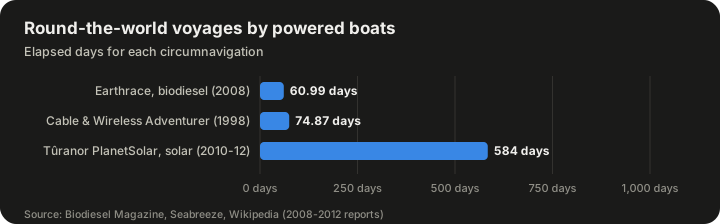
Earthrace was one of several high-profile powered circumnavigations around this time. The comparison shows how different the goals of "fastest" and "cleanest" can be.
| Vessel | Year(s) | Power | Elapsed time |
|---|---|---|---|
| Earthrace | 2008 | Biodiesel | 60 d 23 h 49 min (60.99 days) |
| Cable & Wireless Adventurer | 1998 | Diesel | 74 d 20 h 58 min (74.87 days) |
| Tûranor PlanetSolar | 2010–2012 | Solar electric | 584 days |
Sources: Wikipedia articles on Earthrace and Tûranor PlanetSolar; Motor Boat & Yachting; Sail-World.
Cable & Wireless Adventurer (1998)
Cable & Wireless Adventurer was a trimaran designed by the British naval architect Nigel Irens. In 1998 it went round the world in 74 days, 20 hours and 58 minutes, travelling more than 22,600 nautical miles (about 41,855 km) and setting a Guinness World Record for a powered vessel. Its eastbound route included refuelling stops and passages through the Suez and Panama canals. Different sources give slightly different figures for the number of stops and the distance. The vessel was later acquired by Sea Shepherd as a replacement for the Ady Gil.
Tûranor PlanetSolar (2010–2012)
Tûranor PlanetSolar took the opposite approach. It made no attempt to be fast. It was designed to show that a boat could circle the globe using sunlight alone.
| Specification | Tûranor PlanetSolar |
|---|---|
| Launched | March 31, 2010, Kiel, Germany |
| Length | 31 m (35 m with flaps extended) |
| Beam | 15 m (23 m with flaps) |
| Displacement | 85 tonnes |
| Solar panels | 537 m², rated 93 kW peak |
| Batteries | 8.5 tons of lithium-ion |
| Motors | Two 60 kW and two 10 kW electric motors |
| Speed | 10 knots maximum, 5 knots cruising |
| Cost | €15 million |
It left Monaco on September 27, 2010, and returned on May 4, 2012, after 584 days at sea. It was recorded as the first solar electric vehicle to circumnavigate the globe. Its expedition leader was Raphaël Domjan. It was designed by LOMOcean Marine, the same firm that designed Earthrace. It later became a research vessel, then was renamed Race for Water in 2015 and Porrima in 2021.
The contrast is striking. Earthrace was nearly ten times faster than PlanetSolar but burned 12,000 litres of fuel per tank. PlanetSolar burned nothing but took more than a year and a half. Energy-Quest's planned Aurora Expedition, with its mix of diesel, solar and wind on a tiny boat, sat somewhere between these two approaches.
The hydrogen problem
The Hydrogen Expedition's founding goal, a circumnavigation powered only by a hydrogen fuel cell, faced serious technical obstacles in the mid-2000s. Understanding them helps explain why the project did not reach the water.
What a fuel cell does
A fuel cell is a device that combines hydrogen with oxygen from the air to produce electricity, with water and heat as by-products. It works rather like a battery that never runs down as long as it is supplied with fuel. In a hydrogen boat, the fuel cell's electricity drives electric motors that turn the propellers. There is no combustion and no exhaust smoke.
Hydrogen is an energy carrier, not a source
Professor Gorte's warning in 2004 is the key idea. There are no natural reservoirs of pure hydrogen gas to tap. Hydrogen must be made, usually either from natural gas (which releases carbon dioxide unless the carbon is captured) or by splitting water with electricity in a device called an electrolyser. Either way, more energy goes into making the hydrogen than comes back out of the fuel cell. Hydrogen is therefore a way of storing and moving energy, like a battery, rather than a source of energy, like the sun or wind.
So a hydrogen boat is only as clean as the hydrogen it carries. If the hydrogen was made from natural gas, the voyage would still depend on fossil fuels, just at one remove. If it was made with renewable electricity, the boat would be genuinely low-carbon.
Energy per kilogram and per litre
Hydrogen holds a lot of energy for its weight. According to tables in the U.S. National Academies' report The Hydrogen Economy, one kilogram of hydrogen contains 120.1 megajoules (33.3 kilowatt-hours) on a lower heating value basis. That is more energy per kilogram than any other fuel.
The difficulty is volume. Hydrogen is the lightest element, and at normal temperatures and pressures a kilogram of it takes up an enormous space. The U.S. Department of Energy notes that hydrogen has very low energy per unit volume at ambient conditions. To store useful amounts, it must be either:
- compressed in strong tanks at 350 to 700 bar (5,000 to 10,000 psi), or
- liquefied, which requires cooling it to its boiling point of −252.8 °C at normal pressure.
Both methods add weight, cost and complexity. High-pressure tanks are heavy. Liquid hydrogen needs insulated tanks and slowly boils away. On a small boat in rough seas, far from any refuelling station, these problems are much harder than on land.
Refuelling around the world
A car driving on hydrogen needs a network of filling stations. A boat sailing around the world needs hydrogen in every port where it stops, or a way to make its own. In 2005 there was essentially no such network for ships. This was perhaps the single biggest obstacle to the Triton Expedition.
A student hydrogen boat in practice
A 2009 student project shows how hard even a short hydrogen voyage could be. Students from Rensselaer Polytechnic Institute in Troy, New York, fitted a 6.7 m boat called the New Clermont with two 2.2 kW hydrogen fuel cells on loan from Plug Power. Each fuel cell unit weighed about 227 kg. The students set out on September 21, 2009, from Manhattan to retrace Robert Fulton's famous 1807 steamboat route up the Hudson River, a distance of 240 km, at a planned 8 km/h. The boat was designed to go about 97 km between refuellings, and a gas supplier met it at the dock with a refuelling truck.
On the second day, one motor failed less than three hours into the trip. The second shut down about a mile from Beacon, New York, and the students could not restart either motor with the fuel cells or battery packs. They finished that leg with a backup petrol outboard motor. As Scientific American reported, "When hydrogen fails, the students turn to that old standby – gasoline."
That was a 240 km river trip with refuelling trucks waiting on shore. The Triton Expedition aimed to cross oceans.
Did anyone achieve the Triton dream?
Yes, eventually. The French vessel Energy Observer became the first hydrogen-powered vessel to sail around the world, finishing in 2024. Its approach shows what it took.
| Specification | Energy Observer |
|---|---|
| Origin | Built in Canada in 1983 by naval architect Nigel Irens as a racing catamaran, later lengthened four times |
| Length | 30.5 m |
| Width | 12.8 m |
| Weight | 28 tonnes |
| Fuel cell | 22 kW |
| Hydrogen stored | 62 kg |
| Hydrogen system weight | 2,100 kg |
| Solar panels | 130 m², 21 kW peak |
| Other power | Two 1 kW vertical-axis wind turbines and a traction kite |
| Battery | 106 kWh lithium |
| Motors | Two 41 kW reversible electric motors |
| Speed | 8 to 10 knots |
The key feature was that Energy Observer made its own hydrogen on board. It used a desalinator to turn seawater into fresh water, an electrolyser to split that water into hydrogen and oxygen using solar and wind power, and a compressor to store the hydrogen. That solved both of the problems that blocked the Hydrogen Expedition: there was no need for hydrogen filling stations, and the hydrogen was made from renewable energy rather than natural gas.
The vessel was launched at Saint-Malo, France, on April 14, 2017. It returned to Saint-Malo on June 14, 2024, after more than 68,000 nautical miles, 50 countries and 101 stopovers. Its official final port of call was Paris, on September 12, 2024. The expedition was led by Victorien Erussard and Jérôme Delafosse.
Worked example (hypothetical efficiency). How far could 62 kg of hydrogen take Energy Observer? Its stored hydrogen holds 62 × 33.3 = about 2,065 kWh of chemical energy. If we assume, for illustration only, that the fuel cell turns half of that into electricity, the result is about 1,030 kWh. Running the 22 kW fuel cell at full output, that would last about 1,030 ÷ 22 ≈ 47 hours. The 50 per cent efficiency figure is an assumption for this example, not a measured value for this boat. The calculation shows why the boat relied on a mix of sun, wind, batteries and hydrogen, rather than hydrogen alone, and why it took seven years rather than weeks.
Notice also that Energy Observer was not "powered solely by a hydrogen fuel cell," the exact goal of the Triton Expedition. Its success depended on combining several sources. In practical terms, its design looks more like Energy-Quest's Aurora Expedition concept (several energy sources on one boat) than like the pure-hydrogen Triton plan.
Comparing the planned and real projects
| Project | Power source | Size | Organizer | Outcome |
|---|---|---|---|---|
| Earthrace (2008) | Biodiesel | 24 m trimaran | Pete Bethune, with sponsors; Energy-Quest U.S. support | Round-the-world powerboat record, 60 d 23 h 49 min |
| Aurora Expedition (planned) | Diesel, solar cells, wind turbines | 20 ft (about 6 m) | Energy-Quest | No record of departure |
| Triton Expedition (planned) | Hydrogen fuel cell only | Not published | Energy-Quest | No record of departure |
| Tûranor PlanetSolar (2010–2012) | Solar electric | 31 m catamaran | PlanetSolar, funded by Immo Ströher | First solar circumnavigation, 584 days |
| New Clermont (2009) | Hydrogen fuel cells | 6.7 m | Rensselaer students | Hudson trip completed partly with a petrol backup motor |
| Energy Observer (2017–2024) | Solar, wind, batteries, hydrogen made on board | 30.5 m catamaran | Energy Observer team | First hydrogen-powered vessel round the world |
Why Energy-Quest did not succeed
The public record does not include a statement from the organization explaining why it ended. But the sources point to several likely reasons.
Cost. In 2004 the founder estimated the hydrogen voyage would cost "several million dollars." For comparison, Earthrace alone cost about $2.5 million, and that was with more than 100 corporate backers. PlanetSolar cost €15 million. Raising sums like these as a student organization, without an established nonprofit partner, would have been extremely hard. The Daily Pennsylvanian had already identified fundraising as potentially the most difficult step.
Technology readiness. As Professor Vohs said in 2004, fuel cells were then largely at the research stage. A fully hydrogen-powered ocean crossing needed hydrogen storage and production at sea that did not yet exist in practical form.
Fuel logistics. There was no network of hydrogen supplies in ports around the world.
Student turnover. Student organizations face a structural problem: members graduate. A multi-year project to build a boat and sail it round the world needs continuity that a team of undergraduates struggles to provide.
Safety and risk. The Earthrace story, including a fatal collision in 2007 and a cracked hull, shows how dangerous ocean record attempts can be even for experienced, well-funded crews. A small 20-foot boat on a circumnavigation would carry high risk.
What Energy-Quest got right
It would be unfair to measure the project only by the voyages it did not make.
The idea of using adventure to carry a message proved sound. PlanetSolar stopped at Cancún during the 2010 UN climate change conference. Energy Observer visited 50 countries over seven years and drew wide media coverage at its stopovers. Both followed the same basic strategy that the Hydrogen Expedition had proposed in 2004: a record-setting voyage that makes a point about energy.
The diagnosis of the energy problem was mainstream. Concern about fossil-fuel dependence and the need for conservation and renewable energy were at the centre of energy policy debates then and remain so.
Students can launch serious projects. The organization did help support one real world record, Earthrace. And student-led energy projects, such as university solar car teams and the Rensselaer hydrogen boat, have continued to be an important way of training engineers and testing ideas.
The hydrogen goal was eventually reached. Energy Observer's voyage showed that a hydrogen-powered circumnavigation was possible, though it took a large professional team, a 30 m vessel and seven years.
Lessons for energy advocacy
Energy-Quest's story raises questions that apply well beyond one small organization.
Spectacle versus substance. A record voyage is good at gaining attention but can send mixed messages. MacKay's critique of Earthrace's energy use shows that a "green" stunt can use more energy than ordinary transport. Advocates have to decide whether the attention is worth that cost.
Energy carriers versus energy sources. The Hydrogen Expedition's early publicity promoted hydrogen as a clean fuel, but as Gorte said, hydrogen does not solve the energy problem on its own. It is only as clean as the energy used to make it. That distinction remains important in debates about hydrogen today.
Matching ambition to resources. The project's three-step plan, from support role to small boat to hydrogen boat, was sensible. But each step needed far more money and technical capacity than the one before.
Common misconceptions
"Energy-Quest built and sailed Earthrace." It did not. Earthrace was led by Pete Bethune and backed by more than 100 companies. Energy-Quest helped with organization and fundraising in the United States.
"Energy-Quest completed a hydrogen-powered circumnavigation." It did not. The Triton Expedition never departed. The first hydrogen-powered vessel to go around the world was Energy Observer, which finished in 2024.
"Hydrogen is a renewable energy source." Hydrogen is an energy carrier. It is renewable only if it is made using renewable energy.
"Biodiesel made Earthrace energy-efficient." Biodiesel changed where Earthrace's fuel came from, not how much energy it used. As a fast powerboat, it used a great deal of energy per person carried.
"The Aurora Expedition set a small-boat record." There is no public record that it took place. Wikipedia's description refers to what it would have achieved.
Frequently asked questions
What was Energy-Quest? A student-run organization, started by University of Pennsylvania student Joseph F. Sahid, that aimed to raise awareness of the dangers of fossil-fuel dependence and to promote conservation and renewable energy through record-setting ocean voyages.
What was it originally called? The Hydrogen Expedition.
When did it start? Wikipedia dates its start to summer 2005, but Penn's student newspaper was reporting on the Hydrogen Expedition by November 2004, and said its founder had begun work on it in high school.
What were its three voyages? Earthrace (a biodiesel powerboat speed record attempt, which Energy-Quest supported), the Aurora Expedition (a planned circumnavigation in a 20-foot hybrid-powered boat) and the Triton Expedition (a planned hydrogen fuel cell circumnavigation).
Did any of them happen? Earthrace did. It set a round-the-world powerboat record of 60 days, 23 hours and 49 minutes in 2008. There is no record that the other two took place.
Does Energy-Quest still exist? No. Wikipedia says the program has been discontinued.
Why was a hydrogen boat so hard to build in 2005? Fuel cells were still largely experimental, hydrogen is difficult to store in a small space, and there was no network of hydrogen supplies in ports. The hydrogen would also have needed to be made from renewable energy for the voyage to be truly clean.
Has a hydrogen boat ever sailed around the world? Yes. Energy Observer completed a seven-year voyage of more than 68,000 nautical miles in 2024, making its hydrogen on board from seawater using solar and wind power.
Who endorsed the project? Endorsers listed by Wikipedia include Bluewater Network, the National Hydrogen Association of Australia, Save the Planet USA, Environment Colorado, the Italian Hydrogen and Fuel Cell Association and HydrogenBoyz.
Legacy
Energy-Quest is a footnote in the history of energy advocacy, but a revealing one. It shows a group of students in the mid-2000s identifying the same problems that would dominate energy debates for the next twenty years, and choosing a bold, media-friendly way to talk about them. Its experts' early warnings about hydrogen proved accurate. The voyages it imagined were eventually made, though by others, with far larger budgets and better technology: PlanetSolar on sunlight, and Energy Observer on sunlight, wind and hydrogen it made itself. The one voyage it helped to support, Earthrace, set a world record and also showed the limits of using a fast powerboat to carry a message about saving energy.
Sources
- Energy-Quest – Wikipedia
- The Daily Pennsylvanian: Entrepreneurs look to future of hydrogen fuel (Nov 15, 2004)
- MY Ady Gil (Earthrace) – Wikipedia
- Motor Boat & Yachting: Earthrace breaks record
- Sail-World: Earthrace – New Record Round the World in 60 days
- Nigel Irens: Cable & Wireless Adventurer
- MV Brigitte Bardot (formerly Cable & Wireless Adventurer) – Wikipedia
- Tûranor PlanetSolar – Wikipedia
- Energy Observer – Wikipedia
- Energy Observer: Saint-Malo, France (return of the Odyssey)
- H2 View: Energy Observer ends 68,000-mile global voyage at French home port
- Scientific American: Uncharted waters – Students retrofit sailboat with hydrogen power (Sept 22, 2009)
- Scientific American: Uncharted waters – When hydrogen fails, the students turn to gasoline (Sept 23, 2009)
- U.S. Department of Energy: Hydrogen Storage
- National Academies: The Hydrogen Economy (2004), conversion factors appendix