The Czech Biomass Association, known as CZ Biom (in Czech, České sdružení pro biomasu, z. s.), is a non-governmental, non-profit professional association in the Czech Republic. It promotes "phytoenergetics", meaning energy from plant material, and works on composting and the handling of biodegradable waste. It was founded in 1994. Its members are companies, research institutes, municipalities and specialists who produce, use or study biomass as an energy source: wood chips and pellets, agricultural residues, energy crops, biogas, biomethane and compost.
CZ Biom is small. Its own English-language page has described about 160 member firms and organisations and a staff of ten employed experts, and a 2011 presentation gave 130 member companies. But it sits in the middle of one of the largest parts of the Czech renewable energy system. In 2023, biomass and biofuels of all kinds supplied roughly four-fifths of the country's renewable energy, according to Eurostat's energy balance. This article explains what the association is and does, the history of the bioenergy sector it grew up with, the numbers behind Czech biomass and biogas, the policy fights it has been involved in, and the debates and limits that come with burning or digesting plant matter for energy.
At a glance
| Item | Details |
|---|---|
| Full name | CZ Biom – České sdružení pro biomasu, z. s. (Czech Biomass Association) |
| Founded | 1994 |
| Legal form | Registered association (zapsaný spolek); non-governmental, non-profit professional body |
| Registration | Identification number 61383929; association register of the Municipal Court in Prague, Section L, File 5980 |
| Correspondence address | Opletalova 7/918, 111 44 Prague 1 |
| Chair (current) | Jan Habart |
| Sections | Biogas; Biomethane; Sustainability criteria; Heat and electricity from solid biomass; Composting and biodegradable waste |
| International memberships | Bioenergy Europe; European Biogas Association; World Bioenergy Association; European Compost Network |
| Publications | Magazine BIOM (three issues a year), the portal biom.cz, newsletters |
| Websites | czbiom.cz, biom.cz |
What "phytoenergetics" means
The Czech word fytoenergetika is the umbrella term CZ Biom uses for its field. It covers any use of plant-derived material for energy. In practice that means several quite different technologies:
- Solid biomass combustion. Wood chips, sawmill residues, bark, straw, pellets and briquettes are burned in boilers to make heat, or in combined heat and power (CHP) plants to make heat and electricity together. Some large coal-fired heating plants also "co-fire" biomass alongside coal.
- Anaerobic digestion (biogas). Manure, slurry, crop silage, food waste and sewage sludge are broken down by bacteria in sealed tanks without oxygen. The result is biogas, a mixture that CZ Biom-related analysis describes as about 55% methane and 40% carbon dioxide, plus a nutrient-rich digestate that can go back onto fields.
- Biomethane. Biogas can be "upgraded" by removing most of the carbon dioxide and impurities. What is left, at least 95% methane, is chemically very close to natural gas and can be injected into the gas grid or used as vehicle fuel.
- Liquid biofuels. Biodiesel and bioethanol made from crops such as rapeseed and sugar beet, blended into transport fuel.
- Composting. Not an energy technology, but closely linked. Composting turns biodegradable waste into a soil improver, and it competes with digestion for the same feedstocks. CZ Biom has treated composting as a core area since its early years.
The association's own list of fields in a 2011 presentation shows this breadth. It named electricity and heat from phytoenergetics, biogas and biogas plants, biowaste and composting, solid biofuels (pellets, briquettes, chips), energy crops and fast-growing woody plants, and liquid biofuels.
Origins: reclaimed mines, collapsing farms and cleaner air
CZ Biom marked its thirtieth anniversary in 2024 with a special issue of its magazine that tells the story of where it came from. Its account goes back before the 1989 Velvet Revolution. Air pollution in the industrial regions of what was then Czechoslovakia was severe, and residents of cities such as Ústí nad Labem protested regularly for cleaner air. The magazine notes that historians count this environmental anger as one of the triggers of the revolution.
The professional community that later founded CZ Biom also took shape in the communist period. According to the association, its roots lay in the reclamation of land left behind by coal mining. Researchers used fly ash, other by-products of power generation and compost to restore spoil heaps, and on these reclaimed plots they ran some of the first trials of perennial energy grasses and trees. That work was centred at the Crop Research Institute (Výzkumný ústav rostlinné výroby) in Prague-Ruzyně and in Chomutov, in the North Bohemian brown-coal basin.
After 1989, Czech agriculture went through deep structural change. CZ Biom's account lists a fall in livestock numbers, a dramatic drop in fertiliser use, and a new need to protect surface and ground water. Together these opened up the possibility of using arable land and permanent grassland for something other than food. In that setting the association was founded in 1994. At first it concentrated on research into growing and using biomass and on popularising renewable energy. It could build on old traditions: wood had always heated Czech homes, and sawmills and wood-processing plants had long burned their own offcuts for energy.
Growth with EU accession (late 1990s to 2013)
The next big push came with the Czech Republic's preparation to join the European Union, which it did in 2004. In the years before accession, the association's history says, the first modern biomass heating plants were built, pellet factories followed, and some large heating plants began trying out co-firing biomass with coal.
EU membership required a national framework for renewable electricity. The Czech parliament passed the first law supporting renewable sources in 2005 (Act No. 180/2005 Coll., on support for electricity from renewable sources). It guaranteed producers either a fixed purchase price or a "green bonus" on top of the market price. CZ Biom's history describes what followed as a period of strong growth in energy from biomass, with the first biomass heating plants and biogas stations appearing soon after the law took effect.
Biogas in particular boomed. According to CZ Biom's own history of the sector, biogas production in the country dates back to the 1970s, but the big expansion came after 2005 and the first renewables support law. Before the law, support had only been set by price decisions of the Energy Regulatory Office (ERÚ). Even that had allowed several landfill-gas projects, which cut methane emissions from the country's largest landfills.
The early biogas plants
The association's anniversary issue includes a short history of Czech biogas that is worth retelling, because it shows the sector is older than many people assume:
- The first biogas plant in the Czech Republic started up in Třeboň in 1974. It combined a biogas plant with a wastewater treatment plant and digested slurry from a large pig farm along with sewage sludge.
- Under the communist planned economy, a biogas programme added digesters to some of the giant pig-rearing complexes, in some cases with wastewater treatment and production of a liquid nitrogen fertiliser. Other historically important plants were at Mimoň, Šebetov and Kladruby. Some were never finished because the 1989 revolution halted construction.
- One plant at Velké Albrechtice stood out for its engineering. Its digester had no mechanical stirrer. Two nested tanks shared a conical roof, and the difference in gas pressure between them built up until a valve opened. The sudden pressure equalisation sent the liquid levels crashing back and mixed the whole tank. CZ Biom reported in 2024 that the plant was being shut down and prepared for demolition, leaving Kladruby as probably the oldest still-operating plant.
- Because its steel construction did not allow biological desulphurisation with air, the Velké Albrechtice gas was very rich in hydrogen sulphide. Its later TEDOM generating units, with Liaz engines, were rated at the time for an unusually high 2,200 ppm of hydrogen sulphide.
- Before 1989, wastewater treatment plants serving about 10,000 population equivalents or more were fitted with anaerobic digestion. Over time the threshold moved up to around 30,000 and then 50,000.
Work in this period
During the boom years CZ Biom took part in European research and dissemination projects. Its English page lists participation in the EU Sixth Framework Programme project BIOPROS, which looked at safely applying wastewater and sludge to plantations of fast-growing trees, and in projects under the Intelligent Energy Europe, Central Europe and Seventh Framework programmes. A BIO-HEAT project promoted the use of heat from short-rotation coppice in municipal district heating.
The association also wrote policy documents for the government. It prepared the national Biomass Action Plan for the Czech Ministry of Agriculture, following the European Commission's 2005 Biomass Action Plan (COM(2005)628), and its 2011 presentation lists an action plan for 2009 to 2011 and preparation of another for 2012 to 2014. The same presentation shows the frustrations of the job. It records collective appeals to two successive agriculture ministers to bring back support for purpose-grown biomass, recommendations from an inter-ministerial biomass group, lobbying in Brussels through its European umbrella body (then called AEBIOM), and a blunt conclusion that the ministries were ignoring the recommendations and that growers, though unhappy, were not organising themselves.
The 2013 turning point
CZ Biom's history describes the growth period as giving way in 2013 to "a more complicated period". The cause was not biomass. It was solar power. Generous feed-in tariffs and falling panel prices had led to a rush of photovoltaic installations around 2009 and 2010, and the cost of supporting all renewables, paid partly through electricity bills and partly from the state budget, rose sharply. The association describes "the unmanaged development of photovoltaic power plants and relatively high expenditure on renewable support from the state budget" as the background.
The political reaction hit every renewable technology. A new law on supported energy sources, Act No. 165/2012 Coll., replaced the 2005 act, and the state effectively ended operating support for new biogas plants from 2014. CZ Biom's biogas history says development continued "until 2013, when the state significantly limited, in fact ended, support for new biogas stations", and construction stopped completely for several years. In 2016 support was introduced for useful heat from biogas cogeneration, which led to two new waste-processing biogas plants, but CZ Biom says complicated conditions meant further growth was close to zero.
Operators also faced years of checks. The association describes a "fairly difficult period of inspections by various authorities", the most demanding being the review of whether support had been "adequate", that is, whether any plant had been overcompensated under EU state aid rules. CZ Biom said in 2024 that the last round of that review had just finished. Among its current services, the association offers "mock inspections" of biogas plant documentation to help members prepare.
How Czech renewable energy has grown
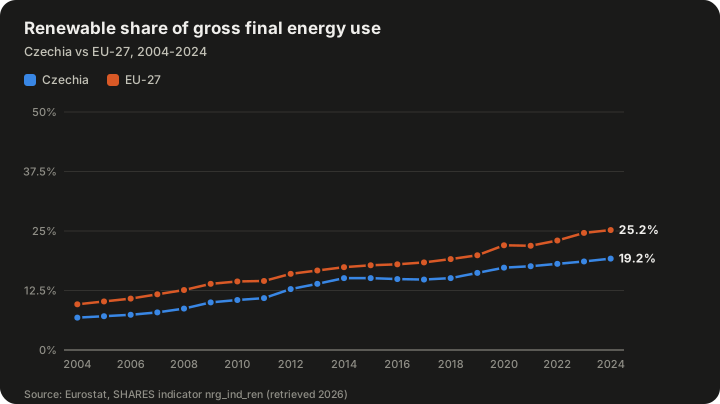
The Czech Republic started from a low base. In 2004, the year it joined the EU, renewables supplied 6.8% of gross final energy consumption, against 9.6% for the 27 countries that now make up the EU. By 2024 the Czech share had reached 19.2%, nearly three times its 2004 level, while the EU-27 share was 25.2%.
| Year | Czechia (%) | EU-27 (%) |
|---|---|---|
| 2004 | 6.8 | 9.6 |
| 2008 | 8.7 | 12.6 |
| 2012 | 12.8 | 16.0 |
| 2013 | 13.9 | 16.7 |
| 2016 | 14.9 | 18.0 |
| 2020 | 17.3 | 22.0 |
| 2022 | 18.1 | 23.0 |
| 2023 | 18.6 | 24.6 |
| 2024 | 19.2 | 25.2 |
Source: Eurostat, SHARES indicator (nrg_ind_ren), retrieved 2026.
The chart shows two things. The fastest growth came between 2008 and 2014, the years of the support boom. Then the Czech line goes almost flat from 2014 to 2018 (15.1%, 15.1%, 14.9%, 14.8%, 15.1%), which matches the freeze on new support after 2013. The EU average kept climbing over the same years, so the gap widened.
The Czech Republic's binding target for 2020 under the EU Renewable Energy Directive of 2009 was 13% of gross final energy consumption, as the Czech Supreme Audit Office noted in a 2014 audit. The country passed that level in 2013 (13.9%), seven years early, largely thanks to biomass. Its 2010 indicative target of 8% had also been met. A low national target, though, is not the same as a high share. By 2024 Czechia was about 6 percentage points behind the EU average.
The updated National Energy and Climate Plan (NECP), which the Czech government has since approved, aims for a renewable share of about 30% by 2030. In its assessment of the draft plan, the European Commission described the 30% contribution as slightly below the 33% that the EU's formula implied for the Czech Republic. The environmental group CEE Bankwatch criticised the draft, arguing that most of the planned increase would come from biomass, which it considers less sustainable than solar and wind.
Why biomass dominates Czech renewables
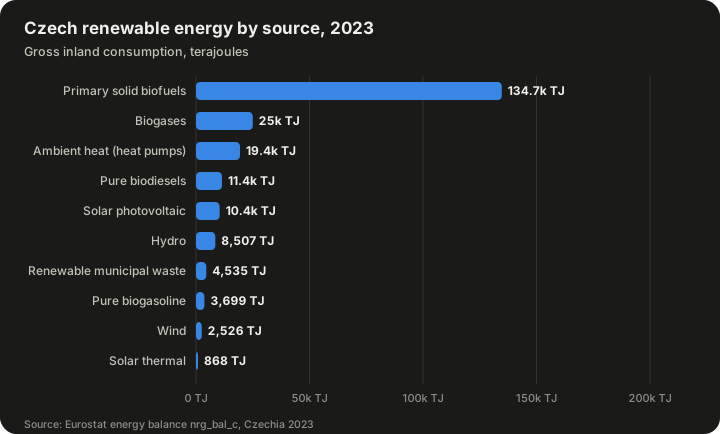
Ask what "renewable energy" means in the Czech Republic and the honest answer is: mostly wood. Eurostat's energy balance for 2023 breaks down the country's gross inland consumption of renewables and biofuels by source.
| Source (2023) | Terajoules |
|---|---|
| Primary solid biofuels (wood, chips, pellets, straw) | 134,708 |
| Biogases | 25,016 |
| Ambient heat (heat pumps) | 19,371 |
| Pure biodiesels | 11,433 |
| Solar photovoltaic | 10,412 |
| Hydro | 8,507 |
| Renewable municipal waste | 4,535 |
| Pure biogasoline (bioethanol) | 3,699 |
| Wind | 2,526 |
| Solar thermal | 868 |
| Total renewables and biofuels | 219,403 |
Source: Eurostat energy balance (nrg_bal_c), Czechia, 2023, gross inland consumption.
Some simple arithmetic on these figures shows how big biomass is:
- Solid biofuels alone were 134,708 ÷ 219,403 = 61.4% of all renewable energy.
- Adding the other biological sources (biogases, biodiesel, bioethanol and the renewable part of municipal waste) gives 179,391 TJ, or 81.8% of the total.
- Wind, at 2,526 TJ, was about 1.2%. Solar photovoltaics, at 10,412 TJ, was about 4.7%.
- All renewables together were 219,403 ÷ 1,609,388 = about 13.6% of the country's total gross inland energy consumption. (This is a different measure from the "gross final consumption" share in the first chart, which is why the percentages differ.)
The 2024 balance looks similar. Solid biofuels were almost unchanged at 134,679 TJ, biogases rose to 26,289 TJ and photovoltaics grew to 12,934 TJ.
There are clear reasons for this pattern. The Czech Republic is landlocked, has modest wind resources and limited hydro, and was hesitant about wind farms for years. It is also heavily forested, has a large timber industry and a long tradition of wood heating in houses and towns. Many towns already had district heating networks, built for coal, that could switch to wood chips. And the country's farm structure, with large former cooperative and state farms, suited big agricultural biogas plants.
Biogas in numbers
CZ Biom's 2024 anniversary issue gives a detailed snapshot of the sector the association is best known for:
| Indicator | Value |
|---|---|
| Biogas plants in operation (2024) | 578 |
| Annual biogas production | about 7.95 TWh |
| Contribution to renewable energy production | 24,314 TJ, or 11.02% |
| Gross electricity from biogas (2022, ERÚ) | 2.615 TWh |
| Heat from biogas produced and used (2022, ERÚ) | 4,275 TJ |
| Installed heat capacity of biogas plants | almost 420 MW |
| Typical operating hours | around 8,000 a year |
| Bioenergy jobs in Czechia (2021) | 41,000 |
Source: BIOM magazine 3/2024 (CZ Biom), citing reports of the Ministry of Industry and Trade and ERÚ.
The same article explains some of the ups and downs in the data. Heat use from biogas fell in the two years before 2024 because, from 2021, customs officials began requiring tax on gas used to run engines. A spike in reported heat in 2016 came from a change in how it was reported, corrected the next year. Electricity output fell in 2016 and 2019 because droughts in the previous years cut the crops used as feedstock.
Worked example: from biogas to electricity
This is an illustrative calculation using the figures above. The years do not match exactly, so treat the result as approximate.
If 578 plants produce about 7.95 TWh of biogas a year, the average plant produces 7.95 ÷ 578 ≈ 0.0138 TWh, or about 13.8 GWh of biogas energy a year.
In 2022, the sector generated 2.615 TWh of electricity. Dividing by 7.95 TWh of biogas gives 2.615 ÷ 7.95 ≈ 33%. That is in the normal range for engines that turn gas into electricity. Most of the rest of the energy leaves as heat, which is why selling that heat matters so much to a plant's finances. CZ Biom estimated that about 4 PJ of biogas heat is currently used and about another 3 PJ could be, against a national plan to replace 26.5 PJ of coal-based heat.
Greenhouse gas savings
CZ Biom's analysis calculates that, at a consumption of 1.3 billion cubic metres of biogas a year, electricity from biogas saves about 1,996 thousand tonnes of CO2 equivalent a year, and use of the heat saves a further 530.1 thousand tonnes. The association projects a 20% increase by 2030, to 2,395 thousand tonnes for electricity and 636 thousand tonnes for heat. These are the association's own estimates. Like all such savings figures, they depend on what the biogas is assumed to replace and on the emissions from growing and transporting the feedstock.
The biomethane shift
Since about 2022, the main topic for CZ Biom has been biomethane. Two forces are behind this.
The first is the end of support. Czech biogas plants were promised operating support for 20 years. The plants built in the boom after 2005 are now reaching that limit. An analysis published by the Czech energy news site oEnergetice.cz in May 2024 put operating support at up to 4,444 CZK per megawatt-hour of electricity. It said the first plants would lose support at the end of 2025, more than half by 2031, and all by 2033. It warned that market electricity prices alone may not keep the plants profitable.
The second is gas security. CZ Biom's history says Russia's war on Ukraine "cast new light" on renewables, as a matter of energy security and independence, and turned attention to direct replacements for natural gas. Biomethane can use the existing gas pipelines and storage, so a biogas plant can produce gas in summer, when nobody needs its heat, and the grid can store it for winter.
Where the sector stands
| Date | Biomethane plants supplying gas | Notes |
|---|---|---|
| 2019 | 1 | First production at the Rapotín biogas plant (ERÚ dates first grid injection to 2020) |
| 2024 | 10 | About 2,800 MWh a month; capacity around 17.7 million Nm³ a year, not fully used |
| Sept–Oct 2025 | 12 | Government plan for about 100 plants by 2030 |
| January 2026 | 14 | Output 17 million m³, up 9.5 million m³ year on year (CZ Biom statement) |
Sources: BIOM 3/2024; oEnergetice.cz reports, 2025–2026; ERÚ presentation, March 2026.
The targets are much bigger than the current output. CZ Biom noted in 2024 that the 2018 national energy and climate plan had expected about 127 million Nm³ of biomethane from new plants by the end of 2024, and that the country was meeting this "in the order of single-digit percent". Under REPowerEU, the association said, the EU will expect about 750 million Nm³ from sustainable feedstocks by 2030. A government action plan presented in summer 2025 aims for 491 million cubic metres by 2030 and roughly 100 biomethane plants, mainly by converting about half of the existing biogas plants.
Support is the bottleneck. In October 2025, CZ Biom chair Jan Habart called for a new support model based on auctions and warned that the change would slow construction, saying the first plants under the new scheme would not be built before 2027. René Neděla, director of the energy section at the Ministry of Industry and Trade, said the new rules had been set up early to make the move to biomethane smooth. The ministry launched its first biomethane auction in 2026.
Why biomethane matters for transport
CZ Biom argues that biomethane is currently the only "truly mass-available" advanced biofuel. EU rules require at least 3.5% of transport energy to come from advanced biofuels by 2030. Biomethane made from waste feedstocks such as kitchen waste, manure or molasses counts toward that target. The country already has nearly 200 compressed natural gas (CNG) filling stations that could sell "bio-CNG" through guarantees of origin. Because fewer new CNG cars are being sold, the association expects demand to come mainly from medium and heavy trucks, especially those running on liquefied gas (bio-LNG).
Solid biomass and district heating
Biogas gets the headlines, but solid biomass supplies most of the energy. Much of it heats homes directly in stoves and boilers. A significant share also goes through district heating systems in small towns. CZ Biom's anniversary issue profiled several of them, and their stories show both what biomass heating can do and how much it depends on support policy.
| Town or company | Started | Key facts reported |
|---|---|---|
| Bystřice nad Pernštejnem | Decided 1999; built 2001 | Replaced an ageing 1970s coal boiler house; investment over 120 million CZK with state subsidies; now supplies more than 1,500 households and runs without state support |
| Hostětín | 2000 | 732 kW municipal boiler; about 3,500 GJ of heat a year for 80% of households; burns 500–600 tonnes of local biomass; saves about 1,100 tonnes of CO2 a year; 2.8 km network; visited by Prince Charles on 22 March 2010 |
| TTS energo, Třebíč | 1995 | Heats 10,426 households and 29 schools and nurseries; 11 biomass boilers, 12 gas boilers and 13 cogeneration units, 103 MW of heat capacity in total |
| Slavičín | 2002 | 1.6 MW biomass boiler, plus 1 MW added nine years later; burns about 3,400 tonnes of wood chips for about 25,000 GJ of heat a year |
Source: BIOM magazine 3/2024.
Buying fuel by weight, not volume
The Slavičín profile contains a practical lesson that applies to anyone buying wood fuel. The heating company first chose suppliers who offered the lowest price per stacked cubic metre. It then began weighing each delivery and measuring its moisture. After a year of measurements it found that the cheapest suppliers were in fact the most expensive once it counted the real amount of dry wood delivered, because loose chips settle and wet wood carries water rather than energy. The company switched to buying by the "atro" tonne, a tonne of absolutely dry matter.
The 2024 heat support dispute
In 2024 a funding problem hit the sector. Operating support for heat from biomass plants above 1 MW had been set in a government regulation last updated in 2022, which covered the years up to 2024. The support was not paid during 2024. On 26 September 2024 the regulator published price decision No. 7/2024, which set support only for new sources commissioned in 2024 and did not mention older ones. Operators told CZ Biom that this left them very uncertain about their business.
The consequences showed up in heat prices. TTS energo said it had to raise its heat price by 99 CZK per gigajoule (excluding VAT) from 1 September 2024. Its price calculations had assumed support of 145 CZK/GJ under the 2023 price decision. Slavičín said the missing support left a hole of almost 4 million CZK in its budget and that it was considering a rise of 145 CZK/GJ for its 48 connection points, about 14%. Operators warned that if prices rose, customers would disconnect and switch to cheaper but more polluting individual boilers. Then each remaining customer would pay a larger share of the fixed costs, making the network less competitive still.
Worked example: what a 145 CZK/GJ gap means
Illustrative arithmetic using the Slavičín figures above.
- Slavičín produces about 25,000 GJ of heat a year. At 145 CZK/GJ of missing support: 25,000 × 145 = 3,625,000 CZK. That fits the company's own description of "almost 4 million crowns".
- If 145 CZK/GJ is about a 14% rise, the current heat price is roughly 145 ÷ 0.14 ≈ 1,036 CZK/GJ excluding VAT. This is an inferred figure, not one the company published.
- At Hostětín, 3,500 GJ of heat from 500–600 tonnes of biomass works out to about 5.8–7.0 GJ of delivered heat per tonne of fuel. The range depends on how wet the fuel is and how efficient the boiler is.
What CZ Biom does today
The association describes its current mission as improving conditions for biomass, biogas and biomethane as sustainable and flexible energy sources, with the aims of cutting CO2 emissions, protecting nature and soil, and increasing the treatment of bio-waste so that nutrients return to the soil. It also promotes circular material flows.
Sections
| Section | Focus |
|---|---|
| Biogas | Operation, support and regulation of existing biogas plants |
| Biomethane | Upgrading biogas, grid injection, auctions, transport fuel |
| Sustainability criteria | EU sustainability and greenhouse-gas rules for bioenergy, certification, emissions calculations |
| Heat and electricity from solid biomass | Wood chips, pellets, district heating, combined heat and power |
| Composting and biodegradable waste | Composting plants, bio-waste collection, compost quality |
Services to members
According to its website, CZ Biom:
- monitors the market and legislation and communicates with the Czech state administration;
- brings members together to share experience and make business contacts;
- gives legal support and helps prepare members for negotiations with authorities;
- carries out mock inspections of biogas plant documentation;
- produces expert studies, reports, strategies and analyses, often with scientists;
- takes part in research projects;
- offers consultancy, including registration of biomass ash as a fertiliser, help with sustainability criteria, and feasibility or due-diligence assessments;
- promotes its members through media and its own publications.
Publications and tools
- BIOM magazine. A professional magazine and newsletter published three times a year. The 2024 anniversary issue gives a print run of 1,000 copies (ISSN 1801-4038 print, 1801-2655 online).
- biom.cz. An information portal on biomass that the association has run since its early years.
- Calculators. A bioenergy calculator and a tool at prekompenzace.cz for checking whether support levels risk overcompensation.
- Events. Seminars, excursions and conferences, often with Czech and foreign partners.
People
The association's current website lists Jan Habart as chair, with section heads for biogas (Adam Moravec), biomethane (Ondřej Malinovský), heat and electricity from solid biomass (Vojtěch Pospíšil) and bio-waste and composting (Klára Šestáková). Earlier materials list Jan Doležal as chair, and the 2011 presentation was given by Vladimír Stupavský as vice-chair and project director. The magazine's editorial board in 2024 included researchers and practitioners from across the field.
International links
CZ Biom is the Czech member of several European and global bodies:
- Bioenergy Europe, the European umbrella body for bioenergy, founded in Brussels in 1990 as the European Biomass Association (AEBIOM) under French senator Michel Souplet. It is open to national biomass associations and bioenergy companies. It is also the umbrella of the European Pellet Council and owns the ENplus certification for wood pellet quality. Wikipedia describes CZ Biom as a member of the European Biomass Association, which is this organisation under its old name.
- European Biogas Association (EBA), which represents the biogas and biomethane sector in Europe.
- World Bioenergy Association (WBA), a global body.
- European Compost Network (ECN), which represents composting and digestion organisations.
CZ Biom is also listed as national partner of the SURE programme on its website. Its 2011 presentation shows it used its European umbrella body to lobby in Brussels, for example on support for energy crops in the EU's Common Agricultural Policy and rural development programmes.
Policy positions and influence
CZ Biom is a trade and professional association, so its positions reflect its members' interests. Broadly, it argues for:
- Stable, predictable support. Its members have lived through a boom, a freeze, and years of reviews. The association repeatedly argues that sudden changes destroy investment.
- A smooth move from biogas electricity to biomethane. It calls for auctions and investment support so that existing plants can switch to producing gas instead of simply closing when their 20-year support ends.
- Continued heat support for biomass district heating, especially for plants above 1 MW, which were hit by the 2024 dispute.
- Using waste and residues. The association promotes digesting bio-waste and manure and composting, and returning nutrients and organic matter to soil.
- Flexibility. It argues that biogas plants can adjust their output to balance a grid with more wind and solar. CZ Biom's 2024 analysis claims the regulating potential of the whole biogas sector is comparable to the output of the Dlouhé stráně pumped-storage power station. Many plants already provide aggregated balancing services, mostly by cutting output when asked.
Its influence is hard to measure. Politicians have visited its members' plants. The anniversary issue shows President Petr Pavel at the biogas plant in Kněžice, Prime Minister Petr Fiala with the agriculture minister at a farm biogas plant in February 2023, and the speaker of the Chamber of Deputies at the biomethane station in Litomyšl. At the same time, its own documents record many occasions when ministries ignored its recommendations.
Debates and limits
Biomass is the most controversial renewable source, and an honest account of CZ Biom's field has to include the arguments against it.
Is burning wood "carbon neutral"?
CZ Biom's solid biomass review states the standard argument: burning biomass releases about the same amount of carbon dioxide that the plants absorbed while growing, so it is carbon neutral and renewable. That is true over a full growth cycle if the forest or crop regrows and the land stays productive. Critics point out that a mature tree can take decades to regrow. In the meantime, the carbon is in the atmosphere. The timing matters for climate targets set for 2030 and 2050. The argument is weakest for whole trees felled for fuel and strongest for genuine residues, such as sawmill offcuts, bark and branches that would otherwise rot or be burned anyway. Much of the Czech solid biomass supply comes from such residues and from the domestic timber industry, but the mix varies.
Sustainability rules
The EU's Renewable Energy Directive sets sustainability and greenhouse-gas saving criteria that larger bioenergy plants must meet to count toward targets and receive support. CZ Biom runs a whole section on these "sustainability criteria" and helps members document them. The need for such a section shows how complex compliance has become.
Food versus fuel
Many Czech biogas plants built after 2005 ran largely on maize silage grown for the purpose. That uses farmland that could grow food, and maize monocultures raise concerns about soil erosion. The move toward biomethane under EU rules tends to favour wastes and residues instead of energy crops, because waste-based gas counts as an "advanced" biofuel.
Air quality
Wood burning, especially in old domestic stoves, is a major source of fine particulate pollution in Czech towns in winter. Modern district heating boilers with filters perform far better. Bystřice nad Pernštejnem, for instance, says it has installed fine-dust capture to meet the strictest emission standards. The problem is mostly with small, old household boilers rather than with the plants CZ Biom's members operate.
Dependence on subsidies
The 2024 heat dispute and the end of 20-year biogas support both show how much the sector relies on public money. Supporters say this is no different from other renewables or from fossil fuels' hidden costs. Critics note that biogas electricity at up to 4,444 CZK/MWh was much more expensive than wind or solar now are. Even supporters within the industry say that, once support ends, market electricity prices alone may not keep many plants profitable.
Biomass is finite
There is only so much wood, straw and manure. Bystřická tepelná, the Bystřice heating company, told CZ Biom that it is looking for ways to reduce its dependence on affordable biomass, "whose resources are not infinite", and has added rooftop solar. CZ Biom's critics argue that national plans relying heavily on biomass may run into supply limits. Its supporters argue that biomass is the only renewable that can provide heat and gas on demand in a country with little wind and hydro.
Common misconceptions
"CZ Biom is a government agency." It is not. It is a private, non-profit association of companies and experts. It writes studies for ministries and takes part in consultations, but it has no regulatory power.
"Biomass in the Czech Republic means energy crops." Most of it is wood: forest residues, sawmill waste, chips and pellets. Purpose-grown energy crops and fast-growing trees have remained a small part of the supply, despite CZ Biom's long campaigns to support them.
"Biogas plants only produce electricity." They produce biogas, which can be burned for electricity and heat, upgraded to biomethane, or used directly. They also produce digestate, which is used as fertiliser. Heat use and biomethane are now central to their economics.
"Biomethane is a new idea in Czechia." The first plant began producing in 2019, but the idea of upgrading biogas is much older. What is new is the policy push after 2022.
"The Czech Republic missed its renewable targets." It met its binding 2020 target of 13% in 2013. Its share is still below the EU average, because the target was set low and growth stalled after 2013.
"Biomass is always carbon neutral." It can be, but it depends on what is burned, whether it regrows, and over what time period you count. This is an active scientific and policy debate.
Frequently asked questions
What does CZ Biom stand for? It is the short name of České sdružení pro biomasu, the Czech Biomass Association.
When was it founded? In 1994. It celebrated its 30th anniversary in 2024.
How many members does it have? The association's materials have given different figures over time: 130 member companies in a 2011 presentation and about 160 member firms and organisations on its English page. It does not publish a single up-to-date total on its current homepage.
Who leads it? The current chair is Jan Habart.
Is it part of Bioenergy Europe? Yes. It is a member of Bioenergy Europe (formerly the European Biomass Association, AEBIOM), as well as of the European Biogas Association, the World Bioenergy Association and the European Compost Network.
How much of Czech renewable energy comes from biomass? About 61% from solid biofuels alone in 2023, and about 82% if biogas, liquid biofuels and the renewable share of municipal waste are added, based on Eurostat's energy balance.
How many biogas plants are there in the Czech Republic? CZ Biom counted 578 in operation in 2024. Other reports give "more than 500" or "nearly 600", depending on what types of plants are counted.
How many biomethane plants are there? CZ Biom said in January 2026 that there were 14, up from 10 in 2024. The government aims for about 100 by 2030.
Where can I find its publications? On czbiom.cz and the portal biom.cz, which also hosts the archive of BIOM magazine.
Does CZ Biom deal with composting? Yes. Composting and biodegradable waste is one of its five sections, and it is a member of the European Compost Network.
Summary
CZ Biom grew out of a group of researchers who, in the last years of communist Czechoslovakia, were planting energy grasses on reclaimed coal spoil heaps. It was founded in 1994, as Czech agriculture was being restructured, and it grew into the main professional voice for biomass, biogas and composting in a country where plant material supplies most of the renewable energy. Its history follows the country's renewable energy policy closely: slow beginnings, rapid growth after the 2005 support law, a freeze after the solar boom pushed up costs around 2013, years of compliance reviews, and since 2022 a new push toward biomethane driven by the end of 20-year support and by the war in Ukraine. Its arguments, for stable support, for using wastes and residues, and for biogas as a flexible partner to wind and solar, are those of an industry association. The debates around it, over carbon accounting, air quality, land use and subsidy costs, are among the hardest in European energy policy.
Sources
- Czech Biomass Association (Wikipedia)
- CZ Biom – Czech Biomass Association, official English site
- biom.cz – About CZ Biom (English)
- BIOM magazine 3/2024, "30 let sdružení CZ Biom" (CZ Biom)
- Vladimír Stupavský, CZ Biom presentation (2011)
- Eurostat – Share of energy from renewable sources (nrg_ind_ren)
- Eurostat – Complete energy balances (nrg_bal_c)
- Czech Supreme Audit Office, audit report 14/06 on renewable energy support (English)
- European Commission – Assessment of the draft updated NECP of Czechia (2023)
- CzechTrade – Czech government approved its updated national climate and energy plan
- CEE Bankwatch – Czechia an unambitious climate laggard according to Commission assessment
- oEnergetice.cz – Analysis: Czech biogas plants to lose support, biomethane is the solution (May 2024)
- oEnergetice.cz – Czech Republic plans 100 biomethane plants by 2030, up from 12 now (Oct 2025)
- oEnergetice.cz – Czech Industry Ministry launches first biomethane auction (2026)
- Energy Regulatory Office – Biomethane support presentation (March 2026)
- Bioenergy Europe (Wikipedia)