Cognitive holding power is an idea from educational psychology about how a learning environment pushes students toward particular kinds of thinking. Some classrooms press students to follow instructions, copy what the teacher does and check their answers with the teacher. Others press them to set their own goals, link a problem to what they already know, try out new ideas and check their own results. The Australian researcher John C. Stevenson called this pressure the "cognitive holding power" of a setting, and with Glen T. Evans he published a way to measure it, the Cognitive Holding Power Questionnaire (CHPQ), in the Journal of Educational Measurement in 1994.
The concept has two dimensions. First-order cognitive holding power (often shortened to FOCHP) is the press toward following, imitating and relying on the teacher. Second-order cognitive holding power (SOCHP) is the press toward independent problem solving, planning and self-monitoring. A learning environment can be high or low on either dimension, and the questionnaire measures both from the students' point of view.
Cognitive holding power is a niche idea. Its Wikipedia article is only a few sentences long, and most of the research using it consists of small studies in particular schools or university courses. But it touches on questions that matter well beyond its own literature: how much control teachers and students should each have, how to tell whether a classroom is really encouraging higher-order thinking, and what can and cannot be learned from student questionnaires. This article explains where the idea came from, how the questionnaire works, what studies using it have found, how to interpret the numbers, and where the limits lie.
The basic idea
Settings, not just students
Most measures in educational psychology describe students: their ability, motivation, prior knowledge or learning style. Cognitive holding power describes the setting. In the summary of Stevenson and Evans's 1994 paper, the concept is synthesised from theories of settings and of cognitive structures and is treated as a characteristic of a learning setting that presses students into cognitive activity. Settings that press students toward first-order procedures are said to have first-order holding power; settings that press them toward second-order procedures are said to have second-order holding power.
The word "holding" suggests that a setting can hold, or keep, students in a particular mode of thinking. The word "press" appears throughout the literature. Brad Walmsley, writing in the Journal of Technology Education in 2003, defines cognitive holding power as "the press exerted by an educational learning environment, which causes students to utilize certain levels of procedural knowledge." He explains that "press" refers to the learning environment's influence on positive or negative goal attainment, activated by the kinds of tasks students engage with.
Two influences: the teacher and the subject
Which features of a setting create this press? Walmsley, summarising Stevenson's work, says the two factors interpreted as most influential are the teacher and the subject matter. A teacher who demonstrates each step and expects students to reproduce it creates a strong first-order press. A teacher who poses open problems and expects students to plan their own approach creates a second-order press. Subject matter matters too: some content, such as the safe use of a machine tool, almost demands demonstration and imitation, while design problems invite exploration.
Perception, not observation
The CHPQ asks students how often they do certain things in a particular class. It therefore measures students' perceptions of the press their environment exerts, not an observer's rating of the teaching. This is both a strength (students are the ones experiencing the press) and a limitation (perceptions can differ from what actually happens, and students may interpret items differently).
Orders of procedural knowledge
Cognitive holding power is built on a distinction between different levels, or orders, of procedural knowledge. Procedural knowledge is knowing how to do things, as opposed to declarative knowledge, which is knowing that something is the case. Walmsley, citing Stevenson and McKavanagh's 1992 chapter "Skill formation for the workplace", describes three orders.
| Order | Definition (after Stevenson and McKavanagh, 1992, as summarised by Walmsley, 2003) | Example |
|---|---|---|
| First order | Knowing how to perform specific skills | Using a hand tool or machine in the way demonstrated |
| Second order | Knowing how to apply problem-solving skills so that previously learned first-order skills and conceptual knowledge can be used in new or unusual situations | Working out how to build a design that has not been made before |
| Third order | Knowing how to judge whether the other levels of knowledge are appropriate in a particular circumstance | Deciding whether a standard procedure or a new approach suits a given job |
The CHPQ measures the press toward the first two orders. Walmsley notes that the construct is particularly useful because it can tell apart environments that press for first-order procedural knowledge from those that press for second-order procedural knowledge.
What first-order and second-order holding power look like
Later researchers have spelled out the two dimensions in more concrete terms. In a 2020 study published in Heliyon, Mahmoud Mohamed Hussien Ahmed and Bipin Indurkhya, drawing on a 2009 paper by Xin Ziqiang and Zhang Li, describe them as follows:
| Dimension | Typical behaviours pressed by the setting |
|---|---|
| First-order (FOCHP) | Following and relying on the teacher's instructions; executing a plan someone else gave; accepting results passively; confirming results with the teacher; asking the teacher for help |
| Second-order (SOCHP) | Working toward unfamiliar goals; linking problems to prior knowledge; choosing, applying and monitoring strategies; checking one's own results |
Walmsley frames the same contrast as teacher control versus student control. A setting with strong first-order holding power is one where students perceive the teacher as controlling their learning activities; a setting with strong second-order holding power is one where they perceive themselves as in control.
Two dimensions, not one scale
It is easy to assume that first-order and second-order holding power are opposite ends of one scale, so that more of one means less of the other. The 1994 paper treated them as separate dimensions and examined their independence. This matters for interpretation. A classroom can be high on both (the teacher demonstrates carefully and then sets open problems), low on both (students are neither guided nor challenged), or high on one and low on the other.
| Low second-order press | High second-order press | |
|---|---|---|
| High first-order press | Heavily teacher-directed: demonstration and imitation dominate | Guided and challenging: demonstration followed by independent problem solving |
| Low first-order press | Little cognitive press of either kind | Largely student-directed: open problems with little modelling |
Origins and development
John C. Stevenson worked on vocational and workplace learning in Australia. A 1990 paper by Stevenson titled "Measurement of cognitive holding power in TAFE learning settings" is listed in the references of his 1998 article; TAFE stands for technical and further education, Australia's public vocational education system. This suggests the measurement work grew out of vocational settings, where the balance between learning set procedures and learning to solve new problems is a central practical question.
The main publications establishing the concept are:
| Year | Publication | Contribution |
|---|---|---|
| 1990 | Stevenson, "Measurement of cognitive holding power in TAFE learning settings" | Early measurement work in vocational settings (listed in the references of the 1998 article) |
| 1992 | Stevenson and McKavanagh, "Skill formation for the workplace", in M. Poole (ed.), Education and work, pp. 72–90 | Orders of procedural knowledge |
| 1994 | Stevenson and Evans, "Conceptualization and measurement of cognitive holding power", Journal of Educational Measurement 31(2), 161–181 | Defines the concept and outlines the instrument; examines independence, reliability, validity and factor structure of the two dimensions |
| 1998 | Stevenson, "Performance of the cognitive holding power questionnaire in schools", Learning and Instruction 8(5), 393–410 | Tests the questionnaire in school settings |
According to Ahmed and Indurkhya, Stevenson's 1998 paper argued that improving cognitive holding power can lead to the development of thinking skills. Walmsley states that the instrument has been developed, validated and found reliable in the 1994 and 1998 papers.
Wikipedia's short article adds that studies using the concept have suggested ways to improve mathematics education, citing a 2009 paper by Xin and Zhang in Learning and Individual Differences titled "Cognitive holding power, fluid intelligence, and mathematical achievement as predictors of children's realistic problem solving". Ahmed and Indurkhya also cite a 2008 study by Xin reporting that different learning environments motivate students to engage in cognitive activity at different levels.
The Cognitive Holding Power Questionnaire
Structure
The CHPQ is a self-report questionnaire. Walmsley's description of the version he used is the clearest available:
- 30 items.
- A five-point Likert scale, with responses running from "almost never" to "very often".
- Items ask about the amount of control students perceive they or their teachers have over learning activities.
He gives four example items:
| Example item | Dimension it indicates |
|---|---|
| "I ask questions to check my results" | Second-order (student control) |
| "I try out new ideas" | Second-order (student control) |
| "I copy what the teacher does" | First-order (teacher control) |
| "I feel I have to work exactly as I am shown" | First-order (teacher control) |
How items are split between the scales
Accounts of the split between the two subscales differ slightly. Ahmed and Indurkhya report 30 items with 13 assigned to first-order and 18 to second-order holding power, noting that one item (item 5) appears in both subscales. A 2025 study of nursing students at Suez Canal University in Egypt reports using 13 first-order and 17 second-order items. Researchers using the instrument should check which version and scoring key they have.
Scoring
Scores can be reported in two common ways:
- Mean item score for each subscale, on the original 1 to 5 scale. Walmsley reports results this way, so his means are around 3.
- Summed score for each subscale, adding the responses to all its items. Ahmed and Indurkhya report results this way, so their first-order scores are around 30 (13 items) and second-order scores around 37 (18 items).
These two ways of reporting give very different-looking numbers for the same underlying responses, which is a common source of confusion when comparing studies.
A worked scoring example (hypothetical)
Suppose a hypothetical student answers the 13 first-order items with these responses on a 1 to 5 scale: 3, 2, 4, 3, 3, 2, 3, 4, 2, 3, 3, 2, 3. The sum is 37, and the mean is 37 / 13 ≈ 2.85. If the same student answered the 17 or 18 second-order items with a mean of 3.5, their summed second-order score would be about 60 (17 items) or 63 (18 items), depending on the version.
This student perceives a moderate press toward teacher-following and a somewhat stronger press toward independent problem solving. On its own, that tells us little. CHPQ scores are most useful for comparing groups, classrooms or time points, not for diagnosing individuals.
Reliability and validity
Walmsley reports that a principal component analysis with varimax rotation and Cronbach's alpha reliability scores for his data upheld the construct validity of the CHPQ and the reliability of the two scales, though the published article does not give the coefficients. Ahmed and Indurkhya's paper reports a Cronbach's alpha of 0.73 for a separate equity questionnaire, but does not report reliability for the CHPQ itself in their sample.
For readers unfamiliar with these terms:
| Term | Meaning in plain language |
|---|---|
| Likert scale | A rating scale where respondents choose from ordered options such as "almost never" to "very often" |
| Subscale | A group of items intended to measure one dimension |
| Cronbach's alpha | A statistic (from 0 to 1) describing how consistently items in a subscale move together; higher values mean the items are more consistent |
| Principal component or factor analysis | A statistical method for checking whether items cluster into the intended dimensions |
| Construct validity | Evidence that the instrument measures the concept it claims to measure |
What the research has found
Technology education in Queensland (Walmsley, 2003)
The most detailed open-access study using the CHPQ is Brad Walmsley's honours research, published as "Partnership-centered learning: The case for pedagogic balance in technology education" in the Journal of Technology Education in 2003. Walmsley was at the Centre for Technology Education Research at Griffith University.
Background. Technology education in many countries was moving away from the workshop tradition of industrial arts, which focused on hand and machine skills taught by what Walmsley, quoting Fritz (1996), calls "show and follow", toward a design-based approach emphasising problem solving, critical and creative thinking, and decision making. Queensland's syllabus documents of the time called for learner-centred approaches. Walmsley wanted to know whether classrooms that described themselves as design-based actually pressed students toward more independent thinking.
Sample. The study surveyed 480 students in Years 9 and 10, aged 13 to 15, in nine state and independent high schools in south-east Queensland, Australia. All the schools had trialled the developing Years 1 to 10 technology syllabus during the 2000 school year. Each school's head of technology rated its teaching orientation as design-based, industrial arts-based (called manual arts in Queensland) or a combination. Students completed the CHPQ, retitled the Technology Environment Response Form.
| Teaching orientation | Male students | Female students | Total |
|---|---|---|---|
| Design-based | 84 | 77 | 161 |
| Industrial arts-based | 145 | 26 | 171 |
| Combination | 126 | 22 | 148 |
| Total | 355 | 125 | 480 |
Source: Walmsley (2003), Table 1.
Results. First-order holding power was almost identical in all three kinds of classroom. Second-order holding power was highest in design-based classrooms and lowest in industrial arts classrooms.
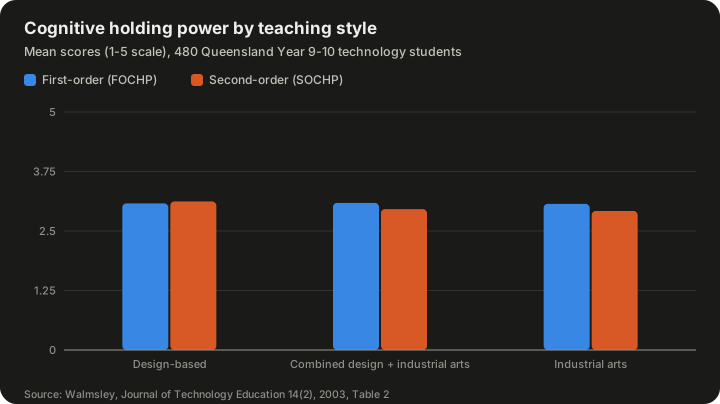
| Teaching orientation | First-order mean (SD) | Second-order mean (SD) | Students |
|---|---|---|---|
| Design-based | 3.08 (0.56) | 3.12 (0.52) | 161 |
| Combination design / industrial arts | 3.09 (0.54) | 2.96 (0.52) | 148 |
| Industrial arts-based | 3.07 (0.68) | 2.92 (0.58) | 171 |
Source: Walmsley, Journal of Technology Education 14(2), 2003, Table 2 (mean item scores on a 1–5 scale).
The statistical tests confirm the pattern:
| Test | Result | Interpretation |
|---|---|---|
| Teaching orientation and first-order holding power (ANOVA) | F = 0.025, p = 0.98 | No difference between classroom types |
| Teaching orientation and second-order holding power (ANOVA) | F = 6.322, p = 0.002, adjusted R² = 0.022 | Statistically significant but explains only about 2% of variation |
| Design-based versus industrial arts, second-order (ANOVA) | F = 11.093, p = 0.001 | Significant; orientation accounts for about 3% of variance |
| Scheffé post hoc comparisons, second-order | Design-based above industrial arts (p = 0.003) and above combination (p = 0.035); industrial arts versus combination not significant (p = 0.79) | Design-based classrooms stand apart |
| Gender and second-order holding power | F = 5.80, p = 0.016, adjusted R² = 0.010 | Significant but very small |
How big is the difference? Walmsley describes the effect as significant but "unsubstantial". One way to see this is to convert it to a standardised effect size. Using the published means and standard deviations, the gap in second-order scores between design-based and industrial arts classrooms is 3.12 − 2.92 = 0.20 points. The pooled standard deviation of the two groups is about 0.55, so the standardised difference (Cohen's d) is roughly 0.20 / 0.55 ≈ 0.36. That is usually described as a small-to-moderate effect. The calculation here is ours, from the published table, and assumes the reported standard deviations are sample standard deviations.
What it means. Walmsley drew two conclusions. First, design-based classrooms did press students toward more independent thinking, but only modestly. Second, the identical first-order scores showed that teacher-directed instruction remained just as common in design-based classrooms as in traditional workshops. He did not see this as a failure. Instead he argued for what he called partnership-centred learning, a term taken from Bell (2000): teachers should move continually between demonstration and student autonomy as the situation demands. He quotes Bell's view that while the balance between teacher-directed and student-managed learning may not be critical, "the direction in which it is moving for each individual certainly is". He recommended using the CHPQ over time to track gradual changes in teaching.
A flipped classroom in Egypt (Ahmed and Indurkhya, 2020)
Ahmed and Indurkhya's 2020 paper in Heliyon, "Investigating cognitive holding power and equity in the flipped classroom", tested whether a flipped classroom changed students' cognitive holding power. In a flipped classroom, students study new material (often through videos or online resources) before class and use class time for activities, discussion and problem solving.
Design. The study used an introductory instructional technology course in the Faculty of Specific Education at South Valley University in Egypt, during the second semester of the 2018/2019 academic year. It was a quasi-experimental, single-group pre-test/post-test design with 33 first-year undergraduates (25 male and 8 female, mean age 20.9). There was no control group for the CHP measure. Responses were collected through online forms.
Results. Scores rose on both dimensions, but only the first-order increase was statistically significant.
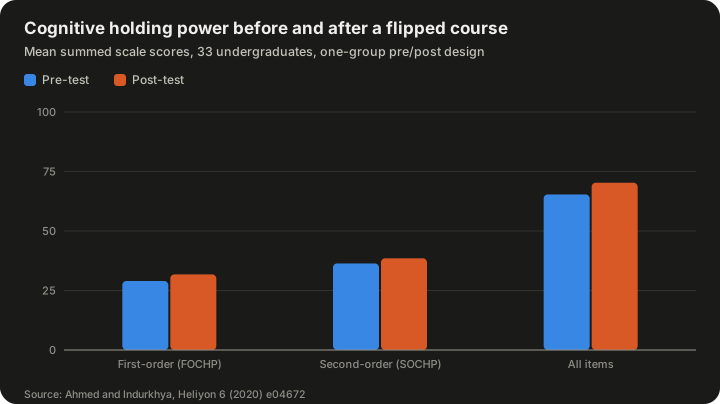
| Measure | Pre-test mean (SD) | Post-test mean (SD) | t | p |
|---|---|---|---|---|
| First-order (FOCHP) | 29.00 (7.68) | 31.76 (7.27) | 2.27 | < 0.05 |
| Second-order (SOCHP) | 36.36 (10.68) | 38.52 (10.75) | 0.96 | 0.34 |
| Total | 65.36 (16.83) | 70.27 (15.99) | 1.58 | 0.12 |
Source: Ahmed and Indurkhya, Heliyon 6 (2020) e04672 (summed scale scores).
The authors conclude that flipped learning helps to a degree with cognitive holding power, particularly in performing learning tasks and following the teacher's instructions. Put differently, the flipped course strengthened the first-order press, not the second-order press that advocates of active learning usually hope for.
Equity. The paper also compared the 33 flipped-classroom students with 33 students taught traditionally, using a 10-item equity questionnaire covering learning environment design, academic practices and learning resources. The flipped group scored higher (mean 17.45, SD 4.78) than the traditional group (mean 14.27, SD 2.99), with t = 3.24 and p < 0.01.
Limits stated by the authors. The authors acknowledge a small sample, no control group for the CHP measure, a short course and a compulsory, rigid curriculum that may have limited second-order development, and they describe the work as preliminary. A careful reader will also notice internal inconsistencies: the methods section describes 10 weeks, while the limitations describe one month, and the methods mention ANOVA while the results report t-tests. These do not invalidate the findings but are reasons for caution.
Rough effect sizes. Dividing each pre-to-post gain by the pre-test standard deviation gives rough standardised changes of about 0.36 for first-order, 0.20 for second-order and 0.29 for total scores. These are our approximations from the published table. Because they ignore the correlation between each student's two scores, they are not the same as a proper paired effect size, which the paper does not report.
Other studies
Cognitive holding power has been used in a number of further studies, particularly in Arabic-language and Egyptian journals. One example, as described in its published abstract, is a 2025 correlational study of 330 nursing students at Suez Canal University's Faculty of Nursing, which used a CHP questionnaire with 13 first-order and 17 second-order items alongside a student engagement scale. It reported a weak positive correlation between first-order holding power and engagement (r = 0.243) and a moderate positive correlation between second-order holding power and engagement (r = 0.426). It reported mean scores of 46.77 (SD 9.48) for first-order and 69.06 (SD 9.96) for second-order holding power, which on 13 and 17 items correspond to average item scores of about 3.6 and 4.1.
Several other regional studies have looked at gender and subject differences, with mixed findings: some report no gender difference and others report differences. Taken together with Walmsley's small gender effect, the safest conclusion is that any gender differences in perceived cognitive holding power are small and inconsistent across settings.
Summary of findings across studies
| Study | Setting | Sample | Main CHP finding |
|---|---|---|---|
| Walmsley (2003) | Year 9–10 technology education, Queensland | 480 students, 9 schools | Design-based classes higher on second-order press; first-order press the same everywhere; effects small |
| Ahmed and Indurkhya (2020) | Flipped introductory instructional technology course, Egypt | 33 undergraduates (pre/post) | First-order press rose significantly; second-order and total changes not significant |
| Suez Canal nursing study (2025) | Faculty of nursing, Egypt | 330 students | Second-order press more strongly correlated with engagement (r = 0.426) than first-order (r = 0.243) |
| Xin and Zhang (2009) | Children's realistic mathematical problem solving | Not available in sources reviewed | CHP examined alongside fluid intelligence and maths achievement as predictors |
How cognitive holding power fits into wider ideas about teaching
Teacher-centred and student-centred learning
Much of the interest in cognitive holding power comes from the long debate between teacher-centred and student-centred instruction. Walmsley's article captures the tension well. Curriculum reforms in technology education in the United States, the United Kingdom and Australia were pushing toward problem solving and student autonomy. Yet teachers still had to demonstrate safe and correct use of hand tools, machines and software, because students cannot design with skills they do not have. He calls this a "pedagogic tightrope".
Cognitive holding power gives this debate a way of measuring where a classroom stands, and the two-dimensional structure suggests that the answer need not be either-or. The ideal implied by Walmsley's analysis is not zero first-order press but a deliberate combination: enough modelling to build skills, and enough open challenge to make students use them independently.
The case of technology education
Technology education is a particularly clear example of why the balance matters, and it is the field where cognitive holding power has been discussed in most depth. Walmsley describes a subject "in transition" in many countries. In the United States, the International Technology Education Association's Standards for Technological Literacy (2000) emphasised "active and experiential learning", and its earlier rationale document, Technology for All Americans (1996), described technological design as engaging mental strategies such as problem solving, visual imagery and reasoning. In the United Kingdom, the National Curriculum for Design and Technology (1999) said pupils should "become autonomous and creative problem solvers, as individuals and members of a team". In Queensland, the Industrial Technology and Design syllabus asked for learner-centred approaches that encourage students "to reflect on and monitor their thinking as they make decisions and take action".
Walmsley points to a paradox in this transition. Teachers still need to demonstrate the safe and proper use of hand tools, machines and computer software, and to model problem-solving skills, because students need these skills to carry out any design. His example is computer-aided design (CAD): students first need some teacher exposition of how the program works, and only once they understand it can they use it for their own design and problem-solving work. Likewise, traditional workshop teaching supports students' procedural abilities until they can apply those skills in design activities.
In other words, the reform did not devalue traditional skills. It revalued them as tools for problem solving. Walmsley argues that the need to keep some industrial arts-style teaching while moving toward design creates tensions for teachers and students over who controls learning. Cognitive holding power is useful here precisely because it measures both kinds of press separately. A classroom that has kept its first-order press while adding second-order press, as his design-based classrooms appear to have done, has not abandoned skills teaching; it has added something to it.
Reading a cognitive holding power study critically
Because the literature is small and studies vary in quality, a short checklist helps when reading any study that uses the CHPQ:
| Question to ask | Why it matters |
|---|---|
| Which version of the CHPQ was used, and how were items split between subscales? | Item allocations differ between studies, which changes summed scores |
| Are results reported as item means or summed scores? | The same responses can look like "3.1" or "38" depending on the method |
| Was reliability reported for this sample? | A subscale that is unreliable in a particular group gives noisy results |
| Is there a comparison or control group? | Without one, changes over time cannot be attributed to the teaching |
| How large is the sample, and how were participants chosen? | Small or self-selected samples limit how far results can be generalised |
| Are effect sizes reported, not just p-values? | A statistically significant difference can still be very small, as in Walmsley's study |
| Does the study measure outcomes as well as perceptions? | CHP describes perceived press; whether it changes learning needs separate evidence |
Higher-order thinking
Second-order cognitive holding power is closely related to what educators call higher-order thinking: analysing, evaluating, creating, solving unfamiliar problems and reflecting on one's own thinking. The Queensland syllabus Walmsley quotes explicitly links learner-centred approaches to critical and creative thinking, problem solving and decision making, and to students reflecting on and monitoring their thinking. The CHPQ's second-order items, such as asking questions to check one's own results, are essentially items about self-monitoring.
Active learning and flipped classrooms
The flipped classroom result is a useful reminder that the label on a teaching method does not guarantee the kind of thinking it produces. A flipped course can still be highly teacher-directed if in-class activities consist of following worked procedures. Ahmed and Indurkhya's finding that first-order, not second-order, press increased fits this possibility, though their small single-group study cannot establish why.
Equity
Ahmed and Indurkhya's paper links cognitive holding power to equity, meaning whether all students have fair access to learning resources and support. This connection is more tentative. Their equity questionnaire is separate from the CHPQ, and the comparison between flipped and traditional groups did not include CHP scores for the traditional group.
Practical uses
Although it remains mostly a research tool, cognitive holding power suggests several practical uses for teachers, schools and course designers.
| Use | How the CHPQ can help | Caution |
|---|---|---|
| Checking whether reforms change classroom experience | Compare scores before and after a new curriculum or teaching approach | Many factors besides the reform can change scores |
| Comparing teaching approaches | Compare classes using different approaches, as Walmsley did | Differences in students, teachers and schools may explain gaps |
| Teacher reflection | Teachers can see how students perceive the balance of control in their class | Perceptions may differ from intentions; results are best discussed, not used for judgement |
| Tracking change over time | Walmsley recommended monitoring scores over time to capture gradual change | Small samples give noisy results |
| Research on thinking and achievement | Relate CHP to engagement, problem solving or achievement | Correlations do not show causes |
A worked example of interpreting results (hypothetical)
A hypothetical school introduces a new project-based science unit and asks the same 60 students to complete the CHPQ before and after. The average second-order item score rises from 2.9 to 3.1, and the average first-order score is unchanged at 3.0.
How should this be read? The rise of 0.2 points is the same size as the gap between design-based and industrial arts classrooms in Walmsley's study, so it is plausible as a small real change. But with no comparison group, it could reflect students growing older, becoming more familiar with the questionnaire, or a different teacher. The unchanged first-order score suggests the teacher still provides as much direction as before, which, in Walmsley's terms, may be exactly the balance the school wants. The school would learn more by comparing with a class that did not use the new unit and by asking students and teachers about specific activities.
Limitations and criticisms
A small evidence base
The research literature on cognitive holding power is small. The founding papers date from the 1990s, and later studies tend to be modest in size and scattered across different countries, subjects and age groups. Wikipedia's article on the topic lists just three references. Claims that cognitive holding power is a well-established predictor of learning outcomes go beyond what the available evidence shows.
Self-report
The CHPQ measures students' perceptions. Students may interpret items differently, respond in socially desirable ways, or answer about what usually happens rather than about a specific class. A classroom observer might rate the same lessons differently.
Small effects
Where differences between learning environments have been found, they have been small. In Walmsley's study, teaching orientation explained about 2 to 3% of the variation in second-order scores. This does not make the differences meaningless, but it does mean that individual students' scores vary far more within a type of classroom than between types.
Design weaknesses in intervention studies
Single-group pre/post designs, like the flipped classroom study, cannot separate the effect of the teaching from other changes over time. Small samples make results unstable. Missing reliability statistics make it hard to judge measurement quality in a given study.
Version and scoring differences
Different studies describe slightly different splits of items between the two subscales and report results either as item means or as summed scores. Comparing numbers across studies without checking these details can be misleading.
Unclear causal direction
A setting's cognitive holding power and its students' behaviour influence each other. A class of confident, independent students may make a teacher more willing to set open problems, which in turn raises second-order press. Correlational studies cannot untangle this.
Common misconceptions
"Cognitive holding power is a trait of the student." It is defined as a characteristic of the learning setting, measured through students' perceptions of it. The same student can perceive very different holding power in different classes.
"First-order holding power is bad and second-order is good." First-order press supports learning specific skills and following safe procedures, which students need. Walmsley's argument is for balance and movement between the two, not for eliminating one.
"First-order and second-order are opposite ends of one scale." They were treated as separate dimensions from the start. In Walmsley's data, design-based classrooms had higher second-order scores without lower first-order scores.
"A design-based or flipped course automatically raises second-order holding power." Walmsley found only a small increase in design-based classrooms, and Ahmed and Indurkhya found that a flipped course raised first-order rather than second-order press.
"Cognitive holding power is the same as cognitive load or attention span." Despite the similar-sounding name, it is not about how much information people can hold in mind or how long they can concentrate. It is about the kind of thinking a setting presses students to use.
"The questionnaire can diagnose individual students." It was designed to describe learning settings. Individual scores are noisy and best used in aggregate.
Frequently asked questions
Who developed cognitive holding power?
John C. Stevenson, with Glen T. Evans as co-author of the main 1994 paper in the Journal of Educational Measurement. Stevenson's 1998 paper in Learning and Instruction examined how the questionnaire performed in schools.
What does the CHPQ measure?
It measures how strongly students perceive their learning environment to press them toward first-order cognitive procedures (following and imitating the teacher) and second-order procedures (independent problem solving and self-monitoring).
How many items does it have?
Thirty items on a five-point scale, according to Walmsley and Ahmed and Indurkhya. Studies report slightly different allocations of items between the two subscales, so users should check the scoring key for their version.
Can it be used outside schools?
Yes. The concept appears to have originated in vocational education (TAFE) settings in Australia and has been used with school students, undergraduates and nursing students.
Is high second-order holding power linked to better learning?
Some studies suggest links with engagement and problem solving, such as the moderate correlation between second-order press and engagement reported in the Suez Canal nursing study. But the evidence is limited and mostly correlational, so it does not show that raising second-order press will by itself improve learning.
How could a teacher raise second-order holding power?
The CHPQ items themselves suggest the kinds of activity involved: encouraging students to try out new ideas, plan their own approaches, link problems to what they already know and check their own results. Walmsley's partnership-centred approach adds that teachers should still demonstrate skills when needed and then step back as students become capable.
Why is the evidence base so small?
The concept has a specific origin in Australian vocational and technology education research and uses its own instrument, so it has not been taken up as widely as more general measures of learning environments or student engagement. Much of the later work appears in regional journals.
Summary
Cognitive holding power is the press a learning environment exerts on students toward particular levels of procedural thinking. Introduced by John C. Stevenson and measured with the 30-item Cognitive Holding Power Questionnaire described by Stevenson and Evans in 1994, it distinguishes first-order press (following and relying on the teacher) from second-order press (independent problem solving and self-monitoring) and treats them as separate dimensions. Studies using it have found that design-based technology classrooms in Queensland pressed students slightly more toward second-order thinking without reducing first-order press, that a small flipped course in Egypt raised first-order press significantly while second-order changes were not significant, and that second-order press correlates more strongly with student engagement in at least one nursing school. The concept offers a useful lens on the balance between teacher direction and student autonomy, but its evidence base is small, its measures are self-reported and the effects found so far are modest.
Sources
- Cognitive holding power — Wikipedia
- Stevenson, J. C. and Evans, G. T. (1994). Conceptualization and measurement of cognitive holding power. Journal of Educational Measurement 31(2), 161–181
- Stevenson, J. C. (1998). Performance of the cognitive holding power questionnaire in schools. Learning and Instruction 8(5), 393–41000029-7)
- Walmsley, B. (2003). Partnership-centered learning: The case for pedagogic balance in technology education. Journal of Technology Education 14(2)
- Ahmed, M. M. H. and Indurkhya, B. (2020). Investigating cognitive holding power and equity in the flipped classroom. Heliyon 6(8), e04672
- Xin, Z. and Zhang, L. (2009). Cognitive holding power, fluid intelligence, and mathematical achievement as predictors of children's realistic problem solving. Learning and Individual Differences 19(1), 124–129
- Relationship between cognitive holding power and students' engagement at Faculty of Nursing, Suez Canal University