The Chartered Quality Institute (CQI) is the British professional body for people who work in quality management: quality managers, quality engineers, auditors, and the people who run management systems built on standards such as ISO 9001. It is a registered charity with a Royal Charter. It awards professional grades, including the title Chartered Quality Professional, and through its International Register of Certificated Auditors (IRCA) it certifies auditors of management systems around the world.
The CQI is old. It traces its origins to 1919, when inspectors of munitions in Britain founded the Technical Inspection Association. It has since been called the Institution of Engineering Inspection and the Institute of Quality Assurance, and it took its present name when it received its Royal Charter in 2006. Today it reports a global register of just under 20,000 individual members and certificated auditors, and more than 75,000 people a year take training courses it certifies.
This article covers the CQI's history, how it is organised and funded, what its membership grades and auditor certifications mean, the numbers behind it, the wider world of quality management it works in, and its limits and the common misunderstandings about it.
At a glance
| Item | Details |
|---|---|
| Formerly | Technical Inspection Association (1919); Institution of Engineering Inspection (1922); Institute of Quality Assurance (1972) |
| Formation | 1919 (Wikipedia gives 13 January 1919; the first general meeting was on 1 April 1919) |
| Royal Charter | Granted 2006; operating as the Chartered Quality Institute from 1 January 2007 |
| Legal status | Registered charity in England and Wales (charity number 259678) incorporated by Royal Charter |
| Headquarters | London |
| Auditor certification arm | International Register of Certificated Auditors (IRCA), with a subsidiary in Japan (IRCA Japan KK) |
| Global register (end of 2024) | 19,851 members and certificated auditors |
| Revenue (2024) | £7.28 million |
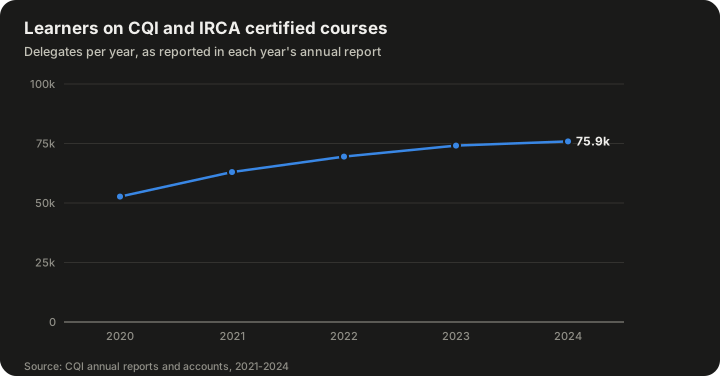
| Learners on certified courses (2024) | 75,882, through 101 approved training partners, in 145 countries |
| President (2024) | Lord Jamie Lindsay |
| Chair of the Board of Trustees (2024) | Rashad Issa |
| Chief Executive | Vince Desmond |
| Website | quality.org |
What "quality management" means
Before looking at the institute, it helps to be clear about the field. Quality management is the set of methods an organisation uses to make sure its products and services consistently do what they are supposed to do, and to keep improving them. It has three broad strands that roughly follow the CQI's own history:
- Inspection. Checking finished items against a specification and rejecting the bad ones. This is where the CQI began, with inspectors checking shells and fuses in the First World War.
- Quality assurance. Designing processes so that defects are prevented in the first place, and documenting those processes so that customers can trust them. The British standard BS 5750 (1979) and its international successor ISO 9001 are quality assurance standards. The CQI's 1972 name, the Institute of Quality Assurance, reflects this stage.
- Quality management and improvement. Treating quality as part of how the whole organisation is run, including leadership, culture, risk, customer focus and continual improvement. The CQI's current Profession Map covers context, governance, assurance, improvement and leadership.
A quality professional today might run an organisation's ISO 9001 system, lead internal audits, investigate failures, manage supplier quality, work on process improvement or advise leaders on risk. An auditor checks whether a management system meets the requirements of a standard, either inside their own organisation (internal audit), for a customer checking a supplier, or for a certification body issuing an ISO certificate.
History
1919: inspectors of munitions
The CQI's own timeline says the Technical Inspection Association (TIA) held its first general meeting on 1 April 1919, and had 500 members by the summer of that year. Membership cost a little more than £1. Wikipedia links the founding to the UK government's Ministry of Munitions, which during the First World War had placed inspectors in factories, and gives the association's first base as 44 Bedford Row in London. The CQI's centenary material describes the founders' aim as stopping the production of faulty munitions.
The timing makes sense. The war had created a large workforce of trained inspectors almost overnight. When it ended, those people had specialist skills and no professional home.
1922: the Institution of Engineering Inspection
On 10 November 1922, according to the CQI's timeline, the TIA reformed as the Institution of Engineering Inspection (IEI). It opened membership to industrial and government inspectors, promoted the work of qualified inspectors in engineering and industry, and invited companies to become affiliated members. Wikipedia records that a branch network was formed in 1929; the CQI's timeline records its first official branch, in Darlington, in 1930.
The Second World War
The Second World War again made inspection a matter of national importance. The CQI's timeline says many members relocated and worked long hours to support the war effort, and that in February 1944 the institution had about 1,200 members. The institution moved its headquarters from London to Bath during the war.
From inspection to quality control
After the war, thinking about quality changed. Statistical quality control, which uses sampling and statistics to monitor processes instead of checking every item, spread from the United States and Britain to Japan and elsewhere. Wikipedia's account of the institute's history includes several steps from this period:
- 1954. The British Productivity Council proposed either a new Society for Quality Control or a quality control branch within an existing society. The council agreed.
- 1955. A general meeting approved changes to the constitution.
- 1958–1960. The institute began considering professional qualifications and set up an education committee. Its first examinations were held in the summer of 1960, with nine candidates.
- 1965. The council approved a change of name.
1972: the Institute of Quality Assurance
In 1972 the IEI became the Institute of Quality Assurance (IQA). The new name marked the move from inspecting finished goods to assuring quality through how things are designed and made.
Britain was influential in this period. The British Standards Institution published BS 5750 in 1979, a quality management standard based on Ministry of Defence and NATO standards for supplier quality assurance and aimed mainly at manufacturing. When the International Organization for Standardization (ISO) published the ISO 9000 series in 1987, it adopted most of the elements of BS 5750. BS 5750 was reissued in 1987 to match, and when the ISO 9000 series was revised in 1994 the BS 5750 title was dropped in favour of the international titles.
1984: the register of auditors
Standards like BS 5750 and ISO 9001 created a new job: the auditor who checks whether an organisation's quality system meets the standard. In 1984, according to the CQI's timeline, a Register of Lead Assessors was created. Within about a decade it had become the International Register of Certificated Auditors (IRCA). IRCA is still part of the CQI and today generates more than half of the institute's revenue.
The 1990s: the British Quality Foundation
Wikipedia notes that in the 1990s the British Quality Foundation separated from the IQA, following the report of the Henderson Committee, which recommended a UK industry quality award modelled on the US Malcolm Baldrige National Quality Award. The British Quality Foundation went on to focus on business excellence and awards, while the IQA remained the body for individual quality professionals.
2006: the Royal Charter
A Royal Charter is granted by the monarch on the advice of the Privy Council and is a mark of an institution's standing. The CQI's own site says it was granted a Royal Charter in 2006, having demonstrated "pre-eminence, public interest, stability and permanence". According to the CQI's timeline, the IQA then reformed as the Chartered Quality Institute, operating under the new name from 1 January 2007. Shortly afterwards it gained the power to award individual chartered status to quality professionals. Sources give 2007 or 2008 for that step.
2019: the centenary
The CQI marked its centenary in 2019. Its 2023 annual report says that during the centenary it recognised that the profession had to respond to digital and sustainability agendas, attract new and diverse talent, and support a global membership operating in more than 100 countries. That thinking led to its "2030 strategy".
Timeline
| Year | Event |
|---|---|
| 1919 | Technical Inspection Association founded; first general meeting 1 April; 500 members by summer |
| 1922 | Becomes the Institution of Engineering Inspection (10 November) |
| 1929–1930 | Branch network formed; first official branch in Darlington |
| 1944 | About 1,200 members; headquarters moved to Bath during the war |
| 1960 | First professional examinations, with nine candidates |
| 1972 | Becomes the Institute of Quality Assurance |
| 1979 | BS 5750 published by the British Standards Institution |
| 1984 | Register of Lead Assessors created, later IRCA |
| 1987 | ISO 9000 series published, based largely on BS 5750 |
| 1990s | British Quality Foundation separates from the IQA |
| 2006 | Royal Charter granted |
| 2007 | Operates as the Chartered Quality Institute from 1 January |
| 2014 | CQI Competency Framework launched |
| 2019 | Centenary |
| 2023 | Profession Map launched |
| 2024 | First meeting of the new CQI Council |
How the CQI is organised
A charity with a Royal Charter
The CQI is a registered charity. Its annual report states its purpose as championing quality management in all sectors "for the benefit of society", through the work of its members, the training and education it provides, its research and its outreach. Being a charity means its trustees answer to the Charity Commission for England and Wales as well as to members, and it must publish annual reports and accounts.
Governance structure
| Body | Role |
|---|---|
| Board of Trustees | The trustees are the directors of the institute and the trustees of the charity. They direct its activities and oversee management. The board meets four times a year. Trustees give their time free of charge. |
| CQI Council | Advises the board on strategy and elects, re-elects and dismisses trustees and council stakeholder members. From 2024 it includes ordinary members elected by voting CQI members and stakeholder members from industry, allied professional bodies, government and regulators, and the wider quality infrastructure. |
| Nominating Committee | Drawn from the board. Recommends trustees to the Council. Under the charter and byelaws the Council can elect up to 15 trustees; the committee can also recommend up to three co-opted trustees. |
| Finance and Resources Committee | Oversees internal control, budgets, accounts, the audit, investments, reserves and staff pay. Chaired by a co-opted trustee who is a chartered accountant. |
| Governance and Risk Committee | Oversees corporate governance and risk management systems. |
| Chief Executive and Senior Management Team | Run the institute day to day. |
| President | A senior ceremonial and ambassadorial role. Lord Jamie Lindsay was President in 2024. |
The CQI holds an annual general meeting. Its 2024 AGM was held online on 12 September 2024. Members voted 105 for, 2 against, with 8 abstentions, on the annual accounts, and the firm Buzzacott had been appointed as auditor for the 2023 and 2024 accounts.
Subsidiaries
The charity has two active, wholly owned subsidiaries:
- IRCA Japan Kabushiki Kaisha, registered in Japan, which provides membership services to members in Japan and promotes the institute's auditor certification there. In 2024 it paid the institute a royalty of £0.124 million.
- CQI Services Limited, registered in the UK, which sells advertising in the members' magazine, earns commission from the Quality Jobs recruitment site and raises sponsorship for the International Quality Awards.
Volunteers and networks
Like most professional bodies, the CQI relies heavily on volunteers. Its 2024 report describes about 350 volunteers delivering continuing professional development (CPD) through 21 geographical networks and 13 special interest networks. Those networks ran 96 events in 2024, including 73 webinars, 13 physical meetings and 10 site visits. The CQI was consulting members on a new model for branch operations, due to launch in 2025, to replace a structure it said took no account of demographics, geography or member needs.
Membership grades
The CQI offers individual grades that reflect experience and competence, rather than just years in a job.
| Grade | Post-nominal letters | Who it is for |
|---|---|---|
| Student | — | People at the start of their careers in quality |
| Affiliate | — | Open to anyone with an interest in quality |
| Practitioner | — | Practising quality professionals who meet the practitioner competence level |
| Chartered Quality Professional – Member | CQP MCQI | Experienced professionals assessed as competent at chartered level |
| Chartered Quality Professional – Fellow | CQP FCQI | Senior professionals assessed at fellowship level |
The table shows post-nominal letters only for the chartered grades, whose letters the CQI states directly. Only organisations with a Royal Charter can award chartered membership. According to the CQI, the assessment for Chartered Quality Professional is based on competency rather than on how long someone has worked. Applicants submit a statement of up to 500 words for each of five competence areas, showing their skills and experience. Chartered members must keep at least three active, quality-related CPD objectives at all times.
From Competency Framework to Profession Map
The CQI launched a Competency Framework in 2014 and completed a revision in 2021. In 2023 it launched the Profession Map, an interactive tool that presents that framework with a self-assessment and e-learning platform. Its 2024 report describes the map as having 18 components across five elements:
| Element | Broadly covers |
|---|---|
| Context | Understanding the organisation, its customers, regulation and external pressures |
| Governance | Management systems, policies, compliance and risk |
| Assurance | Audit, inspection, verification and validation |
| Improvement | Problem solving, data, process and continual improvement |
| Leadership | Influence, culture, strategy and developing people |
Building on the map, the CQI has published "Typical Competence Profiles" for common roles, such as a quality manager, showing the typical level of competence for each of the 18 components. It released its first full e-learning course, on the future of assurance, in October 2024.
IRCA: the auditor register
The International Register of Certificated Auditors is the part of the CQI that most people outside the profession meet, usually as a line on a CV or a training course name such as "IRCA certified ISO 9001 Lead Auditor".
What IRCA certifies
IRCA certifies individuals, not organisations. An IRCA-certificated auditor has passed an IRCA-certified training course, has the audit experience required for their grade, and keeps up CPD. IRCA runs certification schemes for different management system standards, including quality (ISO 9001) and other areas.
IRCA grades
The CQI's current IRCA grades page lists five grades:
| Grade | Broad meaning |
|---|---|
| Associate Auditor | Has passed an IRCA auditor training course but has not yet met the audit experience requirements of a higher grade |
| Internal Auditor | Auditors of their own organisation's management system |
| Auditor | Has the post-course audit experience required for the Auditor grade |
| Lead Auditor | Has, in addition, the required experience of leading audits |
| Principal Auditor | The most senior IRCA auditor grade |
Older IRCA documents used different names, such as Provisional Auditor. Under the current approach, the audit experience gained after the training course decides the grade. Applicants record their audits in an online audit log, giving the standard audited and whether the audit covered the full management system or only part of it. Internal audits can count toward the Auditor, Lead Auditor and Principal Auditor grades if they covered the full system. The person leading each logged audit must be a competent lead auditor, normally certified by IRCA or another recognised body. As an example of the scale required, IRCA guidance from 2014 set a Lead Auditor minimum of three audits as lead auditor and 15 days in total as lead auditor, on top of the Auditor requirements. The CQI notes that requirements are revised, so applicants should check the current scheme documents.
Certified training
Separately from certifying auditors, the CQI and IRCA certify training courses run by independent "approved training partners". Common examples are ISO 9001 internal auditor and lead auditor courses. In 2024 the CQI had 101 approved training partners, and certified courses reached learners in 145 countries. The CQI also completed an online examination platform for these courses, with additional languages.
IRCA Japan
Japan is one of IRCA's strongest markets. The 2024 report says the IRCA Japan register passed 4,000 certificated auditors for the first time, closing the year at 4,122, up from 3,961 in 2023. It recruited 545 new members in 2024 (441 in 2023), helped by online assessments. In 2024 the CQI signed a memorandum of understanding with the Union of Japanese Scientists and Engineers (JUSE), the body that administers Japan's Deming Prize, setting out plans for future collaboration.
The CQI in numbers
Membership
The CQI counts a "global register" made up of CQI members plus IRCA certificated auditors in Japan and the rest of the world.
| Register (end of year) | 2023 | 2024 |
|---|---|---|
| CQI members | 9,247 | 9,551 |
| IRCA auditors, rest of world | 6,232 | about 6,200 |
| IRCA auditors, Japan | 3,961 | 4,122 |
| Global register (as reported) | 19,440 | 19,851 |
Source: CQI annual reports and accounts, 2023 and 2024. The 2024 report gives the rest-of-world IRCA figure as "circa 6,200".
Other 2024 membership facts from the annual report:
- CQI membership grew 2.1%, with retention of 83.9%. The main reasons people left were retirement and moving out of quality roles.
- The IRCA rest-of-world register stayed at about 6,200 for the fourth year running, with 81% retention.
- 1,967 new CQI members joined, 47 above target, and 1,282 new IRCA members joined (1,300 in 2023).
Money
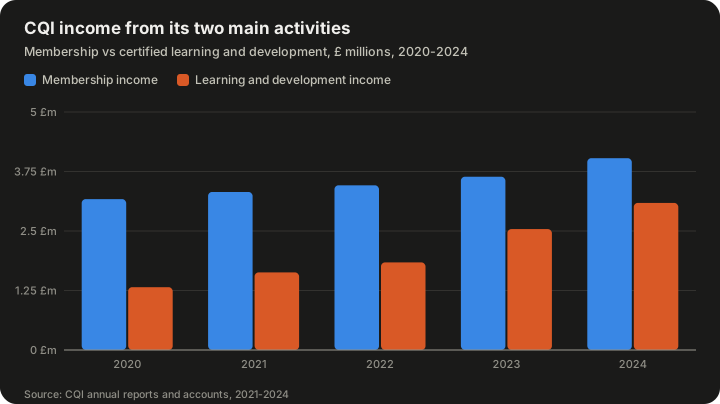
The CQI's income comes mainly from two activities: membership and registration fees, and fees connected with certified learning and development.
| Year | Membership income (£m) | Learning and development income (£m) |
|---|---|---|
| 2020 | 3.17 | 1.32 |
| 2021 | 3.32 | 1.63 |
| 2022 | 3.46 | 1.84 |
| 2023 | 3.64 | 2.54 |
| 2024 | 4.03 | 3.09 |
Source: CQI annual reports and accounts, 2021–2024, each year's figure as reported in that year's report (the 2024 report restates 2023 membership income as £3.63m).
Learning and development income more than doubled between 2020 and 2024, from £1.32 million to £3.09 million. Part of that is recovery from the pandemic: the 2021 report called learning and development "the area of the business worst hit in 2020". Total revenue was £6.3 million in 2023 and £7.28 million in 2024, up £876,000. For comparison, Wikipedia gives a budget of £5.1 million for 2012.
The CQI's own risk register notes that "over half of the Institute's revenue is derived from the IRCA product". That is a strength and a dependency. If the way organisations use audits changes, so does the CQI's income, which is why its strategy includes reviewing and updating the IRCA offer.
Learners
| Year | Learners on certified courses |
|---|---|
| 2020 | 52,699 |
| 2021 | 63,002 |
| 2022 | 69,496 |
| 2023 | 74,119 |
| 2024 | 75,882 |
Source: CQI annual reports and accounts, 2021–2024. The 2023 report restates the 2022 figure as 69,265.
Worked example: income per member and per learner
Rough illustrative averages from the 2024 figures. They are not prices.
- Membership income of £4.03 million across a global register of 19,851 gives about £4,030,000 ÷ 19,851 ≈ £203 per registered member or auditor. In practice fees differ by grade and country, and the income line may include corporate schemes, so this is only an average.
- Learning and development income of £3.09 million across 75,882 learners gives about £3,090,000 ÷ 75,882 ≈ £41 per learner. This is the CQI's own income from certified courses, not what a learner pays a training partner for the course itself.
The comparison shows why certified training has become so important to the CQI: each learner brings in a modest amount, but the number of learners is nearly four times the number of members.
What the CQI does
Professional recognition and development
The core of any professional body is setting standards for its members and helping them meet them. For the CQI that means the membership grades, the Profession Map, CPD requirements, mentoring and e-learning. Its 2022 report said it supported 277 mentoring relationships that year.
Advocacy: World Quality Week and the awards
The CQI runs World Quality Week, an annual campaign that promotes the value of quality management. Its themes in recent years:
| Year | Theme | Reported reach |
|---|---|---|
| 2021 | Sustainability | 37,400 downloads, including 12,618 video views |
| 2022 | Quality conscience: doing the right thing | 56,508 resource kit downloads |
| 2023 | Competitive potential | 44,733 resource kit downloads; 90,928 main webpage views |
| 2024 | From compliance to performance | 69,664 resource kit downloads; 16 million social media impressions |
Source: CQI annual reports 2021–2024.
It also runs the International Quality Awards. In 2024 they attracted 87 entries from 19 countries and 25 sectors. A related conference in 2024 had 382 attendees from 24 countries.
Policy and standards work
The CQI responds to government consultations, such as the UK's planned industrial strategy in 2024. A Standards Consultative Committee, made up of expert members and staff, follows the revision of standards such as ISO 9001 and keeps members informed. The CQI also runs an ISO 9001 working group.
Research
Since its centenary the CQI has carried out research on how the profession should respond to digital transformation, publishing its first output on "Quality 4.0" in 2021, and on sustainability. Its 2024 report cites a 2022 finding that 67% of surveyed employers struggled to attract and develop quality talent.
The CQI's strategy to 2030
The CQI's 2030 strategy has three broad themes: promoting quality management, developing the quality profession, and developing the CQI itself. Its annual reports set out what it means by these:
- The profession as a business partner. The CQI wants organisations to see quality professionals as enablers of performance, not as compliance police. The 2024 World Quality Week theme, "from compliance to performance", captured this.
- Context-relevant quality. Helping organisations adapt quality management to their own situation and strategy.
- Technological agility. Digitalising quality management and supporting digital transformation.
- Sustainability. Linking quality to the sustainability and circular-economy agendas; the CQI runs a Sustainability Special Interest Group.
- Diversity. Attracting new and more diverse people into the profession.
- Digital transformation of the CQI. In 2024 it invested £725,000 in strategic projects, 85% of it in digital systems such as a new membership database and the online examination platform.
The 2024 report is candid about a strategic risk: "a traditional membership offer is unlikely to sustain the CQI", especially given legacy digital systems. That kind of admission is common among professional bodies, many of which have seen younger professionals less willing to pay for traditional membership.
How the register has moved since 2020
Each CQI annual report includes a small table of its registers at the end of the year, compared with the year before. Read side by side, they show a slow, steady build-up rather than dramatic growth.
| Register | End 2020 | End 2021 | End 2022 | End 2023 | End 2024 |
|---|---|---|---|---|---|
| CQI members | 8,319 | 8,619 | 8,591 | 9,247 | 9,551 |
| IRCA auditors, rest of world | 6,026 | 6,186 | 6,189 | 6,232 | about 6,200 |
| IRCA auditors, Japan | 3,581 | 3,695 | 3,491 | 3,961 | 4,122 |
Source: CQI annual reports and accounts, 2021–2024. Each figure is the one given in the report for that year, except 2020, taken from the comparison column of the 2021 report.
A note of caution on reading this table: the CQI restates some earlier figures in later reports. For example, the 2023 report gives end-2022 figures of 8,846 CQI members, 6,190 rest-of-world auditors and 3,858 Japanese auditors, which differ from the 2022 report's own numbers. The reports do not explain the changes. They may reflect later data cleaning or a change in how lapsed members are counted. The broad trend is the same in both versions: CQI membership and the Japanese register grew, while the rest-of-world auditor register stayed close to 6,200.
The CQI's 2030 strategy set a target of 17,942 for the whole global register by the end of its first phase (end of 2023). The 2022 report said the register was running ahead of that target, mainly because of growth in the IRCA Japan and CQI registers, and the 2023 figure of 19,440 was well above it.
Becoming an IRCA-certificated auditor: the usual path
For many people the CQI's most practical role is as the route to a recognised auditor credential. Based on the CQI's published guidance, the usual path looks like this:
- Choose a scheme. IRCA runs separate schemes for different management system standards. A quality auditor would normally choose the quality management systems scheme, based on ISO 9001.
- Pass a certified course. Take an IRCA-certified auditor or lead auditor course from one of the CQI's approved training partners and pass its examination. Someone who already holds auditor status in another recognised scheme can take a certified conversion course instead.
- Apply at the starting grade, if needed. A person who has passed the course but does not yet have enough audit experience can register as an Associate Auditor.
- Build and log audit experience. Carry out audits after the course and record them in the online IRCA audit log, giving the standard, the type of audit and whether it covered the whole management system. Audits must be led by a competent lead auditor.
- Upgrade. Apply for the grade the experience supports: Auditor, Lead Auditor or Principal Auditor. Applicants can apply directly for the grade they want if they meet its requirements.
- Keep it up. Pay the annual fee for each scheme and meet CPD and recertification requirements, which depend on the grade.
This structure separates three things that are often run together: training (the course), experience (the logged audits) and ongoing competence (CPD and recertification). Only all three together produce the grade.
Careers, skills and sustainability
The CQI's reports show it increasingly presenting itself as a careers body as well as a standards-setter for individuals.
The talent problem. The 2024 report cites a 2022 finding that 67% of surveyed employers struggled to attract and develop quality professionals. The CQI's response includes a Career Pathways Map that defines role profiles and career and learning paths, the Typical Competence Profiles, mentoring, a Quality Careers Hub and corporate schemes for employers with groups of quality staff. Its 2021 report credited services such as e-mentoring and the careers hub with helping new-member growth.
Who attends. The 2024 International Quality Awards conference gives a snapshot of the profession's age profile: of 382 attendees, 9% were junior or entry level, 55% mid-level and about 36% senior.
Sustainability. The CQI frames quality as linked to sustainability. Its 2021 World Quality Week argued that "today's quality is tomorrow's sustainability", it includes sustainability topics in the Profession Map, and it runs a Sustainability Special Interest Group. It also reports on its own footprint. When it replaced plastic IRCA membership cards and paper certificates with digital cards and certificates in 2024, it said emissions in that category fell by 42% for plastic production and 86% for freight for worldwide delivery. The digital cards can be added to phone wallets, and members can share digital pins on social media.
The CQI among quality organisations
The CQI is one of several bodies in the quality field. They are often confused.
| Organisation | What it is | Relationship to the CQI |
|---|---|---|
| ISO (International Organization for Standardization) | Writes international standards, including ISO 9001 and ISO 19011 (guidelines for auditing management systems) | The CQI does not write standards but follows and comments on their revision |
| BSI (British Standards Institution) | UK national standards body; published BS 5750; also a commercial certification body | Separate organisation |
| Certification bodies | Companies that audit organisations and issue ISO 9001 certificates | Their auditors may hold IRCA certification, but the CQI does not certify organisations |
| Accreditation bodies (for example UKAS in the UK) | Check that certification bodies are competent | Separate role |
| British Quality Foundation | UK body focused on business excellence and awards | Separated from the IQA in the 1990s |
| American Society for Quality (ASQ) | Large US-based professional body with its own certifications | Comparable body in another country |
| Union of Japanese Scientists and Engineers (JUSE) | Japanese body that administers the Deming Prize | Signed an MoU with the CQI in 2024 |
Limits and criticisms
Certification of individuals, not of quality. An IRCA certificate shows that an auditor has been trained, has audited, and keeps up CPD. It does not guarantee that every audit they carry out is good, and it does not say anything about the organisations they audit.
Paper compliance. A long-standing criticism of ISO 9001 certification in general is that it can encourage organisations to document processes for the sake of the certificate rather than to improve them. The CQI's own emphasis on moving "from compliance to performance" acknowledges this concern.
Dependence on auditing. With more than half its revenue from IRCA, the CQI's finances are tied to the market for management system audits and auditor training. Its risk register describes the external environment for how quality is managed in industry as "changing rapidly".
Flat auditor numbers outside Japan. The rest-of-world IRCA register has stayed at about 6,200 for four years, even as CQI membership and learner numbers have grown.
UK-centred but globally sold. The CQI is British in its governance and history, while much of its IRCA activity and training takes place abroad. That raises the usual questions about how well a UK professional body's standards fit very different national markets.
A thin Wikipedia record. The English Wikipedia article on the CQI carries warnings about promotional tone and a lack of citations, and its infobox lists leadership that has since changed. Readers should check the CQI's own annual reports and the Charity Commission register for current facts.
Common misconceptions
"The CQI issues ISO 9001 certificates." It does not. Organisations get ISO 9001 certificates from certification bodies. The CQI, through IRCA, certifies individual auditors and certifies training courses.
"IRCA is a separate organisation." IRCA is part of the CQI. It began in 1984 as the Register of Lead Assessors and has been run by the institute ever since.
"A Lead Auditor course makes you a Lead Auditor." Passing an IRCA-certified lead auditor course is one requirement. To be registered at Lead Auditor grade, you also need the required audit experience and must keep up CPD.
"Chartered status is awarded for long service." The CQI says chartered assessment is based on competence, demonstrated through written statements across five competence areas, not on time served.
"The CQI writes quality standards." Standards are written by ISO and national standards bodies such as BSI. The CQI follows their revision and helps members apply them.
"The CQI was founded as a quality body." It began as an association of inspectors. The word "quality" only entered its name in 1972.
Frequently asked questions
What does CQI stand for? Chartered Quality Institute. Its auditor certification arm is IRCA, the International Register of Certificated Auditors.
When was it founded? In 1919, as the Technical Inspection Association. It received its Royal Charter in 2006 and has been the Chartered Quality Institute since 1 January 2007.
How many members does it have? Its global register of CQI members and IRCA certificated auditors stood at 19,851 at the end of 2024.
What is a CQP? A Chartered Quality Professional, the CQI's chartered grade. Members use CQP MCQI and Fellows use CQP FCQI after their names.
What are the IRCA auditor grades? Associate Auditor, Internal Auditor, Auditor, Lead Auditor and Principal Auditor.
Is the CQI a charity? Yes. It is a registered charity in England and Wales (number 259678), incorporated by Royal Charter.
Does the CQI only operate in the UK? No. It reports members in more than 100 countries and certified training delivered in 145 countries, and it has a subsidiary in Japan.
What is World Quality Week? An annual CQI campaign that promotes the value of quality management. The 2024 theme was "from compliance to performance".
Where can I check its finances? Its annual reports and accounts are published on its website and filed with the Charity Commission for England and Wales.
Who runs the CQI day to day? A Chief Executive and Senior Management Team, to whom the Board of Trustees delegates daily management. Vince Desmond is Director General and Chief Executive.
Can organisations join, or only individuals? Membership grades are for individuals, but the CQI also runs corporate schemes for employers that want to support groups of quality professionals. Its 2022 report records six new corporate members that year, and its 2021 report seven new corporate members and partners.
How many people take CQI or IRCA certified courses? 75,882 learners in 2024, up from 52,699 in 2020, when the pandemic hit classroom training.
Summary
The Chartered Quality Institute began in 1919 as a small association of munitions inspectors and has followed the changes in quality management over the following century: from inspection, to statistical quality control, to quality assurance standards like BS 5750 and ISO 9001, to today's view of quality as part of how an organisation is led and run. Its names trace that path, from the Technical Inspection Association, to the Institution of Engineering Inspection, to the Institute of Quality Assurance, and, after its Royal Charter in 2006, to the Chartered Quality Institute. Today it is a charity with just under 20,000 people on its global register, a £7.3 million income, and an auditor register, IRCA, that is known worldwide and provides more than half of its revenue. Its challenge, which it states openly, is to stay relevant as organisations move beyond compliance, auditing goes digital, and a new generation decides whether professional membership is worth paying for.
Sources
- Chartered Quality Institute (Wikipedia)
- CQI – Our history (centenary timeline)
- CQI – About us
- CQI – About the Chartered Quality Institute
- CQI – Chartered Quality Professional – Member (CQP MCQI)
- CQI – IRCA grades
- CQI – Lead Auditor
- CQI – IRCA audit experience help
- CQI Annual Report 2024
- The Chartered Quality Institute – accounts for 2024 (via OpenCharities)
- The Chartered Quality Institute – accounts for 2023 (via OpenCharities)
- The Chartered Quality Institute – accounts for 2022 (via OpenCharities)
- The Chartered Quality Institute – accounts for 2021 (via OpenCharities)
- Charity Commission for England and Wales – The Chartered Quality Institute (259678)
- NIST IR 5122 – background on ISO 9000 and BS 5750
- NED Global – The Chartered Quality Institute celebrates its 100th anniversary