The Cantonal Museum of Zoology (Musée cantonal de zoologie) is the zoological museum of the Swiss canton of Vaud, housed in the Palais de Rumine in the centre of Lausanne. Its origins go back to 1779, when the natural history objects of the Académie de Lausanne were first catalogued, and it opened to the public in 1833. Since 1 January 2023 it has no longer been a separate institution: it was merged with the cantonal museums of botany and geology to form the Naturéum, the cantonal museum of natural sciences, in which it now operates as the zoology department.
The museum is small by the standards of the great national natural history museums of London, Paris or New York, but it holds several collections of international importance. They include part of the ant collection of Auguste Forel, one of the founders of the scientific study of ants; the insect collection of a former director, Jacques Aubert; part of the butterfly collection of the novelist Vladimir Nabokov; and the archive of Bernard Heuvelmans, the Belgian-French zoologist who coined the word "cryptozoology." That last collection is the reason the museum sometimes appears in lists about cryptozoology, although the museum itself is a conventional scientific institution.
This article explains the museum's history, its building, its major collections and what they are used for, and how a regional museum of this kind fits into modern biology.
Quick facts
| Item | Detail |
|---|---|
| Name | Musée cantonal de zoologie, Lausanne; since 2023 the zoology department of the Naturéum |
| Location | Palais de Rumine, Place de la Riponne 6, 1005 Lausanne, Switzerland |
| Origins | 1779, inventory of the Académie de Lausanne's natural history objects by Daniel-Alexandre Chavannes |
| Opened | 1833, in the Académie de Lausanne |
| Present building | Palais de Rumine (moved there in 1906 according to Wikipedia; 1909 according to the Swiss Museums Association listing) |
| Status since 1 January 2023 | Department of the Naturéum, with botany and geology |
| Notable collections | Forel ants, Aubert insects, Heuvelmans cryptozoology archive, Nabokov butterflies, birds from Albert Vouga |
| Admission | Free entry to the permanent exhibitions |
| Opening hours | Tuesday to Sunday and public holidays, 10:00–17:00; closed Mondays, 1 January and 25 December |
History
The Académie and Chavannes (1779–1833)
The museum's founding date is usually given as 1779. In that year Daniel-Alexandre Chavannes indexed the natural history "objects" belonging to the Académie de Lausanne, the institution that later became the University of Lausanne. Such inventories were a common starting point for European natural history museums in the eighteenth century. Collections of shells, minerals, stuffed animals and curiosities had accumulated in academies, churches and private cabinets, and listing them was the first step toward treating them as scientific material rather than decoration.
In 1826 the Canton of Vaud purchased Chavannes's vertebrate collection. That purchase marks the point at which the collection became public property, and it is why the museum is a cantonal one: in Switzerland's federal system, the cantons have wide responsibility for culture and education, and many of the country's museums are run by cantons rather than by the federal government.
The museum opened in 1833 in the buildings of the Académie de Lausanne.
Growth in the nineteenth century
Through the nineteenth century the collection grew by purchase and donation. In 1886 the museum acquired 1,300 bird specimens from Albert Vouga (1829–1896), who is also known as the author of Album Neuchâtelois. Vues historiques et pittoresques. Bird collections of this kind were the backbone of many regional museums, since they documented the local fauna and allowed comparison with species from elsewhere.
The move to the Palais de Rumine
In the early twentieth century the museum moved to its present home, the Palais de Rumine. Wikipedia gives 1906 for the move; the Swiss Museums Association listing gives 1909 as the year the museum opened there, and Lausanne Tourisme also describes the zoology collections as being in the building "since 1909." The difference may reflect the gap between moving collections and opening galleries, but the sources do not say.
The twentieth century and the comparative anatomy hall
One part of the museum preserves the look of its early decades particularly well. Its comparative anatomy hall, used for university teaching until the 1930s, displays rows of specimen jars, skeletons and two-headed animals. Comparative anatomy, the study of how the bodies of different animals are built and how their structures correspond, was a central teaching subject in biology, and halls like this were working classrooms rather than showpieces.
The Swiss Museums Association listing describes the permanent exhibition as having the style of the nineteenth or even eighteenth century, giving it a "charmingly old-fashioned" feel. For visitors interested in the history of science, that is part of the appeal: it shows how zoology was displayed and taught before the age of interactive screens.
Into the Naturéum (2023)
On 1 January 2023 the former cantonal museums of botany, geology and zoology were merged to create the Naturéum, the cantonal museum of natural sciences. The new institution has three departments, botany, geology and zoology, and operates on several sites: the Palais de Rumine, the Jardin botanique cantonal in Lausanne, and the alpine garden "La Thomasia" at Pont de Nant.
Mergers of this kind are common among natural history institutions. Combining museums allows shared conservation staff, storage and digitisation programmes, and lets exhibitions cross traditional boundaries, for example by showing a fossil, a living plant and a preserved animal in a single story about an ecosystem.
Timeline
| Year | Event |
|---|---|
| 1779 | Daniel-Alexandre Chavannes indexes the natural history objects of the Académie de Lausanne |
| 1826 | Canton of Vaud buys Chavannes's vertebrate collection |
| 1833 | Museum opens in the Académie de Lausanne |
| 1886 | Acquisition of 1,300 bird specimens from Albert Vouga |
| 1892 | Construction of the Palais de Rumine begins |
| 1902 | Palais de Rumine inaugurated (3 November) |
| 1906 / 1909 | Museum moves to, or opens in, the Palais de Rumine (sources differ) |
| 1923 | Treaty of Lausanne signed in the Palais de Rumine (24 July) |
| 1930s | Comparative anatomy hall ceases to be used for university teaching |
| 1977 | Death of Vladimir Nabokov; his later European butterflies come to the museum |
| 1993–1994 | Exhibition "Les Papillons de Nabokov" (26 November 1993 – 29 January 1994) |
| 1999 | Bernard Heuvelmans's cryptozoology archive donated (announced 8 October) |
| 2023 | Museum becomes the zoology department of the Naturéum (1 January) |
The Palais de Rumine
The building that houses the museum is itself one of Lausanne's landmarks. The Palais de Rumine is a late nineteenth-century building in Florentine Renaissance style, designed by the Lyon architect Gaspard André. It exists because of a bequest: Gabriel de Rumine, from a Russian noble family, left the city 1.5 million Swiss francs on his death to build a public building.
Construction began in 1892. The Palais was inaugurated on 3 November 1902, and work continued until 1904. On 24 July 1923 the Treaty of Lausanne, which set the borders of modern Turkey after the First World War, was signed in the building.
For much of the twentieth century the Palais housed the University of Lausanne's library and the canton's scientific and artistic collections. The university moved to a new campus beside Lake Geneva in the 1980s, after which the building was restructured. The Wikipedia article on the Palais lists it as now hosting one of three sites of the Cantonal and University Library of Lausanne, along with cantonal museums of fine arts, archaeology and history, money, geology and zoology.
| Palais de Rumine fact | Detail |
|---|---|
| Architect | Gaspard André (Lyon) |
| Style | Florentine Renaissance |
| Funding | Bequest of 1.5 million Swiss francs from Gabriel de Rumine |
| Construction | 1892–1904; inaugurated 3 November 1902 |
| Historic event | Treaty of Lausanne signed 24 July 1923 |
| Uses | Library, cantonal museums, including zoology on the fifth floor |
The zoology exhibits occupy the fifth floor. To reach them, visitors pass through a building that combines a library, several museums and civic spaces, which is typical of the nineteenth-century idea of a "palace of knowledge" open to the public.
What visitors see
The museum's permanent exhibition includes vertebrates from Switzerland and around the world, displays of invertebrates, and the comparative anatomy hall. Notable specimens listed by the Swiss Museums Association include a tiger, an elk (moose) and a great white shark that measures 5.89 metres and is described as the largest taxidermied specimen of its kind in the world. Lausanne Tourisme singles out the entomological collections, and especially the world of ants, as a highlight for visitors.
Temporary exhibitions are held regularly. Admission to the permanent exhibitions is free, and the museum participates in the Swiss Museum Pass (Passeport Musées) and the CarteCulture scheme. It is reachable by bus lines 1, 2, 7, 8 and 16 and by the M2 metro, with the Parking de la Riponne nearby.
The major collections
A natural history museum's public galleries usually show only a small part of what it holds. The scientific value lies mostly in the stored collections: drawers of insects, cabinets of bird skins, jars of preserved specimens, and archives. Lausanne's include several collections associated with famous names.
| Collection | Creator | Type | Why it matters |
|---|---|---|---|
| Ants | Auguste Forel (1848–1931) | Pinned insects, including type specimens | Forel described more than 6,000 ant taxa |
| Insects | Jacques Aubert (1916–1995), a later director | Insects | A major personal collection by a museum director |
| Cryptozoology archive | Bernard Heuvelmans (1916–2001) | Books, files, photographs, correspondence, artefacts | The working archive of the founder of cryptozoology |
| Butterflies | Vladimir Nabokov (died 1977) | Pinned Lepidoptera | The writer's later European collection, 4,323 specimens |
| Birds | Albert Vouga (1829–1896) | Bird specimens | 1,300 specimens acquired in 1886 |
| Vertebrates | Daniel-Alexandre Chavannes | Vertebrates | The founding collection, purchased by the canton in 1826 |
Auguste Forel's ants
Auguste-Henri Forel was born on 1 September 1848 at Morges on Lake Geneva and died on 27 July 1931. He was a remarkable and in some ways troubling figure: a neuroanatomist and psychiatrist, a pioneer of the study of ant behaviour, and, as his biographers note, a former eugenicist.
He became interested in ants as a boy after reading a book by Pierre Huber, and kept collecting colonies through medical school. After a field trip to southern Switzerland in his early twenties he wrote Les Fourmis de la Suisse, a 450-page study first published in three parts in a Swiss scientific journal from 1874. In 1886 he carried out a well-known experiment in which he removed the antennae of ants of several species and placed them together in a box; the ants without antennae stopped fighting one another, which supported his view that ants use their antennae to tell friend from foe. He is credited with describing trophallaxis, the mutual exchange of food between ants, in 1898.
Forel described more than 6,000 ant taxa. According to SwissCollNet, the Swiss national programme for natural history collections, his collection contains more than 65,000 pins, many holding several specimens, and more than 10,000 type specimens. It is deposited mainly at the Natural History Museum in Geneva and the Cantonal Museum of Zoology in Lausanne, with some specimens at the Naturmuseum Solothurn.
Forel the scientist in context
Forel's career shows how closely brain science and insect science were once linked. After medical training he went to Vienna in 1871 to study under the neuroanatomist Theodor Meynert, where he did his first comparative study of the thalamus, and later lectured at the Ludwig-Maximilians-Universität in Munich while continuing his ant research. He then took charge of the Burghölzli asylum in Zürich, the psychiatric hospital of the University of Zürich, where at first he worked with only two other physicians treating 300 patients. Accounts of his tenure credit him with turning a poorly run institution into one of the best in Europe.
Throughout, he kept studying ants. His writing on their behaviour was praised by the writer Hammerton, quoted in Forel's Wikipedia biography, as "the most important contribution to insect psychology ever made by a single student." For a museum, the significance is that Forel collected and described specimens with the eye of an anatomist, which is one reason his collection became such a central reference for ant taxonomy.
His legacy is not uncomplicated. Wikipedia describes him as a former eugenicist, and his reputation in psychiatry is debated for that reason. A museum holding his specimens preserves the scientific record without endorsing every view of the person who made it, the same principle that applies to the Heuvelmans archive.
Why type specimens matter
A type specimen is the physical specimen to which a scientific name is permanently attached. When a taxonomist describes a new species, they designate one specimen (the holotype) as the reference. If scientists later disagree about which animals belong to that species, they go back to the type and compare. A collection of thousands of types, such as Forel's, is therefore not just a historical curiosity; it is part of the working infrastructure of biology. Researchers studying ants anywhere in the world may need to examine a Forel type in Lausanne or Geneva to settle what a name means.
Rehousing and digitising the Forel collection
Old collections face a practical problem. Part of the Forel material in Geneva and Lausanne remained in Forel's original boxes, which no longer meet modern conservation standards; old boxes can let in pests, dust and humidity, and old pins can corrode. A SwissCollNet project titled "Reconditioning and digitisation of the patrimonial Auguste Forel ant collections in Switzerland, with a focus on the primary types" was set up to address this. It was led by Anne Freitag of the Naturéum in Lausanne, Bernard Landry of the Natural History Museum of Geneva and Marc Neumann of the Natural History Museum of Solothurn. The material is being moved into new entomological drawers. Geneva, which holds the most species and specimens, is digitising a representative of each species, while Lausanne and Solothurn are being fully digitised.
The project page reports the following results.
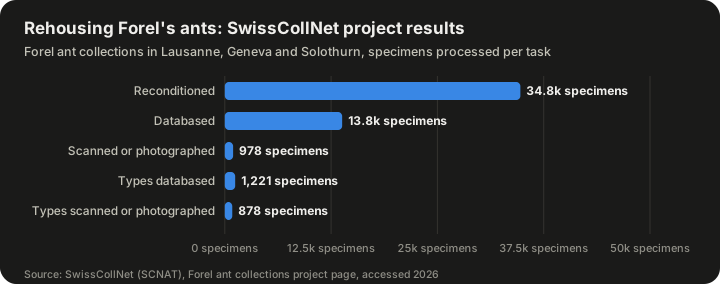
| Task | Specimens |
|---|---|
| Reconditioned | 34,756 |
| Databased | 13,800 |
| Scanned or photographed | 978 |
| Type specimens databased | 1,221 |
| Type specimens scanned or photographed | 878 |
Source: SwissCollNet (Swiss Academy of Sciences), Forel ant collections project page. Figures cover the project across its partner museums.
The numbers show the different speeds of each step. Reconditioning, moving a pinned specimen into a new drawer, is relatively fast. Databasing, entering each specimen's label information into a searchable record, is slower. Imaging is slower still, which is why projects often prioritise type specimens for photography: about 878 of the 1,221 databased types had been imaged, compared with 978 of 13,800 databased specimens overall.
Worked example: what the digitisation figures mean
Using the project's own figures:
- Share of reconditioned specimens that have been databased: 13,800 ÷ 34,756 ≈ 0.397, or about 40%.
- Share of databased types that have been imaged: 878 ÷ 1,221 ≈ 0.719, or about 72%.
- Share of all databased specimens that have been imaged: 978 ÷ 13,800 ≈ 0.071, or about 7%.
In other words, the project focused its imaging effort on the types, which are the most scientifically critical specimens. This is a standard strategy in collection digitisation. SwissCollNet as a whole reported 22 supported invertebrate projects, with 401,093 invertebrate specimens databased, which gives a sense of the scale of the national effort of which the Forel work is one part.
Jacques Aubert's insects
Jacques Aubert (1916–1995) was a later director of the museum, and his insect collection is held there. A director's personal collection often becomes one of a museum's core research holdings, because it reflects decades of specialist work by someone with direct responsibility for the institution's science.
The museum's entomological research continues. SwissCollNet lists Lausanne staff involved in projects on mayflies and stoneflies (Jean-Luc Gattolliat), water mites (Laurent Vuataz) and Neuchâtel type specimens (Jessica Litman). Michel Sartori, who directed the museum in the 1990s, edited the 1993 catalogue of Nabokov's butterflies.
Vladimir Nabokov's butterflies
Vladimir Nabokov is famous as the author of Lolita and Pale Fire, but he was also a serious lepidopterist, a specialist in butterflies. He spent his last years in Montreux on Lake Geneva, the nearest large town to Lausanne along the lake shore, and died in July 1977.
Nabokov's butterflies from his European years came to the Lausanne museum. According to a 2007 message by his son Dmitri Nabokov on the NABOKV-L list of the International Vladimir Nabokov Society, Dmitri and his mother gave the collection to the museum, as Nabokov had wished; it numbers 4,323 specimens, many of them from the Montreux area. Other parts of Nabokov's collections went to other institutions.
The museum honoured the collection with an exhibition, "Les Papillons de Nabokov," which ran from 26 November 1993 to 29 January 1994. Its catalogue, Les Papillons de Nabokov, was edited by Michel Sartori and published in 1993.
A writer's insect collection may sound like a curiosity, but specimens collected by a careful naturalist, with accurate labels of place and date, are real scientific data. A butterfly pinned near Montreux in the 1960s or 1970s records that a species lived there at that time, which is exactly the kind of baseline needed to study changes in distribution caused by habitat loss or a changing climate.
Bernard Heuvelmans and the cryptozoology archive
The collection that gives the museum its odd place on cryptozoology lists is the archive of Bernard Heuvelmans.
Heuvelmans was born on 10 October 1916 in Le Havre, France, and died on 22 August 2001 in Le Vésinet, aged 84. A trained zoologist, he became fascinated by animals reported by witnesses but not recognised by science, such as sea serpents. His book Sur la piste des bêtes ignorées (1955), published in English as On the Track of Unknown Animals (London, 1958; New York, 1959), is regarded as one of the most influential texts in the field. He later wrote In the Wake of the Sea Serpents (1968). He described his new discipline as "the science of hidden animals" and gave it the name cryptozoology.
In 1999 Heuvelmans gave his archive to the Canton of Vaud for the museum. The canton's press release of 8 October 1999 announced it as a "spectacular donation" (donation spectaculaire) and described it as the whole of fifty years of Heuvelmans's work. The president of the Vaud cantonal government, Claude Ruey, was quoted as saying: "Cette donation est tout simplement unique au monde !" ("This donation is simply unique in the world!"). The museum's director, Michel Sartori, called the material gathered over fifty years by a researcher "a windfall and a formidable working tool" for an institution like his. An exhibition was announced to open on 13 October.
The archive is reported to contain about 1,000 books, 25,000 files and 25,000 photographs, along with correspondence and artefacts.
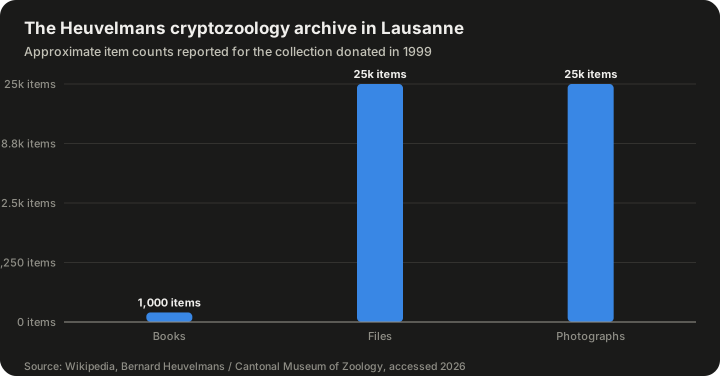
| Archive component | Approximate number |
|---|---|
| Books | 1,000 |
| Files | 25,000 |
| Photographs | 25,000 |
| Correspondence and artefacts | Not counted in the sources |
Source: Wikipedia articles on Bernard Heuvelmans and the Cantonal Museum of Zoology. A Lausanne thesis from 2000 notes that the material occupied two rooms at the Palais de Rumine.
Cryptozoology: what it is and how scientists view it
Because the Heuvelmans archive is the museum's best-known link to popular culture, it is worth being clear about what cryptozoology is.
The idea
Cryptozoology studies animals whose existence is suggested by witness reports, legends, footprints, fragments or photographs, but has not been established by the evidence normally required in zoology, namely a specimen that can be examined and described. Famous examples include the Loch Ness monster and the yeti, both named in the 1999 Vaud press release.
The press release also gave the strongest form of the argument for taking the field seriously: that new animals really are still being found. It stated that some 5,000 to 8,000 new animal species are described each year, and gave two examples. In 1975 the largest of the peccaries, a pig-like New World mammal, was found alive in Paraguay after being known only as a fossil. In 1976 a large shark of an unknown kind, 4.5 metres long and weighing 875 kilograms, was caught off Hawaii and nicknamed "megamouth."
The scientific criticism
Those discoveries are real, but they illustrate a different point from the one cryptozoologists usually make. The megamouth shark and the living peccary were confirmed by specimens and accepted quickly. The famous cryptids, such as the Loch Ness monster, have never produced a specimen despite long searches.
Critics have also pointed to weaknesses in Heuvelmans's own method. The science writer David Quammen called On the Track of Unknown Animals "heavily researched and encyclopedic" but said it contains "leaps of credulity that leave a skeptical reader behind." The biologist Aaron Bauer noted that Heuvelmans's writings often skip critical analysis of the available data. John Burton wrote that the credibility of the posthumous Natural History of Hidden Animals (2007) is "seriously undermined by sloppy research."
| Question | Mainstream zoology | Cryptozoology as practised by Heuvelmans |
|---|---|---|
| What establishes a species? | A specimen, described and deposited in a collection | Often testimony, folklore, traces and photographs |
| How are new species found? | Mostly through fieldwork, collection study and DNA analysis, often of small or obscure animals | By investigating reports of large, dramatic unknown animals |
| How is evidence weighed? | Peer review, reproducible analysis | Critics say critical analysis is often skipped |
| Typical outcome | Thousands of new species described each year | No widely accepted large cryptid confirmed |
Why a scientific museum would want the archive
None of that makes the archive worthless. A collection of 25,000 files and photographs is a rich record of how people across the twentieth century reported, imagined and argued about unknown animals. It is useful to historians of science, to folklorists, and to zoologists who want to trace where a particular report came from. Holding it in a scientific museum also means it is preserved and catalogued rather than dispersed. The museum's role is custodian, not endorser. The same approach applies to many archives held by scientific institutions: the papers of a scientist whose ideas did not survive scrutiny can still show how evidence was gathered, how debates unfolded and why some claims attracted public attention. For a student of the history of zoology, a cryptozoologist's files sit naturally beside the drawers of type specimens, because both record how people have tried to decide which animals exist. Keeping them in the same building, under professional care, makes that comparison possible for future researchers who may ask questions nobody has thought of yet.
How zoological specimens are preserved
Visitors to a museum like Lausanne's see the end result of several very different preparation methods. Each suits a different kind of animal and a different scientific purpose.
| Method | Typical animals | What it keeps | Main risks |
|---|---|---|---|
| Pinning and drying | Insects such as ants and butterflies | External body, wings, colour pattern | Pests such as museum beetles, humidity, pin corrosion |
| Study skins | Birds and small mammals | Feathers or fur, external form, label data | Fading from light, insect damage |
| Taxidermy mounts | Large mammals, fish, display birds | Life-like appearance for exhibition | Cracking, fading, old pesticide residues |
| Fluid preservation | Reptiles, amphibians, fish, soft invertebrates | Whole body including soft tissue | Evaporation of preserving fluid, fire risk |
| Skeletons | Vertebrates | Bones for anatomical comparison | Breakage, mixing of parts |
Each method has its own conservation needs, which is why old collections need regular attention. The Forel rehousing project is a good example: the specimens themselves may be in good condition, but their original boxes can no longer protect them adequately, so the work consists of moving each pinned ant into modern drawers without losing the small paper labels on the same pin. Those labels, often handwritten more than a century ago, record where and when the specimen was collected and who identified it. Without the label, a specimen loses most of its scientific value.
The comparative anatomy hall shows the skeleton and fluid traditions side by side. Jars of preserved animals and articulated skeletons were placed together so that students could compare the same structure, such as a limb or a skull, across many species. Two-headed animals, which are developmental abnormalities, were kept for the same reason: they help show how bodies normally develop by revealing what happens when development goes differently.
Names, rules and why collections are permanent
Zoologists name animals under an international set of rules, the International Code of Zoological Nomenclature. One of its central ideas is that a scientific name is tied to type material rather than to a written description alone. Words can be ambiguous, and a description written in the nineteenth century may not mention the features a modern specialist needs. The specimen, by contrast, can be re-examined with new eyes and new tools.
That is why museums treat type collections as effectively permanent. A regional museum may decide to stop displaying a specimen, or to move it to storage, but it does not throw away a type, because doing so would undermine the meaning of a scientific name used by researchers worldwide. The more than 10,000 types in the Forel collection, divided mainly between Geneva and Lausanne, are a long-term commitment for both institutions.
Collections as a record of change
Natural history collections are increasingly used as a historical record of the living world. A specimen with a reliable date and place shows that a species was present there at that time. Put enough of those records together and scientists can map how a species' range has shifted, how its body size or colour has changed, or when it disappeared from an area.
For a museum in the Lake Geneva region, the local material is especially valuable. Nabokov's butterflies, many collected around Montreux in the 1960s and 1970s; the Vouga birds acquired in 1886; and the ants Forel collected in Switzerland from the 1870s onward together give glimpses of the regional fauna at very different moments. None of these collectors could have anticipated modern questions about habitat loss or climate, but because they labelled their specimens carefully, their work can still help answer them. Digitisation is what turns those scattered glimpses into usable datasets.
How a regional natural history museum works
Three jobs
Museums like Lausanne's do three main things:
- Collections care. Specimens must be protected from pests, light, humidity and decay, and kept with their labels, which carry the essential data of where and when they were collected.
- Research. Curators and visiting scientists use the collections for taxonomy, biogeography, conservation and history. Loans of specimens between museums are routine.
- Public education. Exhibitions, school visits and events make the collections accessible. Free admission, as in Lausanne, is part of that mission.
Why old specimens are newly valuable
Two modern developments have increased the value of historic collections:
- Digitisation. Once label data is in a database, scientists anywhere can search for specimens by species, place and date. Projects such as SwissCollNet's are turning drawers of pinned insects into searchable data.
- New analytical methods. DNA can often be recovered from old specimens, allowing scientists to place historic material in modern family trees and to compare genetic diversity across time.
| Collection type | Example in Lausanne | Typical research use |
|---|---|---|
| Type specimens | Forel ant types | Fixing the meaning of scientific names |
| Regional series | Birds acquired from Albert Vouga | Documenting historical fauna |
| Dated specimens from one area | Nabokov butterflies from the Montreux area | Baselines for distribution change |
| Teaching material | Comparative anatomy hall | History of biology education |
| Archives | Heuvelmans papers | History of science and popular belief |
Lausanne in the Swiss collections network
Switzerland's natural history collections are spread across many cantonal and city museums rather than concentrated in a single national institution. To coordinate their care and digitisation, the Swiss Academy of Sciences runs SwissCollNet, a national network for natural science collections. Its invertebrate programme alone supported 22 projects. Across those projects, 401,093 invertebrate specimens were databased, which SwissCollNet reports as 39% of all objects databased in its programme across collection domains, along with 4,694 invertebrate type specimens databased and 3,677 photographed.
The institutions named in SwissCollNet's invertebrate projects include the natural history museums of Bern, Basel, Geneva, Neuchâtel, Fribourg, Lugano, St. Gallen, Winterthur and Solothurn, the Naturmuseum Lucerne, the ETH Zürich Entomological Collection, Museum.BL and the Bündner Naturmuseum, as well as the Naturéum in Lausanne. The Forel project is a good illustration of why a network is needed: one person's collection ended up divided among three museums in three cantons, and it can only be fully understood if all three parts are documented to the same standard.
| SwissCollNet invertebrate programme | Figure |
|---|---|
| Projects supported | 22 |
| Specimens databased | 401,093 |
| Share of all SwissCollNet objects databased | 39% |
| Invertebrate types databased | 4,694 |
| Invertebrate types photographed | 3,677 |
Source: SwissCollNet (Swiss Academy of Sciences), Zoology: Invertebrates page.
Heuvelmans's main works
For readers who want to understand what the archive documents, Heuvelmans's principal books give the outline of his career.
| Year | Title | Note |
|---|---|---|
| 1955 | Sur la piste des bêtes ignorées | Original French edition, published by Plon |
| 1958 / 1959 | On the Track of Unknown Animals | English editions (London, then New York); his most influential book |
| 1968 | In the Wake of the Sea Serpents | Study of sea-serpent reports |
| 2007 | The Natural History of Hidden Animals | Published after his death |
| 2016 | Neanderthal: The Strange Saga of the Minnesota Iceman | Published after his death by Anomalist Books |
The archive in Lausanne contains the working material behind these books: the files of reports, the photographs and the correspondence through which Heuvelmans gathered and argued over his cases.
Visiting
| Practical detail | Information |
|---|---|
| Address | Palais de Rumine, Place de la Riponne 6, 1005 Lausanne |
| Floor | Zoology exhibits on the fifth floor |
| Opening hours | Tuesday to Sunday and public holidays, 10:00–17:00 |
| Closed | Mondays, 1 January, 25 December |
| Admission | Free to the permanent exhibitions |
| Public transport | Bus lines 1, 2, 7, 8, 16; metro M2 |
| Parking | Parking de la Riponne |
| Other | Shop; family-friendly activities; Passeport Musées and CarteCulture accepted |
Hours and arrangements can change, particularly since the 2023 merger, so it is sensible to check the Naturéum's own website before a visit.
Common misconceptions
"It is a cryptozoology museum." It is a conventional zoology museum that holds, among many other collections, the archive of the founder of cryptozoology. Wikipedia files the museum's article under a cryptozoology category for that reason.
"The museum closed in 2023." It did not close; it became the zoology department of the Naturéum, along with the former botany and geology museums.
"Nabokov's entire butterfly collection is in Lausanne." Lausanne holds the collection from his European years, 4,323 specimens; other parts of his collections are held elsewhere.
"All of Forel's ants are in Lausanne." His collection is mainly divided between Geneva and Lausanne, with some specimens in Solothurn.
"Old museums only show stuffed animals." The public galleries are a small part of the work. The stored collections, research and digitisation projects are the scientific core.
Frequently asked questions
Where is the Cantonal Museum of Zoology?
In the Palais de Rumine at Place de la Riponne 6 in central Lausanne, on the fifth floor.
How old is it?
Its origins date to 1779, it opened in 1833 in the Académie de Lausanne, and it moved to the Palais de Rumine in the early twentieth century (1906 or 1909, depending on the source).
What is the Naturéum?
The cantonal museum of natural sciences of Vaud, created on 1 January 2023 by merging the cantonal museums of botany, geology and zoology.
Is entry free?
Entry to the permanent exhibitions is free.
What is the most famous specimen?
Visitors often single out the great white shark, 5.89 metres long and described as the largest taxidermied specimen of its kind in the world. Among scientists, the Forel ant types are probably the most important holdings.
Why does the museum hold a cryptozoology archive?
Bernard Heuvelmans donated his fifty-year archive to the Canton of Vaud in 1999. The museum preserves it as a historical and documentary collection.
Who was Daniel-Alexandre Chavannes?
The person who in 1779 indexed the natural history objects of the Académie de Lausanne, the act from which the museum dates its origin. The canton bought his vertebrate collection in 1826.
Who directed the museum?
The sources used here name Jacques Aubert (1916–1995) as a former director whose insect collection the museum holds, and Michel Sartori as director at the time of the 1999 Heuvelmans donation. Since 2023 the museum has been part of the Naturéum.
Is the building worth visiting for itself?
Many visitors think so. The Palais de Rumine is a Florentine Renaissance-style building by Gaspard André, inaugurated in 1902, and the Treaty of Lausanne was signed there in 1923.
Can researchers use the collections?
Yes. Collections like Forel's ants are actively used and are being digitised so that they can be searched remotely, and the museum takes part in national collection projects through SwissCollNet.
Sources
- Cantonal Museum of Zoology – Wikipedia
- Palais de Rumine – Wikipedia
- Naturéum – département de zoologie – Swiss Museums Association (museums.ch)
- Naturéum – Zoologie – Lausanne Tourisme
- Etat de Vaud press release, "Les animaux mystérieux viendront à Lausanne !" (8 October 1999)
- Bernard Heuvelmans – Wikipedia
- Auguste Forel – Wikipedia
- SwissCollNet – Zoology: Invertebrates projects (Forel ant collections)
- Dmitri Nabokov on the Lausanne butterfly collection – NABOKV-L, International Vladimir Nabokov Society
- Les papillons de Nabokov list – NABOKV-L, International Vladimir Nabokov Society
- Lausanne thesis (2000) on the museum and its documentation – SONAR