Allan Roy Mackintosh (22 January 1936 – 20 December 1995) was a British-born Danish physicist and a leading authority on magnetism and neutron scattering, especially in the rare-earth metals. Trained at Cambridge, he spent his formative research years in the United States, then moved to Denmark, where he directed the national research laboratory at Risø, held a chair in experimental solid-state physics at the University of Copenhagen, led the Danish and European physical societies and ran the Nordic Institute for Theoretical Physics. With Jens Jensen he wrote Rare Earth Magnetism: Structures and Excitations (1991), a book that became a standard reference in the field. He was elected a Fellow of the Royal Society in 1991 and died in a car accident near Roskilde, a month before his sixtieth birthday.
Mackintosh's name is not widely known outside physics, but his career touches several larger stories: how neutron beams from research reactors opened a window onto magnetism at the atomic scale; why the rare-earth elements, now vital in magnets and electronics, behave so strangely; how small countries such as Denmark built a strong place in postwar science; and how a solid-state physicist became involved in a dispute over who invented the electronic computer. This article covers his life and those contexts.
Quick facts
| Item | Detail |
|---|---|
| Full name | Allan Roy Mackintosh, FRS |
| Born | 22 January 1936, Nottingham, England |
| Died | 20 December 1995, Roskilde, Denmark, aged 59, after a car accident |
| Education | Peterhouse, Cambridge: BA 1957, PhD 1960 |
| Doctoral adviser | Brian Pippard, Cavendish Laboratory |
| Main fields | Magnetism, neutron scattering, rare-earth metals, electronic structure of solids |
| Key positions | Iowa State University and Ames Laboratory (from 1960); Professor of Experimental Solid State Physics, University of Copenhagen (from 1970); Director, Risø National Laboratory (1971–1976); President, Danish Physical Society (1976–1979); President, European Physical Society (1980–1982); Director, NORDITA (1986–1989) |
| Major book | Rare Earth Magnetism: Structures and Excitations (Clarendon Press, Oxford, 1991), with Jens Jensen |
| Honours | Honorary doctorate, Uppsala University (1980); Spedding Prize (1986, with Hans Bjerrum Møller); Fellow of the Royal Society (1991); Knight of the Order of the Dannebrog |
Early life and Cambridge
Mackintosh was born in Nottingham in the English Midlands in January 1936. He studied at Peterhouse, one of the colleges of the University of Cambridge, earning a BA in 1957 and a PhD in 1960.
His doctoral research was done at the Cavendish Laboratory under Brian Pippard, one of the most important figures in British low-temperature physics at the time. Pippard had shown that the Fermi surface of copper was a real, measurable physical feature rather than just an abstract idea, by studying how metals reflect and absorb microwave radiation, work tied to what is called the anomalous skin effect. He also introduced the concept of the coherence length in superconductors. Pippard later became Cavendish Professor of Physics (1971–1982) and was knighted in 1975; another of his doctoral students, Brian Josephson, shared the 1973 Nobel Prize in Physics.
Under Pippard, Mackintosh investigated the Fermi surface of metals. This was a natural starting point for a career in the physics of metals.
What a Fermi surface is
In a metal, the outer electrons of the atoms are not tied to individual atoms; they move through the whole crystal. Quantum mechanics says these electrons fill up available energy states from the bottom, like water filling a vessel, up to a highest occupied energy called the Fermi energy. If you describe each electron state by its momentum, the boundary between filled and empty states forms a surface in "momentum space." That boundary is the Fermi surface.
The shape of the Fermi surface governs almost everything about how a metal conducts electricity and heat, how it responds to magnetic fields, and, as Mackintosh's later work would show, how the magnetic moments of atoms in the metal talk to one another. In the late 1950s, measuring Fermi surfaces was one of the most exciting frontiers in solid-state physics.
At Cambridge Mackintosh also met Jette Stannow, who was Danish. They married in 1958 and had three children: Anne Karen (born 1959), Paul Erik (born 1962) and Ida Alys (born 1964). The Danish connection would shape the rest of his career.
Iowa State and the Ames Laboratory (1960s)
In 1960 Mackintosh became an associate professor of physics at Iowa State University in Ames, and worked at its Ames Laboratory for about seven years. The choice was significant. The Ames Laboratory was then one of the world's leading centres for the chemistry and metallurgy of the rare-earth elements. Separating the rare earths from one another is notoriously difficult because they are chemically so similar, and Ames was one of the places that learned to produce them in pure form. The Spedding Prize that Mackintosh later received is named after Frank Spedding, a pioneer of rare-earth research who organised and directed the chemistry work at Iowa State for the Manhattan Project. Its full name today is the Frank H. Spedding Award for Outstanding Contributions to Science and Technology of the Rare Earths, and it is usually presented at the Rare Earth Research Conferences.
At Ames Mackintosh established himself as an expert on the fundamental electrical and magnetic properties of the rare-earth metals. Pure, well-characterised samples were essential, because impurities can easily mask the subtle effects a physicist wants to measure.
The Danish encyclopedia Lex, in an entry written by Henrik Smith of the University of Copenhagen, also credits Mackintosh with helping to develop methods for calculating the electronic structure of solids. That work linked his Cambridge training on Fermi surfaces to the problem of explaining rare-earth magnetism from first principles.
Why the rare earths are special
The rare-earth metals, mainly the lanthanide series from lanthanum to lutetium, form a family of elements with very similar chemistry. What makes them magnetically remarkable is a set of electrons in the so-called 4f shell. These electrons are buried deep inside the atom, close to the nucleus and shielded by outer electron shells. As a result:
- Each rare-earth atom in a metal carries a large, well-defined magnetic moment, almost as if it were an isolated atom.
- The 4f electrons of neighbouring atoms barely overlap, so they cannot interact directly in the usual way.
- Instead, the moments communicate indirectly through the conduction electrons that flow through the metal. A magnetic moment slightly polarises the conduction electrons around it, and that polarisation is felt by other moments some distance away.
This indirect coupling depends on the details of the Fermi surface, which is why a Fermi-surface specialist was well placed to study rare-earth magnetism. The coupling can change sign with distance, favouring parallel alignment at some separations and antiparallel at others. The result is that many rare-earth metals adopt complex magnetic structures, such as spirals and modulated patterns, rather than simple ferromagnetic order.
Ordering temperatures in the heavy rare earths
One visible sign of this complexity is that several heavy rare-earth metals pass through more than one magnetic phase as they are cooled. The figures below come from the Wikipedia articles on each element.
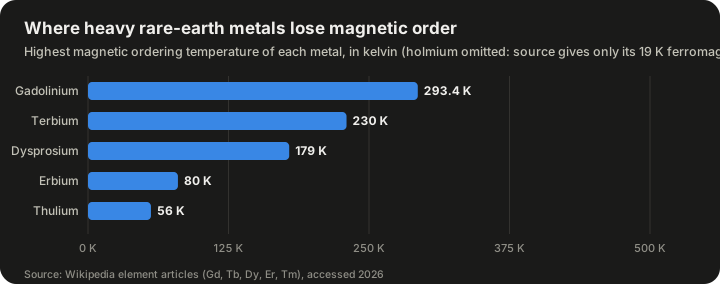
| Metal | Highest ordering temperature (K) | Behaviour above it |
|---|---|---|
| Gadolinium | 293.4 | Paramagnetic (ferromagnetic–paramagnetic transition) |
| Terbium | 230 | Paramagnetic |
| Dysprosium | 179 | Paramagnetic |
| Erbium | 80 | Paramagnetic |
| Thulium | 56 | Paramagnetic |
Source: Wikipedia articles on gadolinium, terbium, dysprosium, erbium and thulium. Holmium is left out because its article gives only its ferromagnetic point (below 19 K), not its upper transition.
Gadolinium's transition sits close to room temperature, around 20 °C, which is one reason it has been studied for magnetic refrigeration. The others order only well below room temperature.
Four of these metals show two distinct transitions: a higher one where some form of antiferromagnetic or helical order appears, and a lower one where the metal becomes ferromagnetic.
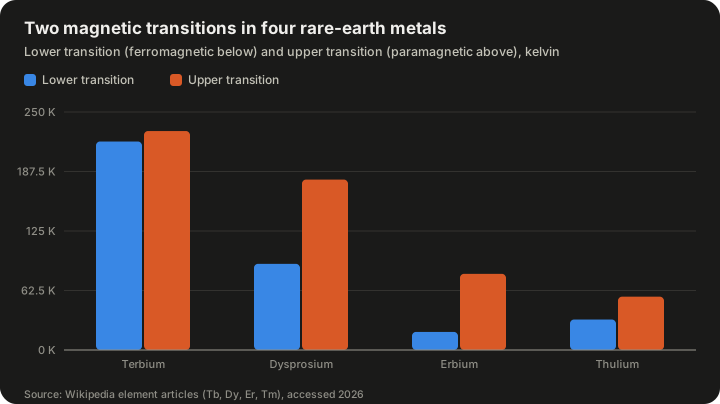
| Metal | Ferromagnetic below (K) | Intermediate ordered phase | Paramagnetic above (K) |
|---|---|---|---|
| Terbium | 219 | Helical antiferromagnet, 219–230 K | 230 |
| Dysprosium | 90.5 | Helical antiferromagnet, 90.5–179 K | 179 |
| Erbium | 19 | Antiferromagnetic, 19–80 K | 80 |
| Thulium | 32 | Antiferromagnetic, 32–56 K | 56 |
Source: Wikipedia element articles. In terbium's helical phase, for example, the moments within each atomic layer point the same way, but each layer is turned by a fixed angle relative to the layer below, producing a spiral.
Worked example: cooling a rare-earth crystal
The tables can be read as a sequence of events. Suppose, as a hypothetical exercise, that a single crystal of each metal is cooled slowly from room temperature, about 293 K, toward absolute zero.
- Gadolinium is already at its transition at room temperature. Its ordering point of 293.4 K corresponds to about 20.3 °C (293.4 minus 273.15), so on a cool day a lump of gadolinium is ferromagnetic and on a warm day it is not.
- Terbium stays paramagnetic until 230 K, enters its helical phase, and becomes ferromagnetic at 219 K. The helical window is only 230 − 219 = 11 K wide.
- Dysprosium becomes helical at 179 K and stays in that phase until 90.5 K, a window of 179 − 90.5 = 88.5 K. That broad window makes dysprosium a convenient material for studying how a spiral structure changes with temperature.
- Erbium orders at 80 K and becomes ferromagnetic only at 19 K, a window of 61 K.
- Thulium orders at 56 K and changes phase again at 32 K, a window of 24 K.
The differences in these windows, and the different kinds of order inside them, are exactly what a theory of rare-earth magnetism has to explain. The relevant ingredients are the strength and range of the indirect exchange, which depends on each metal's Fermi surface, and the crystal-field forces on the 4f electrons, which differ from element to element. Neutron diffraction tells the experimenter which structure exists at each temperature; inelastic neutron scattering tells them how the moments move. Mackintosh's career combined both.
Holmium, the Wikipedia article notes, has the highest magnetic moment of any naturally occurring element, at 10.6 Bohr magnetons. These are the kinds of materials whose structures and excitations Mackintosh spent his career explaining.
Risø and the neutron revolution
The 1966 sabbatical
In 1966 Mackintosh spent a sabbatical at the Risø laboratory in Denmark (the Lex entry also records an earlier visit in 1963). Risø had been officially inaugurated on 6 June 1958 as Denmark's atomic research establishment, and between 1957 and 1960 three research reactors, DR-1, DR-2 and DR-3, came into operation there. A research reactor is not a power plant; its main product for physicists is a steady, intense beam of neutrons.
At Risø, Mackintosh worked out how to use a newly built neutron spectrometer to quantify magnetic moments and their dynamics at the atomic scale. His measurements of spin waves in rare-earth metals were a significant advance in the study of magnetism. For this work he and Hans Bjerrum Møller shared the Spedding Prize in 1986.
Why neutrons see magnetism
Neutrons are ideal probes of magnetism for three reasons:
- They have no electric charge, so they pass deep into a solid sample rather than being stopped at the surface like electrons.
- They carry a magnetic moment, so they scatter from the magnetic moments of atoms as well as from atomic nuclei. That makes magnetic order directly visible.
- Their wavelengths and energies match those of atoms in solids. Neutrons from a reactor, after slowing down, have wavelengths comparable to the spacing between atoms and energies comparable to the energies of atomic vibrations and magnetic excitations. A single scattering experiment can therefore measure both where the moments are and how they move.
The technique that exploits the third point is inelastic neutron scattering, in which researchers measure how much energy and momentum a neutron gains or loses when it scatters. The key instrument, the triple-axis spectrometer, is associated with Bertram Brockhouse, who shared the 1994 Nobel Prize in Physics with Clifford Shull "for pioneering contributions to the development of neutron scattering techniques for studies of condensed matter."
What spin waves are
In a magnetically ordered material at absolute zero, all moments would sit in their lowest-energy arrangement. At any finite temperature, the moments wobble. Because each moment is coupled to its neighbours, a wobble does not stay put; it travels through the crystal as a wave, much as a disturbance moves along a line of linked pendulums. These travelling disturbances are spin waves, and their quantum units are called magnons.
The energy of a spin wave depends on its wavelength in a way that is set by the strength and range of the coupling between moments. Plotting energy against wavevector gives a "dispersion relation," and from its shape a physicist can work backwards to the forces between the magnetic atoms. In the rare earths, those forces are carried by the conduction electrons, so spin-wave measurements also test theories of the electronic structure.
That is the significance of Mackintosh's Risø work. By measuring rare-earth spin waves with neutrons, he and his collaborators could test, in detail, the theory of indirect exchange through the conduction electrons.
| Concept | Plain-English meaning | Why it mattered to Mackintosh |
|---|---|---|
| 4f electrons | Inner-shell electrons that carry the rare-earth magnetic moment | Give large, localised moments |
| Indirect exchange | Moments coupled through the sea of conduction electrons | Links magnetism to the Fermi surface he studied at Cambridge |
| Magnetic structure | The spatial pattern of moments, such as a helix | Neutron diffraction reveals it |
| Spin wave | A travelling wobble of coupled moments | Its dispersion reveals the coupling forces |
| Crystal field | Electric field of neighbouring ions acting on 4f electrons | Shapes the anisotropy and excitations |
| Inelastic neutron scattering | Measuring energy lost or gained by scattered neutrons | Main experimental tool for spin waves |
From experiment to theory and back
A recurring theme in accounts of Mackintosh's work is that he moved freely between measurement and theory. The Lex entry credits him both with experimental contributions using neutron scattering and with helping to develop methods for calculating the electronic structure of solids. In rare-earth physics this combination is unusually important, because the interesting effects arise from the interplay of two very different kinds of electrons:
- the localised 4f electrons, which behave almost like those in an isolated atom and can be described with atomic physics and crystal-field theory; and
- the itinerant conduction electrons, which belong to the whole crystal and must be described with band theory and the Fermi surface.
An experiment that measures a spin-wave dispersion or a magnetic structure provides numbers. Turning those numbers into understanding requires a model in which both kinds of electrons appear. The structure of Rare Earth Magnetism, which places chapters on linear response theory and neutron scattering alongside chapters on structures and excitations, reflects that approach: it teaches the reader how measured quantities are connected to the underlying interactions.
How a spin-wave experiment works, step by step
The basic sequence of an inelastic neutron scattering measurement on a magnet is the same today as in the 1960s, even though the instruments are far more sophisticated.
- Make a neutron beam. Neutrons released in the reactor core are slowed by a moderator and led out through a beam tube.
- Choose an energy. A large single crystal, the monochromator, reflects only neutrons of one wavelength toward the sample, in the same way a diffraction grating picks out one colour of light.
- Scatter from the sample. The neutrons hit a single crystal of the material, often held at low temperature so that it is magnetically ordered. Some neutrons create or absorb a spin wave and change energy as they do.
- Analyse the scattered energy. A second crystal, the analyser, passes only neutrons of a chosen final energy to the detector.
- Repeat across angles and energies. By rotating the sample, the analyser and the detector, the experimenter maps out at which combinations of momentum and energy transfer the scattering is strong. Each strong peak marks a spin wave with that momentum and energy.
The three rotating axes, at the monochromator, the sample and the analyser, give the triple-axis spectrometer its name. The resulting map of energy against momentum is the spin-wave dispersion relation, from which the coupling between the magnetic atoms can be deduced. A measurement like this can take days of beam time for a single crystal, which is why access to a national reactor such as Risø's was so valuable for a research group.
Copenhagen and the directorship of Risø
In 1970 Mackintosh became Professor of Experimental Solid State Physics at the University of Copenhagen, a post he held until his death. The Lex entry notes that his Danish professorship began at the Technical University of Denmark (DTU) before he moved to Copenhagen.
From 1971 to 1976 he was also Director of Risø National Laboratory, known in its early years as the Danish Atomic Energy Research Establishment. That was a period of major change for Risø. The Danish Atomic Energy Commission had been established in December 1955 under the chairmanship of Niels Bohr, and the question of whether Denmark should build nuclear power stations was, by the mid-1970s, the subject of intense public debate.
The Danish nuclear power debate
Mackintosh was a major voice in Danish science policy and a prolific contributor to the public debate on nuclear power. The debate itself is well documented:
| Year | Event |
|---|---|
| 1955 | Danish Atomic Energy Commission established, chaired by Niels Bohr (December) |
| 1957–1960 | Research reactors DR-1, DR-2 and DR-3 open at Risø |
| 1958 | Risø officially inaugurated (6 June) |
| 1971–1976 | Mackintosh is Director of Risø |
| 1974 | Anti-nuclear group OOA founded in Copenhagen (January) |
| 1976 | Government halts the rollout of a nuclear power programme |
| 1978 | OOA march draws about 50,000 people; polls show 32% in favour and 53% against nuclear power (August) |
| 1979 | OOA delivers an open letter with over 300,000 signatures to the Prime Minister |
| 1985 | Folketing votes to remove nuclear power from energy planning (March) |
| 2003–2008 | Decommissioning of Risø's research reactors; DR-1 completed 2006, DR-2 completed 2008 |
Source: Wikipedia, Nuclear power in Denmark.
Mackintosh's directorship thus spanned the years when the question of Danish nuclear power was being fought out in public. The sources used for this article record that he contributed extensively to that debate, but do not provide a detailed account of the positions he took, so this article does not attribute specific views to him.
Building Danish solid-state physics
Mackintosh is remembered for his role in building up solid-state physics in Denmark and for promoting international collaboration. Denmark already had a world-famous tradition in physics through Niels Bohr and the Niels Bohr Institute, but that tradition was strongest in atomic and nuclear physics. The postwar decades saw condensed-matter physics, the physics of solids and liquids, grow into the largest branch of physics worldwide, and the combination of neutron beams at Risø and university groups in Copenhagen gave Denmark a strong position in neutron studies of magnetism.
Many of Mackintosh's former students went on to hold leading positions in academia and industry. He was also known for a careful, lucid writing style, a quality that is evident in the book that is his best-known legacy.
Rare Earth Magnetism (1991)
Rare Earth Magnetism: Structures and Excitations, written with Jens Jensen of the H.C. Ørsted Institute at the University of Copenhagen, was published by Clarendon Press, Oxford, in 1991 (ISBN 978-0-19-852027-6). It is widely described as a landmark and became a classic text in solid-state physics.
The book's coverage includes:
| Part of the book | What it covers |
|---|---|
| Elements of rare-earth magnetism | The 4f electrons, crystal fields and the indirect exchange interaction |
| Magnetic structures | Helical, modulated and ferromagnetic arrangements and how they arise |
| Linear response theory | The mathematical framework connecting measurements to underlying interactions |
| Neutron scattering | How scattering experiments measure magnetic structure and dynamics |
| Spin waves | Excitations of ordered magnets and their dispersion |
| Crystal-field excitations | Excitations of the 4f electrons in the electric field of neighbouring ions |
Jensen later made a corrected PDF edition available from his university web page, with corrections introduced in October 2011, August 2023 and November 2024, which has helped keep the book in use long after the print edition became hard to find.
The European Physical Society
The European Physical Society (EPS) was formally established in 1968 and legally incorporated in Geneva on 26 September of that year. It brings together national physical societies; its membership today includes the societies of 42 countries and about 3,200 individual members.
Mackintosh served as President of the Danish Physical Society from 1976 to 1979, and then as President of the EPS from 1980 to 1982. He was the society's sixth president.
| Term | EPS President | Country |
|---|---|---|
| 1968–1970 | Gilberto Bernardini | Italy |
| 1970–1972 | Erik Gustav Rydberg | Sweden |
| 1972–1976 | H.B.G. Casimir | Netherlands |
| 1976–1978 | I. Ursu | Romania |
| 1978–1980 | Antonino Zichichi | Italy |
| 1980–1982 | A.R. Mackintosh | Denmark |
| 1982–1984 | Jacques Friedel | France |
| 1984–1986 | G.H. Stafford | United Kingdom |
Source: Wikipedia, European Physical Society.
His term fell during the later Cold War. The list of early presidents, which includes a Romanian physicist (I. Ursu) immediately before Zichichi and Mackintosh, reflects the society's role as one of the few scientific organisations bridging both halves of a divided Europe. Mackintosh's reputation for promoting international collaboration fits that setting.
What a learned-society president does
The presidency of a federation such as the EPS is not a research post. The society's work includes organising conferences, publishing journals and newsletters, representing physicists in discussions with governments and international organisations, and building links between national societies that have different traditions, languages and resources. For a society founded in 1968 that drew members from both Western and Eastern Europe, the job also had a diplomatic side.
Mackintosh's earlier roles prepared him for this. As director of a national laboratory he had dealt with ministries, budgets and public controversy; as president of the Danish Physical Society he had represented a national community of physicists. His later directorship of NORDITA continued the same thread of cross-border scientific cooperation, this time on a Nordic scale.
NORDITA
From 1986 to 1989 Mackintosh was Director of NORDITA, the Nordic Institute for Theoretical Physics. NORDITA was established in 1957 by Niels Bohr and the Swedish physicist Torsten Gustafson, originally under the name Nordisk Institut for Teoretisk Atomfysik, and was housed at the Niels Bohr Institute in Copenhagen. It moved to the AlbaNova University Centre in Stockholm on 1 January 2007.
NORDITA's mission is to support theoretical physics across the Nordic countries and to connect Nordic physicists with the international community, through visiting researchers, conferences and multi-week scientific programmes. It is notable that an experimental physicist was appointed to lead an institute of theoretical physics; Mackintosh's work had always bridged the two, using theory of electronic structure and magnetic interactions to interpret neutron experiments.
"Dr. Atanasoff's Computer" (1988)
Outside his own field, Mackintosh's most widely read piece of writing was an article in Scientific American in 1988 titled "Dr. Atanasoff's Computer" (pages 90–96). It argued that John Vincent Atanasoff deserved wider recognition as the inventor of the first electronic digital computer.
The machine
Atanasoff was a mathematics and physics professor at Iowa State College, the same institution where Mackintosh had worked in the 1960s. With his graduate student Clifford Berry he designed and built what became known as the Atanasoff–Berry Computer, or ABC.
| Feature | Detail |
|---|---|
| Conceived | 1937, during a night drive in the winter of 1937–38 |
| Prototype | An 11-tube prototype demonstrated in October 1939 |
| Built | 1939–1942, in the basement of the physics building at Iowa State College |
| Tubes | Over 300 vacuum tubes, including 280 dual-triode tubes and 31 thyratrons |
| Memory | Regenerative capacitor memory on two drums of 1,600 capacitors each, providing 3,000 bits |
| Number format | 50-bit fixed-point binary |
| Speed | About 30 additions or subtractions per second |
| Purpose | Solving systems of up to 29 linear equations |
| Limitations | Not programmable; no stored-program architecture |
| Fate | Dismantled in 1948, except for one memory drum |
Source: Wikipedia, Atanasoff–Berry computer.
The patent case
The ABC's place in history was decided partly in court. In 1941 John Mauchly, who later co-designed the ENIAC, visited Atanasoff for a week and examined the machine's ideas in detail. Eckert and Mauchly filed the ENIAC patent on 26 June 1947, and it was issued on 4 February 1964. On 19 October 1973 Judge Earl R. Larson of the US District Court for the District of Minnesota ruled in Honeywell v. Sperry Rand that the ENIAC patent was invalid and that its subject matter was derived from Atanasoff's work.
Despite that ruling, Atanasoff's role remained little known to the public, and many popular histories continued to name the ENIAC as the first electronic computer. Mackintosh's article brought the case to a large international audience and was widely cited. The question of what counts as "the first computer" depends on definitions, since the ABC was electronic and digital but not programmable, and historians still debate how to weigh those features. Mackintosh's contribution was to make sure Atanasoff's name was part of that discussion.
Honours
| Year | Honour |
|---|---|
| 1980 | Honorary doctorate of philosophy, Uppsala University |
| 1986 | Spedding Prize, shared with Hans Bjerrum Møller, for spin-wave measurements in rare-earth metals |
| 1991 | Elected Fellow of the Royal Society (FRS) |
| Not dated in sources | Knight of the Order of the Dannebrog |
| Not dated in sources | Fellow of the Royal Danish Academy of Sciences and Letters, the Danish Academy of Technical Sciences, the Royal Norwegian Scientific Academy and the American Physical Society |
The Royal Society published a biographical memoir of him by B. Bleaney in 1997, in volume 43 of its Biographical Memoirs of Fellows of the Royal Society.
Death and memorial
Mackintosh died on 20 December 1995 in Roskilde, Denmark, after a car accident, a month before his 60th birthday. He had conceived a symposium on magnetism in metals, held in Copenhagen in 1996, and its proceedings were published as a memorial volume in 1997 by the Royal Danish Academy of Sciences and Letters under the title Magnetism in Metals.
Career at a glance
| Years | Role | Place |
|---|---|---|
| 1957 | BA | Peterhouse, Cambridge |
| 1960 | PhD (Fermi surfaces of metals, under Brian Pippard) | Cavendish Laboratory, Cambridge |
| 1960–c.1967 | Associate Professor of Physics; Ames Laboratory | Iowa State University, USA |
| 1963, 1966 | Visiting researcher / sabbatical | Risø, Denmark |
| 1970–1995 | Professor of Experimental Solid State Physics | University of Copenhagen |
| 1971–1976 | Director | Risø National Laboratory |
| 1976–1979 | President | Danish Physical Society |
| 1980–1982 | President | European Physical Society |
| 1986–1989 | Director | NORDITA, Copenhagen |
Why his work still matters
Rare-earth magnetism is no longer a niche topic. Rare-earth elements are central to the strongest permanent magnets used in electric motors, wind-turbine generators and electronics. Understanding why rare-earth moments are so large, how crystal fields lock them into particular directions, and how they interact through conduction electrons is part of the scientific foundation for those materials. Mackintosh and Jensen's book is still read as an explanation of those fundamentals.
Neutron scattering, too, has grown far beyond the reactor halls of the 1960s. Large facilities across Europe and elsewhere now provide neutron beams to thousands of researchers studying magnetism, superconductivity, batteries, polymers and biological molecules. The methods Mackintosh helped to pioneer for measuring spin waves remain a core part of that toolkit.
Finally, his career illustrates something about how science works in a small country. Denmark could not compete with the largest nations by sheer size, but by combining a national reactor laboratory, strong universities, Nordic cooperation through NORDITA and active participation in European bodies such as the EPS, it built an influential position in a major field. Mackintosh was involved in all four of those institutions.
There is also a lesson in his writing. Physicists who knew his work describe a careful, lucid style, and that quality is not a minor virtue in science. A clearly written monograph can train several generations of researchers who never meet its authors, and a well-argued magazine article, such as his piece on Atanasoff, can change how a wide public remembers history. Mackintosh used both forms, the specialist book and the popular article, and both are still being read and cited decades after his death.
Mackintosh in the wider history of magnetism
Magnetism is one of the oldest topics in physics and also one of the most persistently difficult. A real explanation of why atomic moments line up had to wait for quantum mechanics in the twentieth century, because the alignment arises from the quantum behaviour of electrons. The mid-century decades brought two developments that set the stage for Mackintosh's career.
The first was the availability of neutron beams from research reactors. Neutron diffraction showed that the arrangement of magnetic moments in a crystal could be seen directly, and Bertram Brockhouse's triple-axis spectrometer made it possible to measure how those moments move. The 1994 Nobel Prize to Brockhouse and Clifford Shull recognised both. National laboratories such as Risø, with their own reactors, became the places where this kind of experiment could be done.
The second was the production of pure rare-earth metals. Because the lanthanides are so similar chemically, separating them was a major challenge, and laboratories such as the one at Ames built expertise in doing so. Only with pure crystals could physicists separate the intrinsic behaviour of each element from the effects of impurities.
Mackintosh's career sits at the junction of those two developments. He went to Ames, where the materials were, and then to Risø, where the neutrons were, and he brought with him from Cambridge the understanding of metals and Fermi surfaces needed to interpret what he found. The rare earths turned out to be a near-ideal testing ground for the theory of magnetism in metals: their moments are large and well defined, their interactions are indirect and long-ranged, and their magnetic structures are varied. That combination is why a single family of elements could support an entire monograph, and why the subject has its own dedicated prize.
| Development | Period | Relevance to Mackintosh |
|---|---|---|
| Fermi-surface physics at Cambridge | 1950s | His PhD topic under Pippard |
| Rare-earth research at Ames | 1960s | His research base from 1960 |
| Research reactors at Risø | Opened 1957–1960 | Neutron beams for his spin-wave work |
| Neutron scattering methods | Recognised by the 1994 Nobel Prize | The method for measuring spin waves |
| Synthesis in Rare Earth Magnetism | 1991 | His and Jensen's summary of the field |
Common misconceptions
"He was Danish-born." He was born in Nottingham, England, and educated at Cambridge. He became a Danish physicist through his marriage, his career and decades of work in Copenhagen.
"Risø was a nuclear power station." Risø hosted research reactors that produced neutrons for experiments, and Denmark's parliament decided in 1985 to remove nuclear power from its energy planning. Risø's reactors were later decommissioned.
"Spin waves are a theoretical idea." They are measured directly, with inelastic neutron scattering being the main method. Measuring them in rare-earth metals was Mackintosh's prize-winning work.
"He discovered the Atanasoff–Berry Computer." The ABC's role had already been the subject of the 1973 court ruling. Mackintosh's 1988 article argued for wider public recognition of Atanasoff; it did not uncover the machine.
Frequently asked questions
What was Allan Mackintosh known for?
Research on magnetism in rare-earth metals using neutron scattering, especially spin-wave measurements; the 1991 book Rare Earth Magnetism with Jens Jensen; and leadership roles at Risø, the University of Copenhagen, the Danish and European physical societies and NORDITA.
When was he President of the European Physical Society?
From 1980 to 1982, between Antonino Zichichi and Jacques Friedel.
What is the Spedding Prize?
A prize for rare-earth research, now formally the Frank H. Spedding Award, named after the Iowa State rare-earth pioneer Frank Spedding. Mackintosh shared it in 1986 with Hans Bjerrum Møller for their measurements of spin waves in rare-earth metals.
What did his Scientific American article argue?
That John Vincent Atanasoff, working at Iowa State College with Clifford Berry between 1939 and 1942, should be widely recognised as the inventor of the first electronic digital computer.
Is his book still available?
The 1991 Clarendon Press edition is listed by booksellers as hard to obtain, but co-author Jens Jensen has made a corrected PDF version available from his University of Copenhagen web page.
Why are neutrons better than X-rays for magnetism?
X-rays scatter mainly from electric charge, so they are excellent for locating atoms but interact only weakly with magnetic moments. Neutrons carry a magnetic moment and no charge, so they scatter strongly from magnetic order, penetrate deep into samples, and have energies that match magnetic excitations.
What is a helical magnet?
A magnet in which the moments within each atomic layer are parallel, but each successive layer is rotated by a fixed angle, so the moment direction traces out a spiral along one crystal axis. Terbium and dysprosium have helical phases between their two transition temperatures.
Who was his co-author?
Jens Jensen, a physicist at the H.C. Ørsted Institute of the University of Copenhagen, which is now part of the Niels Bohr Institute.
How did he die?
In a car accident near Roskilde, Denmark, on 20 December 1995, aged 59.
Sources
- Allan Mackintosh – Wikipedia
- Allan Mackintosh – Lex (Danish national encyclopedia), by Henrik Smith
- Europhysics News obituary (1996)
- European Physical Society – Wikipedia
- Nordic Institute for Theoretical Physics – Wikipedia
- Nuclear power in Denmark – Wikipedia
- Atanasoff–Berry computer – Wikipedia
- Brian Pippard – Wikipedia
- Bertram Brockhouse – Wikipedia
- Rare Earth Magnetism (Jensen and Mackintosh) – Oxford Academic
- Rare Earth Magnetism, author's PDF edition – University of Copenhagen
- Paul Canfield to receive the 2025 Frank H. Spedding Award – Ames Laboratory
- Frank Spedding – Wikipedia
- Gadolinium – Wikipedia
- Terbium – Wikipedia
- Dysprosium – Wikipedia
- Holmium – Wikipedia
- Erbium – Wikipedia
- Thulium – Wikipedia