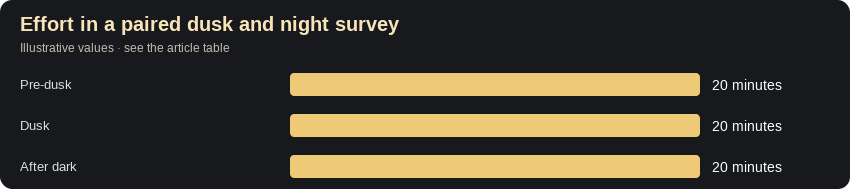
| Category | Value (minutes) |
|---|---|
| Pre-dusk | 20 |
| Dusk | 20 |
| After dark | 20 |
Worked observation budget with equal observation periods; not moth activity measurements.
At the edge of a public desert trail, you can watch a pale moth vanish into a creamy white flower and still leave with two perfectly honest stories. In one, a moth landed on a yucca during a dusk watch. In the other, a female deliberately placed pollen in a flower and the plant and insect benefited from an association that spans generations. The first story can be supported by a single clear view. The second takes evidence from behavior, identification, and reproduction that one evening rarely supplies. Both are interesting; confusing them takes much of the interest away. The precision of the smaller story is what makes it useful to someone trying to build the larger one.
Mojave yucca and banana yucca make a good comparison because they let us follow that distinction without having to invent competing explanations from scratch. The Forest Service's profiles for Mojave yucca and banana yucca both describe relationships with yucca moths, but the route from one flower visit to that conclusion differs from the route by which an evening visitor identifies the plant or insect. The profiles are species reviews, not live records of your slope. Their claims, their underlying studies, and your observations belong in different columns. This guide explains how to keep those columns separate, how to use the accompanying chart, and how to enjoy a watch without changing the event you hoped to witness.
Three verbs for the same flower
Visit is the first verb. Define it before looking: for instance, a landing with contact on the flower, or entry within the opening. Choose whether landing on a stalk next to a flower counts. In this guide it does not. A moth that circles the stalk repeatedly without touching a flower qualifies as an approach, which is worth noting but does not belong in the visit count. If an insect moves across two open flowers in one uninterrupted flight and you watched it touch both, you may have recorded two flower visits and one encounter. Neither total is necessarily the number of individual moths on the plant. Report the unit, not just the number.
Deposit is the second verb. A visitor can bring pollen to a plant without leaving any on a receptive surface. It can touch the outside of the flower, briefly rest in a folded petal, or spend its entire visible time away from the stigma. Conversely, a visitor can place pollen where it counts but do so inside a flower in an angle you cannot see. The fact that an observer failed to see placement does not establish that none occurred. An honest category is contact consistent with pollination, but placement unverified. When the tiny movements are unclear, describe the visible movement without the inferred pollen. A few deliberately chosen words are better evidence than a confident label attached to a shadow.
Produce is the third verb. Did the flower subsequently form a fruit? Did seeds develop, and were some viable? Did any viable seeds ultimately establish? Those are distinct outcomes on different clocks. An intact young fruit is not a guarantee of mature seed or a seedling. Even if you can follow the same flower to a mature fruit, you may not know which visit mattered, whether multiple pollen donors were involved, or how the plant's later conditions influenced its development. Each question needs a matching unit of evidence. Fruit visible from a path is one outcome; the origin and fate of seeds are something else.
Now consider the sentence, “The moth pollinated the yucca.” It could mean you saw the behavior of placing pollen, you have a sample showing pollen on a receptive surface, or a study established that a particular species is an effective pollinator for this host. All are sensible uses in the right context, but they are not interchangeable. An observer with a photograph and a field notebook should not silently borrow the confidence of the third whenever the evidence is the first or second. If the exact action is not visible, citing the study explains why it would be worth looking for, not why it must have happened in that frame.
What is exchanged, and why cost matters
In the classic system, a female pollinating yucca moth gathers pollen and carries it to flowers; she actively applies it rather than simply leaving grains behind as she brushes by. Her eggs are laid in floral tissues associated with the ovary in familiar examples, and larvae of pollinating species feed on some of the developing seeds. The plant gets a route to sexual reproduction, while developing offspring of the moth get food. Those statements summarize the association, not a guarantee about every flower. Exact sequence and placement should be taken from direct observations for the partner pair in question, not imposed on all species from an introductory drawing. A comparative paper on the lineage links active pollination and its specialized structures while distinguishing those features from traits already present in relatives. Pellmyr and Thompson, comparative study
“Mutualism” means outcomes benefit both sides in the relationship as judged against a relevant alternative. It does not mean that each visit is helpful, that larvae do no damage, or that the partners always have the same interests. A plant can lose seeds to developing larvae and still gain through access to viable pollen. A pollinating moth can leave offspring in one flower that aborts while benefiting from successfully developing offspring in others. Carefully define the baseline before using words like benefit or loss. Against a flower with no effective pollination, a fruit with some surviving seeds can be a large gain. Against the same amount of effective pollen without seed consumption, consuming seeds can be a cost. Both comparisons can be true.
This is why proportion eaten and absolute viable seed count answer different questions. Consider two entirely imaginary ripe fruits. One had room to develop a hundred seeds and retained sixty viable ones; the second had room for forty but retained thirty. The first produced more viable seeds even though its fraction was lower. Those numbers do not tell us what caused the remaining loss. Some ovules might never have been fertilized, others could have failed during development, and some could have been eaten. Writing “the rest were eaten by moths” would be an assumption unless the analysis measured the relevant damage. Numbers can improve a description without resolving attribution.
In an early empirical study, researchers reported that flower retention decreased with more moth eggs and increased with more pollinations in the system they studied. Their results help explain how an interaction can persist despite conflicting costs and benefits. They do not imply that any dropped fruit in your own yucca garden diagnoses heavy egg loads. Flower loss documented from a distance contains none of those comparative measurements by itself. If a popular account attributes every dropped flower to retaliation or calls the relationship altruism, it is using the research as a metaphor rather than reporting what it measured. Pellmyr and Huth, evolutionary stability study
Mojave yucca: the names in old records are not interchangeable
The Forest Service profile for Mojave yucca, scientific name Yucca schidigera, outlines seed reproduction and vegetative growth, and discusses research on the insect partners. Its account includes an older use of the name Tegeticula yuccasella and summarizes later work dividing that broad concept into distinct moths. It names Tegeticula mojavella as the pollinator associated with Mojave yucca in the cited work. That is a useful lead for reading the literature. It does not license assigning the species to a small moth in an undersized video frame solely because a nearby yucca might be Mojave yucca. Older sources can be right about the interaction they studied even when their insect naming needs translation. USDA Forest Service Mojave yucca profile
The same review mentions a non-pollinating moth in this general association whose life history uses developing yucca fruits. It is a reminder that the label “yucca moth” can identify a neighborhood of relatives, not one ecological job. Even if you get the moth family right, that step does not sort all likely behaviors. The insect at the flower that provides pollination and another insect later using the fruit might both belong in the account. Do not assign ownership of all traces to the first moth spotted. A story about how one plant supports several organisms is often more accurate than a ranking in which every visitor is either the hero or an intruder.
Another basic problem is donor identity. Seeing pollen arrive at another flower does not by itself demonstrate transfer among genetically distinct plants. It might have come from a flower on the same stalk, another stalk with shared roots, a different plant, or a series of mixed donors. Movement across visible space has a place in the notes: moth left the target flower in the direction of the next stalk. The stronger inference about cross-pollination is not available simply because two heads looked far apart. The Mojave review distinguishes uncertainty about cross-pollination and additional pollination pathways from the account of the moth relationship. Those uncertainties are worth preserving when you write for a new site.
Plants can also appear to be thriving at a particular location without each individual being the descendant of a recent successful seed crop. Vegetative spread is another mechanism for survival and persistence. In a longstanding patch, the sight of several rosettes near each other does not tell you when any of them germinated. A watch conducted on a flowering stalk starts in the middle of a much longer story and has no special authority about what happened to establish the patch. The same is true of a solitary plant without fruit: it is an individual snapshot, not a census of a region's reproductive health.
Banana yucca: nocturnal pollination is not a clock
The Forest Service describes the pollination of banana yucca, Yucca baccata, by nocturnal yucca moths and distinguishes sexual reproduction from vegetative reproduction. Its seed production discussion treats pollen transfer as necessary to explain viable seed, but also considers resources and damage. The archived Forest Service species review presents the same topic under regeneration processes. Read these accounts at their natural scale: a species review brings together research from specified sites and circumstances. It does not provide a universal schedule, a guaranteed observation window, or a public instruction to handle flowers and fruits.
At a given site, the timing question begins before the moth arrives. Is the plant flowering at all this year? Are many flowers open near the watch date, or just one in an otherwise closed or finished head? Has a slope that normally blooms earlier had an unusual season? The profile describes variation in flowering time, including later flowering at higher elevations in cited observations. This does not mean that elevation mechanically gives you a certain offset in days. A mountain edge and a foothill garden may each be useful sites on their own terms, but conclusions about plant or moth activity need the timing, terrain, and context identified in the account.
Banana yucca is not a second sample of Mojave yucca with a different common name. The Forest Service's Mojave review discusses moth findings where the two host plants overlap, including a small departure from a simple one-plant one-moth story and records associated with likely hybrids. The sample is evidence that partner specificity matters, not evidence that every encounter can be assigned from host alone. It is also not evidence that every visually unusual yucca is a hybrid. On an evening walk in an overlap area, you can write “yucca, species uncertain” with a photograph of the whole plant and revisit the identification in daylight. Let the plant identification and moth identification each earn their own confidence ratings.
What the natural-history account gives you is a good reason to pay attention after the last tourist photograph, not a promise that a visitor will arrive at a certain minute. Even the term nocturnal can hide several kinds of timing when people use it casually: movement around sunset, behavior between late twilight and dawn, or night observations differing from those made in full sun. State the actual span you watched. A calendar date plus a phrase like “after dinner” is hard to compare across locations or across weeks when the sun moves noticeably.
Read the chart as a schedule, not a result
The accompanying bar chart shows an invented effort budget. Pre-dusk gets twenty minutes. Dusk gets twenty minutes. After dark gets twenty minutes. Total planned observation time is sixty minutes. Identical bar heights are intentional: you are comparing the accounting entries for a design, not visualizing visits per minute, moth abundance, pollen transfer, fruit retention, or dates. The chart has no field observations behind it and no reason to recommend that exact allocation for some other study. “Paired” here means observations arranged together for comparison on a common evening, not experimental pairing of individual insects.
For one hypothetical calendar entry, suppose sunset is 7:40 p.m. local time. Set your pre-dusk block from 7:10 to 7:30 and your dusk block from 7:30 to 7:50, spanning sunset. Arrange a third block from 8:20 to 8:40 only if it is actually dark by your definition at your location and access remains safe and permitted. The unobserved interval between 7:50 and 8:20 is not part of the sixty minutes. If you want comparable after-dark bins across different latitudes or seasons, define them with a stated twilight convention or an explicit measure of visibility instead of assuming 8:20 works everywhere. A separate practical choice is to use a later safe, organized session, then indicate that it is on a different date.
Now make up observations for those three blocks: one certain floral visit before dusk, four certain visits during dusk, and one certain visit after dark. Those are invented counts to illustrate the ledger, not figures shown by the chart. In the final block the observer lost sight of the target flowers for eight minutes because a person needed safe passage and the observer moved aside. The realized table is therefore twenty, twenty, and twelve minutes of comparable watch, not twenty for each. The scheduled chart is still correct as a plan. It is incorrect as a report of what happened. Label the planned and realized columns before averaging anything.
What if the twelve usable minutes were so dim that you could only score entries, no details at the stigma? The answer is not to turn the after-dark observation from one known visit into zero pollinations or to normalize all three blocks as if the scoring standard were identical. At best you can compare a behavior that your observers could reliably score in every included block. You can also publish the observation as a contextual note and decline to calculate a cross-bin ratio. Dividing by minutes solves a denominator mismatch only where the event definition, view, and interpretation are comparable. A precise decimal computed from the wrong set of observations makes the report look less uncertain than it is.
Choose a stable vantage and a defensible unit
Pick a legally accessible plant that can be watched from a safe pullout, public path, or approved viewing point. Confirm access and closing time before leaving daylight. Reject a plant that requires leaning into spiny growth, moving flowers, or standing in a passage where people need to get through. A good watch does not require the tallest stalk or the greatest number of open blossoms. It requires a view that can be described without reference to extraordinary luck. If access rules or darkness make a later block impractical, skip it and label it unsampled. Use a partner where appropriate and value a route out over completing a table.
Define a target as a small recognizable subset of visible open flowers, perhaps those nearest a natural bend in the stalk. Use a photograph or sketch from the same viewpoint for later reference rather than attaching a tag, spreading leaves, moving the supporting stalk, or setting a light on it. The full inflorescence may have many blossoms you cannot see. If you follow only four of them, your count is for that subset, not for the plant. An insect that passes behind the stalk and emerges beside a different flower is an unconfirmed transition unless you saw it through the whole movement; you need not infer the path to maintain a useful record.
At the start and end of each block, record the number of target flowers still open and visible. If two of six flowers become hidden because you had to change vantage, note the transition rather than quietly changing your target. A block of twenty minutes with five flowers continuously visible exposes one hundred flower-minutes to view, on paper. A twenty-minute block with three visible flowers exposes sixty on the same idealized calculation. These are differences in monitoring opportunity, not necessarily equal differences in available floral resources for moths. An observer's line of sight is not the boundary between ecological use and nonuse.
Record whether you attempted to watch the entire target set, watched one flower at a time, or alternated between plants. Dividing the count for five continuously visible flowers by the count from another watch in which five flowers were each watched in rotation treats very different search coverage as the same thing. Dwell time is useful as well, provided start and end can be observed. If a moth is already present when a block opens, label the event as ongoing at the start; do not give it a fabricated arrival timestamp. If you lose it after ten seconds, the stay was at least ten seconds, not necessarily exactly ten.
Keep a field ledger that another person can reconstruct
Use one row for each watch and link it to separate rows for events. A watch can record the plant identification and confidence, site alias, local date and time zone, interval definition, observer, position, open flower subset, planned and realized minutes, interruptions, available light, and weather notes. Event rows can record elapsed time from watch start, the flower or subset involved, contact status, best defensible visitor label, visible behavior, associated photo or video, and notes. Keep the original if you correct it later. Write the correction as a separate version so someone can see why a count changed.
Imagine a watch called Trail Edge, evening three. At minute two an unidentified insect flies past the flowers but never lands. At minute five a small moth lands inside bloom A; no useful view of the mouthparts. At minute eight an insect resembling that moth appears on flower B after you looked away. Count two observed flower visits if both contacts are clear, mark the first as beginning during observation and the second as already present if that is what you saw, and preserve a possible link rather than declaring them the same or different individual. The minute-two flyby is a separate entry. The fact that its photo looks better than either contact is irrelevant to the count.
If at minute fourteen you see a series of motions against the central flower parts, write what could actually be made out. A note such as “head repeatedly pressed inward; grains not resolved; donor not observed” is a better record than a vague label of “pollinated.” If a later reviewer with a clearer video identifies specific movement supporting active insertion, add the interpretive note with the reviewer's confidence. Keep the words “consistent with” when the diagnostic detail is missing. The file records one event. A second person reviewing the same file supplies another interpretation of it, not another independent event.
Use at least three different status values, not merely a count column with a space in it. Zero during a completed watch means no event meeting your recording definition was detected. Unobservable means the target could not be viewed clearly enough to apply the definition. Unsampled means nobody watched that period. The distinction is needed for both summaries and illustrations. A stacked report can include a bar indicating full or partial usable minutes without silently putting zeros on a species chart. Do not delete difficult rows to make the page look tidy: they explain what your samples can and cannot support.
Account for dusk changing what the observer can see
The view through a camera at dusk may look brighter than your eye sees it. That does not mean it resolves the same behavior a daylight image would have shown. Slow exposures smear movement; gain can reveal the flower outline while dissolving fine structures into flecks; automatic focus may search, then settle on the nearest petal. A useful still of a whole plant and a useful record of a tiny moving moth require different settings and expectations. Use only non-disruptive options. Review files after the watch rather than repeatedly checking a glowing screen immediately beside the flowers.
Changing the light can also change the observation itself. An intense beam, repeated flash, lamp beside a flower, or improvised lure makes arrivals under that light a different observation from unassisted arrivals. This guide is about quiet public observation, not setting bait or manipulating the pollinator. Work with ambient light where the site allows it and the evidence is adequate. Keep any light needed for safe walking directed down and away from the plant. If you cannot safely remain in position and record, leave. Protecting the record is never a reason to sacrifice trail safety or site rules.
A repeat watch in brighter conditions has its own limits. Suppose your daylight files allow classification of almost every visitor to a broad group, while your night files distinguish mostly angular silhouettes. Comparing a table of named taxa then makes daylight look more diverse partly because the night observations are harder to resolve. Publish detections at a common taxonomic resolution where possible, and put finer identifications in separate columns. Retain the unresolved observations, including whether they were scored as a certain flower entry or a possible flyby. The uncertainty has content; it flags where another method or a better positioned watch would add knowledge.
Weather and human activity influence both what you detect and how the insects behave. A wind gust can move blossoms out of view, reduce stable footage, and alter flight behavior at the same time. A cluster of people can obstruct the view briefly without visibly changing the flowers. Note these changes in the watch record as events separate from the moth entries. A raw difference between time bins cannot automatically distinguish the moth's schedule from conditions, visible flower changes, or the observer's fatigue. Pairing blocks within a night helps hold some factors steady but never controls everything.
A better follow-up than opening the fruit
If the plant can be revisited from a public path, take a reference view in daylight so you can match the same stalk and flowers later. Focus on recognizable branching and the order of blossoms. Store the precise reference privately if publishing it could draw people into a protected area or reveal sensitive records. A follow-up of the same plant can say that a marked-in-the-image location changed from a flower into a swelling fruit, or that the flower was no longer present. It cannot follow an individual seed unless the study has evidence designed for that purpose.
The reason a fruit vanished can have several explanations even if the first and last photograph are excellent. It might have aborted and fallen, been eaten, been removed along with a damaged stalk, or simply become obscured by the change of viewing angle. Record the observation as last seen and then not visible. When the stalk is broken, document that separately, rather than writing “failed to set fruit.” The latter looks like a conclusion about reproduction; the former is evidence about a physical record interruption. You can list candidate explanations for missing fruit without pretending to know which applies.
You may find a pod lying open some distance away. Resist linking it to the tracked flower just because it looks similar. In wild settings leave flowers, fruit, seeds, larvae, and leaf material in place; do not sample, dissect, or attach markers for this project. Keep the public guide clear that fruit integrity and seed viability are diagnostic measurements only in research with suitable approval and a justified method, not prerequisites for casual documentation. It is enough to make the smaller claim with honest evidence. A sharp sequence of an undisturbed flower and later apparent fruit is already useful when it includes uncertainty and a photo date.
Research can distinguish these outcomes through designed comparisons. Conceptually, a controlled study might separate access by different visitors, verify the compatible pollen arriving at a receptive surface, follow retention, and assess viable seeds. To identify the moth's benefit, its offspring outcomes also need attention. These are separate comparisons because removal of one species, exposure at a different time, and physical handling can each introduce new effects. A brief field watch does not have to pretend to be such a study. Its strength is to locate an interesting question and support a clear description of what happened without disrupting a population to obtain a complete story.
Compare nights, plants, and places without collapsing them
If you want to go beyond one evening, repeat a comfortable routine on different accessible dates before declaring some part of the night the important one. Decide whether comparisons are meant to describe this plant, plants on this path, or a region. One target repeated several times is valuable for the first question. Several plants on the same path expand local coverage. Neither is an automatic sample of distinct environments and host species across a desert. Avoid combining them into one headline without describing the actual design. More watch blocks make some comparisons better while leaving broader inference unchanged.
Treat independent units honestly. Six separate twenty-minute blocks on one evening are not equivalent to six evenings; consecutive blocks can share almost everything that made the first block unusual. Likewise, several flowers on one stalk share neighborhood conditions and pollinator access. A small uncertainty interval computed as if every flower visit were an independent site is not better evidence because the calculation is polished. Report a plain per-watch table before pooling results. A helpful figure can show separate rows for evenings or plants instead of one overall column, especially when the goal is to learn how observations vary.
Make negative evidence readable. If you watched two weeks of evenings, saw several ordinary flower visitors, but never saw diagnostic pollen placement, the result depends on optical resolution and how many useful minutes you had when the flower was open. It does not invalidate a well-supported mutualism, nor does it confirm that the expected moth was present. It may lead to an excellent field question: which vantage or time would let you distinguish contact from placement, and what is the least disruptive way to improve the record? Sometimes the right upgrade is a closer public viewpoint of a different flower rather than stronger light or more visits to a plant you cannot see.
Keep a comparison of Mojave and banana yucca on similar units, if the aim is to discuss variation between the hosts. The proportion of minutes with a detected moth is not the same outcome as the fraction of monitored flowers contacted. A shift in proportion might be interesting, but one species watched at a lowland garden and another watched on a mountain edge introduces habitat, season, plants, and many other differences. Use a well-documented local comparison as a local comparison. The goal is not to strip every observation of context, but to make the context itself a visible part of the result.
What to read in a natural-history claim
Ask what authors actually measured, then read the geographic and taxonomic labels on the finding. For example, work on pollen dispersal in Yucca filamentosa provides a useful comparison because it explicitly studies donor patterns in that different host, showing why the action at the stigma alone doesn't resolve how pollen moved between plants. It is not a donor test for a photograph of Mojave yucca. A common editorial mistake is to take a demonstrated process from one system, a species portrait from a second, and an image from a third, and imply all three are observations of the same location. Name the mismatch rather than blending them. Pellmyr and colleagues, pollen dispersal study
One useful exercise is to underline every “only,” “always,” or “never” in a draft story. Decide what observation or study supports the word. A source may support a specific claim about a defined lineage or a documented partner at a study site; it will not necessarily support a general claim about all flowers with similar shapes or about insects in a different region. A common mistake is to extend the concept of obligate pollination to a guarantee about fruit set or to call a familiar flower visitor the exclusive pollinator of any similar plant. You can explain the strength of specialization without treating an identification shortcut as a conclusion.
Another editorial exercise is to look for the strongest conclusion that survives the weakest record. Consider a spectacular image of a pale visitor inside a flower. Is the plant identification defensible from this one flower, or does the photo need context? Are there enough insect traits visible to identify it, or is the label simply “moth”? Is the behavior even visible, or do you know only that a body was there? Material facts left unknown are not weaknesses when the caption is clear about its aim. A good caption could report plant identity independently and leave visitor identity unresolved. It need not claim to show an exchange it has not pictured.
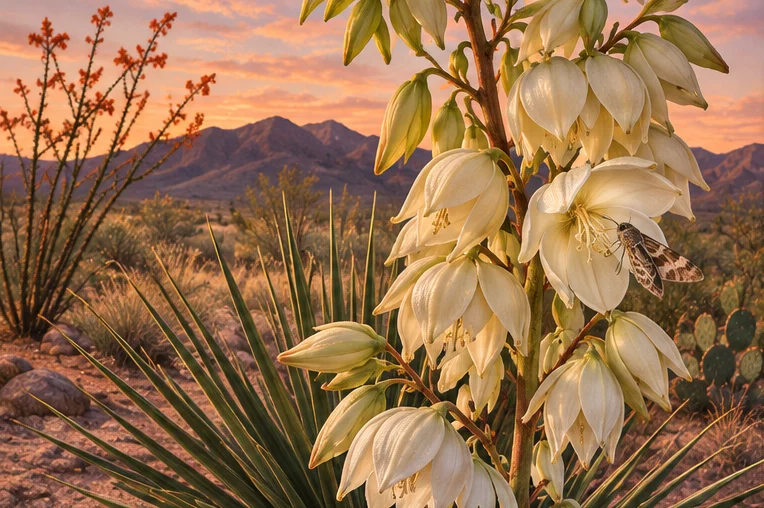
Modern pictures add a second risk. The illustration at the top of this article is generated to suggest a desert dusk and a visiting moth. It is not a taxonomic plate, a record of an event, or an image taken at a study site. Keep it paired with explicit labeling and separate from any numbered evidence figures. Treat the graph separately too: its inputs are planned minutes, not observations. The art and graph make an idea accessible, but neither supplies the biological evidence. Good editorial design makes the separation obvious even to a reader who opens only the image or uses the chart's companion table.
A realistic closing field report
Here is what the public summary of a careful evening might look like, using invented facts for the example. “I watched four visible flowers on a yucca from a public path on one evening. Two twenty-minute watches around sunset were completed, and the later watch provided twelve clear minutes. I recorded six visits across the three watches under a flower-contact definition. The visitors were not identified beyond broad groups and I could not verify pollen deposition. A later photograph showed one apparent fruit on that stalk, not necessarily from a flower I saw visited. The observations establish local flower use, not which insects produced the fruit.” This is a readable story with a traceable boundary at every important claim.
For a more useful second visit, choose one gap that would improve the report. If flower identity is uncertain, take a good full-plant view in daylight before doing another dusk watch. If you consistently lose sight of the lower flowers, change the marked viewing subset and call the switch a new protocol. If many potential moth visits occur in the time you cannot safely observe, conclude that your public design does not cover that period. The right next step is not always to fill a gap. Some gaps are limits of the site or method, and a useful report makes them easy to spot.
The deepest appeal of the yucca story is not that it lets us use the word mutualism after seeing anything with wings. It is that a tiny visible act and a durable ecological relationship can both be real while requiring different kinds of proof. In sufficient light from a public path, count what comes to the flowers and make a note of what it does. In the reading afterward, follow the research that shows where pollen goes, what the plant produces, and what the moth's offspring receive. The two kinds of knowledge reinforce each other when they remain distinct. Curiosity survives the removal of the guess, and the flowers are still there for the next person to see.
References
- USDA Forest Service, Fire Effects Information System: Mojave yucca.
- USDA Forest Service, Fire Effects Information System: Banana yucca, with legacy full-text institutional copy.
- Pellmyr and Thompson, Multiple occurrences of mutualism in the yucca moth lineage.
- Pellmyr and Huth, Evolutionary stability of mutualism between yuccas and yucca moths.
- Pellmyr and colleagues, Pollen dispersal in Yucca filamentosa.