
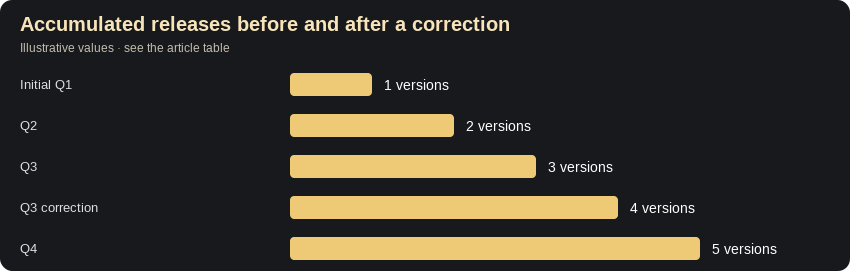
| Category | Value (versions) |
|---|---|
| Initial Q1 | 1 |
| Q2 | 2 |
| Q3 | 3 |
| Q3 correction | 4 |
| Q4 | 5 |
Illustrative calculation (not sourced observations). Each fictional release adds exactly one immutable edition; the correction is an edition, not an overwritten original.
A reader opens a report about flowering along a fictional creek. The report cites the Q3 edition of the observation register. On the day the report appeared, that edition held 240 rows. Now the download has 236, even though the page still says Q3 and the filename has not changed. Four rows might have been duplicates; they might have been withdrawn; the reader might be downloading a different artifact. The reader has no reliable basis for distinguishing those possibilities. In trying to keep the data useful, the publisher has made a claim about the past impossible to check.
A correction should be discoverable without pretending it was always in place. That requires two routes: a route to current guidance for someone beginning work today, and a route to the exact edition for someone reading or repeating a past analysis. At times the earlier files cannot remain public. Then the second route leads to a record of the edition and its availability, not to a silent substitution of a new dataset. An identifier tells the reader which object was meant; it does not promise that preservation or access can be maintained under every circumstance.
This article builds a small, fictional edition history and follows it through publication, correction, withdrawal and reuse. The central example is a versioned creek observation register, not a real publication or prescribing a repository policy. The identifiers are human shorthand written for this illustration, not registered digital object identifiers. The point is to design an edition model that remains legible when two readers want different answers from the same catalog.
Decide what is stable before choosing an identifier
Begin by distinguishing three objects. The dataset family is the continuing intellectual project: the creek observations maintained with a stated purpose, scope and steward. Its landing page can show the latest usable edition, the previous editions and maintenance notices. An edition is the released dataset as defined at a particular editorial checkpoint. A distribution is one way of obtaining an edition, such as a particular CSV file or a compressed package. One family can have many editions, and a given edition can have multiple distributions. The kind of object matters as much as the spelling of its identifier.
On the family page, call the register “Creek Flowering Observations,” with a stable key like Creek. Give released editions distinct keys such as Creek-Q1, Creek-Q2, Creek-Q3, Creek-Q3-R1 and Creek-Q4. The edition identifiers should remain valid descriptions even if URLs, the catalog interface or storage providers change. A downloadable artifact can carry that edition key plus a format name and artifact version where appropriate. The family key should not be stretched to mean whatever rows happened to be downloaded by the last person who clicked it.
In the example, each quarterly edition is a cumulative snapshot of a growing register, rather than an isolated file containing just one quarter. A corrected Q3 snapshot still has Q3 coverage; a Q4 snapshot expands coverage. Both are releases, but their data changes have different purposes. A separate project might publish an independent monthly dataset for each month. In that project a new monthly dataset is not automatically a revision of the old one. Describe both the logical nature of a release and the reason it exists before modeling chronological adjacency as a new version.
The W3C Data Catalog Vocabulary, version 3 distinguishes datasets and distributions and provides terms for versioning and dataset series. Its series concept can help organize separately released datasets that share characteristics. It is not necessary to collapse series membership and version membership into one field. A repository can have a series of annual datasets, with each annual dataset having editions due to corrections. A mutable family view can also provide a catalog entry and navigation without being a distribution itself. Decide which of these shapes represents the scholarly relationship instead of choosing it by how a web folder happens to be arranged.
There is also a boundary between an edition and associated presentation. Fixing a broken image on a landing page need not change observation data. Updating the public availability notice on an old edition is part of maintaining the catalog, not rewriting the old edition. Decide which descriptive metadata formed part of the released package and which are maintained outside it. A frozen README inside a release and a revised caution label outside it can coexist. The first tells the reader what shipped; the second tells the reader what the steward knows now.
Read the figure as an edition ledger
The chart shows five categories: Initial Q1, Q2, Q3, Q3 correction and Q4. The values are 1, 2, 3, 4 and 5 accumulated editions. The first release starts the ledger at one. Q2 adds a second edition, and Q3 adds a third. The correction to Q3 adds a fourth edition while the original Q3 remains an identified object. Q4 adds a fifth. No data from an external repository or an actual versioning system were used to make the chart. The linked vocabulary is a reference for describing releases, not the origin of the figure's numbers.
These are categorical bars in release order. There is no duration on the horizontal axis and nothing implying that the intervals between releases were equal. A correction might take two hours or several weeks; its bar still moves the accumulated count up by one. The vertical axis counts versions, not rows, CSV downloads, release frequency or editions that are still publicly available. If the old Q3 bytes later become restricted, the example still records that five previously released editions exist as historical identities. The number of public downloads and the number of edition records can differ.
Imagine that the publisher silently overwrites Q3 and then releases Q4. A download picker might display four labels, and a report might show Q3 as a single stop in the sequence. The problem is not just that the correction is missing from a count. There were two publicly distributed artifacts with different claim-relevant contents, and the system did not leave a way to distinguish them. A recipient who saved the first bytes and a recipient who downloaded the overwrite might both label their figures Q3. Giving the correction its own edition, together with a scoped notice, allows both statements to be checked.
The arithmetic does not mean every change requires a separately ranked edition. If a navigation label is corrected without changing released data, the label event can happen without a new bar. Re-encoding an identical tabular result for a second supported format may add a distribution instead. If the claimed equivalence is uncertain, review it instead of applying the familiar label. The edition ledger only counts events that the fictional publisher formally defines and records as newly released dataset states.
Model four different connections rather than a single status field
First, store membership: an edition is a version of its family. DCAT includes terms such as dcat:isVersionOf and dcat:hasVersion to describe the two directions of that relationship. The entries for Creek-Q1 and Creek-Q3-R1 both belong to Creek even if their contents or approval status differ. That relationship does not change when the newest version arrives. A family entry with no previous editions published yet can still have its own persistent role; it is useful for discovery and explaining the scope of the project.
Second, store editorial succession. Within a straightforward chain, a new edition can identify its immediate previous edition with dcat:previousVersion. The past entry can separately surface the correction notice and a link forward, labeled with an unambiguous relation. For the fictional history, Creek-Q3-R1 can describe Creek-Q3 as the earlier release it corrects. The previous edition date tells a reader when it was released, not whether the earlier content is available or whether the next edition superseded every intended use. In branching collections, avoid forcing independent products into this single chain solely because a generated timestamp placed one after another.
Third, record a current pointer. The family landing page can identify one chosen ready snapshot for new users, with a visible version label and issuance date. DCAT's dcat:hasCurrentVersion describes a link from a non-versioned or abstract resource to its current version. A newest-by-time sorting routine can populate a menu; it should not necessarily pick the recommended version. A newer edition could be pending validation, restricted, withdrawn or only current in a separately maintained branch. Define what current means for the particular family and make deliberate promotion explicit.
Fourth, distinguish descriptive status from access. An earlier Q3 can be superseded but still downloadable for replication, while a different edition may have its data file withdrawn. Recommended availability, chronological succession and validity for a specific analytical use are distinct. The statuses do not need to become a universal metadata vocabulary; the repository can publish a small controlled list and define its semantics. A date-stamped status event is a better record than a boolean called active whose meaning changes between editorial review and the download screen.
A compact schema can have separate fields for a family key, edition key, edition label, issuance date, observation coverage, parent or predecessor, status event identifiers and approved distribution manifest. Maintain one current-pointer record per family or branch with its own approval history. For a public release these fields can be rendered in human-readable prose and machine-readable metadata. In the preview example, the version label in the page title, the obvious notice, and the metadata can be derived from the same registry to avoid contradictory signals. A second spreadsheet with manually copied status labels should not be the hidden authority.
Use a change log to tell readers what changed and why it matters
Consider two facts a new Q3 correction page might show. The observation coverage is unchanged, and four rows with duplicate source-record identities were excluded by a documented review rule. Original Q3 contained 240 records; Q3-R1 contains 236. If the actual episode involved sensitive details, a public note would not need to reveal the duplicate source identifiers. The publisher can preserve internal review evidence separately. The public log should make the size and kind of change understandable and say whether prior users should review affected outputs. A useful note tells a reader what to check instead of saying only that the data were refreshed.
Different changes call for different descriptions. A unit error may leave the number of rows unchanged while changing values that feed a graph. A wrong date range may leave every row intact but make a comparison misleading if readers believed the dataset covered a different interval. A deduplication decision may change counts in predictable subgroups, yet leave other uses unaffected. A new column may affect consumers that depend on fixed schemas even if old values remain correct. Choose a summary that allows a past user to judge which analyses may need review, and give the narrowest warranted scope to your claims.
The change log should carry a resolution as well as a diagnosis. A date and editor role, explanation of the corrective process, intended replacement and a description of policy for reusing the original are more useful than a bare warning banner. Where reliable facts are still being checked, a provisional note can identify the uncertainty rather than speculate about its cause. If an estimate later changes, append the review decision or replace the caution while preserving the status-event history. Keep public copy readable without making it disclose material that has to remain restricted.
One form of release does not substitute for a communication policy. A famous dataset can accumulate uses the publisher cannot enumerate. Some users might rely only on the API or a downloaded file, and a third-party mirror may not refresh immediately. Make the correction evident on the family record, the old edition's landing page, current API responses that list metadata, and any supplied release index. A file already in someone's notebook cannot be recalled by changing a web page, which makes a portable version identifier in the file or accompanying manifest particularly useful.
A correction can fork the citation trail
After Q3-R1 appears, two branches of use remain. The original report either still says what it originally said or has its own correction process. Its cited Q3 remains the source of the original calculation. If the researchers recalculate and issue a revised report, their revised analysis cites Q3-R1 and links back to the earlier report or correction notice. Readers entering at either publication can tell which evidence was used. Retargeting the original Q3 citation to Q3-R1 would not correct the report's numbers; it would quietly create a mismatch.
Suppose the original report counted 60 qualifying encounters from the 240 rows under a plain local rule, and the duplication review found that three of the four withdrawn rows qualified. A recalculation on 236 rows would count 57 qualifying encounters if nothing else changed. These are fictional counts, not the chart's contents. An older abstract reporting 60 is not reproduced by downloading the current edition and obtaining 57. That discrepancy can be valuable evidence of the correction's scope, but only if the reader knows the original source edition and the exact inventory at each stage.
The release chain can be linear while the citation graph branches. A data consumer using Q2 and one using Q3 need not update on the same day, and a training example may continue to reproduce only Q3. If both teams update, their new reports can point to the appropriate current edition as of their own analysis. Do not model those downstream dependencies by replacing every Q3 link with one destination. Preserve the exact reference and add a warning, a replacement link, and documentation of any corrected analysis. That gives downstream work a traceable decision instead of an invisible rerouting.
A citation may redirect when a repository migrates to a new domain. The important question is whether the redirect preserves identity, not whether a redirect occurs. Moving an exact edition identifier to a new page about that same edition is compatible with citation stability. Moving it to a generic/latest view without assuring the reader which edition was meant is not. A separate mutable latest route can use a reversible routing choice and a visible edition identifier, but it should not be the citation stored for a static result. If the service offers a latest download for convenience, the file and response should still let the user identify the version obtained.
DataCite's versioning guidance distinguishes links among specific previous and new versions from links between a group and its versions. DataCite recommends a new DOI for major content changes; it leaves the major/minor determination to stewards and does not require a new DOI for every minor change. Thus an immutable edition policy cannot rely on assuming that every DOI at every repository identifies byte-identical content forever. If the local edition identifier does finer work than a DOI, cite both where meaningful and make the mapping visible. A checksum is helpful for exact-byte identification but by itself is not an editorial status or a persistent resolver.
Keep formats replaceable without confusing equivalence and identity
Imagine Q3-R1 can be downloaded as UTF-8 CSV, Parquet or a package including the CSV and a data dictionary. The distributions serve different consumers and can be released together without counting as three new editions. But they are not identical files. Distinguish the edition key from each distribution key, media type, byte digest and creation time. A file can advertise the same logical dataset without sharing a checksum with another serialization. The choice of artifact may still matter if the analysis is sensitive to typing or missing-value representation.
If you claim equivalence between representations, specify the comparison rule. It might require identical keys and field values after known normalization, identical null distinctions, and matching membership of excluded rows. CSV might use a written policy for missing values while Parquet carries typed nulls; a consumer may not parse them alike. Row order might be irrelevant for a key-defined table but essential for a particular fixed-layout export. An edition plan that tests only row count will miss these differences. A representation issue can warrant an artifact correction and notice even when the logical dataset is unchanged.
Test the distribution described by the manifest rather than a file discovered by its familiar name. Record its expected byte size and digest, and check the content after a real download. If a historical representation had a defect and cannot safely remain discoverable as an ordinary option, mark that artifact superseded or withdrawn and preserve its identifier's documented status. Whether a corrected representation also triggers a new dataset edition depends on what errors it exposed about the claimed source data. If the old artifact interpreted missing readings as zero, for example, the intended equivalence failed; show exactly which bytes did that and which representation corrects it.
A link to a read-only API can describe the availability of a dataset while serving changing results over time. If the API exposes an exact edition parameter that remains supported, make the response and help pages show how to select it. A public query endpoint that always returns current values is not equivalent to an archived release, even if it can produce the same columns. Similarly, a compacted or re-encoded file can still carry an edition identifier while needing its own artifact identifier. These distinctions allow efficient format maintenance without severing methods records or claiming that representation details never affect reproducibility.
Use provenance to answer questions that the version chain cannot
The W3C PROV Data Model distinguishes entities, activities and agents and describes relations including usage, generation, derivation and revision. In the fictional case, Creek-Q3 and Creek-Q3-R1 are entities. A documented duplicate-review and export process is an activity. Its inputs might include the original edition and an approved decision ledger. Its output is the corrected edition or its release manifest. The responsible editorial organization or role can be recorded as an agent, with responsibility described at the right level. These distinctions are practical questions, not a mandate to choose a particular database.
A predecessor link by itself does not prove that one edition was computed from the prior edition. The Q4 files might be rebuilt from authoritative originals and the validated correction decisions rather than loading Q3-R1 as an input. A maintenance history may call Q3-R1 the predecessor for continuity, while provenance records the actual inputs of the Q4 activity. Conversely, an experimental derivative can be generated from Q3 without becoming part of Creek's authoritative version chain. Keep the two kinds of edges separately named so that a reader can know whether an assertion is about ancestry of the data or sequence of publication.
A provenance entry needs enough detail to answer likely audit questions. Which approved ledger expressed the exclusion rule? What edition contained the duplicate records? Which role accepted the check? Was conversion run from released files or a restricted source store? Public metadata may name only a suitably generalized activity and omit sensitive access details. An internal review can retain more precise inputs where permitted. The absence of a public field is not an excuse for inventing provenance; note when an exact step is unknown.
Do not assume that describing an audit activity makes the result reproducible. Reproducibility also requires preserved inputs and sufficient instructions in the intended environment. Provenance helps a reader know what went into a release and who was responsible for decisions. It does not supply missing bytes or convert a notice into an executable reconstruction. For a prior edition that is restricted, a link to an abstract provenance record may be all a typical reader can use. State that limit directly and maintain the additional historical material only under the appropriate stewardship policy.
Document a withdrawal without amplifying what must be removed
One of the hardest cases is an edition that was once downloadable but cannot safely stay public. Imagine reviewers learn that the old Q3 distribution included observation-location details outside the approved sharing scope. Whether the organization must disable downloads, retain internal evidence or notify downstream users depends on its circumstances and policy. The editorial pattern is to identify the affected edition, distinguish the withdrawn files from unaffected records, and give a clear status page. Do not publish raw rows, coordinates, detailed diffs or retrieval hints in the name of explaining the withdrawal.
DataCite's tombstone guidance describes an identifying landing page for a removed DOI-described item. A page can preserve citation information, an unavailability notice and as much safe context as the publisher can provide, with links to suitable alternates if allowed. The newer file should be presented as another edition or replacement, not transferred into the old identity. The practical message for a reader is straightforward: this is the object you asked for; its public file is unavailable; here is what is documented about its replacement. This is different from a generic broken link or a technical error page.
An implementation must think beyond the most obvious download button. A removed archive may also have been served through object storage, a different encoding, an export endpoint or a public cache. Review authorized delivery surfaces and known maintained mirrors as part of the response. This is maintenance of the publisher's own access policy, not a guarantee that third-party copies vanish. Explain uncertainty about outside archives where appropriate and do not imply control that the publisher lacks. Internal preservation and public accessibility are separate decisions subject to the organization's authorized processes.
An ordinary correction without an access restriction is different. If old data can safely be consulted, preserving downloads with a visible warning makes exact replication easier. If only one distribution was affected, the remaining conforming distributions can still be usable subject to a clear status. The policy may prefer a superseded flag or a warning for new use rather than treating all prior versions as withdrawn. Avoid design choices that normalize erasing work, but do not make openness a reason to disclose protected material. The durable commitment is clear identity and honest status, not automatic public retention of every byte.
Time-based web archives are useful but do not replace releases
RFC 7089 describes Memento, an HTTP framework for accessing prior resource states. Its terms distinguish the Original Resource from a Memento reflecting a past state, a TimeGate for date-time negotiation, and a TimeMap listing Mementos known to a server. A supported archive can use these relationships to help a reader find a past representation of a changing page. Time negotiation can be useful when someone has a family URL and a date, or needs to determine what a version page looked like before a notice was posted.
The date a representation was archived is not necessarily the date the dataset edition was released. A historical capture of the family landing page could say that Q3-R1 was current on one date, but its linked files might not have been captured then. A system may offer the closest suitable available capture rather than an exact video of every page at every moment. Coverage depends on what was captured and retained. TimeMap discovery does not prove that all published editions, bitstreams or notices are present. A release registry should hold its own issuance dates, metadata and distribution manifest.
A citation can cite an exact historical landing page capture for a claim about the appearance of the page. That is a different reference from citing the dataset edition used to compute a graph. An archive may provide corroborating evidence of the edition identifier or status but cannot magically restore a missing CSV or the data dictionary that never made it into a capture. Time-based discovery works well as a second route for questions about web history; it should not be relied on as the only preservation plan for scholarly objects or as proof that data withdrawn from public access remain lawfully or appropriately available.
Promote the current edition only after testing both reader routes
Prepare the correction as a separate release and validate its files before altering which edition is recommended. Check that labeled coverage and versions match across formats, expected row and field checks pass, and logs distinguish changes to documented content from changes to presentation. Put the replacement page and release manifest where they can be reviewed without publishing unfinished conclusions. Coordinate status banners, family listing and promotion so a reader is not told to get a file that is still unavailable.
Then test the stable citation as an outsider would. Start from the old report's link, confirm that the edition name still identifies Q3, confirm the status and replacement notice, and if public access remains permitted, verify the old file against its own manifest. Next start from the family page and confirm that following its highlighted current path lands at the chosen edition, not at an accidental newest-by-date fallback. Once Q4 is promoted, Q3-R1 remains a distinct correction edition even if it is no longer the preferred download. Check navigation in both directions to counter the common bias of validating only the page the editor has just touched.
Some acceptance checks can be automated. Expect edition keys to be unique and nonreusable, ensure the current pointer targets a release eligible under policy, and detect a dangling predecessor. In a straightforward chain, test that the directed predecessor links do not form a cycle. Verify that each link joining family and edition agrees with its inverse where the system exposes both. Expect render tests to see a visible edition title, dated status and release links. A database that merely contains the right rows is not enough if current pages or resolver destinations omit them.
Other checks benefit from human review. Can a reader tell why an archive flag appears and what to do next? Does a notice imply that a revised result exists before any revised report has been approved? Would the correction note expose the same protected material removed from the file? Does a provenance trail confuse editing activity with external endorsement? A checklist that pairs human interpretation with data validation can detect failures that numeric row counts will miss.
The succession plan should survive someone changing jobs. Write down who can approve a status change, maintain resolver targets, and restore files or archive metadata following an outage. Keep a portable export of the registry and test recovery of a past edition as well as a current one. A promise of persistent identifiers is realistic only to the extent that stewardship is organized to maintain them. The current pointer can move; the owner of continuity must remain identifiable, even if the team or host is replaced.
When newer does not mean replacement for every use
Suppose the Q4 release uses a new field protocol that does not collect exactly the same information as Q3. The new distribution remains a real edition of the project, but a reviewer who needs to understand an older comparison may have good reasons to use Q3-R1. The family view can recommend Q4 for newly collected records while noting which questions still require the prior methodology. If two independently maintained branches remain eligible for their intended readers, show their scopes plainly instead of advertising two indistinguishable current buttons. The version graph can make chronology and lineage clear without declaring that every new dataset is functionally interchangeable with each old dataset.
For example, Creek-Q4 could move from recording a first-observed date to recording an interval when a visit pair bounds the transition. An observation in the revised record is not merely a less precise spelling of the earlier field. The older date reflects how staff interpreted incomplete coverage at the time; the newer interval is explicitly dependent on which visits were completed. A user computing an onset-day average as a teaching exercise needs a documented conversion or the prior edition, not an export that coerces both fields to a single date. The edition's notice can identify the changed fields, link the former data dictionary, and warn older consumers about a false equivalence without labeling all of their uses invalid.
This is also where the data steward should ask whether a divergent product deserves its own family. A spatially generalized public register and a detailed, restricted counterpart can serve different users and present different admissible views. It may be better to describe one as a derivative of another rather than as an ordinary distribution if rows, coordinate precision or summary values differ in ways that matter to scientific conclusions. Both can point to their actual provenance where disclosure is appropriate. Such a decision should depend on what the repository promises about each resource, not how convenient it would be to reuse an existing key.
A small compatibility record makes the practical consequence explicit. List the core use cases, which editions support them, what assumptions a user needs to check, and whether a bridge table or transformation was officially released. Avoid a global “backward compatible” label when it only refers to column names. Someone can load the fields successfully and still compare the wrong coverage or meaning. If the effect on earlier methods is not yet assessed, mark it unknown and separate that uncertainty from the verification that the file loads. Availability, validity and fit for purpose are different judgments.
Finally, preserve the possibility that an error notice is resolved without changing data. A reader may report four suspect rows that look duplicated because the same plant was watched twice, even though the source record keys show two intentional sampling events. A documented investigation might resolve the concern, remove a provisional warning from the current view and append a status event. No new edition count is appropriate if nothing about the released data changed. That is not a failed correction workflow. It is a useful outcome that distinguishes an allegation, an investigation and a release, so readers can follow the decision even when the correct action is to leave the data alone.
Pick the citation that answers the reader's actual question
If a paragraph describes the ongoing creek monitoring project, cite the family and explain which kind of ongoing resource was consulted. If a graph uses a fixed release, cite the edition and, when useful, its distribution or digest. If discussing why some Q3-derived conclusions may differ, cite both original and corrected editions with change context. If a withdrawn old edition is central to a historical discussion, cite the identifying status record and say that public bytes were not available. These decisions let the references support the claim instead of simply pointing at the publisher's home page.
For a correction notice, test the language by asking the two reader questions out loud: “What should I use now?” and “What did this earlier report use?” The family route should give the first answer. The edition and provenance routes give the second, including safe constraints around access. The fictional chart counts the quiet act that makes those routes coexist: each release, including a correction, gets its own distinct place in the edition ledger. That separation makes it possible to improve today's data without rearranging yesterday's evidence.
References and chart scope
- W3C, Data Catalog Vocabulary (DCAT) Version 3: datasets, distributions, versions, current snapshots and dataset series.
- W3C, PROV Data Model: entities, activities, agents, derivation and revision.
- RFC 7089, Memento: Original Resources, TimeGates, TimeMaps and Mementos.
- DataCite, Versioning and Best Practices for Tombstone Pages: DOI metadata and identification during withdrawal.
- Figure: categorical release sequence with counts of one through five cumulative editions. All editions, dates implied by quarter labels, and worked data counts are fictional, not figures from the cited sources.