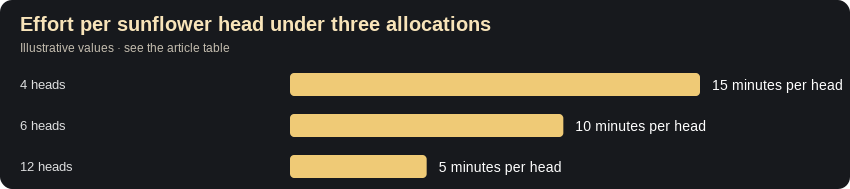
| Category | Value (minutes per head) |
|---|---|
| 4 heads | 15 |
| 6 heads | 10 |
| 12 heads | 5 |
Worked allocation of a fixed 60-minute budget; not a prescribed schedule.
From the sidewalk, a sunflower looks like one enormous landing pad. From a bee's perspective, it is a patchwork of small feeding opportunities, interrupted by gaps and surrounded by places to land or rest. From the observer's perspective, it is both of those things and also a choice about what to count. A bee can arrive once, move among several florets, disappear behind a petal, and leave. Which of those moments enters the tally? What changes if you can see every move on a low plant but only the top edge of a taller one?
The best neighborhood observation is not necessarily the most detailed one. It is the one whose question, unit, and viewing conditions fit together. You can use a whole-head count to compare arrivals, track visible contacts to describe behavior, or record opening zones to describe what the plants offered. You cannot trade one of those measurements for another after the watch. This guide builds a simple, non-destructive observation that can do more than one job, while keeping the answers separate.
What the sunflower head is showing you
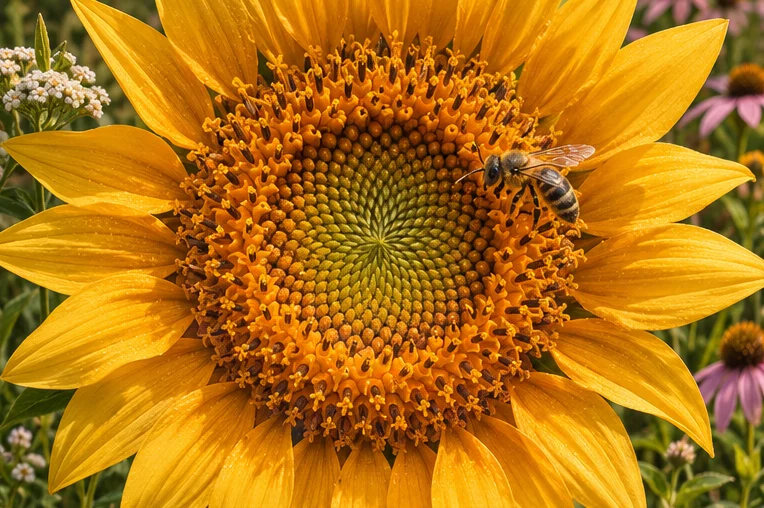
The conspicuous object on the stem is a head, or capitulum. On a typical single-flowered common sunflower, the broad outer structures that look like petals are parts of ray florets; the middle consists of many small disk florets. A visitor can land on either part. An arrival on the head and a contact with a disk floret are different observations. A landing on a ray may be the start of a feeding trip across the disk, or it may be the entire stop.
The spiral pattern you can see across a disk is not a reliable map of which florets opened together. In common sunflower, opening occurs in ring-like developmental cohorts that proceed from the outside toward the center. The rings are sometimes called pseudowhorls. A primary study by Marshall and colleagues examined how the plants synchronize those stages. Think of the spiral as a pattern of placement and the active rings as a pattern of timing. One cannot stand in for the other. The same physical sector can include florets in different stages, from the rim all the way to the center.
As an individual disk floret develops, it can pass through a pollen-presenting stage and then a stage with receptive female structures. This is a progression in the same floret, not a permanent division of the disk into male and female flowers. Neighboring developmental rings can therefore represent different stages at the same moment. What an observer can see depends on sun angle, distance, height, and the plant itself. A ring that looks darker in a photograph might be past a visible flowering stage, but it could also be shaded. Color by itself is not an adequate diagnosis of reproductive status.
For a small field watch, record what you can see reliably. It might be a bright band with clearly protruding structures, an outer band that looks weathered, a compact inner zone, and an area you could not classify. You need not judge whether a stigma is receptive or estimate how much nectar a floret contains. If the article or report later says the bee crossed from one visual band to another, readers should be able to tell that the bands were classified by appearance. If you want to claim that the visitor crossed a developmental boundary, you need evidence for that additional judgment.
Not every garden stand makes the basic pattern equally legible. Some ornamental heads have so much ray-like tissue that the disk is difficult to define from the path. A branching plant may open several smaller heads at different times. A tilted head may show the upper semicircle and hide the lower one. Start with an ordinary head where the disk is recognizable, rather than inventing observations for a structure you cannot see. Document the kinds of plants your definition leaves out. The omitted heads are part of the limits of the study, not proof that their flowers had no visitors.
Give each question the right counting unit
Suppose your question is, “Which heads did insects arrive at more often during today's watch?” A convenient observation is a landing on a named head, measured over a known window of time. You do not need to identify the insect to species to count that event. You do need to keep the window consistent, record which entire or partial head was visible, and distinguish an insect that was already there when you started from a new arrival.
Now ask, “Once on the disk, did an insect use the visible outer band, the inner band, or both?” The useful unit is a continuously seen visit, with a sequence of zones rather than a tally of landings. If you lose track of the insect, the sequence ends with an unknown portion. A brief stretch of clear view may suffice to demonstrate a crossing. To say that no crossing occurred, you need enough view to support absence within the tracked interval, not just a gap in your evidence.
A third question is, “How many individual florets did this insect contact?” This can be possible at close enough range, but it asks for a finer unit. The observer needs to distinguish the insect's point of contact, adjacent florets, and repeat visits to the same floret. If the bee's body hides the contact point, write that its head passed over a cluster or its mouthparts were not distinguishable. Do not count every floret under the insect's shadow. If you cannot reliably identify one floret, count visible contacts with zones, or score whether a specific behavior occurred at least once during the visit.
There is a fourth question that often slips into reports: “How many bees were there?” Five arrivals are not necessarily five different bees. A single unmarked bee could make several visits to the same head. Several bees might be present without all of them having arrived inside the window. An instantaneous scan gives an occupancy count, the number visible at one time. A complete watch gives arrivals per unit time. If you can follow two insects simultaneously for ten seconds, you know at least two were there together. You still do not know how many different insects contributed to the arrival total over the whole session.
Call the head a sampling unit for arrival comparisons, the session a unit of effort, the arrival an event, and the floret or visible zone a unit of within-visit behavior. These labels are not interchangeable. A data sheet that puts “unit” above a list of numbers without specifying which kind makes tomorrow's result needlessly hard to interpret.
Sketch the disk before starting the watch
Give each plant and head a stable code. If one plant carries three heads, you can label the plant B and its heads B1, B2, and B3. A head need not have a physical tag. A quick sketch, a directional landmark, or a photo from a permitted position helps you return to the same target without tying anything around the plant. The note should be good enough that a partner can find the head unassisted. If two heads look identical, add a fixed scene reference such as which one is above the bench, not just “the one on the left.” The left changes when someone approaches from the other gate.
Draw the large outlines first. Mark which parts of the disk you could see and whether you saw the rim as well. For each visible band, note whether you could distinguish an active-looking front, a compact inner zone, or an older-looking outer area. Number the bands from the rim inward rather than naming them after their supposed reproductive stage. If you revisit the plant the next day, keep the head code but make a fresh sketch; an old numbering scheme describes yesterday's boundaries, not today's.
A viewer's clock face can be useful for locating an ambiguous edge. Specify that twelve o'clock means the apparent top from your marked viewing spot. A note such as “lower-left rim hidden from the bench” is more precise than “partial” on its own. If you move to a new observation point, either start a new session or record that the geometry changed, so a different share of the disk is not mistaken for a sudden change in use. No observer should have to climb a fence or reach into a bed to finish this exercise.
You can also sketch a fixed sector within the disk, like the slice between two o'clock and four o'clock. It is easier to follow individual contacts in a small sector than to cover every corner of a head. That choice narrows the question. You are measuring behavior in the sector, not taking a complete census of the head. A sector can sample all visible bands if the rings cut across it, but their areas within the sector will differ. An ant or fly on a ray outside the sector may be real and interesting without belonging in the sector count.
Do not pick a particularly animated patch after looking at what the insects do and report it as though it was chosen in advance. It is fine to choose a good example for a field notebook, but that is different from a planned comparison. For a comparison, pick a view and sector using plant structure before the watch, or give each head the same rule, such as “the middle of the upper visible third.” If the selection rule causes more than half the candidate heads to be excluded, record it. A narrower set of readable observations is useful when it is labeled honestly.
Decide where a visit begins and ends
For whole-head arrivals, a simple rule is that an insect must make visible contact with the head after a clearly observed approach. A hover without contact does not count. A person walking past the bed at the start of your timer may block your view of the approach; if you subsequently see a bee on the disk, record an occupancy or an uncertain beginning, not a confirmed arrival. The distinction limits the amount you can say, but it prevents obstruction from inflating the arrival tally.
Once landed, a bee can walk across the head or make a short repositioning hop. If you maintain sight and it moves immediately to another position on the same head, treating that movement as part of the same visit is a sensible convention for many studies. Write the rule before the watch. A visible outward departure that leaves the observer's defined head boundary ends the visit. A later clearly observed arrival belongs to a new visit event even if the insect looks like the one that just left. The event does not give that animal a new identity.
If the insect disappears behind a ray or around the far side and then comes back into view, you often cannot tell whether it left. This is not equivalent to an observed outward departure and later arrival. Use an uncertain track code. If two nearly identical bees occupy one head and their paths intersect, label the individually tracked paths lost unless a feature or uninterrupted view supports the distinction. The fact that one bee emerged on the far edge does not tell you which one. For whole-head arrival counts, you can retain confirmed events from before the confusion. It is the subsequent paths that have become unresolved.
Time visitors at the window edges carefully. An insect is on the disk at the opening bell; its arrival was before the watch, or not observed. At the closing bell, an insect is still present; your record is a lower bound on the duration you observed, not its total visit length. These incomplete intervals belong in the notebook. They can support descriptions like “disk occupied throughout the last minute,” but an average of finished visit durations should not quietly include them as if their endpoints were known. Time bins can be less burdensome than second-level timing if your question does not require seconds.
It is also possible for an insect to leave head A and make a confirmed landing on head B. At a single head, these are an exit and an arrival. At the plant or patch level, they are a visible transfer by one tracked visitor. Keep both details if you saw them, but do not insist on classifying a transfer after losing the track in the gap between heads. The useful feature of an event-based record is that you can choose the scale of the question without changing what you originally saw.
What a minute per head actually buys
The accompanying graph is a worked planning example, not a set of readings from a field. Divide a fixed sixty minutes of unobstructed observation by the number of heads: four heads receive fifteen minutes each; six receive ten; twelve receive five. The bar height is minutes per head, not a count of pollinators and not a pollination rate. No allocation in the figure is a prescribed visit length. Travel, note-taking, route access, and waiting for a blocked view are assumed to take no time out of the sixty minutes in this arithmetic. A real schedule requires a separate allowance for them.
The short-watch option makes it possible to see more different heads. It can also generate more apparent zeros when events are infrequent. The long-watch option gives more opportunity to see an arrival, a departure, and a return sequence on each head, but you have fewer chances to represent variations among plants. All three bars describe the same total observation effort. The distribution of that effort changes what you can learn. Increasing minutes on one head does not add another independent plant, and watching another head on the same plant does not unambiguously add either an independent plant or a different local environment.
Think about the practical choice on a path through a demonstration garden. If the aim is to decide whether it is even possible to distinguish disk bands on different varieties from the path, twelve short windows may be a useful scouting pass. For a long tracking sequence among florets, four heads with longer views are more sensible, particularly if rare events interest you. For a garden group returning week after week, six heads may allow the same people to remember each position, retain within-head detail, and finish all sessions before the public program starts. The best option follows from the question and the crowd, not from the tallest bar on the graph.
Recording time in whole minutes also helps preserve the meaning of a zero. If six heads received ten minutes each as planned, and one had no arrivals, that is a zero eligible arrivals during ten valid minutes. If a gardener moved a cart into the line of sight after two minutes, that is not the same observation. With a predeclared rule you might retain two valid minutes as a partial session, or exclude the incomplete watch from the planned comparison and reschedule it. Either way, preserve the actual interruption and do not allocate phantom minutes to satisfy the chart.
Change the watch order before blaming a head
A narrow, single-person schedule can produce a pattern simply because the observer always starts in one corner. Suppose a west head is first every morning, and an east head is last. The two heads now stand in for different positions and different times. A cloud bank, shade cast by the next building, or an opening phase that shifts within a morning can influence what happens. Even an experienced observer can become faster at noticing a small visitor as the watch progresses. Equal durations alone do not eliminate any of those differences.
Plan to alternate routes or rotate the starting head. If you have four heads and can repeat over several comparable days, starting at a different head each time helps distribute the effects of position in the watch order. Do not pretend that the days are identical, and do not pool a hot midafternoon round with a cool dawn round merely to make the sample larger. You can publish separate counts with their clock windows and describe what overlaps. If there is no overlap, save the comparison for when you can make one without the complete time-of-day split.
Two observers can watch simultaneously, but now viewing technique and skill matter. In a pilot, have both quietly record the same target for a brief session, independently. Compare exact decisions about arrivals and occlusions, not just whether the totals happen to match. One pair of totals can match when one person missed a landing and counted a hover instead. After agreeing on definitions, swap partners or target roles across repetitions so each person's attention is not permanently attached to one area. Count any shared pilot as one observed session; two accounts of the same event are not two events.
Finally, decide whether you are studying a single garden's heads or trying to represent several gardens. Twelve heads in one bed can show interesting variation inside that bed. They do not give you twelve different gardens. Even separate gardens chosen because their hosts responded to a workshop invitation are not a random sample of all gardens. The cleanest result may be a description of named site types or observation blocks, not an estimate for a county or region.
A complete miniature observation
Imagine a city garden with a public path, several sunflowers, and a volunteer who can sustain ten minutes of attention per head. On the planning sketch, three heads belong to one branching stem, two to separate stems at the other end of the path, and one to a small plant in a container. All six are eligible because each is readable from the path at the planned time. This is an invented exercise. The six heads do not become six independent plants simply because they have separate labels, and the accessibility rule limits the observation to visible heads.
The group wants counts of landings on the whole head and a record of whether each tracked visitor touches one or more visible disk bands. Its basic record is a row per session, with a child row for each detected event or attempted track. It starts with a map of head labels and band appearances. The primary arrival tally includes insects landing on rays as well as on the disk, but a separate field records where they first contacted the head. This makes a later disk-only calculation possible from the same rows. It does not allow someone to reconstruct an invisible underside.
At head B2 the timer starts with a bee already sitting on the outer disk. It moves inward before leaving. This is useful evidence of one zone transition in the portion watched, but not a confirmed arrival. About two minutes later a second insect approaches and visibly touches a ray. It steps onto the disk, walks across an outer band, and briefly crosses to the next inner band before taking off away from the head. A later hover is visible but makes no contact. Near the end another insect appears in a shadow where the underside cannot be seen; it is recorded as present with an uncertain beginning. Those notes support one clearly observed arrival, at least two observed changes of position on the disk, and two unobserved starting points. They do not tell you how many distinct bees visited.
At head C1, a visitor contacts the disk almost immediately, then goes behind the rim for several seconds. When an insect reappears, a volunteer wants to call it a second arrival. The recording rule says no: the first approach was clearly seen, but there was no observed departure or later approach. This row contains one confirmed arrival and one unresolved continuation. A different head has an insect leave visibly and another insect of the same apparent kind arrive shortly afterward. Those are two events regardless of whether one animal accounts for both. The group's choices are consistent even though neither head yields a confident identity.
At the container head, there are four minutes of complete observation before a line forms between the observer and the bed. There have been no arrivals. The group uses a predeclared minimum for the paired comparison and leaves this window out of that comparison. It keeps the record of four clear minutes and zero observed arrivals in a partial-session category. If it replaces the session later, it adds a new row with a new clock time. Repairing a window by borrowing the later minutes while keeping the original time would disguise why no arrival was seen and make the record harder to reconcile.
For practice, suppose the five complete ten-minute watches record one, four, zero, two, and three arrivals. Together they contain ten arrivals in fifty minutes. A pooled effort rate is therefore twelve arrivals per hour of valid head watch, or one arrival per five head-minutes. That is a descriptive conversion, not a forecast of what one head would do during the next hour. The spread from zero to four is worth showing separately because the group might have seen one exceptionally active window. A table with head, plant, clock interval, and eligible arrivals lets a reader see that the garden total is not uniformly distributed.
What if one head received only five minutes, but the group wanted to retain it for a descriptive summary? The pooled rate would use the sum of eligible arrivals over the sum of the actual valid durations. Taking an average of the separate per-minute rates gives each head equal weight, even the one with the brief session. Both summaries can be calculated when the inputs are known, but they answer different questions: per minute of observed exposure versus the average head's recorded rate. Neither weighting method fixes uneven visibility or makes the heads from one stem independent. State the summary and report the actual observations underneath it.
A sparse data sheet works better than an ambitious one
A workable session record includes a unique session identifier, site or garden code, plant and head identifiers, date and local time window, planned length, valid visible effort, observation position, head visibility, weather notes, and an indication of whether the complete watch finished. Pair that record with a short list of event fields: relative time or time bin, visit code if tracked, action, location, broad visitor group, and evidence quality. Ambiguous details can be written in a short note instead of forced into one of the primary counts. If the terms are enumerated on a separate page, teammates will not need to parse everyone's handwriting to know whether “maybe” is part of a tally.
For instance, reserve “unseen” for an interval or surface you could not observe, “uncertain” for an event or classification you saw but could not resolve, and “zero” for none of the specified eligible events in an otherwise valid window. “Not applicable” can be separate as well. A ray-only arrival with no visible disk contact does not have a measured disk-contact count if the disk was later hidden. That is not the same as a clearly tracked ray-only visit ending without crossing to the disk. If an analyst inherits both as a zero, the apparent preference for rays will depend in part on how many heads were hard to see.
Make a field sketch or image reference available to the team if you have permission to take one. A photograph of the head just before a watch can document its orientation and which parts were visible. It cannot show the later changes in visitor position unless you specifically recorded them. Similarly, a photograph of a visitor is a record of one moment, however convincing it looks. You can keep images for evidence review without using them as the denominator. For data you share publicly, avoid identifying bystanders and follow any limits the garden has on photography or location sharing.
A pencil note is a usable instrument when you can write it without looking away for long. The watch can also be divided across roles: one person tracks a head, another records short spoken codes. But spoken codes may be overheard by a second observer in a calibration exercise. For independent calibration, keep the records separate until the session ends. The procedure you choose changes what you can compare, so note it rather than trying to make all data sheets look the same afterward.
Consider piloting the sheet on an unusually busy head and a quiet one. On the busy head, test whether your event categories overload the observer. Reduce the number of location codes or call that trial a coarse arrival watch if needed. On the quiet head, ask whether the form accurately captures valid minutes, not just whether the event log is empty. The first data sheet that handles both cases without invention is more useful than an elaborate form with dozens of mostly blank columns.
Wild and managed visitors are separate from what you can identify
A sunflower can attract several groups of insects. A confident identification of a honey bee at ordinary field distance is possible for someone familiar with the local lookalikes, but appearances alone generally do not identify its colony or whether that colony is managed. Do not convert a honey bee record to “managed hive visitor” without additional evidence. Conversely, a native-looking bee need not be identified to a specialized genus to contribute to a descriptive count. If the identification evidence is weak, “bee, not resolved” or “insect, not resolved” is better than an invented species name.
Start with broad groups the team can apply consistently. Put the features you actually saw in a separate field from the name you inferred. Comparing honey bees with other visitors is more credible if the other column distinguishes “confidently assigned to another group” from “too little evidence.” A tiny insect against a bright disk may allow a landing record without a trustworthy group. If the unknown category grows under backlighting or at the farthest head, be cautious about interpreting apparently lower activity for any specific group there.
The USDA ARS record of Ferguson and colleagues' two-year honey bee study provides an example of why the visible setting matters. In the first year, honey bees preferred lines with shorter florets in the study's comparison. The same relationship was not detected in the second year, when floral nectar rewards were unusually low relative to the first. The investigators also found variation in pollen fatty-acid measures among the lines they sampled in that second year. The study does not say every short-floreted sunflower is the most attractive one, and a glance at the head from a path does not measure nectar availability, pollen composition, or floret length.
The USDA ARS project record on non-sunflower foraging describes questions about specialist bees in North Dakota, including which resources they may use away from sunflower blooms and how results might differ between field edges and interiors. Its project objectives are not findings and do not transfer automatically to a neighborhood plot in another region. The useful design lesson is to ask whether the flowering window you see on one crop represents all the resources the local visitors encounter. The local data needed to answer that question are not on your six sunflowers alone.
Keep a separate note of what else is visibly flowering nearby, but do not call it an exhaustive survey. It might include a bed of another genus at the entrance, a row of flowering weeds outside the fence, or a blank line for an area you could not access. A bee flying away toward that entrance is not proof that it went to the other bed. If you happened to see an uninterrupted movement between two targets, say so. Otherwise preserve the uncertainty about where the insect came from and where it went.
Why you cannot skip from activity to seed set
The nearest thing to a pollination story in this watch is a visible visitor reaching the disk and contacting structures. Even that is an observation of behavior, not a direct record of viable pollen being deposited on a receptive stigma. An arrival on rays might involve no disk contact. An insect interacting with disk florets could collect resources without leaving compatible pollen where it matters. Events that appear similar at observation distance can differ in their consequences, and much of the relevant process is not visible from the path.
Seed development is another step removed. An eventual sunflower head reflects a longer history than your watch, including other visitors, the plants that were flowering nearby, and the conditions under which the plant matured. Depending on the plant and variety, pollen availability and compatibility can matter; resource stress and losses during development can also affect what you see later. If a bee-rich head has many mature fruits, that pairing alone cannot establish that the particular visitors in your log caused the result. If a comparatively quiet head still matures well, that likewise does not prove visitors were irrelevant.
It helps to draw a ladder of the claims your records support. At the bottom is the visible approach or landing. The next level is observed disk contact, with notes about visible structures or zones. Above that is evidence of pollen transfer; above that is the reproductive outcome. A sound public watch will often stop after the first or second level. No amount of precise logging at one level creates measurements at the next. Connect them as a research question if needed, but do not reconnect them as an untested result.
A later photograph from the public path can be a non-destructive record that the head changed appearance or matured, provided access is allowed. It does not replace a count of filled seeds, and a seed-looking structure in a photo is not proof of a filled, viable seed. You do not need to tug on a ripening head, pick it, or dissect one to meet the goals of this exercise. A controlled study addressing a later outcome would need permissions, an explicit outcome definition, a way to compare conditions, and a separate design for the confounding factors. A short volunteer watch is valuable without crossing that line.
If the audience asks whether it should plant a certain cultivar for bees, distinguish what it can learn from its own observation and from results in a study elsewhere. A first visit series might suggest a cultivar merits a larger local pilot. It does not support a universal purchase recommendation or a claim that visitors will achieve a particular yield. If readers are ultimately interested in flowering resources rather than crop outcomes, report the visible window of disk activity and how reliably visitors used it. That is useful and close to the evidence.
Keep the field exercise safe and non-destructive
Start by asking whether it is appropriate to stand where you intend to watch. Public entry does not mean that every bed, crop row, or service lane is available for observation. Stay on the path, leave room for other people, and obey temporary closures and signs. Avoid choosing a head that requires leaning over somebody's plants, clearing foliage, disturbing sting-capable insects, or blocking wheelchair access. If a head cannot be watched under those constraints, change the eligible target instead of changing the site.
Binoculars, a zoom lens from a permitted location, and a notebook can expand what you can see without altering the head. A busy sidewalk may make all of these inconvenient; accept a coarser observation or a different time. Avoid baiting visitors or adding a liquid to the florets. That changes the question and can affect other users of the garden. Keep distance from bees, and let anyone uncomfortable near them record weather, help with timekeeping, or use only previously permitted photographs. No result is worth an unwanted close encounter.
Decide in advance what makes a watch end early. A blocked path, weather shift that makes observation unsafe, loss of visibility, or garden staff asking the group to move are all good reasons. Record the time and why the session ended. A canceled window may also signal that your intended route is too difficult to replicate. Choose a better set of heads when you repeat, rather than quietly filling a file with estimates based on whatever could be seen for a few seconds between interruptions.
There is no need to publish sensitive details of the location. A report can say “north bed of the demonstration garden” when exact coordinates are not relevant. If documenting the site publicly is appropriate, agree with the garden on what can be shared, especially when photographs include visitors, private property, or identifying details visible in the background. This concern is separate from the quality of an insect identification, and should not be deferred until after the photographs are already in a shared folder.
Audit the claim before circulating it
The most helpful closing sentence has both an observation and its boundary. “Across five complete ten-minute watches covering five visible heads, we saw ten eligible arrivals; two heads shared one plant, and we did not identify the individual insects” is a bounded result. “Bees visited every sunflower in the garden” is not, even if you saw many visits. The first sentence tells a reader what was actually watched, why the number is not a population estimate, and how much additional evidence she would need to compare it with her own garden.
Review the event log with a partner and mark where you disagree. Categories that cause disagreement are clues about what you should simplify on the next trip. Remove a category only after keeping the original record and defining what happens to its earlier entries. If nobody can consistently distinguish a head hop from a brief departure at a particular distance, future watchers might count only arrivals with clear outward approaches and preserve other movements as unclassified. A changed protocol starts a new version; it should not make the old data appear to have been collected by the new procedure.
Check a few data facts in both directions. Does every reported arrival have an eligible event row? Does every event row belong to an actual valid session? Are shorter sessions coded as short rather than assigned their planned lengths? Does the count of visibly tracked contacts accidentally include a series of appearances separated by occlusion? If photo files were reviewed, does each image at least have a date and a connection to the correct head and session? Most errors in a small pilot come from using a sensible note as evidence of a different fact than it can support.
Finally, write down what you would repeat and what you would change. You might keep six heads but start at the opposite end tomorrow, or drop an unreadable head from future within-floret tracking while retaining it for head-level counts if the eligible boundaries are clear. If you want to follow the band as it moves inward over several days, keep the same head codes and anchor each day's diagram to its own visible conditions. Let the unit follow the question. The sunflower remains one head, the disk remains many florets, and both observations remain useful when their scales are allowed to differ.
Sources
- Marshall and colleagues: the circadian clock and spatial patterns of floret development. Primary research on the timing and arrangement of common sunflower disk-floret maturation.
- USDA ARS publication record: Ferguson and colleagues on sunflower floral traits and honey bee visitation. Primary-study summary and abstract; the contrast between years is specific to the tested lines and conditions.
- USDA ARS project: Sunflower Pollinator Foraging on Non-Helianthus Plants. Agency statement of regional project questions and approach, not evidence of completed results.