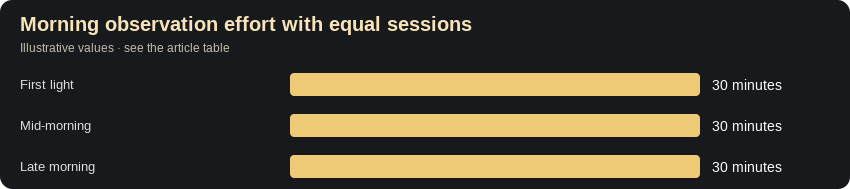
| Category | Value (minutes) |
|---|---|
| First light | 30 |
| Mid-morning | 30 |
| Late morning | 30 |
Three ten-minute rounds per window in a worked design; equal time is effort, not measured bee activity.
Before the garden becomes a place to pick things, it can be a place to count things. At first light, a squash blossom can look like a little lamp left on among dark leaves. Sit where you can see its rim, and the lamp changes from scenery into a working surface: an insect crosses the edge, another hangs briefly in the air, and something already deep inside moves only when the light hits it. These are three different observations. They are not three interchangeable pollination events. The first might qualify as a new landing, the second might never become one, and the third might have begun before you arrived. A useful notebook keeps the distinctions instead of flattening them into a total.
The question here is narrow: what can a gardener or community observer learn by watching the same squash patch at first light, mid-morning and late morning? Not how many bees live in the neighborhood. Not how many pumpkins the plot will eventually produce. Not even which visitor did the most pollination. Instead, the exercise can show whether particular kinds of visits were visible in particular windows, what those insects did when the flower interior was clear, and how the local timing of flower availability shaped what there was to see. That is enough to change when you bring a group to look, or to give an extension specialist a much better description than “we never see any bees.”
A patch of squash has another virtue: it is familiar enough to make the method accessible but variable enough to expose mistakes. A table can say thirty minutes per time window even if one window offered a good view of open flowers and another mostly offered folded petals. The arithmetic can be right while the comparison is wrong. The skill is not to produce the tidiest spreadsheet. It is to describe how the flowers, light and watcher set the limits of the spreadsheet.
Why the first visit of the day is worth making
The USDA Agricultural Research Service account of squash pollination identifies native squash bees as specialists on pollen from plants in the genus Cucurbita, the group that includes cultivated squashes and many pumpkins. The account describes these bees as ground nesters that often forage very early. That is a strong reason to add an early look to a local observation plan, not a promise that the first light at your particular plot will be busy. The account also describes a coordinated survey that recorded flower and plant counts and other site variables. A garden exercise can borrow the logic of reporting what was available without claiming to replicate that survey.
Put the first appointment into the plan before you know whether the morning will be beautiful. A photograph taken on the one especially sunny day might make an excellent picture, but it cannot supply the missing mornings in a comparison. Conversely, there is no obligation to brave unsafe conditions to fill a cell. A stop for lightning or inadequate footing is a missing visit with a reason, not an embarrassing hole to conceal. Make the rule early and use it consistently. That lets a second observer tell which days belong together without first needing a conversation about how enthusiastic everyone felt.
Timing refers to more than the clock in a car. A garden beside a tall wall may have daylight enough for the observer to walk safely while the flowers remain in shade. Another bed ten meters away may already be bright at the same time. The two beds share the local sunrise time but not their light history. If a window is defined relative to sunrise, retain the actual clock time, date and time zone as well. In the field note distinguish “sky bright enough to observe” from “direct light on target flowers.” If a shelter or hill blocks sunlight, write it down rather than guessing at a correction.
Even in a small yard, the entire garden is not one location in the sense that matters for a watch. A sheltered patch by a fence, an exposed strip beside a drive, and a bed whose vines lie below shrubs can put both insects and observers in different conditions. Choose one repeatable vantage point for the core comparison. Describe it in ordinary language, such as looking west from the paved corner of the community bed, then give the watched area a short code. A second patch can add interest, but keep it as a labeled second location rather than treating it as a continuation of one stopwatch session.
Identify the flower, then describe the visitor
Start with the flower and keep its identity separate from the insect. Cucurbita usually presents separate male and female flowers on the plant; in ordinary field language those words name the flower structures, not the visitors. A male flower supplies pollen, and a female flower has the stigma where pollen may be deposited. A visible swelling beneath a female flower can help identify it from the side. That swelling is part of the flower, not proof that fertilization has taken place. If the base is obscured or the interior does not agree with your first impression, the honest code is “type uncertain.” The USDA account explains why the separation matters: pollen needs to travel between appropriate flowers, rather than being made and received by one squash bloom.
Give a few original blossoms short names in a notebook sketch. You do not need to tie things to stems, mark petals, or rearrange the vines. The sketch might say that flower A is the open bloom beside the edge stone, B is above the broad torn leaf, and C is the low bloom on the opposite side of the same visible vine. A fixed photograph made from the path can help identify the sketch later. If B wilts or disappears behind a leaf, leave its identity in the record and note the change. Do not assign its letter to the flower that looks most similar. A code is a pointer to a flower, not a badge for whichever bloom happens to offer the better view.
Knowing flower type improves a description of what happened inside. For example, an insect visibly brushing the central pollen-bearing structure in a male flower adds more information than a plain landing. When it enters a female flower a moment later, can you actually see whether it comes near the stigma, or did a petal block your view? There is no advantage in guessing. Record the sequence you saw and the contact you saw. A video may confirm the order and still leave the contact uncertain. It also may not establish that it was the same individual after the insect disappeared behind a leaf. The observable sequence and the interpretation are two fields, not rival versions of the same field.
Distinguish the plant’s sex expression from any attempt to describe the bee’s sex. A bee in a male flower is not necessarily male; a visitor in a female flower is not necessarily female. The Forest Service and Pollinator Partnership guide, Bee Basics, gives examples of differences between male and female bees, and notes that male squash bees can rest in blossoms. The useful implication for a public watch is straightforward. An insect already there when the timer starts should be noted as present at the start, not assigned a made-up arrival time. A stationary insect may be resting; if you only see its abdomen disappear behind a fold, you may not be able to tell what it is doing at all.
Decide what a count means before you look
An arrival count is workable for this exercise because it ties a mark to a visible moment. Define one as an insect arriving from outside and landing on or inside a watched flower during the session. A visitor that shifts position without leaving remains one arrival. If it goes airborne, disappears beyond the boundary of the flower, and returns visibly, count a second arrival, without counting a second individual. The distinction matters for a bee moving among a few blossoms in quick succession. Nothing in this setup identifies individuals. A single insect could produce a large share of the tally. Calling the column “bees” would imply something the method cannot establish.
Decide what to do with a bee that lands on a leaf and then crawls to the edge of a blossom. For an all-terrain observation, this is interesting. For a simple flight-based arrival count, it may not fit. Either choice can work if explained, but make the same choice for all windows. One workable version counts the first entry into a watched flower regardless of whether the visitor comes by air or on foot, and then keeps a separate behavior code for approach route. Another records only a clearly seen landing on the bloom and writes crawl-ins as context. Do not switch halfway because the behavior is impressive. A neat series made from a shifting rule is not more useful than a messy series made from a stable rule.
A standard line might include clock time, flower identifier, arrival category, broad visitor label, whether the interior was visible, and any observed contact. Add a short free-text field for unusual events instead of allowing a whole sentence to live inside the taxon column. The tally can use dots beside flower codes while the richer detail goes on the next line only when the observer has time. The job is to see the flower, not to miss it because the notebook asks for a miniature dissertation after every landing. An unknown visitor or unknown action is evidence about the limits of that watch, not an error to fix from memory at the end.
Keep three records conceptually separate even if the page is small: new arrivals; visitors present without a known arrival; and visible interactions with floral structures. An insect can contribute to the first and third in the same session. A bee that began in the flower before the session may contribute to the second and third. An insect that hovers without landing might be noted separately but cannot contribute an arrival. A direct contact observation is still not a measurement of pollen deposition. It is possible to see the movement well and remain unable to see whether even one pollen grain moved to a receptive surface.
A brief trial before the formal watch makes rules easier to apply. Two observers can watch the same two blooms for several minutes and compare their accounts, not to negotiate a perfect score but to locate disagreement. Perhaps one observer counted a lap around a flower edge as a new visit and another counted it as the same one. Perhaps they watched different sides of the same flower. Write the resolution into the procedure before starting, and preserve the trial as practice rather than adding it to the formal tally. If substantial disagreement persists, narrow the field to what both people can see and document that the smaller field, not the whole patch, is what your result represents.
What the illustrative graph measures
The graph labeled Morning observation effort with equal sessions gives first light, mid-morning and late morning thirty minutes each. The unit is minutes. Within each window there are three ten-minute rounds. That makes nine rounds and ninety minutes of observation time spread across the three windows. The height is identical for all three bars because the design allocates the same time to each. The bars do not encode insects, contacts, pollen delivered, time bees spent foraging, or any crop outcome. No recordings from a real garden were used to produce the graph. Neither cited publication is the source of those numbers; the values come from this worked schedule.
One implementation is to use one round per time window on each of three mornings, at the same watched part of the bed. This gives a first-light, a mid-morning and a late-morning entry each day. It also distributes effort across mornings instead of hoping that three successive rounds on one date capture a whole season. The allocation remains ninety minutes if all rounds happen as planned. If the scheduled mid-morning look on the second date does not happen, actual effort under a complete-round policy is only twenty minutes for that window. Do not draw the planned bar as if it were the achieved bar. A one-line difference like that can change how someone reads a report much more than a subtle variation in design colors.
Time is only the first denominator. Imagine that first light offers three open watched flowers during each minute of one round, while late morning offers only one because two have closed. Every round still takes ten minutes. If those counts remain constant, the first round includes thirty open-flower minutes and the last includes ten. That does not turn the later flower into a sample of the same patch conditions, but it shows why an equal length of time cannot guarantee equal opportunity. The open-flower calculation is simple: for any period with stable coverage, multiply the number of visible, open watched blooms by the minutes that condition lasted, and add the periods. Use it only when the underlying records justify the effort and acknowledge that blooms remain ecologically different.
You do not need to track openness by the second. For a tiny patch, note open and visibly usable flowers at the start, then record obvious changes and their approximate times. For a larger patch, it may make more sense to keep strict presence criteria for just a few focal blooms. If all you have are start and end snapshots, report both rather than silently building a precise exposure estimate from them. If an insect can enter a flower that you coded as partly closed, log both the flower state and the event. A flower state is a convenience for discussing opportunity, not a claim that its doors are locked to insects.
Suppose a signed-off notebook lists six qualifying arrivals in thirty minutes at first light, three in thirty minutes at mid-morning, and none in thirty minutes at late morning. These figures are a separate invented example and are not hidden values in the graph. The narrow conclusion is that under that made-up protocol more arrivals per equal block of watched time were recorded early. It does not follow that all community members forage earlier, that six insects visited, or that the late patch was avoided. If the late flowers were closed for much of the period, the comparison of counts also compares the changing behavior of the floral display. That outcome can be interesting precisely because the display changed; the problem is hiding the change while treating it as a species preference.
Build a watch that can be repeated
Pick several blossoms that can be seen without walking into the bed. Two to four may be plenty if the observer can reliably tell where each is and watch the landing surface while writing. Take a broad reference photo before the first session if the plot steward agrees and no one’s private information is captured. Point the camera low enough that the view matches the observer’s line of sight. A high, overhead shot is often poor documentation of what was visible from a real path. A simple pencil sketch works just as well if it captures orientation, flower codes and which end of the row is being watched.
One person should run the clock, even if others attend. If there is a helper, give them a specific job such as logging a change in flower state, not keeping a second secret arrival tally that will later be added to the first. Independent double-watching can be useful during calibration, but pooling records from observers who watched the same targets creates duplicate events unless there is a reconciliation rule. Two observers on different targets can produce separate sessions, but those sessions are no longer equivalent to one person watching all targets. Describe the staffing arrangement instead of averaging it away.
Start the clock only when the observer is in position and ready to apply the counting rule. If a group arrives late, the actual window matters more than the planned one. An observer who can see a bloom only after taking their hands off a phone needs a reporting method that frees those hands. A soft clipboard with preprinted columns works. A colleague can take quiet dictation, provided the plants are not crowded and the helper understands that blind minutes count as impaired visibility. Record interruptions caused by conversation, a dog, irrigation or morning delivery. A simple “eight minutes, two not watched” is more instructive than ten invented clean minutes.
Plan the middle and late windows with the same care as dawn. A schedule such as starting shortly after local sunrise, then after the garden has been lit for a while, then later in the morning can be acceptable if documented and replicated according to a written rule. Whenever possible, give the windows explicit time bands before the watch, and note changes in their relation to sunrise as the season advances. Do not use “mid-morning” as a flexible place to put the most photogenic clip. If a regular gardener cannot attend the first window on some days, that scheduling inconvenience can motivate a smaller balanced design. It should not be silently solved by substituting a weekend with a different watering schedule.
Weather context should be easy to write and modest in its claims. If there is a temperature reading, record where it came from, whether it is from the garden or a distant station, and its time basis. There is nothing wrong with observing that the bed was cool and windy without a device; record it as a qualitative observation. Distinguish dew on the petals from rain falling during the session. A morning when flowers were visibly windblown is unlike a still one even if the thermometer reads the same number. Do not infer a temperature threshold when temperature, light, wind and flower state changed together. The report can note the combination and propose a follow-up that sees the patch under another combination of conditions.
Recognize plausible squash bee behavior without inventing certainty
The federal accounts make dawn at an open squash blossom a sensible place to look. They do not make every brown insect encountered there a squash bee. Honey bees, other native bees and flies can appear in similar light or share the same flower. A glossy thorax seen for half a second and a banded blur on a screen do not normally justify a species label. Make three broad levels in the report: identified from adequate independent evidence, plausible field identification with documented uncertainty, and unknown. A broad unknown is usually more valuable than a plausible but unsupported species name, because another person can use it in the total without trusting a guess.
A good photograph answers a specific question. If the picture is intended to show the host flower, include a side view or the traits that connect it to the written code. If it is intended to show the insect, a clear view of the body and the parts a reviewer might use is more useful than a dramatic blur. If it is intended to document the behavior, time order and continuity may outrank a beautiful close portrait. Separate photographs serve separate purposes. It is fine if only one succeeds; never move an insect into a flower or pry a bloom open to manufacture the missing angle. A photograph of an ordinary observation is evidence only for what it visibly contains.
The Forest Service guide describes rapid visits at opening flowers and mentions the use of blossoms for rest. Treat these patterns as two clues that can help formulate a question, not a stopwatch identification key. An insect that darts into a flower may have arrived fast because the approach was short, not because it belongs to a specialist group. A slow entry may reflect low temperature, the shape of the bloom, or a momentary obstruction. Note real actions such as “flew directly past rim into interior” or “stayed still in a folded flower already occupied at start.” If you also add a probable label, keep that label separate so a future reviewer can revise it without rewriting the behavior.
The crop helps narrow context only if the plant identification is reliable. Common names can be vague, and a garden nursery label can go missing or follow a pot after transplanting. Use the confirmed kind of squash if known, a garden label with appropriate provenance if that is all you have, or a generic description if identification is uncertain. The federal squash account uses Cucurbita for its claim about specialist pollen. Do not generalize that claim to all gourd-family blossoms in a mixed garden. Likewise, the question “is this plant in the crop genus?” is not the same question as “what looked like a bee on it?”
Soil clues belong in a separate notebook column
Watching the ground can add landscape context when the same patch of flowers brings repeated flights low over soil. A small hole in an open strip of ground, however, is just a small hole until there is better evidence. Insects use holes for more than one purpose; an insect disappearing near a hole is not proof it constructed or occupies a nest. The Forest Service research fact sheet on wild bee nesting habitat explains that ground nesting is common among wild bees. That background makes soil features relevant, but it also means a ground hole alone is not diagnostic of a squash specialist.
Keep the soil record separate from the timed flower record. “Possible entrance near the second bed; small insect entered; watched from path” adds a detail. “Squash bees nested four feet away” is a stronger identification and a stronger account of behavior than that detail supports. Repeated direct observations of similar insects entering and leaving a feature can improve confidence that it merits attention. They still cannot link any one flower visitor to the hole unless the sequence was seen and the identification evidence supports it. Do not mark a nest by pushing anything into it or ask a participant to demonstrate occupancy by tapping the soil.
Avoid invasive verification. The proposed activity does not require digging, catching, cooling, feeding, moving or handling anything. Do not test a hole by pouring water, putting bait near it, or blocking it to see what happens. Do not compress the patch by bringing a group into it, even if nothing appears active at that moment. Stand on an existing path with the owner’s permission. If there is no safe angle, record that and leave the location alone. A collection of ambiguous holes can stay ambiguous without making a report useless; the flower portion and the soil portion address different questions.
Respect both the stewardship and privacy of the site. An extension agent or garden lead may need a private description sufficient to locate a patch again. A public reader probably needs only the general neighborhood or region and the setting. The gap between those two levels of specificity is useful. It lets a shared article illustrate the observing method without publishing a location that attracts crowds or telling readers which front-yard bed to inspect. Remove house numbers, faces, school signs and precise photo coordinates from public copies. A small map showing the relationship of the path to the bed may be a safer and more useful illustration than an exact aerial marker.
Why no fruit forecast belongs next to the tally
A new arrival is a unit of observation. Pollination is a biological process. Harvest is a later outcome. The three can be connected through evidence gathered through an appropriate study, but a morning watch does not create those connections automatically. Consider two cases. In one, an insect lands on several flowers and its body stays at the inner petal lip; you see no contact with the stigma. In another, an insect enters one female flower and visibly passes across the stigma, but you cannot determine what pollen it brought. Both cases matter for field notes. Neither yields a quantitative estimate of fertilization or an exact probability of fruit set.
There can also be a time lag between what is seen and anything that could reasonably be called fruit development. A swelling at the flower base precedes your observation, so its presence immediately after the watch is not an endpoint. A horticultural follow-up could choose a separate set of clearly defined outcome measures and record factors besides pollinator behavior. This article does not propose an intervention or assert a diagnosis when a fruit later fails to develop. If a grower wants an agronomic recommendation, the helpful next step is to provide patch observations, crop details and growing conditions to a local specialist rather than multiplying the count by a purported yield coefficient.
The USDA reports effective squash pollination by native specialists in some settings, but a broad research observation does not turn into a transferable threshold for a garden. Apple-sized and wheelbarrow-sized estimates of yield can both be wrong for the same small study. A row might receive visitors before any scheduled watch, other visitors might arrive later, and watched flowers might not represent hidden parts of the bed. Even if all visits were observed, their mechanical details could vary. What the watch can show is an opportunity: a particular kind of insect entered particular flowers in a defined place and period. That is already better evidence than a quick walk around after breakfast.
There is a parallel mistake in assuming the most numerous observed group is necessarily the most effective pollinator. An insect that makes a long series of landings provides a strong signal in an arrival count under the stated rule; it might be one individual. Another kind of insect might make only one clear visit that looks, from the available angle, more directly associated with a flower’s reproductive structures. The watch is not designed to rank the two groups by pollen delivered. Report frequency and behavior in separate fields. A graph of time watched, the one included here, cannot arbitrate either question, and there is no need to make it try.
Assemble a report people can reuse
A reusable report begins with an uncomplicated sentence: where, what and when. Then give the observation rule and the actual effort before mentioning totals. For example, in an invented garden summary, “We observed four marked-in-the-notebook blossoms from the path during nine ten-minute watches across three dates. Arrivals were visible entries into the watched blooms. We did not mark insects or tally unique individuals.” That statement tells a second team how to compare its data with yours and immediately heads off a misleading interpretation of the word “visits.” The phrase “marked in the notebook” also matters because it leaves the flowers themselves undisturbed.
Next distinguish constraints that were planned from problems that actually happened. Include the clock windows, shade, opening state, number of visible blooms, and whether any round was incomplete. For notes on insect identity, give the confidence label and evidence type. A note such as “photograph shows the insect but not the characters needed for confirmation” is more useful than a generic “photo available.” If the report includes a site photo, make clear which blossoms were inside the observation boundary. Someone studying the figure should not have to guess whether insects elsewhere in the frame would have made it into the count.
Read aloud the most exciting conclusion before sharing it. If you would rather say “the squash bees are back” than “an insect consistent with a squash bee appeared in the first-light watch,” ask whether your evidence truly crossed that gap. If you would rather say “no bees came later” than “no qualifying arrivals were observed during those completed late watches,” check whether the bins account for view and flower availability. Simpler language is welcome when it does not change the claim. A sentence might read, “We saw early flower visits, but not enough detail to confirm which bees made them.” That is neither a hedge nor a failure; it is a straightforward interpretation of a constrained observation.
Your spreadsheet can be as short as a handful of columns. Keep the raw field notes separately, with date, observer code and page number. Summarize zeros by completed, valid rounds; explicit blank entries can mean unobserved. Do not design a sheet that hides a missing data code by turning it into zero. If a late window consists of one valid zero and two unobserved rounds, report the planned thirty minutes as planned and ten valid minutes as achieved. In future seasons, the clipping of a row may look incidental until someone discovers that the previous observer used an entirely different meaning of zero. A short data dictionary saves that future person work.
If your result points to a better local viewing time, make that next step concrete. An organizer could schedule two short watches at documented times on a later day and ask whether the same kind of early event is visible again. A garden steward could ask a local naturalist to review one uncertain image before sharing a possible identification with a public group. A grower trying to understand a particular fruiting issue could bring the completed effort and plant-context notes to a horticultural adviser. These uses do not require pretending the watch was a survey of everything alive in the plot. They benefit from the limited claims that the watch can actually support.
What changes when you take the exercise somewhere else
The plant genus and the broad reasons to look early travel more readily than the timing at one bed. In a new region, use locally relevant references and someone familiar with the regional bee fauna before assigning a likely group. The USDA survey page reports geographic differences rather than a guarantee of comparable abundance at every site. A gardener on the north side of a house, a grower on a valley floor and an observer in a covered growing area may have three very different views of “first light.” Treat new settings as new comparisons; do not paste the old result over them because the blossoms have a similar color.
If an invitation to watch comes from a farm, first learn where the public may stand, whether the route is open at that hour, and which activities take precedence over watching. Do not put a group on a tractor route or use an observation request to wander into a crop area. A school garden may have limits on access and photography even when the crop is visible to walkers. A rule like “watch only from the east paving; do not approach the soil strip” is both courteous and analytically useful. It gives future visits the same approximate visibility and keeps the human activity from becoming a different treatment each morning.
Sample dates are also part of the claim. A garden in its first week of bloom is not the same context as a garden with many flowers already appearing daily. Nearby flowering resources can shift as the season changes. Access, pruning, row covers, frost damage or simple loss of the watched flower can change the view. A new session using a similar protocol can be valuable; just identify those changes. The strongest practical comparison is usually the one where readers can see exactly which elements stayed the same and which did not. A large table that strips off all the context is not inherently stronger than a smaller table with clear documentation.
Finally, plan what would change your mind. If a repeat set of mornings consistently shows ample open flowers in the first window but no clearly observed arrivals, the next question may shift to a later window or a still morning. If an expert rejects your identification, keep the observed event and change its label. If the same visitor is later filmed entering several flowers, that validates a sequence in the new record, not the identities of earlier blurry insects. The goal is a record that can be corrected without collapsing. Keep effort visible, report what the flowers allowed you to see, and use breakfast as a practical reminder to try an earlier watch rather than as a line dividing true activity from everything else.
Sources
- USDA Agricultural Research Service: Squash Pollination for Cucurbita pollen specialization, flower roles, early activity, ground nesting and the SPAS survey's attention to site and effort.
- Bee Basics: An Introduction to Our Native Bees, USDA Forest Service and Pollinator Partnership for examples of floral specialization, behavior at squash flowers, and male bees resting in flowers. Alternate agency archive address returned a gateway error at editorial review; the issuing agency's working PDF is the verified copy.
- USDA Forest Service Research and Development: Pollinator Habitat in Log Landings: Wild Bees for the broad context that native ground-nesting bees are not unique to squash patches.