
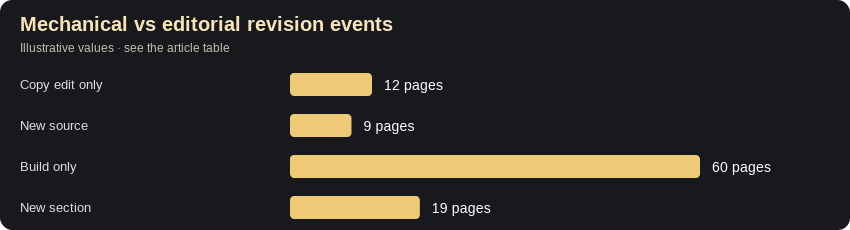
| Category | Value (pages) |
|---|---|
| Copy edit only | 12 |
| New source | 9 |
| Build only | 60 |
| New section | 19 |
Illustrative calculation (not sourced observations). Fictional mutually exclusive classes for 100 changed pages. The article must explain the difference between this count and a publishing policy, not prescribe every copy edit as meaningful.
A small archive rebuilds its site late on Thursday. By breakfast, its sitemap says that every article was modified that morning. The footer did change: the publication corrected the address for its newsletter. But the field guide on measuring flower coverage is exactly what a reader downloaded in April. So is the pollinator photo essay published two summers earlier. Then an editor opens Friday's edition of a third article and finds that its sampling period has really changed. The date attached to the actual correction looks just like the date attached to five hundred untouched articles. What should have been a useful signal has become a record of when the computer last ran.
This is not merely a tidy-up for search. A living archive maintains distinctions among the date a version appeared, the date its claims changed, and the date a deployment reached readers. A useful sitemap can communicate one of those distinctions to a crawler. A webpage with an edition history can communicate more to people. Neither one gets the right answer by inspecting the modification times on a folder of freshly built HTML. Without a separate editorial record, the publication cannot reliably explain which date is attached to what change, even when everyone handling the next release is acting in good faith.
Start with a concrete statement of what the site intends to mean. For its articles, a sitemap entry's last modification should reflect the latest publication event that materially changed the version readers encounter, as defined by a written editorial policy. This article builds that policy, shows how to derive dates from evidence, and works through a fictional archive with a hundred changed outputs. The example is illustrative: it is not an audit of Apiary, a recommendation to mark some fixed percentage of pages, or a guarantee that an external crawler will do anything on a particular day.
Begin by separating five clocks
The publication date answers when the article first became available to its intended public. It is not the date the author started writing. A publisher can draft a February guide in January and release it in February; neither month is interchangeable with the other. The first public date belongs to the article's stable history, and no routine rebuild should overwrite it. If you discover a missing original date, recovering it is research work. An uncertain value should not be replaced with an exact time simply because the current database makes a year-month-day input easy.
The material modification date answers when the current substantive revision became available. An editor may fix the text on Tuesday while the approved correction appears on Wednesday. If Wednesday is when the public could first see the new information, Tuesday's commit timestamp is not ideal evidence of a public change. In many organizations, build starts and production rollouts are separated by enough time to cross midnight, including because of failures. Decide whether the workflow measures first publication of a revision or sustained release after verification, and document how that affects the correction history.
The deployment clock is operational. It answers when the build started, when a hosting service reported a release, or when a live check verified it. It can help determine when readers could have seen a change, but it does not prove what changed. A cached view at an older edge can survive an otherwise successful deploy. Conversely, a routine release may change thousands of file timestamps while leaving the information in their articles intact. Keep deployment evidence to diagnose who saw which version, not as a universal substitute for article revision dates.
The subject's own date answers when something described in the article happened. An August reading about a spring survey can have a May fieldwork date, an August publication date, and a September methods correction. Putting the May date in article-publication metadata would confuse the reading with its evidence. Google Search Central's publication date guidance addresses article dates and explicitly distinguishes them from dates of events described on the page. Give readers both where they matter, but describe what they are. For a field report, "Observed May 3 to May 6" is not a replacement for a publication label.
The crawler or diagnostic clock is different again. It says when a service fetched, parsed, or reported something about the public address. It may be later than the time the revision was published. A crawler visit that occurred yesterday does not change yesterday's page into a new revision of the article. If another observer fetches a different result, use both observations to investigate distribution or caching; do not use the most recent observation as the article's modification time. This distinction protects the integrity of the same revision even when distribution is imperfect.
For a modest publication, these clocks fit in a few fields: first published, latest qualifying release, deployment version, date or period of the subject, and any external observation date. The fields should not all be public to all readers. An editor may want internal deployment evidence for debugging; a reader needs a clear publication label and, for meaningful corrections, an explanation. A sitemap's optional hint serves a narrower purpose. Once a system has those separate values, each presentation layer can choose the right one without trying to reconstruct meaning from a single database column called date.
What the protocol and search documentation actually say
The Sitemaps XML protocol describes the optional last modification entry and distinguishes modification of the linked page from generation of the sitemap file. The distinction is essential for a nightly build: emitting new XML is not proof that the listed documents changed. The protocol uses a date or date-time format and allows precision down to a date. A publication that only knows a real calendar date should not give an invented time of midnight to look exact. The choice of precision has to reflect the underlying evidence.
Google's sitemap documentation says it uses the last modification value if it is consistently and verifiably accurate. The documentation discusses significant updates rather than automatically treating all output changes as meaningful, and gives a routine copyright date update as an example that does not change a page significantly. Think about the class of change, not only the characters it touched. A correction of one digit in a data table can be more important than changing the same footer on every page.
There is an often-missed difference between an entry for a content URL and an entry in a sitemap index. In a sitemap index, a modification element can refer to the sitemap file listed in the index. It does not announce a revision for every page mentioned by that file. If the publication updates one child sitemap while several child sitemaps stay byte-for-byte unchanged, its index can describe the changed child artifact without inventing revision dates for the articles inside. The protocol describes the index separately and explains why the modification time of a listed sitemap can matter to an incremental process.
The date shown to a reader has its own guidance. Google's publication dates documentation discusses clear visible dates and structured signals; its Article structured data documentation describes the fields for first publication and latest modification in that markup. The values should agree in meaning with the article's applicable public dates, but each format has its own requirements. The first published label does not disappear just because a revised article has a second date. And a public editor's note saying what changed is more useful than machine-readable markup by itself.
Common timestamp formats look orderly even when the facts behind them are wrong. RFC 3339 describes an Internet timestamp representation and numeric offsets. It is useful as a reference for data interchange, not evidence that a historical event occurred. A bare local time without an offset is especially fragile if an archive spans time zones or passes through clock changes. Record a time zone or explicit offset when your evidence supports a real time. Record a date alone in a sitemap when that is all you know. Keep the archive's chosen local display policy separate from the precision of the underlying event.
None of this promises indexing, crawling, ranking, or a particular date displayed in search. Google describes sitemap submission as a hint in its own documentation. The publisher can report that its sitemap now points at the correct, reachable URLs and declares known dates consistently. It cannot derive search behavior merely from a successful response. This is a useful limit: it directs testing toward the things the site actually controls and keeps separate records for external systems to which the publisher does not have immediate visibility.
Write an editorial rule that resolves hard cases
Start from what a reader could do differently with the updated page. If the article changes the method for counting a field observation, the resulting interpretation changes and a substantial update is easy to defend. If a large photographic caption swaps the names of two visually similar species, the length of the edit is tiny but the consequence is real. If a source is replaced with a more directly relevant one and the accompanying explanation changes, readers may now be able to verify a claim they previously could not. These are changes to evidence, meaning, or accessibility of the information, not mere differences in output bytes.
An ordinary copy edit is usually mechanical when it does not change the claim or its discoverability. Correcting repeated spaces, smoothing an awkward transition, or normalizing quotation marks normally shouldn't renew a long-lived article's signal. Do not ban copy edits from qualifying in every case. Correcting "wasps" to "bees" may happen during copy editing, but the classification follows the effect, not the editor's job title. If a typo changes a plant's scientific name into another legitimate taxon, that repair is a change to substance. Put these pairs of examples next to each other in the policy so reviewers do not mistake the label for the test.
Changing a link has several different meanings. Replacing a tracking parameter with a clean URL to exactly the same study typically leaves the evidence intact. Repairing the only source link after it led readers to a different study can materially alter their ability to verify the page. Replacing a source with a stronger paper while keeping a claim unchanged may warrant a visible references note if the reasoning, limits, or confidence change. The rule should be explicit about what makes a materially repaired link count. If published dates are supposed to help readers understand current evidence, stop treating every link change as either always important or never important.
Template changes deserve an independent category because readers encounter information through a presentation system. Altering a footer, updating a button color, or changing a sidebar's order is ordinarily not an article revision. But a template that had accidentally hidden an entire methods table does change what a reader can access when repaired. An archive can choose to record presentation corrections as their own kind of qualifying event when previously absent evidence becomes accessible. That does not require renewing every page that used the template. Identify the affected cohort, verify the actual public difference, and record why it matters.
Structured data has a similar edge case. Reformatting JSON or relocating an unchanged block need not be treated as a new editorial edition. Correcting a false author attribution, material article dates, or significant omitted declarative information is different. Google's sitemap documentation discusses substantial changes to page information and can help define the question, but the publication still needs a policy it can apply reliably. If the change affects what a machine and reader can understand about the article, specify which visible labels and records also change. A correction hidden only in an invisible data layer is difficult for the people who previously saw incorrect information to notice.
Keep a list of examples short enough to use. An example might state "correcting the measurement units of the lead chart qualifies; changing its line color normally does not." Add a tie-breaker: when reasonable editors disagree, record the disputed effect and hold the date or omit the hint until the change can be understood. Do not hold back an urgent correction purely because a date classification debate is unresolved. Fix public information that needs to be fixed, log when it was corrected, and then decide whether the public revision lists and sitemap should include it. The archive should not organize its editorial response around a crawler's clock.
Fingerprints help, but cannot decide what changed
A content hash answers an equality question about input bytes. If a repository records known text and every article's source hash remains identical between releases, it is plausible that no source prose changed. But online users read a published composition: tables, charts, embeds, credits, captions, external data snapshots, and templates. Hashing the prose alone cannot tell whether a revised table was included. Hashing the entire build directory makes the opposite mistake: it makes everything, including a bundle fingerprint and footer timestamp, look equally material. Compute checks over different layers rather than making one fingerprint settle the whole matter.
Consider three useful fingerprints. The first captures the raw article inputs, such as the editorial document plus a dependency manifest describing which data and figure versions were intended. The second captures a normalized reader-facing representation with deliberate exclusions for build IDs and irrelevant layout churn. The third is the actual published artifact identity, useful to prove a particular file was deployed. Any two can disagree without contradiction. If a template recovers a hidden caption, the raw inputs can match while the normalized output differs. The article may deserve a correction event even though the writer did not touch its source.
Normalization decisions must be reviewable. Removing a transient content-navigation widget may improve comparisons. Removing a footnote, alt description, or small numerical change would hide the matter that the ledger was built to catch. Define which elements are excluded and preserve a diagnostic view of what was removed when there is a dispute. Keep field-level deltas for likely substantive anchors, including units, counts, quoted dates, bylines and references. A fingerprint can route an article into the human review queue. It cannot replace someone who can explain the significance of a changed denominator.
Captions deserve special consideration in an archive with generated visuals. A decorative image change may not qualify; a generated image that was falsely identified as a real field photograph is a correction when its provenance is made clear. A controlled update to a chart illustration might be mechanical if the numerical chart and label remain the same. Replacing generated axis values with a source-based graph is material. Track a figure ID and the visible detail that tells readers how to interpret it: photograph, reconstruction, generated illustration, measured series, or worked example. Don't silently encode those categories in tree paths only developers can see.
One practice is to store the classifications with each release rather than re-evaluating them after the fact. For example, an editorial record can describe a change as "citation reach restored" and include a short before and after explanation. That record travels into the build; the sitemap derivation consults the approved significance, not a rules engine guessing from the diff. Keep a route for template-level incidents: a developer can submit a list of articles for review with a sharp description of the reader-visible loss. Avoid setting every article touched by the same deployment as new simply because a shared problem was present somewhere.
A later correction to the classification should also be recorded. An editor might initially think a table change is mere formatting. A reviewer then discovers the old version incorrectly combined two non-comparable sample windows. The new release's real timestamp does not change when that discovery is made; the significance label does. Revising the ledger can promote the existing effective change to a qualifying event without pretending readers first saw it on the day someone noticed its importance. If readers also need a new explanation, that new explanation has its own release.
Apply the rule to a hundred changed outputs
The accompanying bar chart is a hypothetical classification exercise. It imagines comparing two releases and finding changed artifacts for one hundred distinct article URLs. Twelve are classified as copy edit only, nine as a new source, sixty as build only, and nineteen as a new section. These four groups are mutually exclusive for the example: if one article has both a new section and new references, it falls under the more substantive class rather than being counted twice. The four values sum to one hundred. There were no real page observations behind the chart.
In this deliberately simple ledger, the sixty build-only entries were altered by deploy identifiers, packaging, or a shared footer, not by changes in article information. Keep each article's previously known date; leaving a hint unchanged is not the same as leaving it out. The twelve copy-edit cases were reviewed and found not to alter meaning, sources, navigability, or evidence. Their article dates also remain as they were. This is a finding within the fictional case, not a universal instruction to ignore copy edits. The next archive might find one mislabeled measurement hidden among otherwise innocuous fixes.
For the nineteen articles with a new section, the example assumes the sections add substantive material. One introduces a method and its limitations; another compares two previously unconnected maps; a third adds an example the existing text did not cover. The nine source changes require a different kind of review. If all nine are materially new and change how a reader can verify a claim, they can qualify. If two are merely replacement links to identical published documents, then only seven qualify under the example policy. State which assumption you use before asserting any derived count.
With all nine source changes verified as material, twenty-eight of one hundred articles qualify, and seventy-two keep existing dates. If only seven source changes qualify, twenty-six qualify and seventy-four keep existing dates. Neither percentage is an optimization target. Both depend on the case definition and the reviewer decisions. A publication that uses this as training can ask a reviewer to examine sample change notes, give a disposition for each, and then compare the reviewer's reasons rather than treating column totals as the answer key.
The chart's equal axes let a reviewer quickly see that the majority of changes came from rebuilding, but the accompanying explanation prevents a second sort of error. A large bar is not a recommendation that most pages are poor quality, nor is nineteen a measured proportion of all articles in the archive. The denominator is the one hundred changed outputs selected for the exercise. It says nothing about pages that did not appear in the comparison. In a real review, include the period covered, how outputs were paired, and how articles entering or leaving the catalog were treated.
One illustrative topic can serve as a practice case. A guide to establishing a street-side observation plot adds a short note defining the hours included in its count. The photo appears unchanged. The text before the note refers generally to midday, while the new note provides a precise interval and explains how visits outside it were excluded. That alteration can matter to someone attempting to reproduce the exercise, so it qualifies despite involving one paragraph. Whether search notices it is a separate question. Record who approved the explanation, what it changed, when it appeared, and the context readers need to interpret the earlier text.
Another guide gets a refreshed navigation banner with the same article information, including all tables and source destinations. Accessibility checks show the new banner has better keyboard focus visibility, but it didn't previously hide any of this guide's content. The project can still communicate the navigation improvement in its own release notes without implying that the scientific guidance was revised. Should the repair instead make some previously inaccessible methods content available to a cohort of readers, record that specific effect. The article's history and the platform's history overlap; they are not exchangeable.
Store publication events, then derive a date
Treat the simplest publication event as an append-only record with a stable article identifier, revision identifier, effective moment or date, event class, editor or review authority, and a reason. Include the previous revision or edition when it matters. In a site that uses immutable dated editions, a new release may create a separate resource rather than changing the old one. The current landing page can receive a new substantive date while the archived edition retains its effective date. It is important to derive per-resource output, not merely one timestamp from an entire work family.
Add a few distinct operational states: proposed, editorially approved, released, release verified, rolled back, and superseded. The sitemap should generally draw from events tied to the material version actually served to its audience. It cannot use a private approved revision in a branch just because the narrative is finished. A rollback complicates matters. If the corrected article reverts to an older released version, the team should decide whether the public rollback notice itself becomes a substantive event. Blindly choosing the largest past timestamp can announce a revision that readers can no longer retrieve.
Maintain the ability to explain a date before discussing automation. Suppose one date is wrong. A person looking at the event record should be able to answer whether the source change qualified, whether the release happened, what public version the XML currently references, and what evidence shows that date is appropriate. Preserve a confirmation route such as a deploy receipt and a minimal public body proof of the version, but avoid concentrating unrelated logs or private comments in the article record. A small evidence packet is more useful than a large database of opaque retries.
Use a deterministic precedence rule. First identify the version or resource the URL actually represents. Locate its latest qualifying public event by effective date and stable event order, excluding events that belong only to a withdrawn version unless the public resource retains a notice that warrants a date. If there is no qualifying update, preserve a known genuine first publication date when the archive's policy and evidence support that as the start, or omit the hint. Missing date is a meaningful state. The XML format does not demand a guess from the oldest file in the checkout.
To simplify older archives, derive recorded confidence without inventing a precision code for every slight doubt. A contemporaneous publisher record matching the article generally supports higher confidence than a later historical recollection. An exact timezone supported by a genuine release log can be retained; a date reconstructed from documented newsletter release may support only a date. A date printed inside an imported PDF could be a date of authoring rather than first publication. Keep the provenance of the date choice and mark unresolved approximations internally. A convenient "imported at" date means import, not any of the other possibilities.
The workflow can accept one higher-level change event with the specific affected articles listed. This helps when a single template fix restores charts on thirty of ninety articles: one correction record explains the fault and repair, thirty affected records connect to it, and the other sixty preserve their dates. Validate the affected cohort with output evidence rather than selecting every article that shares a stylesheet. Readers searching for how their page changed should be able to follow the cohort rationale without having to understand the rendering code.
Build checks that detect lies without reading minds
The strongest automated tests enforce consistency at the boundaries. Ensure sitemap entries refer to the intended URL set, not template search results or retired redirects. Validate the date syntax with a parser appropriate to the format rather than with a pattern that might accept invalid calendar dates. Reject future values when the site's policy is to advertise only released information, allowing a documented tolerance if machines disagree slightly. Compare every changed date to an approved event tied to the current resource. Each check has a bounded interpretation and should give a result someone can act on.
Capture the previous artifact or a small baseline from a known release to allow differential checks. If the change set has only a deploy identifier update and the next sitemap modifies seven thousand content dates, the build should raise a warning or stop, depending on the organization's ability to review it. If a batch release intentionally replaced the references on every topic, the release manifest should prescribe that cohort and include evidence that it really happened. This reduces the chance that anomaly checks turn into isolated limits that teams learn to work around without improving reporting.
Test time zones with examples, not intuition. Two representations of a full timestamp that differ by offset can refer to the same instant. The site might display a date based on the archive's local time while a feed presents UTC, so dates at the edge of midnight can appear different without the records disagreeing about time. A date-only value lacks enough information to recover an instant. Keep a fixture with real offset information, another for a verified date without a time, and another with unknown evidence. The rendering tests should prove that none gains invented precision in later layers.
Check sitemap entry type independently. Build one test that touches only a child sitemap's metadata and verify that the sitemap index event changes as intended while the content events do not. Build another test that materially revises one article and confirm that the appropriate child entry reflects it, without artificial churn elsewhere. Keep a no-op rebuild case. A production release can run for many reasons; the output should remain stable in informational content fields when the editorial inputs that govern them have not changed.
Check the reader-facing version as well. Compare a sampled set of current public pages to their expected dates and visible labels. When an article supplies an updated label, can a reader tell what changed? Does the label refer to the latest article content that the route actually serves? If deployment issues cause one version's HTML to lead to another version's chart, a perfect XML test won't detect it. A lightweight content check can verify a stable unique section or figure note associated with the expected revision. This is proof of something stronger than a hosting service's successful response alone.
Do not turn a freshness check into an editorial permission system. A tested, approved correction should not be blocked by an unavailable search reporting interface. The pipeline can ship a correction with an omitted date hint if the timestamp is unverified, then update the hint when enough evidence exists. Review the cause separately. Automated checks are valuable because they prevent silent inconsistency, not because they give a computer sole control over when a researcher can fix a mistake.
Run a practical repair in stages
First, freeze the habit of rewriting article dates at deploy time. This does not mean freezing the article release process or removing a currently valid sitemap wholesale. Identify exactly which pipeline is generating inaccurate values and change the input policy before planning a backfill. Export a small sample of the current URL and date entries, plus visible labels and known editorial events for those pages. Distinguish no known date from a proven correct old date. Begin with the highest-used works and recent corrections where evidence is easiest to verify.
Second, compare deltas across at least two operational scenarios. A no-op rebuild should demonstrate that the public date logic is stable. A testing revision should demonstrate that a material change updates only its intended set. If a public publishing route cannot safely accept a test revision, test in a controlled copy and then perform a read-only production check when the release occurs. Maintain an allow list of expected public changes and review a few near misses, especially pages that share a build template.
Third, recover older dates carefully. Use a contemporaneous issue archive, version history tied to an actual public release, or a reliable published citation; prefer multiple forms of evidence when they are available. A source imported into a new site may carry a Git author date, but commits can be copied, rewritten, batched or authored before a release. Do not claim more than the evidence establishes. When the original first public date cannot be reconstructed, the archive can indicate uncertainty to readers and omit an unsupported sitemap hint. Omitting a field often takes real effort precisely because every downstream layer must accept that state.
Fourth, publish visible provenance where readers need it. The revision note may link to a corrected appendix, display an edition link with an explicit date or give a plain-language statement of the change. An archive that fixes a mostly historical formatting problem need not show a public note for every corrected date field. But whenever the corrected metadata changes how someone understands the article's origin or its relation to an earlier edition, explain the distinction on the page. Frequently, a one-sentence note returns more value than another invisible field.
Fifth, verify the public result and measure any external effects separately. Fetch the intended sitemap or child file, inspect the edited and untouched cohorts, and check a few real readers' entry paths if feasible. Note what the testing verified: generated XML, deployed URLs and dates, and the actual reader-facing labels. Record search diagnostics with their observation times, not as a substitute for public content evidence. A later search observation can give useful feedback, especially about whether an external service trusted the values, but it does not retroactively establish whether any particular article revision happened.
For routine operations, a compact review report can summarize accepted date changes, article revisions intentionally excluded, mismatches that remain blocked, and unsupported timestamps removed rather than guessed. The summary should not give a bare percentage as though a bigger one proved more editorial progress. When years of build-time dates are replaced with fewer verified hints, the system may look less complete while becoming more trustworthy. The right test is whether a reviewer can start at an article and trace its advertised date to evidence that matches the meaning readers are given.
An archive cannot make every date certain. Old material arrives with gaps, and editors sometimes uncover a correction long after the event. But it can refuse to make uncertainty look like recent work. A useful sitemap is a derivative of that discipline. It follows the article's revision history without trying to substitute for it, and leaves the crawl outcome to systems the archive doesn't control. Most importantly, once the clock on a page means something, readers can use it to decide whether they need to read the article again.